Within AI Deskilling
Can Doctors Lose Skills While AI Improves Care?
Studies in diagnosis and colonoscopy suggest AI can improve assisted performance while weakening some clinicians' unaided judgement and visual search skills.
On this page
- What automation bias looks like in diagnosis
- The colonoscopy evidence and its limits
- Why training pipelines may lose difficult cases
Page outline Jump by section
Introduction
The short answer is possibly, but the evidence is mixed and highly specific. Studies increasingly show that AI can improve doctors’ performance while it is being used, yet some clinicians perform worse when the assistance is removed. This does not mean AI inevitably makes doctors less competent. Instead, it suggests that repeated reliance on AI can change how clinicians search for abnormalities, make decisions and learn difficult cases. Those effects resemble well-known human-factors problems such as automation bias and skill decay.
Within discussions about AI deskilling and institutional dependence, medicine matters because it provides one of the first large-scale, real-world tests of professionals working alongside increasingly capable AI. If clinicians gradually lose the ability to detect mistakes without machine support, the concern is not only individual performance but whether institutions remain capable of independently verifying increasingly powerful AI systems. At present, however, the evidence points to a genuine risk that requires careful management rather than proof that AI-driven deskilling is unavoidable.
What automation bias looks like in diagnosis
Medical AI is usually introduced as a decision-support tool rather than an autonomous decision-maker. Radiologists, pathologists and endoscopists remain legally and professionally responsible for the final diagnosis. That arrangement assumes clinicians can reliably recognise when AI is wrong.
Research suggests this assumption deserves scrutiny.
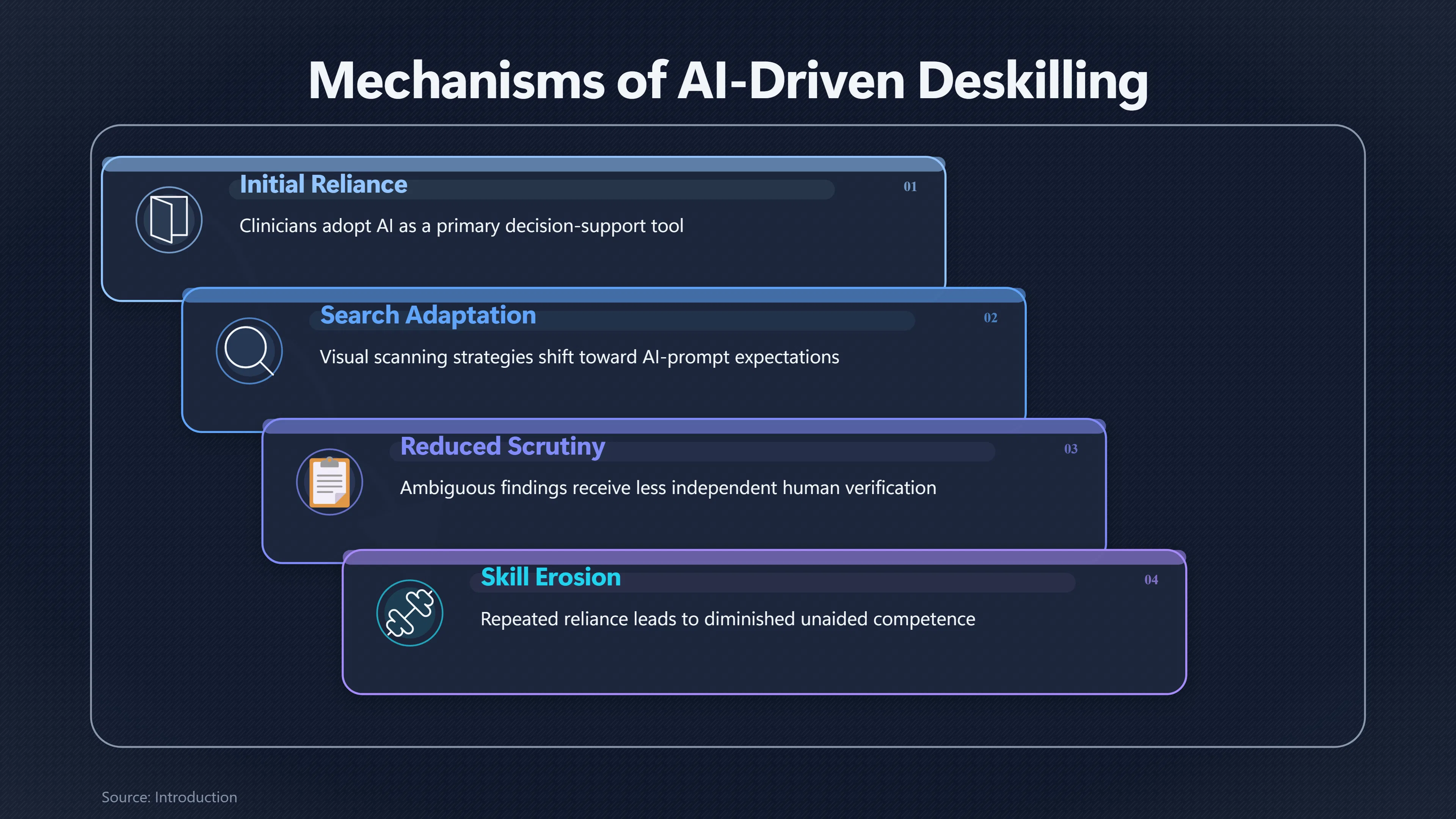
Automation bias describes the tendency to give excessive weight to computer recommendations, even when independent evidence points elsewhere. In medicine this can appear in several ways:
- A doctor changes an initially correct diagnosis after seeing an incorrect AI recommendation.
- Clinicians spend less time searching because they expect AI to identify abnormalities.
- Difficult or ambiguous findings receive less independent scrutiny once AI appears confident.
- Junior clinicians become accustomed to validating AI instead of constructing diagnoses from first principles.
These behaviours differ from simple trust in a useful tool. The concern is that clinicians stop exercising the perceptual and reasoning skills that allow them to detect AI failures.
Experimental studies in breast imaging illustrate the problem clearly. In one prospective study, radiologists of all experience levels were influenced by deliberately incorrect AI suggestions while interpreting mammograms. Less experienced readers were particularly susceptible, but even very experienced radiologists altered correct assessments in response to erroneous AI advice.[RSNA Publications Online]pubs.rsna.orgRSNA Publications OnlineAutomation Bias in Mammography: The Impact of Artificial Intelligence BI-RADS Suggestions on Reader Performance |…
More recent reviews of the evidence conclude that automation bias appears consistently across multiple radiology subspecialties. Although AI generally improves average diagnostic performance, clinicians can still become substantially more likely to accept incorrect recommendations when AI makes mistakes.[Rowan Digital Works]rdw.rowan.eduRowan Digital WorksA Systematic Review of Artificial Intelligence and Automation Bias in Radiology: Implications for Diagnostic AccuracyM…
Importantly, this does not imply clinicians become passive. Rather, their judgement becomes systematically influenced by machine outputs, especially under time pressure or when cases appear routine.
The colonoscopy evidence and its limits
The strongest real-world evidence for possible medical deskilling comes from AI-assisted colonoscopy.
AI systems that highlight potential polyps have repeatedly improved adenoma detection rates during assisted procedures in clinical trials. Better detection is important because missing adenomas increases the future risk of colorectal cancer.
The concern emerged only after researchers examined what happened when AI was switched off again.
A multicentre observational study embedded within the Polish ACCEPT programme compared colonoscopy performance before and after routine AI adoption. After clinicians had become accustomed to AI assistance, their adenoma detection rate during non-AI procedures fell from around 28% to 22%, an absolute decline of roughly six percentage points. The authors argued that continuous AI exposure may have altered endoscopists’ visual search behaviour, producing measurable deskilling when assistance was unavailable.[ft.com]ft.comAhmad urged caution in real-world implementation and called for more behavioral studies to understand how AI alters physician performance…
This finding attracted attention because it moved beyond laboratory experiments. Instead of asking clinicians to interpret images under artificial conditions, it examined routine clinical practice after months of AI use.
Researchers proposed several possible mechanisms:
- Endoscopists may rely on AI prompts instead of maintaining exhaustive visual scanning.
- Search strategies may gradually adapt to the expectation that AI will identify subtle lesions.
- Continuous feedback from AI could unintentionally reduce active vigilance during inspection.
However, the study also has important limitations.
It was observational rather than a randomised experiment designed specifically to measure deskilling. Changes in case mix, workflow, staffing or other operational factors might have contributed to the decline. The findings therefore suggest a plausible mechanism rather than proving that AI caused every aspect of the reduced performance. The authors themselves called for replication across other healthcare systems before drawing broad conclusions.[nature.com]nature.comOpen source on nature.com.
The broader evidence remains positive for AI-assisted colonoscopy itself: during assisted procedures, AI generally increases lesion detection rather than reducing it. The unresolved question is how continuous exposure affects clinicians’ unaided skills over many years.
Why training pipelines may lose difficult cases
Perhaps the largest long-term concern is not today’s experienced consultants but tomorrow’s specialists.
Medical expertise develops through repeated exposure to challenging cases. Trainees gradually learn subtle visual patterns, diagnostic reasoning and procedural judgement by solving problems themselves.
As AI becomes better at identifying obvious abnormalities, trainees may encounter fewer opportunities to practise precisely the cases that build expertise.
Several mechanisms could contribute:
- Reduced independent interpretation. Trainees may see AI suggestions before forming their own judgement.
- Fewer borderline cases. AI may resolve many straightforward decisions, leaving learners with less structured experience.
- Confirmation rather than discovery. Learning shifts from actively finding abnormalities to checking whether AI appears reasonable.
- Compressed feedback loops. While AI provides rapid answers, immediate correction can reduce the productive struggle that often strengthens long-term learning.
Medical educators increasingly argue that AI should be introduced after trainees have developed core diagnostic skills rather than replacing the early stages of learning. Recent reviews likewise recommend explicit training on automation bias, independent verification and situations where AI performs poorly.[Rowan Digital Works]rdw.rowan.eduRowan Digital WorksA Systematic Review of Artificial Intelligence and Automation Bias in Radiology: Implications for Diagnostic AccuracyM…
Better performance today does not guarantee resilient performance tomorrow
One reason this issue is difficult is that two apparently contradictory findings can both be true.
AI may increase average clinical performance while simultaneously reducing unaided performance.
For example, radiology studies have shown meaningful reductions in reporting time with little or no loss of diagnostic quality when radiologists review AI-generated draft reports. These productivity gains are valuable for healthcare systems facing workforce shortages.[arXiv]arxiv.orgThe Impact of AI Assistance on Radiology Reporting: A Pilot Study Using Simulated AI Draft ReportsDecember 16, 2024…
At the same time, experiments using intentionally incorrect AI advice show that clinicians can become less accurate than they would have been working independently.[RSNA Publications Online]pubs.rsna.orgRSNA Publications OnlineAutomation Bias in Mammography: The Impact of Artificial Intelligence BI-RADS Suggestions on Reader Performance |…
These findings are not inconsistent.
AI may function like a calculator in mathematics. It improves performance when available, yet someone who always relies on it may become slower or less confident performing calculations unaided. Whether that trade-off is acceptable depends on how often independent expertise is needed and how serious failures become when automation is unavailable or incorrect.

Why this matters to AI doom debates
Medical deskilling is not evidence for AI takeover or existential catastrophe. Hospitals operate under extensive regulation, clinicians remain accountable, and today’s medical AI is narrow rather than generally intelligent.
Its importance lies elsewhere.
Healthcare provides one of the earliest large-scale examples of a broader concern within AI doom discussions: institutions may gradually lose the practical ability to verify AI outputs independently because humans perform fewer tasks without machine assistance.
If this pattern generalised far beyond medicine—to scientific research, engineering, cybersecurity or the governance of advanced AI systems—it could weaken meaningful human oversight. Human approval is only an effective safeguard if people retain the knowledge and confidence to reject incorrect recommendations.
The current medical evidence therefore supports a limited but important claim. AI can improve immediate clinical outcomes while also creating measurable risks of automation bias and, in some settings, possible skill erosion. It does not show that widespread institutional dependence is inevitable, nor that deskilling cannot be mitigated through training, periodic unaided practice, careful workflow design and maintaining opportunities for clinicians to develop independent expertise.
Amazon book picks
Further Reading
Books and field guides related to Can Doctors Lose Skills While AI Improves Care?. Use these as the next step if you want deeper reading beyond the article.
Deep Medicine
One of America's top doctors reveals how AI will empower physicians and revolutionize patient care Medicine has become inhuman, to disast...
The Checklist Manifesto
THE GAME-CHANGING BOOK FROM THE BESTSELLING AUTHOR OF BEING MORTAL Today we find ourselves in possession of stupendous know-how, which we...
The Digital Doctor
The New York Times Science Bestseller from Robert Wachter, Modern Healthcare’s #1 Most Influential Physician-Executive in the US While mo...
The Glass Cage
At once a celebration of technology and a warning about its misuse, The Glass Cage will change the way you think about the tools you use...
eBay marketplace picks
Marketplace Samples
Live-tested eBay searches with available results related to this page.
Selected fromdoctor wall art oneBay.co.uk.



Endnotes
1.
Source: pubs.rsna.org
Link:https://pubs.rsna.org/doi/10.1148/radiol.222176
Source snippet
RSNA Publications OnlineAutomation Bias in Mammography: The Impact of Artificial [Intelligence]({{ 'hard-bottlenecks/' | relative_url }}) BI-RADS Suggestions on Reader Performance |...
2.
Source: rdw.rowan.edu
Link:https://rdw.rowan.edu/stratford_research_day/2026/may6and7/150/
Source snippet
Rowan Digital WorksA Systematic Review of Artificial Intelligence and Automation Bias in Radiology: Implications for Diagnostic AccuracyM...
3.
Source: ft.com
Link:https://www.ft.com/content/74b82366-1ea1-4f90-80aa-e84a1e655d28
Source snippet
Ahmad urged caution in real-world implementation and called for more behavioral studies to understand how AI alters physician performance...
4.
Source: time.com
Link:https://time.com/7309274/ai-lancet-study-artificial-intelligence-colonoscopy-cancer-detection-medicine-deskilling/
Source snippet
Conducted across four endoscopy centers in Poland as part of the AI in Colonoscopy for Cancer Prevention (ACCEPT) trial, researchers foun...
5.
Source: nature.com
Link:https://www.nature.com/articles/s41575-025-01122-3
6.
Source: arxiv.org
Link:https://arxiv.org/abs/2412.12042
Source snippet
The Impact of AI Assistance on Radiology Reporting: A Pilot Study Using Simulated AI Draft ReportsDecember 16, 2024...
Published: December 16, 2024
7.
Source: nature.com
Link:https://www.nature.com/articles/s41591-024-02850-w
8.
Source: pubs.rsna.org
Link:https://pubs.rsna.org/doi/abs/10.1148/radiol.222176
9.
Source: rsna.org
Link:https://www.rsna.org/media/press/i/2432
10.
Source: rsna.org
Title: ai bias may impair accuracy
Link:https://www.rsna.org/news/2023/may/ai-bias-may-impair-accuracy
11.
Source: doi.org
Link:https://doi.org/10.1148/radiol.222176
Source snippet
Automation Bias in Mammography: The Impact of Artificial Intelligence BI-RADS Suggestions on Reader Performance | Radiology...
Additional References
12.
Source: washingtonpost.com
Title: ai machine learning radiology software
Link:https://www.washingtonpost.com/health/2025/04/05/ai-machine-learning-radiology-software/
Source snippet
With over 340 AI tools approved by the FDA, primarily for detection tasks, radiology is at the forefront of integrating AI in clinical pr...
13.
Source: pubmed.ncbi.nlm.nih.gov
Link:https://pubmed.ncbi.nlm.nih.gov/42445869/
Source snippet
2026 Jul 9:18:590498. doi: 10.2147/JHL.S590498. eCollection 2026. GENERATIVE ARTIFICIAL INTELLIGENCE IN HEALTHCARE: AUTOMATI...
14.
Source: youtube.com
Link:https://www.youtube.com/watch?v=6sp03fwKi1Y
Source snippet
Automation Complacency - AI Induced Abdication of Medical Decision Making...
15.
Source: youtube.com
Title: Jonathan Chen on AI in Medicine: Promise, Pitfalls, and Practice
Link:https://www.youtube.com/watch?v=Vr8o7u3iFf4
Source snippet
Peter Brodeur, MD – AI in Healthcare: What Helps, What Hurts, and What Comes Next...
16.
Source: youtube.com
Title: Teaching Radiologists for an AI-First World with Ali Tejani
Link:https://www.youtube.com/watch?v=BESxBUTXhwY
Source snippet
Jonathan Chen on AI in Medicine: Promise, Pitfalls, and Practice...
17.
Source: youtube.com
Title: Clinical Artificial Intelligence in Radiology
Link:https://www.youtube.com/watch?v=gofjeow3gyo
Source snippet
Teaching Radiologists for an AI-First World with Ali Tejani...
18.
Source: sciencedirect.com
Link:https://www.sciencedirect.com/science/article/pii/S2949820126000123
19.
Source: giejournal.org
Link:https://www.giejournal.org/article/S0016-5107%2823%2902975-9/fulltext
20.
Source: sciencedirect.com
Link:https://www.sciencedirect.com/science/article/abs/pii/S0016510723029759
21.
Source: sciencedirect.com
Link:https://www.sciencedirect.com/science/article/pii/S0016510723029759