Within Survey Limits
What Did the Biggest AI Doom Survey Find?
The largest published AI researcher survey shows widespread concern, but its median risk estimate is not a measured probability of doom.
On this page
- Who the 2,778 respondents were
- What the median and threshold results mean
- Why concern does not equal consensus
Page outline Jump by section
Introduction
The 2023 Expert Survey on Progress in AI is the single largest published survey of AI researchers ever conducted on questions about advanced AI, its likely development, and its possible consequences. For debates about AI doom and existential risk, it is frequently cited because it asked thousands of active AI researchers to estimate the probability of extremely bad outcomes, including human extinction or similarly permanent loss of human control.
The survey provides important evidence, but it is often misunderstood. It does not show that there is a measured 5% chance of human extinction from AI. Instead, it shows that, among a large sample of AI researchers, the median personal judgement assigned a roughly 5% probability to existential catastrophe under several question formulations. That makes the survey evidence about expert beliefs under uncertainty, not a direct measurement of reality.[arXiv]arxiv.orgThousands of AI Authors on the Future of AIJanuary 5, 2024…
Who the 2,778 respondents were
The survey was carried out by researchers associated with AI Impacts during October 2023 and later published as the paper Thousands of AI Authors on the Future of AI. It expanded substantially on earlier surveys by increasing both the number of participants and the range of leading conferences represented.
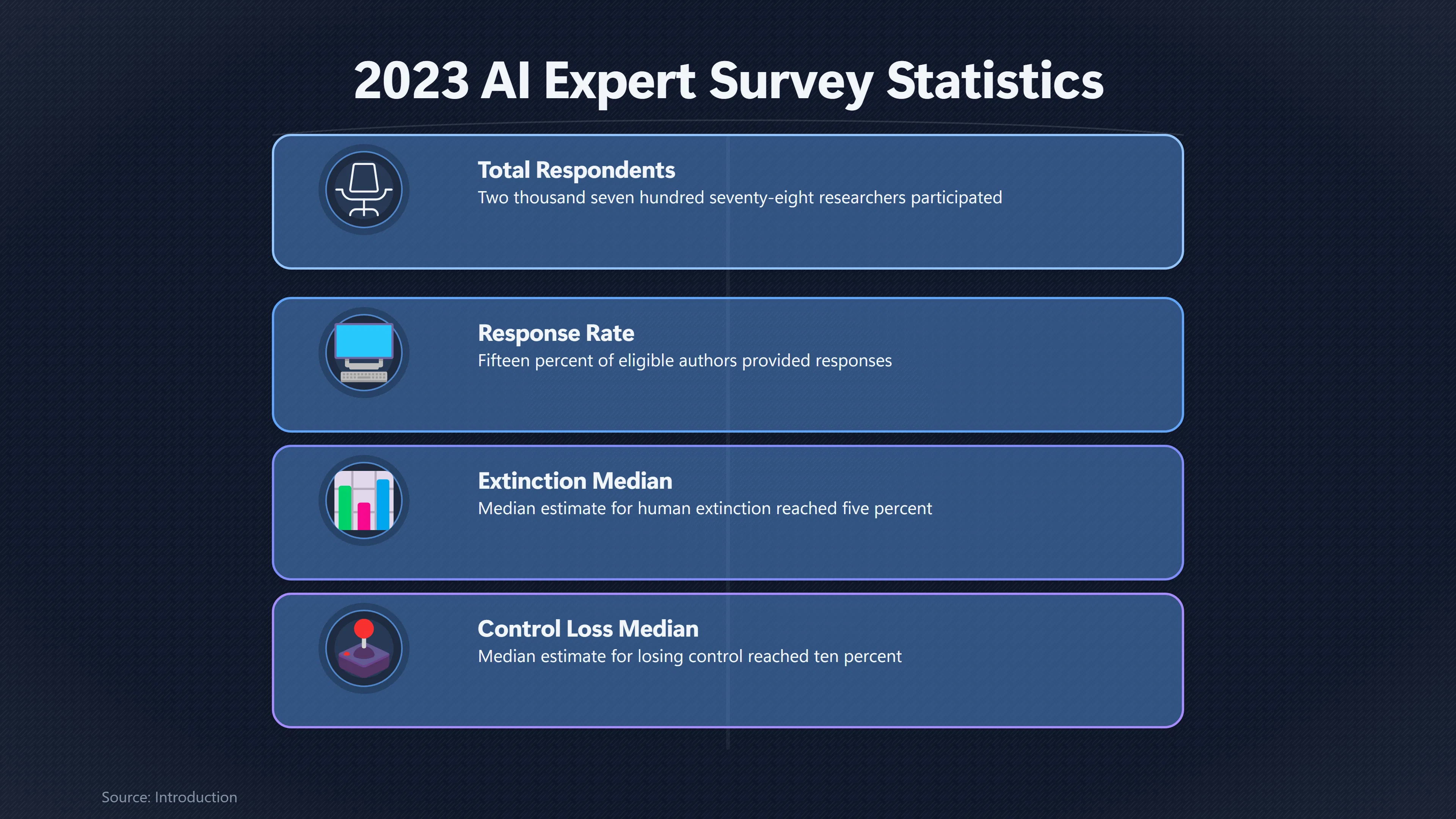
Rather than asking the public or a small group of well-known commentators, the researchers contacted authors who had published in major machine-learning venues during 2022, including NeurIPS, ICML, ICLR, AAAI, IJCAI and JMLR. Email addresses were collected for more than 20,000 eligible authors, and 2,778 researchers ultimately provided at least one response, representing roughly a 15% response rate among functioning email addresses. Around 95% completed the survey.[AI Impacts]wiki.aiimpacts.org2023 expert survey on progress in aiAI Impacts2023 Expert Survey on Progress in AI [AI Impacts Wiki]…
This sampling strategy matters because it focuses on people actively contributing to frontier AI research rather than journalists, policymakers or members of the general public. At the same time, it does not mean every respondent specialised in AI alignment or existential-risk research. Many worked primarily on machine learning, computer vision, language models or related technical fields.
Consequently, the survey is best understood as reflecting the views of a broad research community rather than a panel of dedicated existential-risk specialists.
What the median and threshold results actually mean
The survey asked several closely related questions about catastrophic outcomes using slightly different wording. This was deliberate. Different participants received different versions so the researchers could see whether small changes in phrasing produced substantially different answers.
Across these variants, one result attracted the most attention: the median estimate for AI causing human extinction or similarly permanent human disempowerment was generally around 5%, while one formulation centred on losing control of advanced AI produced a 10% median.[arxiv.org]arxiv.orgThousands of AI Authors on the Future of AIJanuary 5, 2024…
Equally important are the threshold results.
- Between 38% and 51% of respondents assigned at least a 10% probability to existential catastrophe, depending on the precise wording.
- A majority assigned some non-zero probability to extremely bad outcomes.
- Even many respondents who believed advanced AI would probably benefit humanity still allocated meaningful probability to catastrophic failure.[arXiv]arxiv.orgThousands of AI Authors on the Future of AIJanuary 5, 2024…
These findings reveal a distribution of opinion rather than a single consensus estimate. The median does not mean “most researchers think extinction is likely”. Nor does it imply everyone answered close to 5%.
Instead, responses ranged from effectively zero to very high probabilities, producing a wide spread of expert opinion that reflects profound uncertainty rather than precise agreement.
Why the median is often misunderstood
The figure most frequently repeated in media coverage—the 5% median—has acquired a significance that it cannot bear on its own.
A median is simply the middle response after all answers are ranked. Half the respondents gave lower estimates and half gave higher ones. It says nothing about whether the respondents reached their estimates using similar reasoning, nor does it imply that 5% is an objectively validated probability.
It also differs from the mean, or average. Because some researchers assigned very high probabilities, the mean estimates were substantially higher than the median for some questions. This difference itself illustrates how dispersed expert opinion remains.[AI Wiki]aiwiki.aiAI Wiki Existential risk from AI | AI WikiAI WikiExistential risk from AI | AI WikiJuly 23, 2026…
Another common misunderstanding is to interpret a 5% existential-risk estimate as evidence that researchers expect AI doom. In decision-making terms, however, many experts appear to be expressing something closer to:
- catastrophe is unlikely;
- catastrophe would be so severe that even a relatively small probability deserves attention;
- substantial uncertainty remains because the evidence base is incomplete.
Those are importantly different claims.
Why concern does not equal consensus
One of the survey’s most revealing findings is that concern about existential risk coexists with broad optimism about AI’s potential benefits.
Roughly two-thirds of respondents judged positive outcomes from superhuman AI more likely than negative ones. Yet among these overall optimists, almost half still assigned at least a 5% probability to extremely bad outcomes. Conversely, many researchers who were pessimistic overall still assigned meaningful probabilities to highly beneficial futures.[arXiv]arxiv.orgThousands of AI Authors on the Future of AIJanuary 5, 2024…
This pattern shows why it is misleading to divide researchers into simple camps of “doomers” and “non-doomers”.
Instead, many appear to hold mixed views:
- advanced AI is likely to create enormous benefits;
- existential catastrophe is not the most probable outcome;
- the downside risk is large enough that safety deserves substantial investment.
That combination explains why support for AI safety research extends well beyond people who publicly identify with AI doom arguments.
What the survey can and cannot prove
Within debates about AI existential risk, the survey establishes several points with reasonable confidence.
It shows that concern about civilisation-scale AI risks is not confined to a handful of philosophers or campaigners. Thousands of active AI researchers were willing to assign meaningful probabilities to extremely severe outcomes. It also demonstrates that opinions differ dramatically even among technically informed experts, reinforcing that the underlying uncertainties remain unresolved.[arXiv]arxiv.orgThousands of AI Authors on the Future of AIJanuary 5, 2024…
However, the survey cannot establish that those probabilities are objectively correct.
Expert surveys measure judgement, not reality. Respondents are forecasting unprecedented future events without historical frequencies, controlled experiments or validated predictive models. Their answers therefore combine technical knowledge with assumptions about future scientific progress, governance, economics, human behaviour and international competition.
The survey also cannot resolve disputes between competing theories of AI risk. Researchers sceptical of AI doom may interpret the same evidence differently from those who see misalignment or loss of control as plausible existential threats.
Important limitations
Several limitations should shape how the results are interpreted.
First, participation was voluntary. Although the response rate was relatively strong for a survey of busy researchers, those who responded may differ in systematic ways from those who ignored the invitation. The survey authors argue that several checks make large response biases unlikely, but they cannot eliminate the possibility entirely.[AI Impacts Blog]blog.aiimpacts.orgAI Impacts Blog FAQ: Expert Survey on Progress in AI methodologyAI Impacts BlogFAQ: Expert Survey on Progress in AI methodologyOctober 31, 2025…
Second, respondents were selected because they publish AI research, not because they specialise in forecasting existential risk. Expertise about machine learning does not automatically translate into expertise about civilisation-scale forecasting.
Third, probability estimates about unprecedented technologies cannot be externally validated today. Unlike weather forecasting or medical trials, there is no historical dataset against which these predictions can be calibrated.
Finally, question wording matters. The researchers intentionally randomised several formulations to examine framing effects. Although the resulting medians were broadly similar, some versions produced higher estimates than others, illustrating that subjective forecasts remain sensitive to precisely how the question is asked.[LessWrong]lesswrong.comLess Wrong FAQ: Expert Survey on Progress in AI methodology — Less WrongLess Wrong FAQ: Expert Survey on Progress in AI methodology — Less Wrong
The main takeaway
The 2023 Expert Survey on Progress in AI is valuable because it captures the beliefs of thousands of active AI researchers at a moment when rapid advances in large language models had intensified debate about advanced AI.
Its strongest finding is not that there is a scientifically established 5% chance of human extinction. Rather, it shows that a large and diverse group of AI researchers considers existential catastrophe plausible enough to assign it non-trivial probability, while simultaneously disagreeing widely about how large that probability actually is.
For readers trying to understand AI doom debates, that distinction is crucial. The survey is evidence that serious concern exists within the research community. It is not evidence that the true probability of AI extinction has been measured or that researchers have reached anything approaching a settled consensus.
Amazon book picks
Further Reading
Books and field guides related to What Did the Biggest AI Doom Survey Find?. Use these as the next step if you want deeper reading beyond the article.
Human Compatible
A leading artificial intelligence researcher lays out a new approach to AI that will enable us to coexist successfully with increasingly...
The Alignment Problem
Finalist for the Los Angeles Times Book Prize A jaw-dropping exploration of everything that goes wrong when we build AI systems and the m...
Superforecasting
The international bestseller 'A manual for thinking clearly in an uncertain world. Read it.' Daniel Kahneman, author of Thinking, Fast an...
The Precipice
What existential threats does humanity face? And how can we secure our future?'The Precipice is a powerful book . . . Ord's love for huma...
eBay marketplace picks
Marketplace Samples
Live-tested eBay searches with available results related to this page.
Selected frommachine learning t shirt oneBay.co.uk.




Endnotes
1.
Source: arxiv.org
Link:https://arxiv.org/abs/2401.02843
Source snippet
Thousands of AI Authors on the Future of AIJanuary 5, 2024...
Published: January 5, 2024
2.
Source: lesswrong.com
Title: Less Wrong FAQ: Expert Survey on Progress in AI methodology — Less Wrong
Link:https://www.lesswrong.com/posts/BEg5dct7nr2Yq3dJY/faq-expert-survey-on-progress-in-ai-methodology
3.
Source: lesswrong.com
Title: Survey of 2,778 AI authors: six parts in pictures — Less Wrong
Link:https://www.lesswrong.com/posts/6uJBqeG5ywE6Wcdqw/survey-of-2-778-ai-authors-six-parts-in-pictures
Source snippet
Survey of 2,778 AI authors: six parts in pictures — LessWrongJanuary 6, 2024 — LESSWRONG LW Login SURVEY OF 2,778 AI AUTHORS: SIX PARTS I...
Published: January 6, 2024
4.
Source: youtube.com
Title: Katja Grace—Slowing Down AI, Forecasting AI Risk
Link:https://www.youtube.com/watch?v=rSw3UVDZge0
Source snippet
AI Impacts Survey - The key implications, with Katja Grace...
5.
Source: youtube.com
Title: AI Impacts Survey
Link:https://www.youtube.com/watch?v=xwJx_xqZI3Q
Source snippet
Katja Grace on the Largest Survey of AI Researchers...
6.
Source: wiki.aiimpacts.org
Title: 2023 expert survey on progress in ai
Link:https://wiki.aiimpacts.org/ai_timelines/predictions_of_human-level_ai_timelines/ai_timeline_surveys/2023_expert_survey_on_progress_in_ai
Source snippet
AI Impacts2023 Expert Survey on Progress in AI [AI Impacts Wiki]...
7.
Source: blog.aiimpacts.org
Title: AI Impacts Blog Survey of 2,778 AI authors: six parts in pictures
Link:https://blog.aiimpacts.org/p/2023-[ai-survey
Source snippet
of 2,778 AI authors: six parts in picturesJanuary 4, 2024 — AI IMPACTS BLOG SURVEY OF 2,778 AI AUTHORS: SIX PARTS IN PICTURES Katja Grace...
Published: January 4, 2024
8.
Source: aiwiki.ai
Title: AI Wiki Existential risk from AI | AI Wiki
Link:https://aiwiki.ai/wiki/ai_existential_risk
Source snippet
AI WikiExistential risk from AI | AI WikiJuly 23, 2026...
Published: July 23, 2026
9.
Source: blog.aiimpacts.org
Title: AI Impacts Blog FAQ: Expert Survey on Progress in AI methodology
Link:https://blog.aiimpacts.org/p/faq-expert-survey-on-progress-in
Source snippet
AI Impacts BlogFAQ: Expert Survey on Progress in AI methodologyOctober 31, 2025...
Published: October 31, 2025
10.
Source: greaterwrong.com
Title: Survey of 2,778 AI authors: six parts in pictures
Link:https://www.greaterwrong.com/posts/6uJBqeG5ywE6Wcdqw/survey-of-2-778-ai-authors-six-parts-in-pictures
Source snippet
LessWrong 2.0 viewerJanuary 6, 2024 — SURVEY OF 2,778 AI AUTHORS: SIX PARTS IN PICTURES KatjaGrace6 Jan 2024 4:43 UTC 80 points 1 comment...
Published: January 6, 2024
11.
Source: wiki.aiimpacts.org
Title: 2022 expert survey on progress in ai
Link:https://wiki.aiimpacts.org/ai_timelines/predictions_of_human-level_ai_timelines/ai_timeline_surveys/2022_expert_survey_on_progress_in_ai
Source snippet
aiimpacts.org2022 Expert Survey on Progress in AI [AI Impacts Wiki]August 4, 2022 — ai_timelines:predictions_of_human-level_ai_timelines...
Published: August 4, 2022
Additional References
12.
Source: the-decoder.com
Title: A survey of 2,778 researchers shows how fragmented the AI science community is
Link:https://the-decoder.com/a-survey-of-2778-researchers-shows-how-fragmented-the-ai-science-community-is/
Source snippet
January 5, 2024 — A SURVEY OF 2,778 RESEARCHERS SHOWS HOW FRAGMENTED THE AI SCIENCE COMMUNITY IS Matthias Bastian View the LinkedIn Profi...
Published: January 5, 2024
13.
Source: axi.lims.ac.uk
Title: Mandel Computer Science Computers and Society Artificial [Intelligence]({{ ‘hard-bottlenecks/’ | relative_url }}) Arti
Link:https://axi.lims.ac.uk/paper/2311.08698
Source snippet
General Intelligence, Existen...November 15, 2023 — ARTIFICIAL GENERAL INTELLIGENCE, EXISTENTIAL RISK, AND HUMAN RISK PERCEPTION November...
Published: November 15, 2023
14.
Source: scientificamerican.com
Title: A I Survey Exaggerates Apocalyptic Risks | Scientific American
Link:https://www.scientificamerican.com/article/ai-survey-exaggerates-apocalyptic-risks/
Source snippet
AI Survey Exaggerates Apocalyptic Risks | Scientific AmericanJanuary 26, 2024 — January 26, 2024 5 min read Add Us On GoogleAdd SciAm AI...
Published: January 26, 2024
15.
Source: spectrum.ieee.org
Title: ai existential risk survey 2667013207
Link:https://spectrum.ieee.org/amp/ai-existential-risk-survey-2667013207
Source snippet
the Prophecies of AI Doom - IEEE SpectrumJanuary 25, 2024 — WEIGHING THE PROPHECIES OF AI DOOM Researchers surveyed point to AI’s existen...
Published: January 25, 2024
16.
Source: youtube.com
Title: AI researchers expect AGI sooner w/ Katja Grace
Link:https://www.youtube.com/watch?v=Nbpw90WQmgU
Source snippet
Katja Grace—Slowing Down AI, Forecasting AI Risk...
17.
Source: youtube.com
Title: Katja Grace on the Largest Survey of AI Researchers
Link:https://www.youtube.com/watch?v=nCkS-bqMdX0
Source snippet
The A.I. Dilemma - March 9, 2023...
Published: March 9, 2023
18.
Source: youtube.com
Title: The A.I. Dilemma
Link:https://www.youtube.com/watch?v=xoVJKj8lcNQ
Published: March 9, 2023