Within Automation Race
When Human Oversight Becomes a Rubber Stamp
Reliable AI recommendations can make reviewers less likely to question errors, turning formal approval into weak or automatic consent.
On this page
- Why people defer to reliable automated advice
- How workload and time pressure weaken independent checks
- What meaningful oversight requires in practice
Page outline Jump by section
Introduction
In debates about AI doom and existential risk, one recurring concern is that human oversight may survive in name but disappear in practice. The issue is not simply whether a person signs off on an AI system’s recommendation. It is whether that person still exercises independent judgement. Researchers call the tendency to place excessive trust in automated recommendations automation bias: the habit of accepting computer-generated advice without sufficiently checking whether it is correct.[ICO]ico.org.ukICOHow do we ensure individual rights in our AI systems? | ICOICOHow do we ensure individual rights in our AI systems? | ICO
Within the broader concern about competitive pressure to remove human judgement, automation bias provides a concrete mechanism by which oversight can become a rubber stamp. Organisations may retain formal approval processes to satisfy governance or legal requirements, yet reviewers working under time pressure, high workload or confidence in previously reliable systems may rarely challenge the AI. From an AI-doom perspective, this matters because meaningful human control depends not only on having humans “in the loop”, but on those humans remaining capable and willing to override the system when necessary.
Why people defer to reliable automated advice
Automation bias was first studied long before modern generative AI, in fields such as aviation and clinical decision support. The central finding is surprisingly simple: as automated systems become more reliable, people become less likely to notice the occasions when they are wrong. Trust built from many correct recommendations can make rare failures especially difficult to detect.[Springer]link.springer.comExploring automation bias in human–AI collaboration: a review and implications for explainable AI | AI & SOCIETY | Springer Natur…
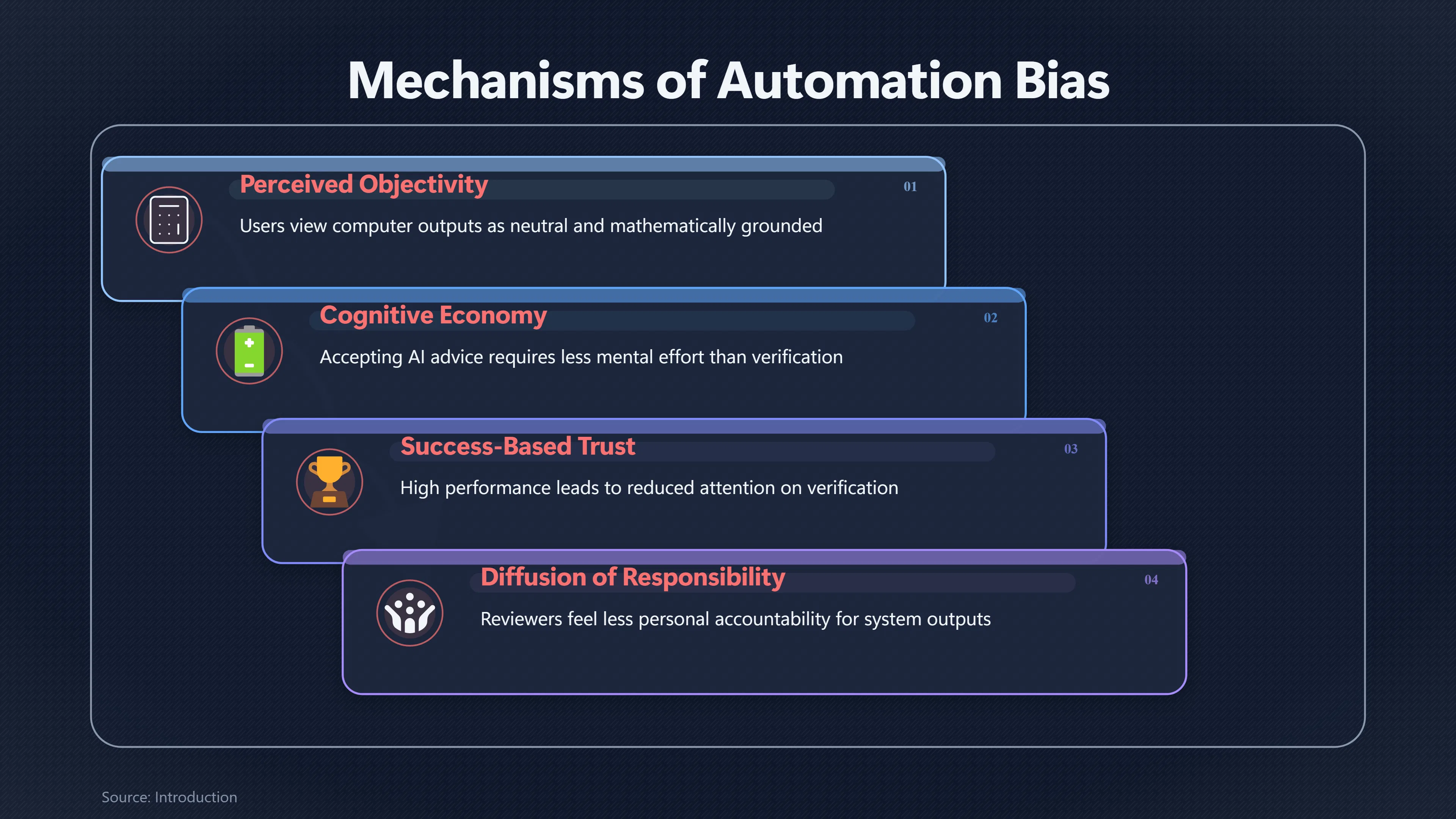
Several well-understood psychological mechanisms contribute to this effect:
- Perceived objectivity. Computer-generated recommendations often appear more neutral or mathematically grounded than human judgement, even when they are based on imperfect data or uncertain models.[ICO]ico.org.ukICOHow do we ensure individual rights in our AI systems? | ICOICOHow do we ensure individual rights in our AI systems? | ICO
- Cognitive economy. Verifying an AI recommendation requires effort. Accepting it is usually easier, particularly when previous recommendations have been accurate.[arXiv]arxiv.orgarXiv Explanations Can Reduce Overreliance on AI Systems During Decision-MakingExplanations Can Reduce Overreliance on AI Systems During Decision-MakingDecember 13, 2022…
- Success-based trust calibration. High-performing systems encourage users to devote progressively less attention to independent verification because checking seems increasingly unnecessary.[Springer]link.springer.comExploring automation bias in human–AI collaboration: a review and implications for explainable AI | AI & SOCIETY | Springer Natur…
- Diffusion of responsibility. When a sophisticated system produces the recommendation, reviewers may feel less personally responsible for questioning it, especially inside large organisations.
None of these mechanisms requires blind faith in AI. Automation bias is typically gradual. Reviewers often believe they are exercising independent judgement even when, in reality, they rarely reject the system’s recommendations.
How workload and time pressure weaken independent checks
Competitive environments amplify automation bias because they reduce the practical opportunity to verify outputs.
Imagine a reviewer responsible for approving hundreds of AI-assisted decisions during a working day. Even if organisational policy requires every recommendation to receive human approval, there may be insufficient time to investigate each case independently. Human review gradually shifts from evaluating decisions to confirming that the AI has produced one.
Research on human-AI collaboration consistently finds that verification becomes less likely when checking is costly relative to accepting the recommendation. As task difficulty increases, explanations become harder to interpret, or workloads grow, people are more inclined to rely on AI outputs rather than independently reconstruct the reasoning.[arXiv]arxiv.orgarXiv Explanations Can Reduce Overreliance on AI Systems During Decision-MakingExplanations Can Reduce Overreliance on AI Systems During Decision-MakingDecember 13, 2022…
Competitive pressure can reinforce this dynamic:
- Organisations reward throughput and speed.
- Staff are expected to process growing volumes of AI-generated recommendations.
- Review becomes a bottleneck rather than the primary task.
- Managers may interpret high agreement rates as evidence that the AI is performing well, rather than asking whether reviewers have enough time to disagree.
From the outside, governance structures appear intact because every decision still records human approval. Internally, however, genuine scrutiny may have become rare.
Why “human approval” is not always meaningful oversight
Many AI governance frameworks distinguish between having a human involved and having meaningful human involvement.
The UK’s Information Commissioner’s Office warns that automation bias can undermine decision-support systems if human reviewers routinely defer to AI outputs instead of exercising real judgement. The regulator argues that meaningful review requires people to be capable of questioning, interpreting and, where appropriate, rejecting automated recommendations.[ICO]ico.org.ukICOHow do we ensure individual rights in our AI systems? | ICOICOHow do we ensure individual rights in our AI systems? | ICO
Similarly, the UK’s Centre for Data Ethics and Innovation argues that organisations should assess the entire decision-making process rather than assuming that placing a person somewhere in the workflow automatically guarantees accountability. The report explicitly notes that “humans over the loop”—people supervising how the overall system behaves—remain necessary alongside any individual reviewers.[GOV.UK]GOV.UKReview into bias in algorithmic decision-makingReview into bias in algorithmic decision-making
These distinctions matter because organisations sometimes describe systems as “human-in-the-loop” even when the human has:
- insufficient information to assess the recommendation;
- too many cases to review carefully;
- no practical authority to overrule the system; or
- strong organisational incentives to approve recommendations quickly.
In those situations, human involvement may satisfy a procedural requirement without providing substantial protection against systematic error.

Why this matters in AI-doom arguments
Automation bias alone is not an existential risk. Most documented cases involve ordinary organisational failures rather than civilisation-scale consequences.
Its importance in AI-doom discussions comes from scale and accumulation.
Researchers concerned about gradual loss of human control argue that if increasingly capable AI systems become responsible for more consequential decisions, and if human reviewers become progressively less willing or able to challenge them, formal authority may remain with people while practical decision-making shifts elsewhere.
Under this view, the danger is not that humans deliberately surrender control overnight. Instead:
- AI recommendations become increasingly accurate.
- Organisations optimise for efficiency.
- Human review becomes increasingly superficial.
- Independent human judgement gradually weakens through lack of use.
- Critical institutions become dependent on AI systems whose outputs are rarely challenged.
Whether this process could contribute to existential risk depends on many additional assumptions—including future AI capabilities, institutional incentives and the effectiveness of safety measures—but automation bias represents one plausible mechanism by which nominal human oversight could become ineffective rather than disappearing outright.
What evidence supports—and challenges—this concern?
Evidence for automation bias is strongest at the level of human cognition rather than long-term societal forecasting.
Laboratory studies and operational research repeatedly show that people can become over-reliant on automated advice, particularly when systems perform well most of the time or when independent verification is expensive. More recent reviews conclude that automation bias remains an important challenge as AI enters medicine, public administration, law and other high-stakes settings.[Springer]link.springer.comExploring automation bias in human–AI collaboration: a review and implications for explainable AI | AI & SOCIETY | Springer Natur…
At the same time, the evidence is more nuanced than popular discussions sometimes suggest.
Some experiments find little or no automation bias under particular conditions, while others identify the opposite tendency—algorithm aversion—where people reject useful AI advice after observing mistakes. Recent research involving military cadets, for example, found more calibrated trust than many commentators expected, suggesting that training and experience can substantially influence how people interact with AI decision-support systems.[arXiv]arxiv.orgWhat is Human in Judgment? Testing Automation Bias and Algorithm Aversion Among United States Military Academy CadetsApril 6, 2026…
This mixed evidence suggests that automation bias is neither inevitable nor universal. It depends on system design, institutional incentives, user training, workload and organisational culture.
What meaningful oversight requires in practice
Research and governance guidance increasingly converge on the idea that meaningful oversight is an organisational capability rather than a checkbox.
Important safeguards include:
- Independent verification. Reviewers need sufficient time and information to evaluate recommendations rather than merely acknowledge them.[ICO]ico.org.ukICOHow do we ensure individual rights in our AI systems? | ICOICOHow do we ensure individual rights in our AI systems? | ICO
- Calibrated trust. Users should understand when systems are reliable and when uncertainty is high, instead of treating all recommendations equally.[axios.com]axios.comIn AI we trustOriginally studied in the context of airplane autopilots, automation bias has become a more serious concern as AI technologies are integr…
- Authority to intervene. Human reviewers must be able to reject or escalate decisions without being penalised for slowing workflows.
- System-level monitoring. Organisations should measure disagreement rates, audit override decisions and examine whether reviewers are actively exercising judgement rather than assuming approval equals oversight.[GOV.UK]GOV.UKReview into bias in algorithmic decision-makingReview into bias in algorithmic decision-making
- Regular practice without automation. Critical organisations may need periodic exercises in which staff perform essential functions without AI assistance, helping preserve the skills needed if automated systems fail.
From the perspective of AI existential-risk debates, these measures matter because they aim to preserve human judgement as an active capability rather than a ceremonial step. If oversight exists only on organisational charts while decisions are effectively accepted automatically, then keeping “a human in the loop” may provide far less protection than it appears to offer.

Amazon book picks
Further Reading
Books and field guides related to When Human Oversight Becomes a Rubber Stamp. Use these as the next step if you want deeper reading beyond the article.
The Alignment Problem
Finalist for the Los Angeles Times Book Prize A jaw-dropping exploration of everything that goes wrong when we build AI systems and the m...
Human Compatible
A leading artificial intelligence researcher lays out a new approach to AI that will enable us to coexist successfully with increasingly...
Thinking, Fast and Slow
Why is there more chance we'll believe something if it's in a bold type face? Why are judges more likely to deny parole before lunch? Why...
The Checklist Manifesto
THE GAME-CHANGING BOOK FROM THE BESTSELLING AUTHOR OF BEING MORTAL Today we find ourselves in possession of stupendous know-how, which we...
eBay marketplace picks
Marketplace Samples
Live-tested eBay searches with available results related to this page.
Selected fromAI robot poster oneBay.co.uk.




Endnotes
1.
Source: ico.org.uk
Title: ICOHow do we ensure individual rights in our AI systems? | ICO
Link:https://ico.org.uk/for-organisations/uk-gdpr-guidance-and-resources/artificial-[intelligence
2.
Source: link.springer.com
Link:https://link.springer.com/article/10.1007/s00146-025-02422-7
Source snippet
Exploring automation bias in human–AI collaboration: a review and implications for explainable AI | AI & SOCIETY | Springer Natur...
3.
Source: axios.com
Title: In AI we trust
Link:https://www.axios.com/2019/10/19/ai-automation-bias-trust
Source snippet
Originally studied in the context of airplane autopilots, automation bias has become a more serious concern as AI technologies are integr...
4.
Source: GOV.UK
Title: Review into bias in algorithmic decision-making
Link:https://www.gov.uk/government/publications/cdei-publishes-review-into-bias-in-algorithmic-decision-making/main-report-cdei-review-into-bias-in-algorithmic-decision-making
5.
Source: arxiv.org
Title: arXiv Explanations Can Reduce Overreliance on AI Systems During Decision-Making
Link:https://arxiv.org/abs/2212.06823
Source snippet
Explanations Can Reduce Overreliance on AI Systems During Decision-MakingDecember 13, 2022...
Published: December 13, 2022
6.
Source: arxiv.org
Title: arXiv Bias in the Loop: How Humans Evaluate AI-Generated Suggestions
Link:https://arxiv.org/abs/2509.08514
7.
Source: arxiv.org
Link:https://arxiv.org/abs/2103.02381
8.
Source: arxiv.org
Link:https://arxiv.org/abs/2604.04333
Source snippet
What is Human in Judgment? Testing Automation Bias and Algorithm Aversion Among United States Military Academy CadetsApril 6, 2026...
Published: April 6, 2026
9.
Source: link.springer.com
Link:https://link.springer.com/article/10.1007/s43681-026-01147-7
10.
Source: link.springer.com
Link:https://link.springer.com/article/10.1007/s13347-026-01090-9
11.
Source: GOV.UK
Title: www.gov.uk Review into bias in algorithmic decision-making
Link:https://www.gov.uk/data-ethics-guidance/review-into-bias-in-algorithmic-decision-making
12.
Source: link.springer.com
Link:https://link.springer.com/article/10.1007/s11023-019-09513-7
13.
Source: GOV.UK
Title: www.gov.uk Interim report: Review into bias in algorithmic decision-making
Link:https://www.gov.uk/government/publications/interim-reports-from-the-centre-for-data-ethics-and-innovation/interim-report-review-into-bias-in-algorithmic-decision-making
Additional References
14.
Source: youtube.com
Title: Managing Automation Bias in AI Systems
Link:https://www.youtube.com/watch?v=I_Lx4CHMz7U
Source snippet
Automation bias human oversight AI risk What Are The Challenges Of Human Oversight In EU AI Act Compliance? - AI and Technology Law AI an...
15.
Source: youtube.com
Title: Toxic Trust: The Psychology of Automation Bias in Generative AI
Link:https://www.youtube.com/watch?v=4vX2NJgKc14
Source snippet
The Psychology of Automation Bias: Why We Trust Machines...
16.
Source: youtube.com
Title: How Does The Irony Of Automation Challenge Human Oversight Of AI?
Link:https://www.youtube.com/watch?v=LNKUFp8S4As
Source snippet
What Are The Challenges Of Human Oversight In EU AI Act Compliance?...
17.
Source: youtube.com
Title: The Psychology of Automation Bias: Why We Trust Machines
Link:https://www.youtube.com/watch?v=P5HxTdkitmA
Source snippet
How Does The Irony Of Automation Challenge Human Oversight Of AI?...
18.
Source: bmj.com
Title: bmj 2025 089213
Link:https://www.bmj.com/content/393/bmj-2025-089213
Source snippet
Clinician in the loop: a flawed solution for AI oversight | The BMJMay 5, 2026 — FRAGILE CONSENSUS ON HUMAN OVERSIGHT Regulators and deve...
Published: May 5, 2026
19.
Source: repository.cam.ac.uk
Link:https://www.repository.cam.ac.uk/items/5a88e1e6-2d20-4bcf-b2f6-36fa081c8a35
20.
Source: research.vu.nl
Link:https://research.vu.nl/en/publications/humanai-interactions-in-public-sector-decision-making-automation-
21.
Source: youtube.com
Title: What Are The Challenges Of Human Oversight In EU AI Act Compliance?
Link:https://www.youtube.com/watch?v=sQm7f0SHfP8
Source snippet
Managing Automation Bias in AI Systems...
22.
Source: doi.org
Title: Humans and Automation: Use, Misuse, Disuse, Abuse
Link:https://doi.org/10.1518/001872097778543886
23.
Source: pubmed.ncbi.nlm.nih.gov
Link:https://pubmed.ncbi.nlm.nih.gov/10929828/