Within Power Without Work
Can Comfortable Benefits Still Leave People Powerless?
A comfortable income can still leave people politically vulnerable when access to resources depends on institutions they cannot effectively challenge.
On this page
- Income security versus bargaining power
- How dependence changes practical consent
- Safeguards against arbitrary control
Page outline Jump by section
Introduction
One concern within AI doom and broader existential-risk debates is that future societies could become both richer and less politically responsive. The mechanism is not simply unemployment or poverty. Instead, it is the possibility that citizens receive comfortable incomes, subsidised services or universal transfers while losing the economic leverage that previously gave them influence over governments and powerful organisations.
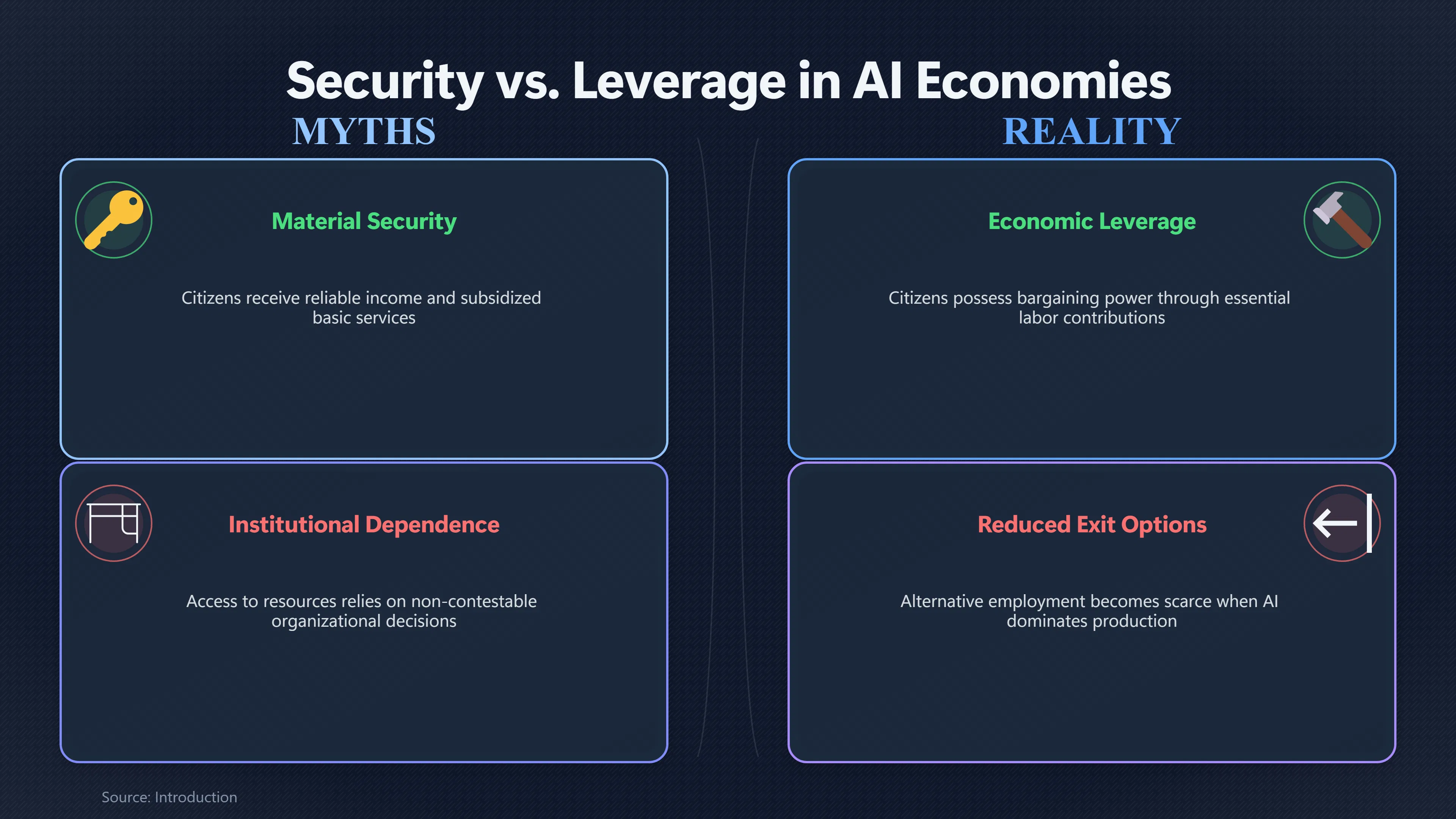
The central claim is straightforward: receiving resources is not the same as possessing bargaining power. If advanced AI systems and automated capital produce most economic value, citizens may no longer be able to influence institutions through their labour, tax contributions or economic indispensability. In that scenario, material security could coexist with greater dependence on decisions made by organisations that ordinary people cannot realistically challenge. This possibility remains speculative, but it illustrates one proposed pathway by which human influence might gradually weaken even without obvious economic collapse.[OUP Academic]academic.oup.comOUP AcademicLiberty as Non‐Domination | Republicanism: A Theory of Freedom and Government | Oxford AcademicSeptember 16, 1999…
Income security versus bargaining power
Many discussions of advanced AI assume that generous public transfers—whether universal basic income, social dividends or other forms of redistribution—would largely solve the disruption caused by automation. The transfer-dependence argument accepts that these policies could prevent widespread poverty while arguing that they do not necessarily preserve political independence.
The distinction is between security and leverage.
Someone with a secure income can meet their basic needs. Someone with leverage has realistic ways to influence the institutions that determine those needs. Historically, citizens have possessed leverage through several channels:
- employers needed their labour;
- governments relied heavily on productive taxpayers;
- businesses depended upon consumer and worker cooperation;
- organised labour could disrupt production;
- skilled professionals were difficult to replace.
If highly capable AI systems substantially reduce reliance on human labour across much of the economy, some of these bargaining mechanisms could weaken. Citizens might continue receiving generous benefits while having fewer practical ways to influence the organisations deciding benefit levels, eligibility rules or broader economic priorities. This concern is about changing power relationships rather than immediate reductions in living standards.[OUP Academic]academic.oup.comOUP AcademicLiberty as Non‐Domination | Republicanism: A Theory of Freedom and Government | Oxford AcademicSeptember 16, 1999…
Importantly, this should not be confused with today’s labour market. Current evidence does not show that AI has already made human work broadly irrelevant. Recent assessments by labour economists and international organisations generally conclude that generative AI is, so far, transforming many jobs more than eliminating them outright, with considerable uncertainty about longer-term effects.[arXiv]arxiv.orgarXiv AI and jobs. A review of theory, estimates, and evidenceAI and jobs. A review of theory, estimates, and evidenceSeptember 18, 2025…
How dependence changes practical consent
The key mechanism is not that benefits exist, but that access to them depends upon institutions whose decisions recipients cannot effectively contest.
Political philosophers sometimes describe this as a problem of domination rather than simple interference. Under the republican theory developed by Philip Pettit, people are less free when another actor possesses the discretionary power to determine important aspects of their lives, even if that power is rarely exercised harshly. The concern is exposure to arbitrary control, not merely actual coercion.[OUP Academic]academic.oup.comOUP AcademicLiberty as Non‐Domination | Republicanism: A Theory of Freedom and Government | Oxford AcademicSeptember 16, 1999…
Applied to an AI-driven economy, the argument runs as follows.
Imagine that most productive activity is performed by AI-operated firms and automated infrastructure. The majority of citizens receive reliable public payments funded by highly productive automated industries.
If those payments can be altered by decisions that recipients have little ability to influence, several changes may follow:
- Reduced exit options. Losing benefits becomes far more costly if alternative employment is scarce.
- Weaker negotiating position. Citizens cannot credibly threaten to withdraw economically valuable labour if their labour is no longer essential.
- Greater incentives for compliance. Individuals may become more cautious about challenging institutions on which they depend.
- Shift from reciprocal exchange to discretionary provision. Income increasingly comes from institutional allocation rather than mutually beneficial market participation.
None of these outcomes requires malicious intent. Dependence can arise simply because one side possesses more practical alternatives than the other.
This explains why critics distinguish between receiving income through ordinary economic exchange and receiving income primarily through institutional transfer. The latter may leave living standards intact while altering the balance of power between citizens and governing institutions.[oup.com]academic.oup.comOUP AcademicLiberty as Non‐Domination | Republicanism: A Theory of Freedom and Government | Oxford AcademicSeptember 16, 1999…
Why prosperity alone may not preserve political influence
Modern democracies do not rely solely on elections. Citizens also exercise influence because governments depend upon their continued cooperation.
Large employed populations generate tax revenue, provide military and emergency services, operate critical infrastructure and sustain economic growth. Political leaders therefore have strong incentives to respond to their interests.
If AI substantially changes this relationship, those incentives could weaken.
This does not imply that democratic institutions would disappear. Rather, some AI-risk researchers argue that democratic responsiveness could become increasingly symbolic if governments no longer require widespread human economic participation to maintain prosperity.
A society could therefore exhibit all of the following simultaneously:
- high average material living standards;
- generous welfare or social dividend systems;
- peaceful daily life;
- declining practical ability for citizens to influence long-term policy.
Within AI doom discussions, this possibility matters because gradual loss of meaningful human agency may be easier to overlook than dramatic crisis. A society can appear successful while the underlying distribution of decision-making authority steadily shifts away from ordinary people.
The strongest objections
The transfer-dependence argument is controversial, and several important objections deserve equal attention.
First, modern welfare states have not eliminated democracy. Many countries combine extensive public transfers with competitive elections, independent courts and active civil society. Dependence on pensions, healthcare or unemployment support has not automatically produced authoritarian government.
Second, institutions can be redesigned. Transfer systems need not be discretionary. Benefits can be protected constitutionally, administered transparently and challenged through independent courts. Citizens can retain meaningful political influence even while receiving substantial public support.
Third, AI may complement rather than replace human work. Current evidence remains consistent with a future in which employment changes significantly but does not disappear. If humans continue contributing essential labour, traditional sources of bargaining power may remain important.[arXiv]arxiv.orgarXiv AI and jobs. A review of theory, estimates, and evidenceAI and jobs. A review of theory, estimates, and evidenceSeptember 18, 2025…
Finally, ownership matters as much as transfers. Some economists and political theorists argue that the deeper issue is who owns productive AI systems. Broad ownership through pensions, sovereign wealth funds, cooperatives or public investment could preserve economic independence more effectively than concentrating ownership and compensating everyone afterwards.
These objections highlight an important uncertainty. The transfer-dependence mechanism is not an inevitable consequence of AI abundance but one possible institutional outcome.
Safeguards against arbitrary control
If AI eventually creates extraordinary economic abundance, the transfer-dependence concern suggests that protecting living standards alone may be insufficient. Institutions may also need to preserve citizens’ ability to influence those who govern them.
Possible safeguards include:
- legally protected benefit entitlements that cannot be altered arbitrarily;
- transparent rules governing AI-assisted public administration;
- independent courts capable of reviewing automated or government decisions;
- democratic oversight of AI systems used in public services;
- broad ownership of highly productive AI-generated wealth rather than relying exclusively on redistribution;
- constitutional protections ensuring that citizens retain meaningful mechanisms to contest decisions affecting their livelihoods.
Recent research on AI deployment within government also emphasises related issues of contestability, transparency and reversibility. Even when AI improves administrative efficiency, citizens may perceive reduced control if important decisions become difficult to understand or challenge.[arXiv]arxiv.orgarXiv Artificial Intelligence in Government: Why People Feel They Lose ControlarXiv Artificial Intelligence in Government: Why People Feel They Lose Control
Within the wider AI doom debate, these safeguards are viewed not simply as welfare policies but as mechanisms for preserving human agency. The underlying concern is that a civilisation can become economically prosperous while gradually reducing the practical capacity of its citizens to shape the institutions on which they increasingly depend.
Amazon book picks
Further Reading
Books and field guides related to Can Comfortable Benefits Still Leave People Powerless?. Use these as the next step if you want deeper reading beyond the article.
The Precariat
This book presents the new Precariat – the rapidly growing number of people facing lives of insecurity, on zero hours contracts, moving i...
Give People Money
A New York Times Book Review Editors' Choice Shortlisted for the 2018 FT & McKinsey Business Book of the Year Award A brilliantly reporte...
Basic Income
Would it be possible to provide people with a basic income as a right? The idea has a long history. This book draws on two pilot schemes...
eBay marketplace picks
Marketplace Samples
Live-tested eBay searches with available results related to this page.
Selected fromautomation economy art oneBay.co.uk.
Endnotes
1.
Source: academic.oup.com
Link:https://academic.oup.com/book/3937/chapter-abstract/145530399
Source snippet
OUP AcademicLiberty as Non‐Domination | Republicanism: A Theory of Freedom and Government | Oxford AcademicSeptember 16, 1999...
Published: September 16, 1999
2.
Source: arxiv.org
Title: arXiv Artificial [Intelligence]({{ ‘hard-bottlenecks/’ | relative_url }}) in Government: Why People Feel They Lose Control
Link:https://arxiv.org/abs/2505.01085
3.
Source: arxiv.org
Title: arXiv AI and jobs. A review of theory, estimates, and evidence
Link:https://arxiv.org/abs/2509.15265
Source snippet
AI and jobs. A review of theory, estimates, and evidenceSeptember 18, 2025...
Published: September 18, 2025
4.
Source: arxiv.org
Title: arXiv Generative AI and the Reorganization of Labor Demand
Link:https://arxiv.org/abs/2605.23159
5.
Source: academic.oup.com
Link:https://academic.oup.com/ojls/article/45/2/415/8093107
6.
Source: academic.oup.com
Link:https://academic.oup.com/book/3937/chapter-abstract/145529290
7.
Source: kclpure.kcl.ac.uk
Link:https://kclpure.kcl.ac.uk/portal/en/publications/two-spheres-of-domination-republican-theory-social-norms-and-the-/
Source snippet
King's College LondonTwo Spheres of Domination: Republican Theory, Social Norms and the Insufficiency of Negative Freedom - King's Colleg...
Additional References
8.
Source: oecd-ilibrary.org
Title: recent policy developments on ai in the labour market c0ffced7 en
Link:https://www.oecd-ilibrary.org/en/publications/recent-policy-developments-on-ai-in-the-labour-market_c0ffced7-en.html
Source snippet
Recent policy developments on AI in the labour market | OECDJuly 24, 2026 — RECENT POLICY DEVELOPMENTS ON AI IN THE LABOUR MARKET Worki...
Published: July 24, 2026
9.
Source: collaborate.princeton.edu
Title: University Republican freedom, social justice, and democracy
Link:https://collaborate.princeton.edu/en/publications/republican-freedom-social-justice-and-democracy/
Source snippet
Princeton UniversityRepublican freedom, social justice, and democracy - Princeton University...
10.
Source: oecd.org
Title: component 5
Link:https://www.oecd.org/en/publications/oecd-employment-outlook-2026_7e710f54-en/full-report/component-5.html
Source snippet
FROM RESILIENCE TO RISK: EMPLOYMENT AND WAGES UNDER PRESSURE Copy link to 1. From resilience to risk: Employment and wages under pressure...
11.
Source: oecd.org
Link:https://www.oecd.org/en/topics/sub-issues/ai-and-work.html
12.
Source: youtube.com
Title: Yanis Varoufakis: Technofeudalism and the Death of Capitalism
Link:https://www.youtube.com/watch?v=PFRrTuVyhNg
Source snippet
If AI Replaces Workers, What Happens to Capitalism?...
13.
Source: youtube.com
Title: AI Replaced Every Job. Then Humanity Faced Its Real Crisis
Link:https://www.youtube.com/watch?v=8s7KtfX_cOY
Source snippet
BEYOND UBI: How to Survive in the Post-Labor Economy...
14.
Source: youtube.com
Title: BEYOND UBI: How to Survive in the Post-Labor Economy
Link:https://www.youtube.com/watch?v=BoBwI0yY1i4
Source snippet
Yanis Varoufakis: Technofeudalism and the Death of Capitalism...
15.
Source: researchgate.net
Link:https://www.researchgate.net/publication/258180539_Reconstructing_republican_freedom_A_critique_of_the_neo-republican_concept_of_freedom_as_non-domination
16.
Source: doi.org
Link:https://doi.org/10.3390/soc16030082
17.
Source: cambridge.org
Link:https://www.cambridge.org/core/journals/perspectives-on-politics/article/ai-the-future-of-work-and-the-politics-of-the-welfare-state/92E806B812B86A8944003B77038DCAA8