Within Cyber Enablers
Could AI Hackers Steal Pandemic Capable Research?
AI-assisted intrusions could lower one barrier to catastrophic biological misuse by exposing sensitive pathogen research and laboratory methods.
On this page
- What sensitive biological information attackers might seek
- How AI could accelerate discovery, access and analysis
- Why stolen research is only one step toward catastrophe
Page outline Jump by section
Introduction
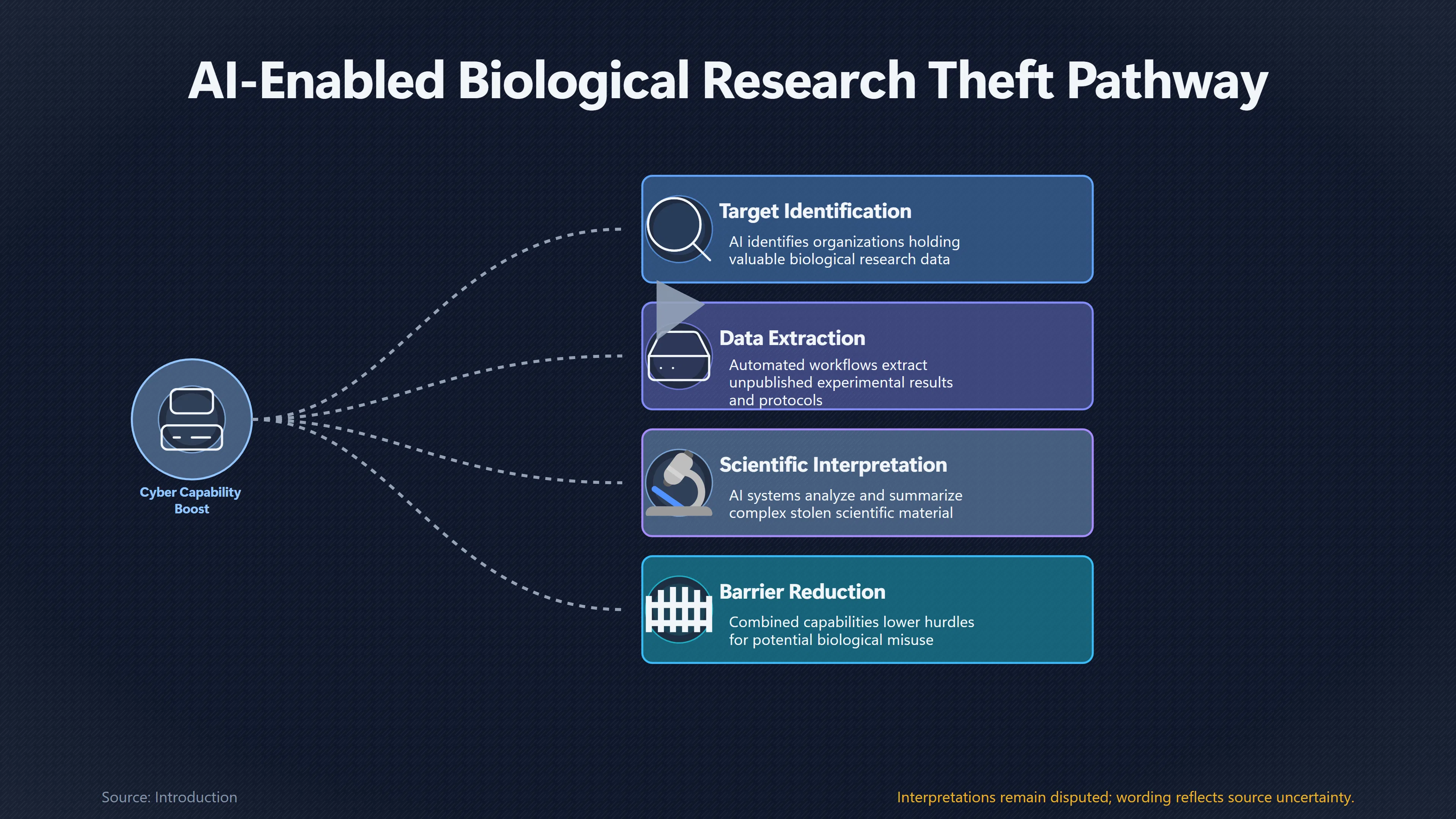
One concern within AI doom discussions is that increasingly capable AI-assisted cyberattacks could make it easier to steal highly sensitive biological research. The fear is not that hacking alone would cause human extinction, but that it could remove one of several barriers that currently make catastrophic biological misuse difficult. If attackers could obtain restricted pathogen research, laboratory methods, unpublished experimental results or defensive countermeasure data, they might gain access to knowledge that is substantially harder to reconstruct independently.
This scenario remains speculative, and there is no public evidence that AI has yet enabled the theft of uniquely dangerous biological research on a scale that changes global risk. However, governments and AI safety researchers increasingly view the combination of stronger AI cyber capabilities and expanding digital biological research as a genuine security concern worth preparing for. Within broader debates about AI existential risk, research theft is therefore treated as an enabling mechanism rather than an independent extinction pathway.[aisi.gov.uk]aisi.gov.ukFrontier AI Trends Report by The AI Security Institute (AISIFrontier AI Trends Report by The AI Security Institute (AISI
What sensitive biological information might attackers seek?
Modern biological research depends heavily on digital infrastructure. Universities, pharmaceutical companies, biotechnology firms, contract research organisations and government laboratories all store large quantities of valuable information in networked systems.
From a biosecurity perspective, researchers often distinguish between ordinary scientific information and material whose misuse could significantly increase dangerous capabilities. Attackers interested in catastrophic misuse would not simply be looking for published papers, which are already widely available. Instead, they would be interested in information that remains difficult to obtain elsewhere, such as:
- Unpublished experimental results.
- Laboratory protocols that are only partially described in publications.
- Genetic sequence datasets that have restricted access.
- Records explaining why particular experiments succeeded or failed.
- Information about defensive research, including vaccines, therapeutics or detection methods that could reveal weaknesses.
- Internal discussions documenting technical obstacles that researchers overcame.
Many of these materials fall into the broader category of dual-use research—work intended for legitimate science that could also have harmful applications if misused. Increasingly, researchers also discuss “dual-use pathogen data of concern”: datasets whose value comes not from a single document but from the ability to train or guide future AI systems working on biology.[arXiv]arxiv.orgarXiv Securing Dual-Use Pathogen Data of ConcernSecuring Dual-Use Pathogen Data of ConcernFebruary 8, 2026…
Importantly, not all pathogen research is equally sensitive. Large amounts of virology and microbiology research are intentionally published because openness accelerates medicine and public health. The debate centres on relatively small categories of information where unrestricted dissemination could plausibly increase security risks.
How AI could accelerate discovery, access and analysis
The distinctive contribution of advanced AI is not necessarily inventing entirely new hacking techniques. Instead, AI could compress many labour-intensive stages of cyber espionage into faster, more automated workflows.
Rather than requiring expert teams to spend weeks identifying valuable targets, analysing unfamiliar networks and sorting through stolen files, increasingly capable AI systems may assist with:
- Identifying organisations likely to possess valuable biological research.
- Analysing software for vulnerabilities.
- Automating reconnaissance across large numbers of potential targets.
- Searching enormous collections of stolen documents for specific biological concepts.
- Connecting related information scattered across multiple repositories.
- Summarising specialised scientific material for attackers with less domain expertise.
The UK AI Security Institute has documented rapid improvements in frontier AI systems’ cyber capabilities, with leading models progressing from rarely completing apprentice-level cybersecurity tasks to succeeding much more frequently, while beginning to demonstrate limited performance on some expert-level evaluation tasks. At the same time, AI capabilities in biology and chemistry have also advanced substantially, meaning the same systems may become increasingly useful for interpreting complex scientific material after it has been obtained.[aisi.gov.uk]aisi.gov.ukFrontier AI Trends Report by The AI Security Institute (AISIFrontier AI Trends Report by The AI Security Institute (AISI
This combination—better cyber assistance plus better scientific reasoning—is what attracts attention in existential-risk discussions. Neither capability alone necessarily changes global risk very much, but together they could reduce multiple barriers simultaneously.
Why stealing research is only one step toward catastrophe
A common misunderstanding is that obtaining sensitive laboratory files would immediately enable a catastrophic biological attack. The evidence does not support such a simple chain of events.
Even exceptionally valuable research would still leave numerous difficult problems unresolved. Real-world biological work typically requires combinations of:
- Practical laboratory skills.
- Appropriate equipment.
- Reliable biological materials.
- Tacit knowledge that experienced researchers acquire through practice rather than documentation.
- Time for experimentation and troubleshooting.
- Organisational resources and operational security.
Many scientific papers already omit important practical details because laboratory work depends on experience that is difficult to capture in writing. Internal documents may reduce some uncertainty, but they rarely eliminate it completely.
For this reason, many AI safety researchers describe cyber theft as reducing one obstacle rather than removing all obstacles. Catastrophic misuse would require several independent steps to succeed, each carrying substantial uncertainty.[arXiv]arxiv.orgBenchmark Early and Red Team Often: A Framework for Assessing and Managing Dual-Use Hazards of AI Foundation ModelsMay 15, 2024…

Why unpublished research may still matter
If published literature already contains enormous amounts of biological information, why would attackers invest in stealing additional research?
Several reasons are commonly discussed.
First, unpublished research often contains negative results. Knowing which approaches failed can save months or years of work that would otherwise be wasted.
Second, laboratory notebooks and internal reports frequently document practical implementation details omitted from journal articles because of space limits or editorial conventions.
Third, collaborative communications may reveal emerging discoveries long before publication.
Finally, internal security assessments or defensive research may unintentionally expose assumptions, limitations or priorities that could be useful to adversaries.
Whether these advantages would materially increase catastrophic biological capability is uncertain, but intelligence agencies have historically treated advanced biotechnology as a strategic target for precisely these reasons.
How this fits into AI doom arguments
Within AI doom discussions, cyber theft of biological research is usually presented as an indirect pathway rather than a primary existential mechanism.
The proposed sequence looks roughly like this:
- AI substantially improves offensive cyber capabilities.
- More sophisticated attackers gain access to sensitive biological research.
- AI also helps interpret and integrate the stolen information.
- Combined capabilities lower barriers to biological misuse.
- If other failures also occur, the probability of an exceptionally severe biological catastrophe increases.
Several important assumptions must all hold simultaneously for this chain to become existentially significant. AI would need to provide meaningful cyber advantages over defenders; valuable research would need to be successfully stolen; the information would need to add capabilities unavailable elsewhere; and downstream biological barriers would also need to be overcome.
Each step introduces uncertainty, which is one reason estimates of AI-related existential risk differ so widely among researchers.
What evidence supports this concern?
The strongest evidence comes from trends rather than from documented catastrophic incidents.
Researchers have observed rapid improvements in frontier AI models’ performance on cybersecurity and biology evaluations, prompting governments to study whether these capabilities could eventually lower barriers to misuse. The UK AI Security Institute explicitly identifies cyber operations and chemistry-and-biology capabilities as dual-use domains requiring ongoing evaluation and stronger safeguards as models improve.[aisi.gov.uk]aisi.gov.ukFrontier AI Trends Report by The AI Security Institute (AISIFrontier AI Trends Report by The AI Security Institute (AISI
Recent research has also proposed treating sensitive pathogen datasets themselves as security assets. One influential proposal argues that some biological data should be categorised according to biosecurity risk, with stronger controls over the most dangerous datasets because future AI systems may derive significant capabilities from training on them.[arXiv]arxiv.orgarXiv Securing Dual-Use Pathogen Data of ConcernSecuring Dual-Use Pathogen Data of ConcernFebruary 8, 2026…
More broadly, cybersecurity researchers increasingly analyse frontier AI as a technology that could benefit both attackers and defenders. Some reviews argue that attackers may gain advantages first because automation lowers costs and scales existing techniques, although the long-term balance remains uncertain.[arXiv]arxiv.orgarXiv So K: Frontier AI's Impact on the Cybersecurity LandscapearXiv So K: Frontier AI's Impact on the Cybersecurity Landscape
Why many experts remain cautious
Despite these concerns, substantial scepticism remains about how much additional risk cyber theft actually creates.
Several objections are frequently raised:
- Much important biology is already published. Open science has long been a defining feature of biomedical research, reducing the amount of uniquely valuable secret knowledge.
- Laboratory expertise cannot easily be stolen. Practical biological capability depends heavily on tacit skills and institutional experience.
- Cybersecurity continues improving. AI is also strengthening defensive monitoring, vulnerability detection and incident response.
- Existing evidence comes largely from capability evaluations rather than real-world attacks. Performance on benchmarks does not automatically translate into successful operations against well-defended organisations.
These objections do not eliminate concern, but they highlight why most serious analyses frame research theft as one uncertain contributor within a much longer causal chain.
How researchers propose reducing the risk
Because the concern lies at the intersection of cybersecurity, AI and biosecurity, proposed mitigations span all three fields.
Common recommendations include stronger cybersecurity for laboratories handling sensitive biological research, better identification and classification of high-risk biological datasets, independent evaluations of frontier AI systems’ cyber and biology capabilities, improved monitoring for attempts to misuse advanced models, and international cooperation on standards for handling particularly sensitive biological information.[arXiv]arxiv.orgarXiv Securing Dual-Use Pathogen Data of ConcernSecuring Dual-Use Pathogen Data of ConcernFebruary 8, 2026…
Within AI doom debates, these measures are often viewed as examples of defence in depth. No single safeguard is expected to eliminate catastrophic risk. Instead, the objective is to ensure that failures in one area—such as a successful cyber intrusion—do not automatically provide everything an attacker would need to progress towards much more dangerous forms of biological misuse.
Amazon book picks
Further Reading
Books and field guides related to Could AI Hackers Steal Pandemic Capable Research?. Use these as the next step if you want deeper reading beyond the article.
Sandworm
"With the nuance of a reporter and the pace of a thriller writer, Andy Greenberg gives us a glimpse of the cyberwars of the future while...
The Perfect Weapon
From Russia’s tampering with the US election to the WannaCry hack that temporarily crippled Britain’s NHS, cyber has become the weapon of...
The Genesis Machine
A New Yorker Best Book of the Year The next frontier in technology is inside our own bodies. The breakthrough science of synthetic biolog...
This is how They Tell Me the World Ends
WINNER OF THE FT & McKINSEY BUSINESS BOOK OF THE YEAR AWARD 2021The instant New York Times bestsellerA Financial Times and The Times Book...
eBay marketplace picks
Marketplace Samples
Live-tested eBay searches with available results related to this page.
Selected fromcybersecurity poster oneBay.co.uk.




Endnotes
1.
Source: aisi.gov.uk
Title: Frontier AI Trends Report by The AI Security Institute (AISI)
Link:https://www.aisi.gov.uk/frontier-ai-trends-report
2.
Source: arxiv.org
Title: arXiv So K: Frontier AI’s Impact on the Cybersecurity Landscape
Link:https://arxiv.org/abs/2504.05408
3.
Source: arxiv.org
Title: arXiv Securing Dual-Use Pathogen Data of Concern
Link:https://arxiv.org/abs/2602.08061
Source snippet
Securing Dual-Use Pathogen Data of ConcernFebruary 8, 2026...
Published: February 8, 2026
4.
Source: aisi.gov.uk
Title: aisi frontier ai trends report 2025
Link:https://www.aisi.gov.uk/research/aisi-frontier-ai-trends-report-2025
5.
Source: arxiv.org
Link:https://arxiv.org/abs/2405.10986
Source snippet
Benchmark Early and Red Team Often: A Framework for Assessing and Managing Dual-Use Hazards of AI Foundation ModelsMay 15, 2024...
Published: May 15, 2024
6.
Source: aisi.gov.uk
Title: AIS I Research & Publications | The AI Security Institute
Link:https://www.aisi.gov.uk/research
7.
Source: arxiv.org
Link:https://arxiv.org/abs/2408.07933
8.
Source: cdc.gov.au
Title: SSB A – Guidelines | Australian Centre for Disease Control
Link:https://www.cdc.gov.au/resources/collections/ssba-guidelines?language=en
9.
Source: GOV.UK
Title: www.gov.uk A I Security Institute – Frontier AI Trends report factsheet
Link:https://www.gov.uk/government/publications/ai-security-institute-frontier-ai-trends-report-factsheet
10.
Source: GOV.UK
Title: www.gov.uk A I Security Institute – Frontier AI Trends report factsheet
Link:https://www.gov.uk/government/publications/ai-security-institute-frontier-ai-trends-report-factsheet/ai-security-institute-frontier-ai-trends-report-factsheet
11.
Source: GOV.UK
Link:https://www.gov.uk/government/news/inaugural-report-pioneered-by-ai-security-institute-gives-clearest-picture-yet-of-capabilities-of-most-advanced-ai
12.
Source: GOV.UK
Title: www.gov.uk Frontier AI: capabilities and risks – discussion paper
Link:https://www.gov.uk/government/publications/frontier-ai-capabilities-and-risks-discussion-paper/frontier-ai-capabilities-and-risks-discussion-paper
13.
Source: aisi.gov.uk
Link:https://www.aisi.gov.uk/research-agenda
14.
Source: aisi.gov.uk
Title: Frontier AI Trends Report PDF
Link:https://www.aisi.gov.uk/frontier-ai-trends-report/pdf
15.
Source: aisi.gov.uk
Link:https://www.aisi.gov.uk/blog/5-key-findings-from-our-first-frontier-ai-trends-report
16.
Source: aisi.gov.uk
Link:https://www.aisi.gov.uk/blog
17.
Source: aisi.gov.uk
Link:https://www.aisi.gov.uk/blog/principles-for-safeguard-evaluation
Additional References
18.
Source: events.nationalacademies.org
Title: in person day 1 securing ai systems new challenges and research priorities
Link:https://events.nationalacademies.org/46521/session/3988467/in-person-day-1-securing-ai-systems-new-challenges-and-research-priorities
Source snippet
Details: Securing AI systems: New challenges and research prioritiesApril 20, 2026 — SESSION DETAILS Name (In-person) Day 1 | Securing AI...
Published: April 20, 2026
19.
Source: youtube.com
Title: AI RISING: Risk vs Reward – The Hinton Lectures™
Link:https://www.youtube.com/watch?v=GtVXw7GKwB0
Source snippet
This curated selection of videos directly explores cyberbiosecurity, digital biological data protection, and the risks of unauthorized cy...
20.
Source: youtube.com
Link:https://www.youtube.com/watch?v=SvPcxRiFauY
Source snippet
SIN22: Cyber-Biosecurity Threats and Risks: Mitigation Challenges and Transdisciplinary Solutions...
21.
Source: youtube.com
Title: Cyberbiosecurity: Protecting Biomedical and Patient Data in the Cloud
Link:https://www.youtube.com/watch?v=hUkNHJrL_Sk
Source snippet
Scaling Laws: Why Data Governance Is the Key to AI Biosecurity, with Jassi Pannu and Doni Bloomfield...
22.
Source: youtube.com
Link:https://www.youtube.com/watch?v=7fvuD81KdHQ
Source snippet
The Security Threat Nobody Expected: DNA as Infrastructure...
23.
Source: files.gao.gov
Link:https://files.gao.gov/reports/GAO-26-107338/index.html
Source snippet
and Selected G20 MembersFebruary 10, 2026 — ADDITIONAL PRECAUTIONS FOR HIGH-RISK BIOLOGICAL AGENTS AND RESEARCH For nine of the key compo...
Published: February 10, 2026
24.
Source: youtube.com
Title: The Security Threat Nobody Expected: DNA as Infrastructure
Link:https://www.youtube.com/watch?v=MCNPpqVUcQI
Source snippet
AI RISING: Risk vs Reward – The Hinton Lectures™ - Livestream Video - Day 2...
25.
Source: nationalacademies.org
Link:https://www.nationalacademies.org/news/ai-tools-can-enhance-u-s-biosecurity-monitoring-and-mitigation-will-be-needed-to-protect-against-misuse
26.
Source: biosecuritycentral.org
Link:https://www.biosecuritycentral.org/resource/core-guidance-and-recommendations/oversight-of-dual-use-life-sciences-research/
27.
Source: biosecuritycentral.org
Link:https://www.biosecuritycentral.org/resource/training-materials/dual-use-research-for-amateurs/