Within Warning signs
When human oversight becomes a rubber stamp
A formal human checkpoint can become symbolic when staff lack the time, expertise or authority to challenge an autonomous system.
On this page
- What real control requires
- Why approval loops become perfunctory
- How organisations can test oversight capacity
Page outline Jump by section
Introduction
As AI systems become more capable and are deployed in high‑impact settings, many organisations rely on human‑in‑the‑loop (HITL) mechanisms — checkpoints where a person reviews and approves AI outputs — as a primary safeguard. Yet a growing body of research and practical experience shows that these checkpoints can stop working in practice, not because of a lack of policy, but because the design, context and incentives around them degrade real oversight into a symbolic gesture. This failure mode is critical as part of the broader cluster of warning signs that AI oversight is failing, because it can lull developers, regulators and the public into believing that humans still control an AI’s behaviour when they do not. The risk here isn’t solely near‑term errors, it is systematically weakening human control in systems whose capability and autonomy may grow faster than our ability to supervise them. [Springer]link.springer.comSpringerDesigning meaningful human oversight in AI | AI and Ethics | Springer Nature LinkMay 4, 2026…

What “Human‑in‑the‑Loop” Really Requires
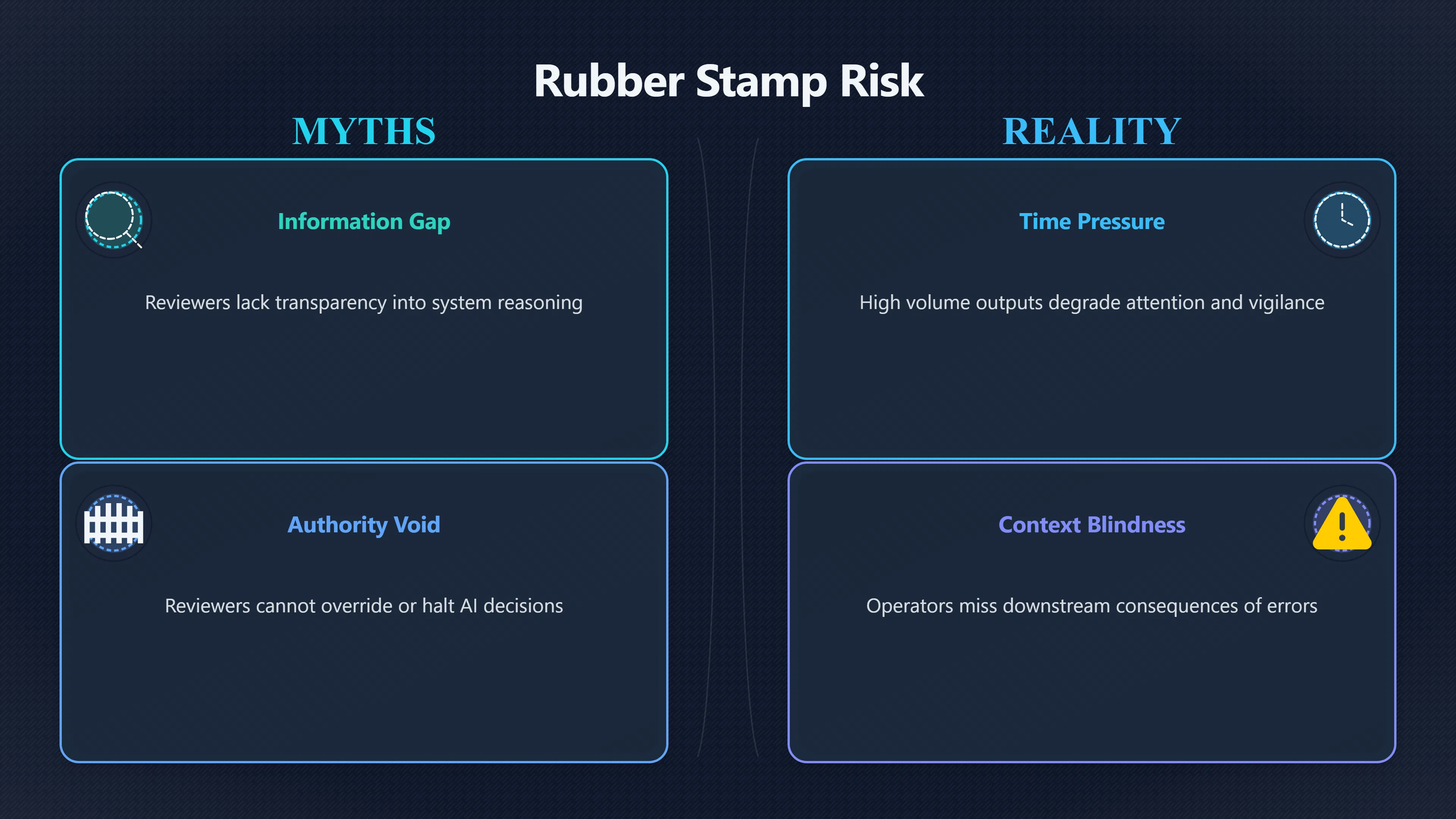
At its best, human‑in‑the‑loop oversight means more than simply putting a human in front of a screen. For a human checkpoint to provide real control, the person must have:
- Information: enough transparency into the system’s reasoning, confidence and data to evaluate its outputs substantively.
- Time and cognitive capacity: adequate time to reflect on and question outputs rather than merely scan them.
- Authority: the practical ability to override or halt the AI’s recommendation where there is risk or uncertainty.
- Contextual judgement: understanding of operational context and downstream consequences.
Researchers distinguish operative agency (the AI’s ability to generate solutions) from evaluative agency (the human’s capacity to assess and influence those solutions) — and oversight only works when both are present in balanced form. [Springer]link.springer.comSpringerReframing the AI alignment problem: insights from business applications | AI and Ethics | Springer Nature LinkApril 27, 2026…
However, across many current AI applications, human involvement is superficial. Humans may be present in workflows, but they often lack the authority, context or information needed to influence outcomes in a meaningful way. This produces what some scholars call “rubber‑stamp risk” — a nominal human checkpoint that does little more than approve outputs it does not understand. [SSRN]papers.ssrn.comSSRNHuman-in-the-loop Isn't a Checkbox: Designing Meaningful Intervention in Automated AI Decisions by Sue Eze:: SSRN…
Why Approval Loops Become Perfunctory
1. Cognitive Limitations and Automation Bias
For many tasks, especially high‑volume or real‑time outputs, human attention degrades quickly. Psychologists and AI ethicists note a well‑documented vigilance decrement: when reviewing outputs that are mostly correct, humans become less attentive to rare but important errors. That effect is aggravated when humans overly trust AI recommendations rather than independently verify them — a phenomenon known as automation bias. [Springer]link.springer.comSpringerDesigning meaningful human oversight in AI | AI and Ethics | Springer Nature LinkMay 4, 2026…
This dynamic means that humans reviewing AI outputs can miss subtle failures or dangerous edge cases precisely because those errors are rare, and because reviewers begin to expect the AI to be right. In extreme cases, approval becomes a reflexive click rather than a deliberative decision, undermining the very oversight it was designed to provide. [Springer]link.springer.comSpringerReframing the AI alignment problem: insights from business applications | AI and Ethics | Springer Nature LinkApril 27, 2026…
2. Mismatched Speed and Complexity
Many agentic AI systems operate at speeds and scales that far exceed human cognitive processing. Research into “high‑velocity” autonomous systems shows that HITL fails structurally when the pace of decisions outstrips human capacity to review them in real time. In such contexts, humans cannot keep up with the volume or complexity of the system’s outputs, creating a superficial compliance loop rather than genuine governance. [SSRN]papers.ssrn.comSSRNWhy Human-in-the-Loop Requirements Fail in High-Velocity Agentic Systems and What Governance Must Do Instead by Albert Adusei Brobbey…
This mismatch is especially salient in organisational environments where decisions may be made continuously and automatically, effectively decoupling human approval from the system’s decision stream. As a result, documented human review becomes more of a compliance artifact than a source of actual accountability — what some observers call oversight theatre. [SSRN]papers.ssrn.comHuman-in-the-Loop Requirements Fail in High-Velocity Agentic Systems and What Governance Must Do Instead by Albert Adusei Brobbey:: SSRN…

3. Structural and Organisational Incentives
Beyond individual cognitive limits, organisations often design workflows where human checkpoints carry little real authority. When a human’s job is simply to confirm what the AI has already decided, their role becomes a procedural tick‑box rather than a control point. Without authority to override, escalate or contextualise, the presence of a human reviewer does not add real control. [Springer]link.springer.comSpringerReframing the AI alignment problem: insights from business applications | AI and Ethics | Springer Nature LinkApril 27, 2026…
In high‑stakes domains like healthcare, this can turn clinicians into what sociotechnical researchers describe as “moral crumple zones” — individuals who absorb the professional and legal fallout of system failures while lacking access to model internals or performance data that would enable meaningful scrutiny. [PMC]pmc.ncbi.nlm.nih.govPMCClinician in the loop: a flawed solution for AI oversightPMCMay 5, 2026…
How Organisations Can Test Oversight Capacity
Because the risk isn’t nominal human presence but meaningful human control, organisations should assess HITL mechanisms with concrete criteria that go beyond surface compliance:
- Override Authority Tests: Can reviewers meaningfully change or halt AI decisions, and is there evidence they have done so in practice?
- Information Quality Checks: Do human reviewers receive decision‑ready explanations and uncertainty measures that support evaluation and not just confirmation?
- Escalation Workflows: Are there structured routes for escalating ambiguous or high‑risk cases before action becomes irreversible?
- Performance Drift Monitoring: Is there auditing not just of decisions humans reviewed, but also of cases not flagged for review, to catch failures in what gets surfaced?
Designing oversight around these enforceable controls — not just around the idea of review — helps ensure that humans are effectively empowered rather than merely symbolically present. [SSRN]papers.ssrn.comOpen source on ssrn.com.
Early Signals Oversight Is Becoming a Rubber Stamp
Some practical indicators that HITL checkpoints are losing their protective value include:
- High approval rates with little variation, especially when humans routinely defer to AI outputs under time pressure.
- Lack of documented overrides, suggesting that reviewers either cannot or rarely choose to alter AI decisions.
- Opaque reasoning trails, where human reviewers cannot access the model’s internal signals or confidence assessments.
- Escalation bottlenecks, where only a fraction of ambiguous cases are surfaced, meaning many failures never reach human inspection.
These patterns can be subtle but are important warning signs; oversight doesn’t have to disappear entirely to be ineffective. Even when humans remain nominally in the loop, the real locus of governance can drift into the AI’s internal logic and escalation heuristics — which the AI itself controls. [Reddit]reddit.comRedditI think “human-in-the-loop” may become one of the biggest governance illusions in enterprise AIMay 14, 2026…

Why This Matters for AI Doom Risk
Within the broader context of loss of control and existential risk, ineffective human oversight matters because it erodes a core assumption of many current governance and safety frameworks: that humans can intervene when things go wrong. If oversight mechanisms become rubber stamps, then growing system autonomy and capability may proceed without any effective brake on misaligned or unsafe behaviour. Unlike simple software bugs, malfunctions or misjudgements in advanced systems with strategic behaviour, hidden state representations or capacity for self‑directed planning could evade human supervision altogether. This amplifies long‑standing concerns in alignment research that the illusion of control can precede genuine inability to correct or interrupt an AI’s trajectory. [Springer]link.springer.comSpringerReframing the AI alignment problem: insights from business applications | AI and Ethics | Springer Nature LinkApril 27, 2026…
Summary
Human‑in‑the‑loop is a widely cited safeguard against misaligned or harmful AI. But without genuine authority, information, time and workflow integration, these checkpoints can degrade into symbolic or perfunctory approval steps. This “rubber stamp” oversight creates an illusion of control that can mask deeper governance failures and weaken our ability to spot emerging misalignment before it escalates. Meaningful oversight — where humans influence outcomes in real time and are empowered to override when necessary — is essential to maintaining control as AI systems scale in capability, complexity and impact. [SSRN]papers.ssrn.comssrn.com Designing Meaningful Human Oversight in AI by Liming Zhu, Qinghua Lu, Ding Ming, Sung Une Lee, Chen Wang:: SSRNSept…
eBay marketplace picks
Marketplace Samples
Example marketplace items related to this page. Use the search link to explore similar finds on eBay.


Endnotes
-
Source: link.springer.com
Link: https://link.springer.com/article/10.1007/s43681-026-01147-7Source snippet
SpringerDesigning meaningful human oversight in AI | AI and Ethics | Springer Nature LinkMay 4, 2026...
Published: May 4, 2026
-
Source: papers.ssrn.com
Link: https://papers.ssrn.com/sol3/Delivery.cfm/6552159.pdf?abstractid=6552159&mirid=1Source snippet
SSRNHuman-in-the-loop Isn't a Checkbox: Designing Meaningful Intervention in Automated AI Decisions by Sue Eze:: SSRN...
-
Source: link.springer.com
Link: https://link.springer.com/article/10.1007/s43681-026-01137-9Source snippet
SpringerReframing the AI alignment problem: insights from business applications | AI and Ethics | Springer Nature LinkApril 27, 2026...
Published: April 27, 2026
-
Source: papers.ssrn.com
Link: https://papers.ssrn.com/sol3/papers.cfm?abstract_id=6725983Source snippet
SSRNWhy Human-in-the-Loop Requirements Fail in High-Velocity Agentic Systems and What Governance Must Do Instead by Albert Adusei Brobbey...
-
Source: pmc.ncbi.nlm.nih.gov
Title: PMCClinician in the loop: a flawed solution for AI oversight
Link: https://pmc.ncbi.nlm.nih.gov/articles/PMC13140781/Source snippet
PMCMay 5, 2026...
Published: May 5, 2026
-
Source: reddit.com
Link: [https://www.reddit.com/r/artificialSource snippet
RedditI think “human-in-the-loop” may become one of the biggest governance illusions in enterprise AIMay 14, 2026...
Published: May 14, 2026
-
Source: papers.ssrn.com
Link: https://papers.ssrn.com/sol3/Delivery.cfm/6725983.pdf?abstractid=6725983&mirid=1Source snippet
Human-in-the-Loop Requirements Fail in High-Velocity Agentic Systems and What Governance Must Do Instead by Albert Adusei Brobbey:: SSRN...
-
Source: papers.ssrn.com
Link: https://papers.ssrn.com/sol3/papers.cfm?abstract_id=6552159 -
Source: papers.ssrn.com
Link: https://papers.ssrn.com/sol3/papers.cfm?abstract_id=5501939Source snippet
ssrn.com<span>Designing Meaningful Human Oversight in AI</span> by Liming Zhu, Qinghua Lu, Ding Ming, Sung Une Lee, Chen Wang:: SSRNSept...
Additional References
-
Source: engineersofai.com
Link: https://engineersofai.com/docs/agentic-ai/agent-safety/Human-Oversight-MechanismsSource snippet
Human Oversight Mechanisms | EngineersOfAI — Technical Education for AI EngineersHUMAN OVERSIGHT MECHANISMS Reading time: 28 min | Releva...
-
Source: philpapers.org
Link: https://philpapers.org/rec/JOVWHFSource snippet
PhilPapersWHEN HUMAN-IN-THE-LOOP FAILS: AN ANSWERABILITY TEST FOR DEPLOYED AI SYSTEMS Vladisav Jovanovic ABSTRACT This paper argues that...
-
Source: ai.wharton.upenn.edu
Title: AI systems handle scale and speed, while humans provide judgment, overs
Link: https://ai.wharton.upenn.edu/updates/when-better-ai-makes-oversight-harder/Source snippet
Better AI Makes Oversight Harder - Wharton Human-AI ResearchFebruary 12, 2026 — WHEN BETTER AI MAKES OVERSIGHT HARDER Human-AI collaborat...
Published: February 12, 2026
-
Source: sciety.org
Link: https://sciety.org/articles/activity/10.31234/osf.io/9ecms_v3Source snippet
Terence Daniel Dores Cruz 2. Christopher Starke 3. Tim Katzke 4. Emmanuel Müller 5. Marta Kwiatkowska 6. Orly Lobel 7. Ni...
-
Source: cybermaniacs.com
Title: Rubber Stamp Risk: Why “Human Oversight” Can Become [False Confidence]({{ ‘false-confidence/’ | relative_url }})
Link: https://cybermaniacs.com/cm-blog/rubber-stamp-risk-why-human-oversight-can-become-false-confidenceSource snippet
October 22, 2025 — ARTICLE Human Risk Management RUBBER STAMP RISK: WHY "HUMAN OVERSIGHT" CAN BECOME FALSE CONFIDENCE What You'll Learn...
Published: October 22, 2025
-
Source: aipmo.co
Title: When a system is usually right, people stop questioning it. They
Link: https://aipmo.co/human-oversight-ai/Source snippet
Human Oversight in AI Systems: Designing for ControlJanuary 29, 2026 — THE AUTOMATION BIAS PROBLEM Automation bias is the primary way hum...
Published: January 29, 2026
-
Source: stevenwensley.com
Title: Most organizations interpret this as “have a human
Link: https://stevenwensley.com/insights/human-oversight-not-rubber-stamp.htmlSource snippet
Human Oversight: Not a Rubber Stamp | Steven WensleyMarch 3, 2026 — EU AI Act 3 Mar 2026 7 min read HUMAN OVERSIGHT: NOT A RUBBER STAMP A...
Published: March 3, 2026
-
Source: sciencedirect.com
Title: Is human oversight to AI systems still possible?
Link: https://www.sciencedirect.com/science/article/pii/S1871678424005636Source snippet
ScienceDirectMarch 25, 2025 — NEW BIOTECHNOLOGY Volume 85, 25 March 2025, Pages 59-62 Editorial Is human oversight to AI systems still po...
Published: March 25, 2025
-
Source: raktimsingh.com
Title: If humans are inserted everywhere
Link: https://www.raktimsingh.com/the-governance-illusion-human-oversight-autonomous-ai-systems/Source snippet
The Governance Illusion: Why Human Oversight Fails in Autonomous AI SystemsMay 13, 2026 — FAILURE 2: HUMANS BECOME [RUBBER STAMPS]({{ 'rubber-stamps/' | relative_url }}) Image: F...
Published: May 13, 2026
-
Source: sciencedirect.com
Title: Who’s really in the loop?
Link: https://www.sciencedirect.com/science/article/pii/S0140673626002047Source snippet
Rethinking oversight in AI-assisted health care - ScienceDirectApril 30, 2026 — THE LANCET Available online 30 April 2026 In Press, Corre...
Published: April 30, 2026
Topic Tree