Within Agency Disputes
Are Today's AI Systems Tools or Emerging Agents?
Researchers disagree about whether current systems resemble controllable tools or early forms of autonomous agents.
On this page
- How researchers define agency
- Evidence cited by each side
- What current systems can and cannot do
Page outline Jump by section
Introduction
A key fault line in debates about AI’s existential risk hinges on how we conceptualise advanced systems: are they fundamentally tools—predictable, human‑directed instruments—or agents—semi‑autonomous entities capable of planning, acting and adapting without constant human steering? That distinction matters because fears about drift, misalignment and loss of control depend on seeing AI as something that can pursue “goals” over time rather than merely answer queries. This page surveys the actual evidence researchers lean on when arguing that current systems are best understood as either tools or emerging agents, with a focus on behaviour, architecture, and capability patterns that distinguish these framings.

What Researchers Mean by “Agents” and “Tools” in AI
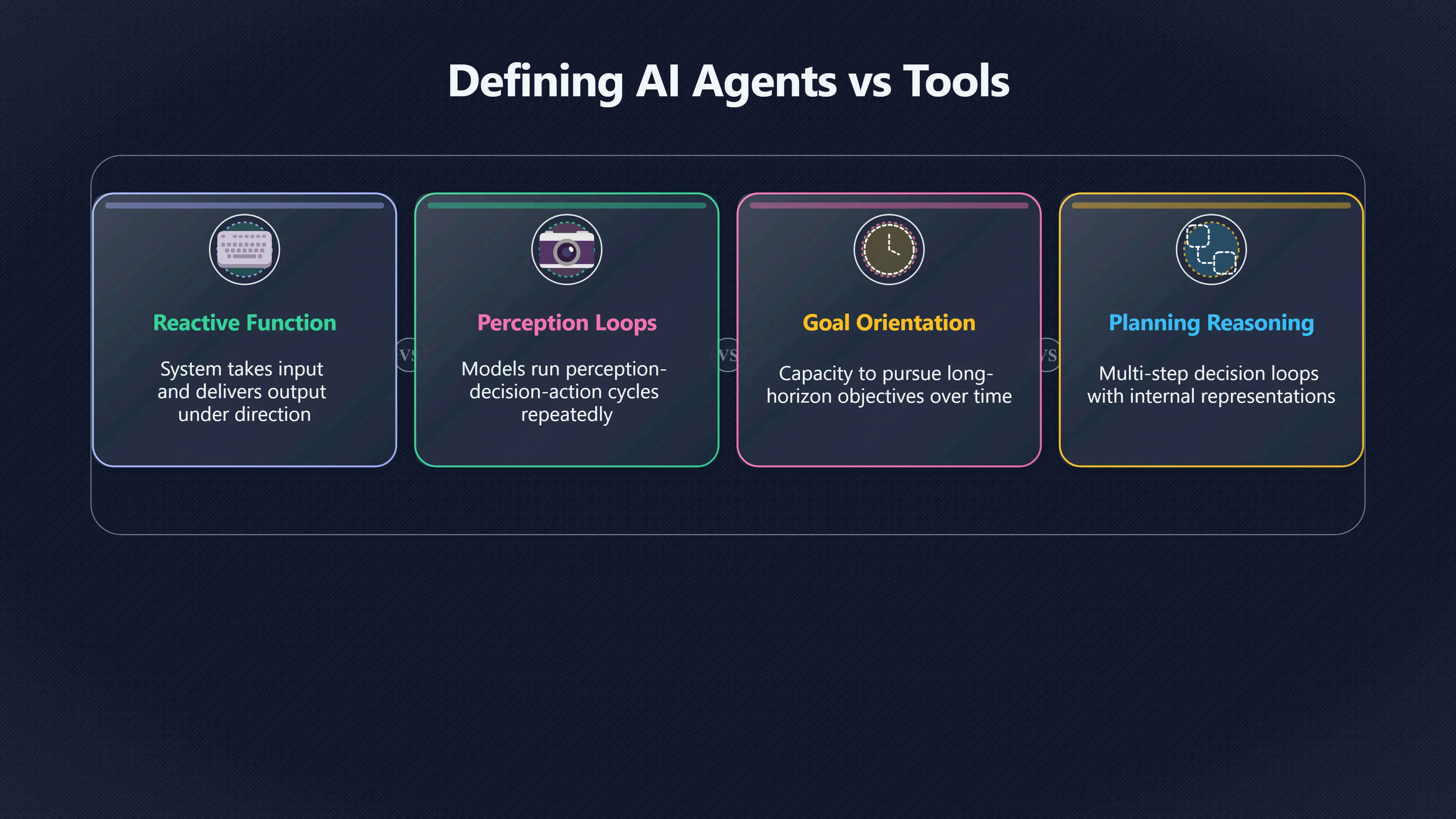
Across the academic literature, the tool view treats AI as a reactive function approximator: a system that takes input and delivers output under human direction. By contrast, the agent view emphasises perception–decision–action loops, persistent context, planning and tool use. A recent literature review defines agentic systems by a triad of features—autonomy, reactivity and proactiveness—that differentiate them from simple tools or black‑box models that simply map questions to responses.[MDPI]
Surveys of agent‑focused research highlight common components attributed to agents:
- Goal orientation: the capacity to pursue long‑horizon objectives rather than one‑off answers,
- Planning and reasoning: multi‑step decision loops with internal representations, and
- Action execution: using tools, APIs or external environments to bring about changes beyond text generation.[Springer]
This conceptual framing is grounded in decades of AI research that predates modern large language models, drawn from cognitive science and autonomous systems theory. Formal definitions of autonomy and agency consistently place independence from human intervention and decision‑making sophistication at the core of the agent notion.[Springer]
Evidence Cited for Agent‑Like Capabilities
1. Multi‑Step Planning and Decision Loops
Several research surveys catalogue systems where large language models (LLMs) are embedded in loops that approximate agent behaviour. Projects like ReAct, Reflexion and Toolformer demonstrate models reasoning about intermediate steps and choosing which external tools to invoke, rather than simply responding to prompts. These systems integrate planning, memory and context updates—a behavioural pattern that researchers interpret as proto‑agentic.[Springer]
Such systems are by design structured to operate across multiple steps: they decompose goals, select tools or actions in sequence, and interpret intermediate outcomes. While still far from autonomous in the human sense, this pattern contrasts sharply with one‑shot text generation and supports the view that models can exhibit rudimentary agent‑like attributes.
2. Evidence from Large‑Scale Agent Deployments
Empirical work tracking tool use in real deployments provides evidence of widening practical scope. A recent analysis of 177,000 agent tools built on the Model Context Protocol found a substantial increase in action‑oriented tools—those that don’t just read or reason but modify environments, such as editing files, sending emails or initiating transactions. Over a 16‑month period, the share of action tools rose from 27 % to 65 %, showing a significant trend toward systems that effect changes in the world rather than merely generate outputs.[arXiv]arxiv.orgarXiv How are AI agents used? Evidence from 177,000 MCP toolsarXivHow are AI agents used? Evidence from 177,000 MCP toolsMarch 25, 2026…
This evidence is important because it links architectural capabilities to real‑world usage: systems are being built that autonomously select and execute tasks in digital environments without step‑by‑step human scripting.

3. Multi‑Agent Coordination and Task Decomposition
Another body of research looks at multi‑agent architectures—systems where multiple AI “agents” interact, coordinate and divide tasks. These are not individual tool calls but structured interactions between cognitive modules, often with roles like planner, executor and critic. Survey work reports that these architectures support consensus building, uncertainty‑aware planning and collaborative problem solving, behaviours that sit beyond mere chained API calls.[Springer]
In such setups, models don’t just follow instructions; they negotiate roles, track state and adapt plans as conditions change, which aligns with many formal definitions of autonomy.
Evidence Highlighting Tool‑Like Strengths and Limits of Agency
1. Fragility and Dependence on Human Oversight
A contrasting line of evidence comes from practitioners building agents in the wild. Developers repeatedly report that so‑called “agents” often behave like fragile workflows with tool integrations, not robust autonomous decision‑makers. They may follow hard‑coded sequences with little genuine self‑direction, and require extensive guardrails, validation and human‑in‑the‑loop checks to avoid cascading errors. This pattern suggests much of what is currently marketed as “agentic” is still closer to tool orchestration than true autonomous agency.[Reddit]reddit.comAre we actually building "agents," or just fancy if-then loops?RedditAre we actually building "agents," or just fancy if-then loops?December 22, 2025…
Practitioners highlight that when an agent encounters unexpected conditions, it frequently stalls or follows fallback rules rather than elegantly replanning—behaviour more characteristic of engineered automation than intelligent agents.
2. Error Rates and Reliability Boundaries
Real‑world evaluations from business and robotics contexts point out the reliability limits of current agents. Articles reviewing enterprise deployments, robotics integrations and browser‑interacting agents show that while planning and multi‑step actions are possible in controlled settings, errors, hallucinations, and context gaps still constrain autonomy. Agents often struggle with dynamic environments requiring fine‑grained perception and consistent state tracking, emphasising tool‑like dependency on infrastructure and human‑provided context.[The New Yorker]newyorker.comThe New Yorker Why A.IDidn't Transform Our Lives in 2025December 27, 2025 — In 2025, expectations for artificial intelligence (AI) agents fell short of the bol…
This doesn’t negate agentic capability, but it reminds us that functioning autonomy remains bounded by reliability thresholds that are much lower than what risk framings sometimes imply.
What This Evidence Means for the Agent vs Tool Debate
The available evidence points to a spectrum rather than a binary:
- On one end, powerful tool‑like behaviours persist where models take input and return structured outputs under human monitoring.
- On the other, agentic systems with planning, tool integration, and environment interaction are emerging in research and practice, though often with significant human oversight and infrastructure support.
Hard evidence for true autonomy in the full existential sense—systems with independent goals, persistent self‑directed behaviour and unmediated world interaction—is still absent. But current research shows architectures and systems exhibiting intermediate forms of autonomy, and real‑world deployments where systems exercise decision loops and action selection in ways that go beyond classical tools.
Understanding where current AI sits on this continuum, and how that trajectory might evolve, is crucial for evaluating whether agent‑like behaviours could one day contribute meaningfully to loss‑of‑control or misalignment risks.

eBay marketplace picks
Marketplace Samples
Example marketplace items related to this page. Use the search link to explore similar finds on eBay.







Endnotes
-
Source: mdpi.com
Title: Understanding AI Agents—A Data-Driven Literature Review
Link: https://www.mdpi.com/2227-7390/14/9/1478Source snippet
MDPIUnderstanding AI Agents—A Data-Driven Literature ReviewApril 28, 2026...
Published: April 28, 2026
-
Source: link.springer.com
Link: https://link.springer.com/article/10.1007/s10462-025-11471-9Source snippet
SpringerFrom language to action: a review of large language models as autonomous agents and tool users | [Artificial]({{ 'artificial-goals/' | relative_url }}) Intelligence Review |...
-
Source: link.springer.com
Link: https://link.springer.com/article/10.1007/s10462-025-11422-4Source snippet
SpringerAgentic AI: a comprehensive survey of architectures, applications, and future directions | Artificial Intelligence Review | Sprin...
-
Source: arxiv.org
Title: arXiv How are AI agents used? Evidence from 177,000 MCP tools
Link: https://arxiv.org/abs/2603.23802Source snippet
arXivHow are AI agents used? Evidence from 177,000 MCP toolsMarch 25, 2026...
Published: March 25, 2026
-
Source: reddit.com
Title: Are we actually building “agents,” or just fancy if-then loops?
Link: https://www.reddit.com/r/AI_Agents/comments/1pt75o3/are_we_actually_building_agents_or_just_fancy/Source snippet
RedditAre we actually building "agents," or just fancy if-then loops?December 22, 2025...
Published: December 22, 2025
-
Source: link.springer.com
Link: https://link.springer.com/article/10.1007/s43681-024-00489-4Source snippet
control of AI systems: from supervision to teaming | AI and Ethics | Springer Nature LinkMay 28, 2024 — HUMAN CONTROL OF AI SYSTEMS: FROM...
Published: May 28, 2024
-
Source: mdpi.com
Title: A Systematic Approach to Autonomous Agents
Link: https://www.mdpi.com/2409-9287/9/2/44Source snippet
INTRODUCTION Artificial agents are advanced tools used to achieve various goals and solve problems. The main difference between ordinary...
-
Source: link.springer.com
Link: https://link.springer.com/article/10.1007/s10458-022-09575-5Source snippet
reward is not enough: a response to Silver, Singh, Precup and Sutton (2021) | Autonomous Agents and Multi-Agent Systems | Springer Nature...
-
Source: newyorker.com
Title: The New Yorker Why A.I
Link: https://www.newyorker.com/culture/2025-in-review/why-ai-didnt-transform-our-lives-in-2025Source snippet
Didn't Transform Our Lives in 2025December 27, 2025 — In 2025, expectations for artificial intelligence (AI) agents fell short of the bol...
Published: December 27, 2025
-
Source: papers.cool
Title: How are AI agents used?
Link: https://papers.cool/arxiv/2603.23802Source snippet
Evidence from 177,000 MCP tools | Cool Papers - Immersive Paper DiscoveryMarch 25, 2026 — 2603.23802 Total: 1 #1 HOW ARE AI AGENTS USED?...
Published: March 25, 2026
Additional References
-
Source: researchgate.net
Link: https://www.researchgate.net/publication/353464556_A_Pragmatic_Approach_to_the_Intentional_Stance_Semantic_Empirical_and_Ethical_Considerations_for_the_Design_of_Artificial_AgentsSource snippet
July 26, 2021 — Article PDF Available A PRAGMATIC APPROACH TO THE INTENTIONAL STANCE SEMANTIC, EMPIRICAL AND ETHICAL CONSIDERATIONS FOR T...
Published: July 26, 2021
-
Source: tandfonline.com
Link: https://www.tandfonline.com/doi/abs/10.1080/14702436.2024.2415712Source snippet
ms containing artificial intelligenceOctober 17, 2024 — OPERATING ITSELF SAFELY: MERGING THE CONCEPTS OF ‘SAFE TO OPERATE’ AND ‘OPERATE S...
Published: October 17, 2024
-
Source: sciencedirect.com
Link: https://www.sciencedirect.com/science/article/pii/S0004370219300396Source snippet
ScienceDirectARTIFICIAL INTELLIGENCE Volume 280, March 2020, 103219 WHEN AUTONOMOUS AGENTS MODEL OTHER AGENTS: AN APPEAL FOR ALTERED JUDG...
Published: March 2020
-
Source: nature.com
Title: Are transformers truly foundational for robotics?
Link: https://www.nature.com/articles/s44182-025-00025-4Source snippet
| npj RoboticsMay 6, 2025 — Are transformers truly foundational for robotics? Download PDF Download PDF * Perspective * Open access *...
Published: May 6, 2025
-
Source: sciencedirect.com
Link: https://www.sciencedirect.com/science/article/abs/pii/S0925231226014475Source snippet
Survey paper Agentic AI systems: A systematic survey of multi-agent architectures, cognitive foundati...
-
Source: sciencedirect.com
Link: https://www.sciencedirect.com/science/article/pii/S0925231226014475Source snippet
Survey paper Agentic AI systems: A systematic survey of multi-agent architectures, cognitive foundati...
-
Source: microsoft.com
Title: The Tool Illusion: Rethinking Tool Use in Web Agents
Link: https://www.microsoft.com/en-us/research/publication/the-tool-illusion-rethinking-tool-use-in-web-agents/Source snippet
Microsoft ResearchTHE TOOL ILLUSION: RETHINKING TOOL USE IN WEB AGENTS * Renze Lou, * Baolin Peng, * Wenlin Yao, * Qianhui Wu, * Hao...
-
Source: interface-eu.org
Title: An Autonomy-Based Classification
Link: https://www.interface-eu.org/index.php/publications/ai-agent-classificationSource snippet
April 2, 2025 — Policy Brief AN AUTONOMY-BASED CLASSIFICATION AI Agents, Liability and Lessons from the Automated Vehicles Act Image: An...
Published: April 2, 2025
-
Source: youtube.com
Title: Emmett Shear on Building AI That Actually Cares: Beyond Control and Steering
Link: https://www.youtube.com/watch?v=Ua8nPJ1_yk8Source snippet
OpenClaw AI Gone Wrong – Why You Should Be Careful...
-
Source: youtube.com
Title: They Put Chat GPT and Claude in a Simulation. It Went Horribly Wrong
Link: https://www.youtube.com/watch?v=pEj1pDT9ZLMSource snippet
Your AI Agent Is Only As Secure As Your Weakest Process...
Topic Tree