Within Timeline Effects
What AI surveys really say about doom
Expert surveys reveal wide disagreement about when advanced AI may arrive and how much catastrophic risk researchers attach to it.
On this page
- Milestone forecasts and uncertainty ranges
- Catastrophic risk questions and wording effects
- Why survey results do not settle p(doom)
Page outline Jump by section
Introduction
AI researcher surveys are often treated as a reality check in debates about AI doom and p(doom), the estimated probability that advanced AI causes existential catastrophe. They matter because they ask the people closest to the technology two related questions: how soon highly capable AI systems might arrive, and how much risk those systems could pose.
 The headline finding is not that experts agree on either question. It is almost the opposite. Large surveys of AI researchers consistently show enormous disagreement about timelines, catastrophic risk, and humanity’s ability to manage increasingly powerful systems. Yet they also show that existential-risk concerns are no longer confined to a small fringe. A meaningful fraction of researchers assign non-trivial probabilities to extremely bad outcomes, including scenarios as severe as human extinction. [AI Impacts]youtube.comAI Impacts SurveyAI Impacts Survey
For readers interested in the impact of AI timelines on p(doom) assessments, survey evidence is important because timelines and risk estimates are closely connected. Researchers who expect transformative AI sooner often worry that safety research, governance, and institutional adaptation may not keep pace. Researchers with longer timelines often see more opportunity for learning, regulation, and technical progress before the most capable systems arrive.
Milestone forecasts and uncertainty ranges
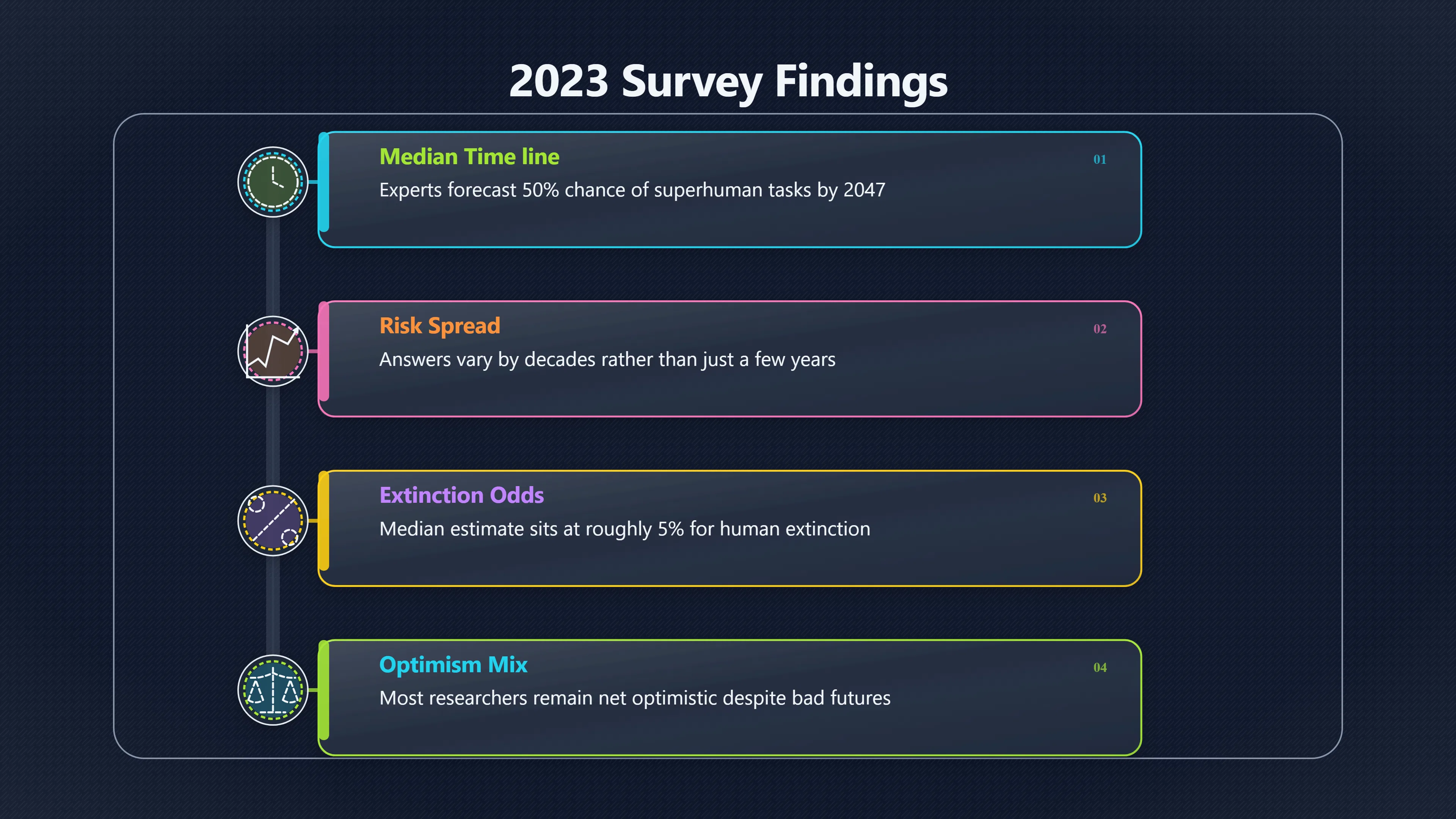
One of the most influential recent datasets is the 2023 Expert Survey on Progress in AI, which gathered responses from 2,778 researchers who had published at leading AI conferences. The results illustrated both accelerating expectations and persistent uncertainty. [arXiv]arxiv.orgarXiv Thousands of AI Authors on the Future of AIarXiv Thousands of AI Authors on the Future of AI
Respondents assigned at least a 50% probability that several demanding AI milestones could be achieved by 2028, including building complex software systems autonomously and performing tasks that had recently been considered far beyond the reach of machine learning systems. The survey also found a median forecast of a 50% chance that machines would outperform humans at every task by around 2047, substantially earlier than estimates from a similar survey conducted only a year before. [arXiv]arxiv.orgarXiv Thousands of AI Authors on the Future of AIarXiv Thousands of AI Authors on the Future of AI
However, focusing only on median forecasts can be misleading. Survey researchers repeatedly emphasise that the spread of answers is often as important as the central estimate. Experts disagree not by a few years but sometimes by many decades. Analyses of AI timeline surveys show that while some researchers expect transformative capabilities within the next decade, others remain sceptical that such systems will arrive this century. [AI Impacts]youtube.comAI Impacts SurveyAI Impacts Survey
This disagreement has been visible across multiple generations of surveys. Earlier work surveying researchers at major AI conferences found median expectations that systems capable of automating the vast majority of economically valuable human work might emerge within a few decades, but with very wide confidence intervals and substantial differences between expert communities. [arXiv]arxiv.orgarXiv Thousands of AI Authors on the Future of AIarXiv Thousands of AI Authors on the Future of AI
For readers trying to interpret p(doom) debates, this means there is no single “expert timeline”. There is a distribution of views, ranging from relatively near-term expectations to much longer horizons.
What catastrophic-risk questions reveal
Timeline forecasts attract most of the attention, but the most relevant questions for AI doom discussions concern catastrophic outcomes.
The 2023 survey found a median estimate of roughly 5% for extremely bad outcomes such as human extinction. The average response was higher, indicating that some respondents assigned much larger probabilities to catastrophic scenarios. More strikingly, over a third of participants assigned at least a 10% chance to extremely bad outcomes. [AI Impacts]youtube.comAI Impacts SurveyAI Impacts Survey
Another way of framing the same data highlights how widespread concern has become. Depending on the precise survey question and interpretation, between 38% and 51% of respondents assigned at least a 10% probability to outcomes as bad as human extinction resulting from advanced AI. [arXiv]arxiv.orgarXiv Thousands of AI Authors on the Future of AIarXiv Thousands of AI Authors on the Future of AI
These numbers are noteworthy because they come from researchers working directly in AI-related fields rather than from advocacy organisations or specialist AI-safety communities. At the same time, they should not be interpreted as a consensus that extinction is likely. Most respondents remained net optimistic about AI’s long-term impact, even while acknowledging meaningful catastrophic risks. Many researchers simultaneously assigned substantial probabilities to both very good and very bad futures. [arXiv]arxiv.orgarXiv Thousands of AI Authors on the Future of AIarXiv Thousands of AI Authors on the Future of AI
That combination can appear contradictory, but it reflects genuine uncertainty. Advanced AI could plausibly produce extraordinary benefits, serious harms, or both. Survey respondents often express uncertainty about which path will dominate rather than confidence in any single outcome.
Why wording changes the results
One of the most important lessons from survey research is that responses depend heavily on how questions are framed.
Questions about “human extinction”, “loss of control”, “catastrophic outcomes”, “transformative AI”, “human-level AI”, or “all tasks humans can do” do not measure exactly the same thing. Small wording changes can shift answers significantly because researchers interpret these terms differently. [AI Impacts]youtube.comAI Impacts SurveyAI Impacts Survey
For example, some researchers may regard extinction as an exceptionally unlikely edge case while still believing there is a substantial risk of permanent global authoritarianism, irreversible economic disruption, or loss of meaningful human control over key systems. Others may bundle several such possibilities together when estimating existential risk.
Timeline questions have similar problems. Forecasts about “human-level AI”, “artificial general intelligence”, “transformative AI”, and “full automation of labour” often produce different answers because respondents are imagining different thresholds. [AI Impacts]youtube.comAI Impacts SurveyAI Impacts Survey
This helps explain why survey findings are sometimes presented in seemingly contradictory ways. One article may emphasise relatively short timelines, while another highlights continuing uncertainty. Both can be accurate descriptions of the same underlying dataset.
Why survey results do not settle p(doom)
A common misunderstanding is that expert surveys can provide a definitive answer to p(doom). They cannot.
First, surveys measure beliefs rather than established facts. Respondents are forecasting unprecedented technological developments, not reporting observed outcomes. Even highly informed experts may be wrong. AI forecasting has a mixed historical record, with periods of both excessive optimism and excessive pessimism. [Our World in Data]ourworldindata.orgai timelinesOur World in DataAI timelines: What do experts in artificial intelligence expect…by M Roser · 2023 · Cited by 50 — Many AI experts bel…
Second, expertise in machine learning does not automatically translate into expertise in existential-risk analysis. Some researchers focus primarily on capabilities, others on safety, and others on entirely different areas. Surveys therefore aggregate views from people with different backgrounds, assumptions, and priorities.
Third, disagreement about timelines is only one source of disagreement about doom estimates. Researchers can share similar expectations about when advanced AI will arrive while strongly disagreeing about alignment difficulty, governance effectiveness, geopolitical competition, or whether powerful AI systems would develop goals that conflict with human interests. Recent work examining disagreement among AI experts suggests that underlying assumptions about controllability and agency help explain why p(doom) estimates vary so widely. [arXiv]arxiv.orgarXiv Thousands of AI Authors on the Future of AIarXiv Thousands of AI Authors on the Future of AI
Finally, survey results change over time. The rapid progress of large language models altered many researchers’ expectations between the early 2020s and the mid-2020s, leading some surveys to report shorter timelines than previous editions. Future developments could shift expectations again in either direction. [arXiv]arxiv.orgarXiv Thousands of AI Authors on the Future of AIarXiv Thousands of AI Authors on the Future of AI

What readers should take away
The strongest conclusion from AI researcher surveys is not that experts agree on a specific p(doom) number. Rather, the surveys show three things simultaneously.
First, many AI researchers expect very substantial capability advances within the coming decades, and some expect them much sooner. [arXiv]arxiv.orgarXiv Thousands of AI Authors on the Future of AIarXiv Thousands of AI Authors on the Future of AI
Second, a non-trivial share of researchers assign meaningful probabilities to catastrophic outcomes, including scenarios severe enough to qualify as existential risks. [AI Impacts]youtube.comAI Impacts SurveyAI Impacts Survey
Third, uncertainty remains enormous. The same datasets that reveal concern also reveal profound disagreement about timelines, risk mechanisms, and the likelihood of successful mitigation. [AI Impacts]youtube.comAI Impacts SurveyAI Impacts Survey
For debates about AI doom, that combination is perhaps the most important finding of all. The survey evidence does not demonstrate that catastrophe is inevitable, nor does it show that existential-risk concerns can be safely dismissed. Instead, it suggests that informed experts remain deeply divided on some of the most consequential questions about humanity’s future with advanced AI. [AI Impacts]youtube.comAI Impacts SurveyAI Impacts Survey 2arXiv
eBay marketplace picks
Marketplace Samples
Example marketplace items related to this page. Use the search link to explore similar finds on eBay.







Endnotes
-
Source: arxiv.org
Title: arXiv Thousands of AI Authors on the Future of AI
Link: https://arxiv.org/abs/2401.02843 -
Source: arxiv.org
Title: arXiv Forecasting Transformative AI: An Expert Survey
Link: https://arxiv.org/abs/1901.08579Source snippet
arXivForecasting Transformative AI: An Expert SurveyJanuary 24, 2019...
Published: January 24, 2019
-
Source: arxiv.org
Link: https://arxiv.org/abs/2401.02843?utm=Source snippet
More than half...Read more...
-
Source: arxiv.org
Link: https://arxiv.org/abs/2502.14870Source snippet
arXivWhy do Experts Disagree on Existential Risk and P(doom)? A Survey of AI ExpertsJanuary 25, 2025...
Published: January 25, 2025
-
Source: arxiv.org
Link: https://arxiv.org/html/2401.02843v3Source snippet
ood outcomes. The broad variance in credence in catastrophic...
-
Source: arxiv.org
Link: https://arxiv.org/pdf/2603.06223Source snippet
"Rogue AI taking over, human extinction"... Thousands of AI authors on the future of AI. Journal of Artificial...
-
Source: businessinsider.com
Title: ai researchers chance tech making humans extinct 2024 1
Link: https://www.businessinsider.com/ai-researchers-chance-tech-making-humans-extinct-2024-1Source snippet
There's only a 5% chance of AI making humans extinct...Jan 4, 2024 — Industry leaders and AI heavyweights said the rapid development of...
-
Source: youtube.com
Title: AI Impacts Survey
Link: http://www.youtube.com/watch?v=xwJx_xqZI3Q -
Source: aiimpacts.org
Title: Thousands of AI authors on the future of AI
Link: https://aiimpacts.org/wp-content/uploads/2023/04/Thousands_of_AI_authors_on_the_future_of_AI.pdfSource snippet
AI ImpactsTHOUSANDS OF AI AUTHORS ON THE FUTURE OF AIJanuary 6, 2024 — by K Grace · 2024 · Cited by 213 — The broad variance in credence...
Published: January 6, 2024
-
Source: wiki.aiimpacts.org
Title: 2023 expert survey on progress in ai
Link: https://wiki.aiimpacts.org/ai_timelines/predictions_of_human-level_ai_timelines/ai_timeline_surveys/2023_expert_survey_on_progress_in_aiSource snippet
aiimpacts.org2023 Expert Survey on Progress in AIAug 17, 2023 — The 2023 Expert Survey on Progress in AI is a survey of 2,778 [AI research]({{ 'ai-research-loop/' | relative_url }})...
-
Source: lesswrong.com
Title: ai impacts survey december 2023 edition
Link: https://www.lesswrong.com/posts/NfPxAp5uwgZugwovY/ai-impacts-survey-december-2023-editionSource snippet
AI Impacts Survey: December 2023 Edition5 Jan 2024 — The aggregate forecasts give at least a 50% chance of AI systems achieving several m...
Published: december 2023
-
Source: aiimpacts.org
Title: how should we analyse survey forecasts of ai timelines
Link: https://aiimpacts.org/how-should-we-analyse-survey-forecasts-of-ai-timelines/Source snippet
AI ImpactsHow should we analyse survey forecasts of AI timelines?The median expert thinks this is 20% likely by 2048, and 80% likely by 2103...
-
Source: ourworldindata.org
Title: ai timelines
Link: https://ourworldindata.org/ai-timelinesSource snippet
Our World in DataAI timelines: What do experts in artificial intelligence expect...by M Roser · 2023 · Cited by 50 — Many AI experts bel...
-
Source: aiimpacts.org
Title: EMBARGOED AI Impacts Survey Release Google Docs
Link: https://aiimpacts.org/wp-content/uploads/2024/01/EMBARGOED_-AI-Impacts-Survey-Release-Google-Docs.pdfSource snippet
Median AI expert says 5% chance of human extinction from...Jan 4, 2024 — Mean responses indicated an even higher risk, suggesting a near...
-
Source: aiimpacts.org
Title: 2022 expert survey on progress in ai
Link: https://aiimpacts.org/2022-expert-survey-on-progress-in-ai/Source snippet
Aug 3, 2022 — The 2022 Expert Survey on Progress in AI (2022 ESPAI) is a survey of machine learning researchers that AI Impacts ran in Ju...
-
Source: wiki.aiimpacts.org
Title: 2022 expert survey on progress in ai
Link: https://wiki.aiimpacts.org/ai_timelines/predictions_of_human-level_ai_timelines/ai_timeline_surveys/2022_expert_survey_on_progress_in_aiSource snippet
aiimpacts.org2022 Expert Survey on Progress in AIAug 4, 2022 — The 2022 Expert Survey on Progress in AI (2022 ESPAI) is a survey of machi...
-
Source: blog.aiimpacts.org
Title: 2023 ai survey of 2778 six things
Link: https://blog.aiimpacts.org/p/2023-ai-survey-of-2778-six-thingsSource snippet
of 2778 AI authors: six parts in pictures4 Jan 2024 — The 2023 Expert Survey on Progress in AI is out, this time with 2778 participants f...
-
Source: blog.biocomm.ai
Link: https://blog.biocomm.ai/2024/02/25/ai-impacts-report-thousands-of-ai-authors-on-the-future-of-ai-38participants-put-at-least-a-10-chance-on-extremely-bad-outcomes-e-g-human-extinction-january-2024/Source snippet
38%participants put at least a 10% chance on extremely bad outcomes (e.g. human extinction).Read more...
-
Source: Wikipedia
Link: https://en.wikipedia.org/wiki/P%28doom%29Source snippet
P(doom)In AI safety, P(doom) is the probability of existentially catastrophic outcomes (so-called "doomsday scenarios") as a result of...
Additional References
-
Source: pauseai.info
Link: https://pauseai.info/polls-and-surveysSource snippet
Polls & SurveysPolls & surveys: Expert opinion on catastrophic risks, Public opinion on catastrophic risks, Public opinion on regulations...
-
Source: techxplore.com
Link: https://techxplore.com/news/2024-01-future-ai-great-catastrophic.htmlSource snippet
The future of AI could be great—or catastrophicThe future of AI could be great—or catastrophic. by Peter Grad, Tech... Katja Grace et al...
-
Source: linkedin.com
Link: https://www.linkedin.com/posts/israeldelrio_thousands-of-ai-authors-on-the-future-of-activity-7153577296908419072-O6wrSource snippet
Thousands of AI Authors on the Future of AI | Israel del RioA pre-print of “Thousands of AI Authors on the Future of AI” paper is out. Th...
-
Source: medium.com
Link: https://medium.com/predict/thousands-of-researchers-predict-ais-future-098054750324Source snippet
Thousands of Researchers Predict AI's FutureFurthermore, the consensus suggests a 50% chance of AI “outperforming” humans in all tasks by...
-
Source: medium.com
Link: https://medium.com/%40meisshaily/what-experts-are-not-telling-you-f39123b7ed98Source snippet
What Experts Are Not Telling You | by Shailendra KumarAI Researcher Surveys: Median estimates place a 25% chance of AGI by the early 2030...
-
Source: iflscience.com
Link: https://www.iflscience.com/a-third-of-ai-researchers-think-ai-could-cause-catastrophic-outcomes-on-par-with-nuclear-war-this-century-65430Source snippet
A Third Of AI Researchers Think AI Could Cause...Sep 22, 2022 — Meanwhile, a non-trivial 36 percent of respondents agreed that it is pla...
-
Source: linkedin.com
Link: https://www.linkedin.com/posts/igorponikarchik_thousands-of-ai-authors-on-the-future-of-activity-7313837928370089984-5vEdSource snippet
Thousands of AI Authors on the Future of AI | Igor Ponikarchik4 Apr 2025 — Friday insights In the largest survey of its kind, 2,778 resea...
-
Source: linkedin.com
Title: projected timeline achieving artificial general trajectory ken kondo b6nsc
Link: https://www.linkedin.com/pulse/projected-timeline-achieving-artificial-general-trajectory-ken-kondo-b6nscSource snippet
Projected Timeline for Achieving Artificial General...For instance, a 2022 expert survey (published by AI Impacts) found a median estima...
-
Source: epoch.ai
Title: literature review of transformative artificial intelligence timelines
Link: https://epoch.ai/blog/literature-review-of-transformative-artificial-intelligence-timelinesSource snippet
Literature review of transformative artificial intelligence...Jan 17, 2023 — We summarize and compare several models and forecasts predi...
-
Source: lesswrong.com
Title: clarifying how our ai timelines forecasts have changed since
Link: https://www.lesswrong.com/posts/qPco9BX5kmKCDzzW9/clarifying-how-our-ai-timelines-forecasts-have-changed-sinceSource snippet
Clarifying how our AI timelines forecasts have changed...Jan 27, 2026 — So the median for AGI remains around 2032-2033, maybe it got 1 y...
Topic Tree