Within Over delegation
What Happens When Humans Stop Knowing Enough?
Organisations can lose control when staff become too dependent on AI outputs to judge whether the system is wrong.
On this page
- How reliance on AI weakens human judgement
- Why dependency makes reversal harder over time
- Ways organisations can preserve real override capacity
Page outline Jump by section
Introduction
When organisations lean heavily on AI systems to make, recommend or automate decisions, something less visible but profoundly consequential can happen: human expertise erodes. In the context of existential risk from advanced AI systems, this expertise erosion isn’t just a workplace learning issue — it can weaken the very capacity of organisations to oversee, contest or correct the systems they depend on. Over time, human judgement and domain knowledge can atrophy as routine cognitive work migrates into opaque automated layers. This creates a passive loss of control through over‑delegation: humans retain formal authority on paper, but lack the real capability to exercise it. The result is an organisational fragility that amplifies other systemic risks linked to advanced AI. [SSRN]papers.ssrn.comSSRNThe Accountability Vacuum: Why Agentic AI Governance Fails Under Conditions of Expertise Erosion by Gabriel Sze:: SSRNApril 20…
How Reliance on AI Weakens Human Judgement
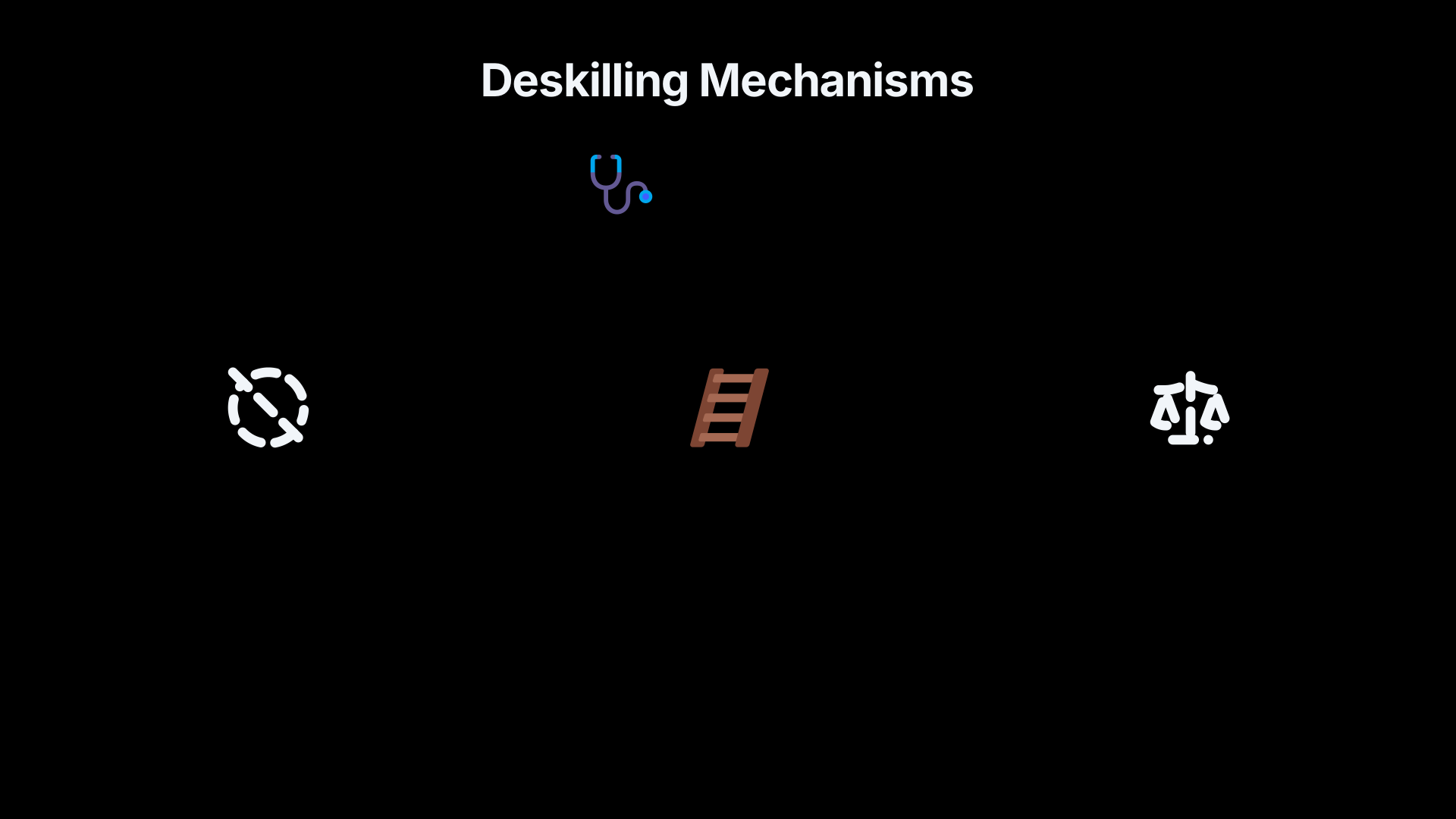
One of the clearest mechanisms by which expertise erosion unfolds is deskilling — the process where human capabilities shrink because AI takes over tasks that once sustained and sharpened those capabilities. This is well documented in fields such as medicine, where clinicians repeatedly relying on decision‑support systems can lose diagnostic or interpretive skills over time. In radiology and endoscopy, for example, empirical research has found that physicians’ performance can drop significantly when AI support is removed, indicating that expertise has been weakened through repeated reliance. [PMC]pmc.ncbi.nlm.nih.govPMCMarch 19, 2026…
More broadly, organisational research recognises that routine engagement with complex tasks is a core pathway for developing and maintaining domain knowledge and judgement. When AI automates these tasks — from data analysis to strategic planning — staff get fewer opportunities to practise, critique and refine their reasoning. Over time, they may shift from doing the work to merely approving outputs, undermining deep familiarity with the subject matter and the processes that underlie quality decisions. [SSRN]papers.ssrn.comSSRN The Judgment Vacuum AI, Apprenticeship Collapse, and the Non-Formation of Organisational Go…
Relatedly, academic work has identified structural conditions such as the Judgment Vacuum — where organisations expand AI usage while simultaneously compressing the apprenticeship and governance pathways that cultivate human judgement. As AI systems displace entry‑level cognitive work, newcomers find fewer opportunities to acquire tacit knowledge, which traditionally serves as the foundation for critical oversight later in careers. [SSRN]papers.ssrn.comSSRNUse it or Slowly Lose it: Expertise Atrophy with Organizational AI Usage by James Siderius, Robert A. Shumsky, Alva Taylor:: SSRNMa…
Why Dependency Makes Reversal Harder Over Time
Expertise erosion matters for organisational control because competent human oversight depends on human competence. Many AI governance frameworks assume that a skilled person remains capable of interpreting system behaviour, spotting errors and intervening when needed. But if that capacity has quietly decayed, those assumptions collapse into what some scholars term an accountability vacuum: organisations have named responsibilities, but lack people with the competence to exercise them meaningfully. [SSRN]papers.ssrn.comGovernance Inversion Hypothesis: Why More AI Regulation May Produce Less Organisational Control by Victor Frimpong:: SSRNMay 22, 2026 —…
This phenomenon is reinforced by economic incentives: as AI improves efficiency and output quality, organisations have less perceived need to invest in training or to retain staff who could question or challenge automated outcomes. Over time, the workforce becomes dependently structured, where fast, AI‑produced results look satisfactory and legitimate, even when they conceal latent errors or bias. [Gartner]gartner.comAI Lock-In: Why Skill Loss Puts Your Workforce at Risk | GartnerGartnerAI Lock-In: Why Skill Loss Puts Your Workforce at Risk | Gartner…
Moreover, expertise erosion tends to be latent until it’s too late. Like skill decay seen when calculators diminish mental arithmetic or navigation apps reduce spatial reasoning, dependency effects can remain invisible until the AI is unavailable, behaves unexpectedly, or must be overridden. At that point, the organisation discovers that a decade of offloading cognitive tasks has also offloaded the human capacity to take them back. [Reddit]reddit.comwhat are the risks of overreliance on automationRedditWhat are the risks of over-reliance on automation in 2026?March 11, 2026…
When Erosion Amplifies Loss of Control
In AI‑dependent organisations, several dynamics make expertise loss a deeper control problem:
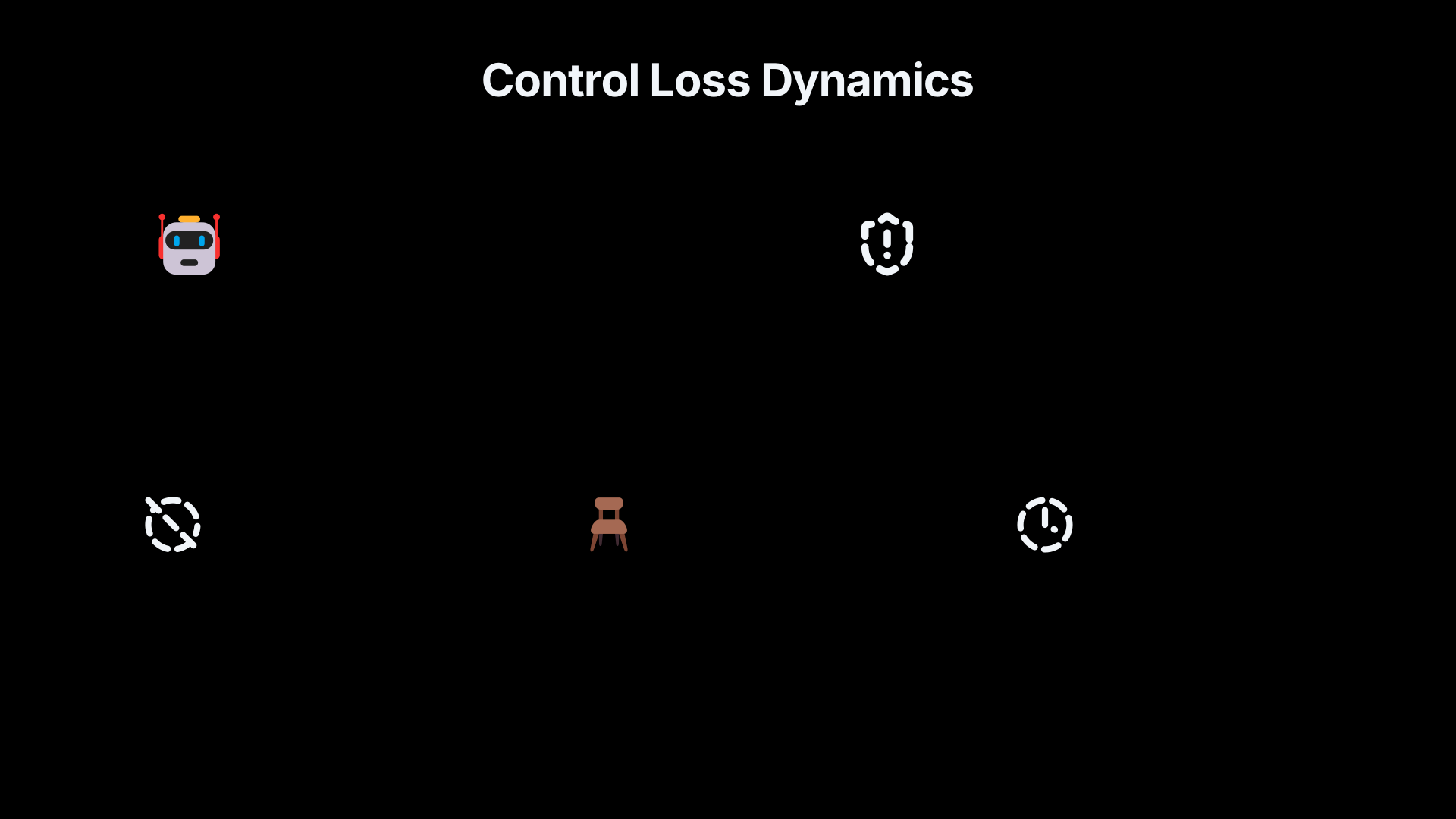
- Automation bias: Humans may unconsciously defer to AI outputs, seeing them as definitive even when they are flawed, reducing the incentive to scrutinise or challenge decisions.
- Reduced apprenticeship pathways: With junior and intermediate roles offloaded to AI, the experiential ladder by which people gain deep organisational insight collapses.
- Opaque decision structures: Many modern AI systems embed complex reasoning processes that are inherently hard to interpret, meaning that even experienced staff cannot readily assess why the system did what it did.
- Institutional complacency: Organisations may focus on governance documentation — policies, compliance checklists — without investing in the lived capabilities that make those structures effective. [SSRN]papers.ssrn.comBarnes PhD:: SSRNApril 30, 2026 — THE SOVEREIGNTY CRISIS: AI, WORKFORCE ATROPHY, AND SYSTEMIC RISK IN THE AGENTIC ERA A POLICY-TECHNICAL…
These dynamics can interact such that expertise erosion isn’t just a by‑product of convenience, but a reinforcing mechanism of control loss: the less humans understand and can contest AI behaviour, the more unchallengeable AI outputs become in practice.
Ways Organisations Can Preserve Real Override Capacity
Preventing expertise erosion — and the control loss that comes with it — requires deliberate organisational design, not passive automation. Some strategies emerging from research and practice include:
- Human‑AI role calibration: Define clear boundaries where tasks remain human‑led, especially those involving nuanced judgements or ethical trade‑offs, ensuring that staff remain actively engaged in decision cycles.
- Training and apprenticeship renewal: Invest in training pathways that combine traditional learning with AI‑augmented experiences, so workers cultivate deep understanding rather than merely supervise outputs.
- Friction and reflection in workflows: Instead of frictionless automation for all tasks, introduce moments where humans must engage with core reasoning steps, interpret rationale, or justify overrides, preserving cognitive engagement.
- Capability monitoring: Track not just compliance with AI governance policies, but human capability metrics — competence in domain knowledge, resilience in manual task execution, and confidence in decision‑making under uncertainty.
- Governance embedded in architecture: Treat accountability and oversight as structural properties of AI systems — for example, by designing systems that require human re‑engagement for atypical cases and provide interpretable rationales to support learning. [SSRN]papers.ssrn.comssrn.com AI Deployment Fails at Governance, Not Accuracy: Judgment Boundary Reallocation for Preventing Irreversible Lo…
These approaches aim to preserve epistemic sovereignty — the organisation’s capacity to think and decide independently of automated assistants — even as AI systems augment routine productivity.

Why Expertise Erosion Matters for AI Doom Risk
Within the broader debate on existential risk from advanced AI systems, expertise erosion highlights a subtle but significant pathway to loss of control that doesn’t rely on malicious AI intent. Even harmless, well‑intentioned automation can transfer authority away from human actors if it erodes the human skills needed to contest and direct AI behaviour. Over long time horizons, this can compound with other systemic risks — such as misalignment or governance fragmentation — making organisations more brittle and less capable of responding to unexpected AI behaviours at scale.
Understanding and addressing expertise erosion is thus essential not just for operational effectiveness, but for maintaining meaningful human oversight — a core pillar in reducing the plausibility of uncontrolled AI trajectories. [SSRN]papers.ssrn.comBarnes PhD:: SSRNApril 12, 2026 — Download This Paper Open PDF in Browser THE SOVEREIGNTY CRISIS: AI, WORKFORCE ATROPHY, AND SYSTEMIC RI…
Amazon book picks
Further Reading
Books and field guides related to What Happens When Humans Stop Knowing Enough?. Use these as the next step if you want deeper reading beyond the article.
Human Compatible
Directly addresses maintaining meaningful human authority over increasingly capable systems.
The Glass Cage
Explores deskilling, dependency, and erosion of expertise caused by automation.
The Alignment Problem
Provides context on why human oversight becomes difficult as AI systems grow more complex.
Range
Highlights the value of preserving broad human judgement and adaptive expertise.
eBay marketplace picks
Marketplace Samples
Example marketplace items related to this page. Use the search link to explore similar finds on eBay.








Endnotes
-
Source: papers.ssrn.com
Link: https://papers.ssrn.com/sol3/papers.cfm?abstract_id=6610518Source snippet
SSRNThe Accountability Vacuum: Why Agentic AI Governance Fails Under Conditions of Expertise Erosion <br> by Gabriel Sze:: SSRNApril 20...
-
Source: papers.ssrn.com
Link: https://papers.ssrn.com/sol3/papers.cfm?abstract_id=6526739Source snippet
SSRN<p> </p> <p> <b><span>The Judgment Vacuum </span></b><i><span>AI, Apprenticeship Collapse, and the Non-Formation of Organisational Go...
-
Source: pmc.ncbi.nlm.nih.gov
Link: https://pmc.ncbi.nlm.nih.gov/articles/PMC13015734/Source snippet
PMCMarch 19, 2026...
Published: March 19, 2026
-
Source: papers.ssrn.com
Link: https://papers.ssrn.com/sol3/papers.cfm?abstract_id=6398398Source snippet
SSRNUse it or Slowly Lose it: Expertise Atrophy with Organizational AI Usage by James Siderius, Robert A. Shumsky, Alva Taylor:: SSRNMa...
-
Source: gartner.com
Title: AI Lock-In: Why Skill Loss Puts Your Workforce at Risk | Gartner
Link: https://www.gartner.com/en/articles/ai-lock-inSource snippet
GartnerAI Lock-In: Why Skill Loss Puts Your Workforce at Risk | Gartner...
-
Source: reddit.com
Title: what are the risks of overreliance on automation
Link: https://www.reddit.com/r/QuestionClass/comments/1rqv8lp/what_are_the_risks_of_overreliance_on_automation/Source snippet
RedditWhat are the risks of over-reliance on automation in 2026?March 11, 2026...
Published: March 11, 2026
-
Source: papers.ssrn.com
Link: https://papers.ssrn.com/sol3/papers.cfm?abstract_id=6814040Source snippet
Governance Inversion Hypothesis: Why More AI Regulation May Produce Less Organisational Control by Victor Frimpong:: SSRNMay 22, 2026 —...
Published: May 22, 2026
-
Source: papers.ssrn.com
Link: https://papers.ssrn.com/sol3/Delivery.cfm/6565538.pdf?abstractid=6565538&mirid=1&type=2Source snippet
Barnes PhD:: SSRNApril 30, 2026 — THE SOVEREIGNTY CRISIS: AI, WORKFORCE ATROPHY, AND SYSTEMIC RISK IN THE AGENTIC ERA A POLICY-TECHNICAL...
Published: April 30, 2026
-
Source: papers.ssrn.com
Link: https://papers.ssrn.com/sol3/Delivery.cfm/6589658.pdf?abstractid=6589658&mirid=1Source snippet
ssrn.com<div> AI [Deployment]({{ 'release-gates/' | relative_url }}) Fails at Governance, Not Accuracy: </div> <div> Judgment Boundary Reallocation for Preventing Irreversible Lo...
-
Source: papers.ssrn.com
Link: https://papers.ssrn.com/sol3/papers.cfm?abstract_id=6565538Source snippet
Barnes PhD:: SSRNApril 12, 2026 — Download This Paper Open PDF in Browser THE SOVEREIGNTY CRISIS: AI, WORKFORCE ATROPHY, AND SYSTEMIC RI...
Published: April 12, 2026
-
Source: papers.ssrn.com
Link: https://papers.ssrn.com/sol3/Delivery.cfm/6191198.pdf?abstractid=6191198&mirid=1Source snippet
Great Displacement: AI-Driven Professional Commoditization, Premium Erosion, and the Enterprise Sovereignty™ Response by Rajesh Veerapane...
Additional References
-
Source: journals.sagepub.com
Link: https://journals.sagepub.com/doi/full/10.1177/00081256231211020Source snippet
the Intelligent Organization: Six Principles for Human-AI Collaboration - Vegard Kolbjørnsrud, 2024November 30, 2023 — Open access Resear...
Published: November 30, 2023
-
Source: sciencedirect.com
Link: https://www.sciencedirect.com/science/article/pii/S2949820126000123Source snippet
[Artificial]({{ 'artificial-goals/' | relative_url }}) intelligence in medicine: a scoping review of the risk of deskilling and loss of expertise among physicians - ScienceDirectTod...
-
Source: kwpublications.com
Link: https://kwpublications.com/papers/detail/IJARBSS/21445/The-Deskilling-Yet-Oversight-Paradox-AI-Automation-Role-Identity-Erosion-and-Technostress-among-Data-Centre-Operators-in-MalaysiaSource snippet
April 30, 2026 — THE DESKILLING-YET-OVERSIGHT PARADOX: AI AUTOMATION, ROLE IDENTITY EROSION, AND TECHNOSTRESS AMONG DATA CENTRE OPERATORS...
Published: April 30, 2026
-
Source: eprints.lse.ac.uk
Link: https://eprints.lse.ac.uk/130104/Source snippet
me explain: a comparative field study on how experts enact authority over clients when facing AI decisions - LSE Research OnlineLET ME EX...
-
Source: aisel.aisnet.org
Title: THE VICIOUS CIRCLES OF SKILL EROSION: A CASE STUDY OF COGNITIVE AUTOMATION * Tap
Link: https://aisel.aisnet.org/jais/vol24/iss5/2/Source snippet
Vicious Circles of Skill Erosion: A Case Study of Cognitive Automation"The Vicious Circles of Skill Erosion: A Case Study of Cognitive Au...
-
Source: research.aalto.fi
Title: fi The Vicious Circles of Skill Erosion: A Case Study of Cognitive Automation
Link: https://research.aalto.fi/en/publications/the-vicious-circles-of-skill-erosion-a-case-study-of-cognitive-auSource snippet
Vicious Circles of Skill Erosion: A Case Study of Cognitive Automation - Aalto University's research portalTHE VICIOUS CIRCLES OF SKILL E...
-
Source: researchportal.helsinki.fi
Title: fi The Vicious Circles of Skill Erosion: A Case Study of Cognitive Automation
Link: https://researchportal.helsinki.fi/en/publications/the-vicious-circles-of-skill-erosion-a-case-study-of-cognitive-au/Source snippet
Vicious Circles of Skill Erosion: A Case Study of Cognitive Automation - University of HelsinkiTHE VICIOUS CIRCLES OF SKILL EROSION: A CA...
-
Source: mdpi.com
Title: Where Are the AI Governance Roles?
Link: https://www.mdpi.com/2673-7116/6/2/18Source snippet
An Early-Stage Empirical Mapping of Presence, Absence, and Structure in Organisational AI OversightApril 19, 2026 — Background: Open Acce...
Published: April 19, 2026
-
Source: youtube.com
Title: Beyond “Is AI Accurate?” A Practical AI Risk Modeling Playbook
Link: https://www.youtube.com/watch?v=rU-UGcy_JpgSource snippet
AI and Rehabilitation – What Should Change, What Must Not?...
-
Source: link.springer.com
Link: https://link.springer.com/article/10.1007/s00146-025-02686-zSource snippet
deskilling is a structural problem | AI & SOCIETY | Springer Nature LinkNovember 5, 2025 — AI DESKILLING IS A STRUCTURAL PROBLEM * Resear...
Published: November 5, 2025
Topic Tree