Within Chip Controls
Do chip controls really buy safety time?
Chip controls may reduce AI doom risk only if compute delays give safety work and governance enough time to catch up.
On this page
- Why compute delays matter for AI doom timelines
- When extra years help alignment and evaluations
- When delays merely postpone the same danger
Page outline Jump by section
Introduction
Whether chip controls reduce AI doom risk depends less on the controls themselves and more on what happens during the delay they create. Supporters of export controls on advanced AI chips argue that slowing access to the largest amounts of computing power can buy valuable safety time: extra years in which researchers can improve alignment methods, develop better evaluations, build monitoring systems, and establish governance before more dangerous AI capabilities emerge. Critics respond that a delay only matters if safety advances faster than capabilities. If the same risks arrive a few years later with little improvement in preparedness, then chip controls may merely postpone danger rather than reduce it. The central question is therefore not whether controls slow progress, but whether the time gained changes humanity’s readiness for advanced AI. [Governance AI]cdn.governance.aiAIComputing Power and the Governance of ArtificialGovernance AIComputing Power and the Governance of Artificial…February 13, 2024 — 14 Feb 2024 — Computing power, or "compute," is cruc… [Default]Lawfareto govern ai we must govern computeGovern AI, We Must Govern Computeby L Heim · 2024 · Cited by 2 — Compute governance can support AI policy goals in multiple ways: by incr…
Why compute delays matter for AI doom timelines
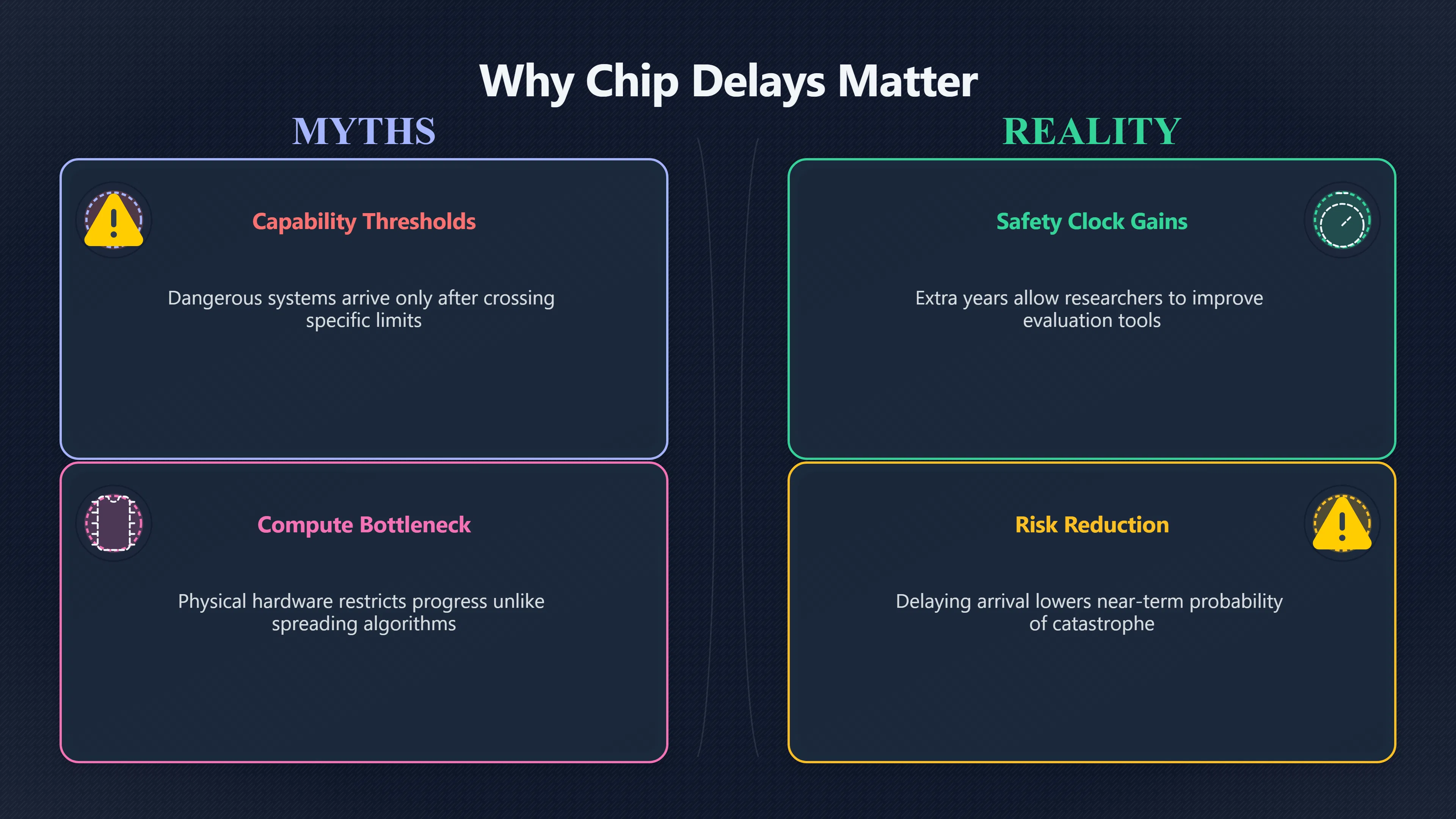
Many AI doom arguments assume that existential risk becomes serious only after systems cross certain capability thresholds. The exact threshold is disputed, but examples often include highly autonomous agents, systems capable of strategic deception, or AI that can substantially accelerate its own development.
Under this view, the timing of arrival matters. If a dangerous capability arrives in 2029 rather than 2026, society receives three additional years to improve technical and institutional safeguards. This logic resembles risk reduction in other domains: delaying the arrival of a hazardous technology can be valuable if protective measures improve during the delay.
The argument is strengthened by the unusual role of compute in frontier AI. Training the largest models requires enormous quantities of specialised hardware, electricity, data-centre infrastructure, and capital investment. Unlike algorithms, which spread rapidly once discovered, compute is a physical resource that governments can monitor and restrict. This makes compute one of the few potential bottlenecks available to policymakers. [Governance AI]cdn.governance.aiAIComputing Power and the Governance of ArtificialGovernance AIComputing Power and the Governance of Artificial…February 13, 2024 — 14 Feb 2024 — Computing power, or "compute," is cruc…
For people with substantial p(doom) estimates, even a modest delay can appear worthwhile. If they believe there is a meaningful probability that frontier systems could become difficult to control within the next decade, then a few additional years may have significant expected value. The reasoning is straightforward: if catastrophe is tied to a future capability threshold, slowing arrival at that threshold can lower near-term risk and create opportunities for intervention. [Effective Altruism Forum]forum.effectivealtruism.orgEffective Altruism ForumAI governance and strategy: a list of research agendas and…12 Mar 2024 — Much compute governance work hinges o…
When extra years help alignment and evaluations
The strongest case for safety time assumes that safety work is currently lagging behind capability progress.
Many researchers concerned about loss of control argue that existing techniques for understanding and supervising advanced models remain immature. Interpretability tools only reveal limited information about model reasoning. Evaluations can detect some dangerous capabilities but often struggle to predict behaviour in novel situations. Control methods remain largely untested against systems substantially more capable than humans in many domains. Governments and research organisations continue to describe frontier AI risks as highly uncertain and insufficiently understood. [GOV.UK]GOV.UKFrontier AI: capabilities and risks – discussion paperIt describes the current state and key trends relating to frontier AI capabilities, and then explores how frontier AI capabilities…Rea… [GOV.UK]GOV.UKrisks of frontier AI (Annex A)28 Apr 2025 — The risks posed by future Frontier AI will include the risks we see today, but with potential…
If additional years are available, several developments could plausibly reduce risk:
- Better evaluations that detect dangerous capabilities before deployment.
- Stronger interpretability tools that reveal what advanced models are planning or representing internally.
- More rigorous safety cases, where developers must present evidence that systems are safe enough for deployment.
- Monitoring systems for large training runs and compute usage.
- Improved international coordination around frontier AI development. [IAI]iai.itEnhancing Global AI Governance through Compute…22 May 2024 — The internationalisation of compute governance is necessary because advan…
The value of delay therefore depends on differential progress. Safety time matters most if alignment, monitoring, governance, and evaluation capabilities improve faster than frontier AI capabilities during the same period.
A useful analogy is a race between two clocks. One clock measures how quickly AI capabilities advance. The other measures how quickly humanity learns to evaluate and control those capabilities. A delay only improves outcomes if the safety clock gains ground.
The race-dynamics argument
Some supporters of chip controls emphasise competition rather than technology.
A recurring concern in AI doom discussions is that intense geopolitical or commercial competition could encourage developers to deploy increasingly capable systems before they are adequately understood. In this story, the danger comes not only from the technology itself but from incentives that reward speed over caution.
If export controls slow capability growth, they may also reduce pressure to rush. Governments gain more time to negotiate standards. Companies gain more time to conduct evaluations. Regulators gain more time to understand emerging risks. The hope is not merely that systems arrive later, but that development occurs under less extreme time pressure. [Center for AI Safety]safe.aiCAIS focusses on mitigating risks that could lead to catastrophic outcomes for society, such as bioterrorism or loss… [IAI]iai.itEnhancing Global AI Governance through Compute…22 May 2024 — The internationalisation of compute governance is necessary because advan…
For some doom-focused analysts, this governance effect is as important as the direct technological slowdown. They worry that many catastrophic outcomes arise from institutions deploying systems prematurely rather than from an unavoidable technological process.
When delays merely postpone the same danger
The strongest objection is that delay is not the same thing as risk reduction.
Suppose export controls slow frontier development by three years, but alignment research makes little progress, governance institutions remain weak, and dangerous capabilities eventually emerge anyway. In that scenario, humanity arrives at essentially the same destination on a slightly later date.
This criticism is particularly powerful if one believes that alignment is fundamentally hard. If the underlying technical problem proves extremely difficult, a short delay may not materially improve the odds of success. A capability that is dangerous in 2028 may remain dangerous in 2031.
Another challenge comes from uncertainty about how tightly compute and capabilities are linked. Historically, algorithmic improvements have often reduced the amount of compute needed to achieve a given performance level. If software improvements compensate for hardware restrictions, the practical delay may be smaller than policymakers expect. [Effective Altruism Forum]forum.effectivealtruism.orgEffective Altruism ForumAI governance and strategy: a list of research agendas and…12 Mar 2024 — Much compute governance work hinges o…
Critics also note that countries facing restrictions may invest heavily in domestic semiconductor industries, alternative hardware pathways, or more efficient algorithms. Over longer periods, these responses can erode the effectiveness of controls. International cooperation becomes particularly important because unilateral restrictions are generally easier to circumvent than coordinated ones. [blog.bluedot.org]blog.bluedot.orgPrimer on AI Chips and AI GovernanceAugust 23, 2023 — 23 Aug 2023 — A report from CSIS argues that export controls from allies are crucial for the effectiveness of US export…

The hidden assumption: safety must be able to catch up
A useful way to understand the debate is that both supporters and critics often agree on the first step.
Both sides generally accept that limiting access to cutting-edge chips can slow some frontier AI projects. The real disagreement concerns the second step: whether slowing capability growth changes the eventual probability of catastrophe.
For chip controls to reduce existential risk rather than merely postpone it, several conditions probably need to hold simultaneously:
- Compute must remain a meaningful bottleneck.
- The delay must be substantial rather than trivial.
- Safety research must make genuine progress during the delay.
- Governance institutions must improve enough to influence future deployment decisions.
- The slowdown must not be offset by other developments that recreate the same competitive pressures. [arXiv]arxiv.orgarXivHardware-Level Governance of AI Compute: A Feasibility…6 Apr 2026 — The rationale for compute-based governance rests on three pro… [Default]Lawfareto govern ai we must govern computeGovern AI, We Must Govern Computeby L Heim · 2024 · Cited by 2 — Compute governance can support AI policy goals in multiple ways: by incr…
If these conditions are met, safety time could translate into lower p(doom). If they are not, export controls may function mainly as a schedule adjustment.
What evidence would show that safety time is working?
One difficulty in this debate is that the key outcome cannot be observed directly. We cannot compare two worlds, one with chip controls and one without them.
Instead, observers look for indirect signs that additional time is being converted into preparedness. Examples include:
- Frontier AI developers adopting increasingly rigorous evaluations.
- Governments establishing systems for monitoring large training runs.
- Progress in interpretability and control research.
- Safety-case frameworks becoming standard practice before deployment.
- Greater international coordination on frontier AI governance. [IAI]iai.itEnhancing Global AI Governance through Compute…22 May 2024 — The internationalisation of compute governance is necessary because advan…
From an AI doom perspective, these developments are the real target. Chip controls are not usually viewed as a complete solution. Rather, they are justified as a way of creating breathing room for measures that might eventually make advanced AI safer.
The debate therefore turns on a narrow but important question: does the extra time generated by compute restrictions allow safety and governance to catch up meaningfully? If the answer is yes, chip controls could reduce existential risk. If the answer is no, they may only move the timeline without changing the destination.

eBay marketplace picks
Marketplace Samples
Example marketplace items related to this page. Use the search link to explore similar finds on eBay.








Endnotes
-
Source: cdn.governance.ai
Title: AIComputing Power and the Governance of [Artificial]({{ ‘artificial-goals/’ | relative_url }})
Link: https://cdn.governance.ai/Computing_Power_and_the_Governance_of_AI.pdfSource snippet
Governance AIComputing Power and the Governance of Artificial...February 13, 2024 — 14 Feb 2024 — Computing power, or "compute," is cruc...
Published: February 13, 2024
-
Source: arxiv.org
Link: https://arxiv.org/html/2604.04712v1Source snippet
arXivHardware-Level Governance of AI Compute: A Feasibility...6 Apr 2026 — The rationale for compute-based governance rests on three pro...
-
Source: safe.ai
Link: https://safe.ai/ai-riskSource snippet
CAIS focusses on mitigating risks that could lead to catastrophic outcomes for society, such as bioterrorism or loss...
-
Source: GOV.UK
Title: Frontier AI: capabilities and risks – discussion paper
Link: https://www.gov.uk/government/publications/frontier-ai-capabilities-and-risks-discussion-paper/frontier-ai-capabilities-and-risks-discussion-paperSource snippet
It describes the current state and key trends relating to frontier AI capabilities, and then explores how frontier AI capabilities...Rea...
-
Source: assets.publishing.service.gov.uk
Link: https://assets.publishing.service.gov.uk/media/65395abae6c968000daa9b25/frontier-ai-capabilities-risks-report.pdfSource snippet
and risks from frontier AIThe UK Government believes more research into AI risk is needed. This report explains why. It describes the cur...
-
Source: arxiv.org
Title: arXiv Safety cases for frontier AI
Link: https://arxiv.org/abs/2410.21572 -
Source: iai.it
Link: https://www.iai.it/sites/default/files/iaicom2423.pdfSource snippet
Enhancing Global AI Governance through Compute...22 May 2024 — The internationalisation of compute governance is necessary because advan...
Published: May 2024
-
Source: blog.bluedot.org
Title: Primer on AI Chips and AI Governance
Link: https://blog.bluedot.org/p/primer-on-ai-chipsSource snippet
August 23, 2023 — 23 Aug 2023 — A report from CSIS argues that export controls from allies are crucial for the effectiveness of US export...
Published: August 23, 2023
-
Source: arxiv.org
Link: https://arxiv.org/html/2506.20530v1Source snippet
Toward a Global Regime for Compute Governance25 Jun 2025 — Applied to frontier AI, a global export control regime would restrict the sale...
-
Source: GOV.UK
Link: https://www.gov.uk/government/publications/frontier-ai-capabilities-and-risks-discussion-paper/future-risks-of-frontier-ai-annex-aSource snippet
risks of frontier AI (Annex A)28 Apr 2025 — The risks posed by future Frontier AI will include the risks we see today, but with potential...
-
Source: governance.ai
Link: [https://www.governance.ai/research-paper/oversightSource snippet
ital access to compute offers more precise controls, allowing regulatory control...Read more...
-
Source: Lawfare
Title: to govern ai we must govern compute
Link: https://www.lawfaremedia.org/article/to-govern-ai-we-must-govern-computeSource snippet
Govern AI, We Must Govern Computeby L Heim · 2024 · Cited by 2 — Compute governance can support AI policy goals in multiple ways: by incr...
-
Source: forum.effectivealtruism.org
Link: https://forum.effectivealtruism.org/posts/WRnT9hGfg3oKfKtXa/ai-governance-and-strategy-a-list-of-research-agendas-andSource snippet
Effective Altruism ForumAI governance and strategy: a list of research agendas and...12 Mar 2024 — Much compute governance work hinges o...
-
Source: forum.effectivealtruism.org
Title: Effective Altruism Forum On restraining AI development for the sake of safety
Link: https://forum.effectivealtruism.org/posts/8XFsez9HSRXMW4WRx/on-restraining-ai-development-for-the-sake-of-safetySource snippet
Effective Altruism ForumOn restraining AI development for the sake of safetyMarch 19, 2026 — 19 Mar 2026 — Here my basic intuition is tha...
Published: March 19, 2026
-
Source: forum.effectivealtruism.org
Link: https://forum.effectivealtruism.org/posts/iiRGCydMX7aiEjvGm/12-tentative-ideas-for-us-ai-policy-luke-muehlhauserSource snippet
Effective Altruism Forum12 tentative ideas for US AI policy (Luke Muehlhauser)19 Apr 2023 — Security features on chips can be leveraged f...
Additional References
-
Source: ai-frontiers.org
Link: https://ai-frontiers.org/topic/policy-and-regulationSource snippet
Policy & RegulationArticles in this section explore if, when, and how to implement regulation that harnesses AI's benefits while limiting...
-
Source: alignmentforum.org
Title: ai control may increase existential risk
Link: https://www.alignmentforum.org/posts/rZcyemEpBHgb2hqLP/ai-control-may-increase-existential-riskSource snippet
11 Mar 2025 — AI control may primarily shift probability mass away from "moderately large warning shots" and towards "ineffective warning...
-
Source: siliconranch.substack.com
Title: export controls are ai safety
Link: https://siliconranch.substack.com/p/export-controls-are-ai-safetySource snippet
Controls Are AI SafetyExport controls do reduce existential risks, and they hopefully hinder the use of AI for human rights abuses, mass...
-
Source: smarterarticles.co.uk
Link: https://smarterarticles.co.uk/capture-by-design-how-frontier-labs-wrote-ai-rules-before-regulators-arrivedSource snippet
Capture by Design: How Frontier Labs Wrote AI Rules Before...25 Apr 2026 — “[Anthropic]({{ 'anthropic-tests/' | relative_url }})'s dispute with US government exposes deeper rifts...
-
Source: youtube.com
Link: https://www.youtube.com/watch?v=234cxadMBSISource snippet
AI pioneer explains why it poses an existential risk for humanity...
-
Source: law-ai.org
Link: https://law-ai.org/advanced-ai-gov-litrev/Source snippet
search in the emerging field of advanced AI governance.Read more...
-
Source: papers.ssrn.com
Link: https://papers.ssrn.com/sol3/Delivery.cfm/6288138.pdf?abstractid=6288138&mirid=1Source snippet
Intelligence and Existential RiskWe classify and analyze existential AI risks in three categories: human-directed risks, accident risks...
-
Source: markusanderljung.com
Title: a collection of ai governance research ideas 2024
Link: https://www.markusanderljung.com/blog/a-collection-of-ai-governance-research-ideas-2024Source snippet
We collated the list by asking a range of researchers for ideas.Read more...
-
Source: pmc.ncbi.nlm.nih.gov
Link: https://pmc.ncbi.nlm.nih.gov/articles/PMC12035420/Source snippet
for near-term AI risks to evolve into existential threats...by V Subasri · 2025 · Cited by 11 — Failing to align AI with shared human va...
-
Source: youtube.com
Title: Keep the Future Human (with Anthony Aguirre)
Link: https://www.youtube.com/watch?v=IqzB0_pgDGkSource snippet
U.S.-China AI Race + Chip Bans Aren't Working + A Lesson From Nuclear Proliferation | The Spillover...
Topic Tree