Within Bio Threat AI
Evaluating High Risk AI Biological Models Before Release
Experts suggest assessing high-consequence AI biological models before release to prevent misuse and inform safety measures.
On this page
- Frameworks for pre release assessment
- High consequence capability testing
- Regulatory and ethical considerations
Page outline Jump by section
Introduction
As fears about AI‑assisted design of enhanced biological pathogens grow within broader debates about AI doom and existential risk, policymakers and technical experts are increasingly focused on one narrow but high‑stakes problem: How should regulators and developers evaluate powerful biological AI models *before they are released or widely deployed?* Pre‑deployment evaluation isn’t about minor tweaks to guidance; it’s about stopping potentially catastrophic capabilities from ever leaving the lab or cloud in unexamined form — especially when those capabilities could meaningfully lower the barriers to harmful biological design.
 This page examines the policy approaches being proposed and piloted for pre‑deployment evaluation of bio‑AI — advanced artificial intelligence systems that may have dual‑use or harmful biological capabilities — with an eye on why these approaches matter to long‑term safety and existential‑risk concerns, what they aim to assess, and where the most active debates lie.
What “Pre‑Deployment Evaluation” Means in High‑Risk AI Contexts
At its core, pre‑deployment evaluation refers to structured, systematic testing and assessment of an AI model before it is released for public or broad use, with the explicit aim of identifying dangerous capabilities and deciding whether release should proceed, be modified, or be blocked.
For biological AI models — systems trained on genomic data, biomolecular design tasks, or other life‑science domains — the stakes are especially high because of the potential for misuse in designing or interpreting pathogenic sequences. These evaluations attempt to answer two linked questions:
- What harmful capabilities might this model possess or enable? (for example, how well it can assist with tasks that ease biological design)
- Can those capabilities be reliably detected and mitigated before widespread release?
Pre‑deployment evaluation sits at the intersection of biosecurity governance, AI risk assessment, and standards‑based regulation, drawing on analogies with environmental impact assessments and traditional drug or clinical device approvals but adapted for the unique unpredictability of AI systems.
Frameworks and Structures Being Proposed
Current policy thinking on pre‑deployment evaluation of frontier AI models primarily emphasises structured, tiered assessment frameworks that combine technical testing with governance processes. These approaches aim to make evaluation systematic rather than ad‑hoc. Several policy frameworks or proposals are worth highlighting:
Mandatory Technical Evaluations Before Release
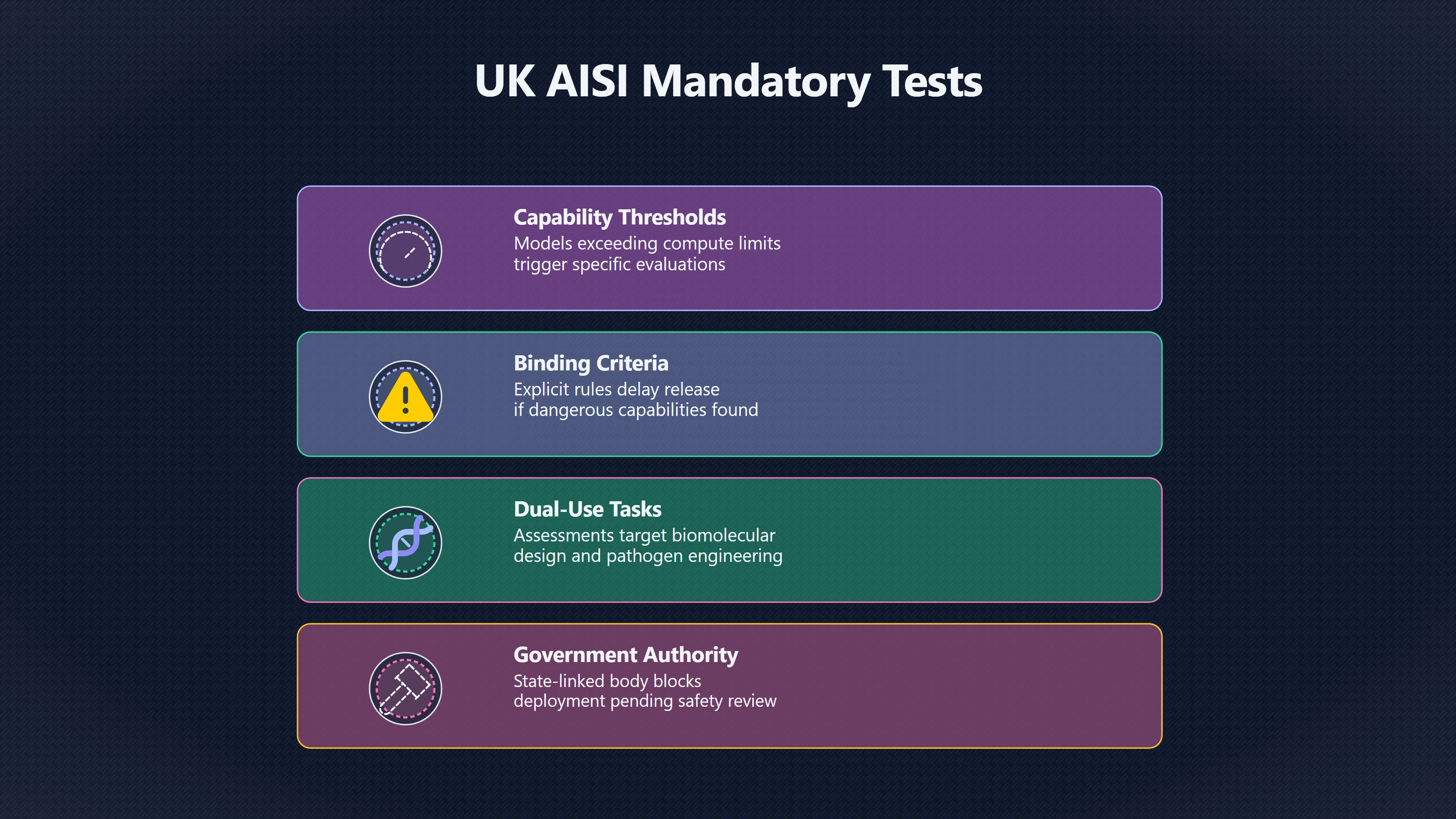
The UK AI Safety Institute (AISI) has published one of the first formalised, mandatory pre‑deployment testing regimes for frontier AI models that include biological risk assessment components. Under this framework:
- Models exceeding defined capability thresholds (e.g. high cumulative compute or broad functional ability) must undergo specific evaluations before they can be deployed in the UK market.
- These evaluations are not just internal checklists; they include defined methodologies for assessing “dangerous capabilities”, including dual‑use biological tasks, and explicitly binding criteria that can delay or prevent release if concerns are found.
- This kind of regime goes beyond voluntary industry commitments by giving a government‑linked body authority to block or delay deployment pending safety review. [Zeph Tech]zephtech.netZeph Tech UK AI Safety Institute Publishes First Mandatory… — Zeph TechZeph TechUK AI Safety Institute Publishes First Mandatory… — Zeph TechFebruary 6, 2026…
By anchoring evaluation in a formal institutional process rather than voluntary corporate practice, the UK AISI framework represents a concrete policy tool that could serve as a template for other jurisdictions.
Risk‑Threshold and Capability‑Focused Assessments
Many proposals, including industry and think‑tank commentaries, argue for pre‑deployment risk assessments linked to defined capability thresholds. In this view:
- Developers should assess whether a model’s capabilities cross into high‑risk territory that could meaningfully enable misuse or harmful outcomes.
- These risk assessments should be structured, documented, and repeatable, not informal judgements, and should account both for current behaviours and plausible near‑term escalations.
- Such assessments can incorporate existing standards, such as the NIST AI Risk Management Framework, to provide consistency with broader AI governance ecosystems. [CNAS]cnas.orgostp national priorities for artificial intelligenceCNASResponse to OSTP “National Priorities for Artificial Intelligence Request for Information” | CNASJuly 20, 2023…
Linking evaluations to capability thresholds — for example, a metric of model size, compute used, or performance in biological reasoning tasks — is intended to make the process predictable and transparent rather than discretionary.
Independent and External Evaluators
One recurring policy idea is externally conducted evaluations, separate from the model developers themselves. Such third‑party evaluation aims to reduce conflicts of interest and provide independent verification of safety claims:
- Policy documents recommend allowing qualified external experts to conduct or oversee assessments, especially at the pre‑deployment phase, where irreversible decisions about release are made.
- This requires legal and procedural scaffolding — e.g. confidentiality agreements and secure access — but is seen as key to accountability.
- At its core, external evaluation mirrors established practices in other high‑risk industries, such as medical device review, where independent bodies verify safety evidence before approval. [GOV.UK]GOV.UKEmerging processes for frontier AI safety27, 2023…
Such external checks are especially important for biological AI, given that underlying risks can be subtle and difficult for insider teams to bound.
Red Teaming and Capability Benchmarking
A set of evaluation techniques are now common in frontier AI risk thinking: [convergenceanalysis.org]convergenceanalysis.orgA I Evaluation & Risk Assessments | Convergence AnalysisAI Evaluation & Risk Assessments | Convergence AnalysisMay 4, 2024 — CHINA China’s Interim Measures for the Management of Generative AI S…
- Red teaming — adversarial testing designed to explore how a system could be misused or coaxed into responses that reveal dangerous capabilities.
- Benchmark evaluations — systematic testing against standardised tasks to measure performance and compare across models.
- Emerging taxonomies for frontier AI evaluations highlight that both approaches are essential: benchmarks flag baseline capabilities, while red teaming simulates adversarial misuse paths. [Frontier Model Forum]frontiermodelforum.orgFrontier Model ForumIssue Brief: Preliminary Taxonomy of Pre-Deployment Frontier AI Safety Evaluations - Frontier Model ForumDecember 20…
For bio‑AI, these techniques might mean testing how models respond to prompts about biomolecular design, pathogen engineering pathways, or debugging of biological protocols — seeking to measure potential to assist harmful tasks versus legitimate scientific utility.
Regulatory and Ethical Considerations
The prospect of introducing pre‑deployment evaluations raises a set of regulatory and ethical tensions:
Balancing Safety and Innovation
A central policy challenge is avoiding choking off beneficial biological AI innovation while still constraining dangerous capabilities. Critics of heavy‑handed regimes sometimes worry that broad obligation could stifle research on vaccine design, synthetic biology tools with positive applications, or scientific discovery; supporters counter that structured, evidence‑based evaluation processes can isolate harmful capabilities without blocking benign work.
Some proposals borrow from traditional governance analogies – such as environmental impact assessments or clinical trial phases – to ensure that evaluation is context‑sensitive and proportionate, rather than one‑size‑fits‑all.
Transparency Versus Security
Pre‑deployment evaluation necessarily involves sharing information about model architectures, training data sources, and evaluation results. However, too much transparency — for example, publishing detailed test outcomes publicly — could itself risk revealing weaknesses or capabilities that malicious actors could exploit.
Policy approaches vary: some propose selective disclosure to regulators and vetted researchers, while redacting proprietary or security‑sensitive details, balanced with aggregated public reporting to build trust.
International Coordination and Regime Differentiation
The governance landscape is already diverse:
- Some countries (e.g. China) require pre‑release registration and security assessment of AI models, including generalized large models, as part of broader state oversight frameworks;
- In the U.S., federal agreements with major labs now give government technical bodies early evaluation access but stop short of mandatory licensing regimes;
- The EU AI Act imposes obligations on high‑risk AI systems, including documentation and evaluation requirements, which could shape how providers prepare models for entry into EU markets.
This patchwork creates tension between softer, voluntary evaluation practices and harder, enforceable assessments that could amount to de facto licensing or gating mechanisms — raising questions about regulatory arbitrage, cross‑border enforcement, and competitive dynamics.

Why Pre‑Deployment Evaluation Matters for AI Doom and Biological Risk
From the perspective of existential risk thinking, pre‑deployment evaluation tackles a crucial structural problem: the unpredictability of advanced AI systems and the outsized harms they could enable when coupled with biological domains.
- Historical tech regulation (e.g. clinical drugs, high‑hazard chemicals) relies on pre‑market safety evidence to protect public welfare.
- AI systems with biological dual‑use capabilities combine unpredictability with widespread accessibility in ways that traditional regulation has not encountered.
- Without structured evaluation, models could be released with latent capabilities that accelerate the design or misuse of dangerous biological agents, lowering technical barriers and widening the pool of actors capable of harm.
In this light, pre‑deployment evaluation is not a bureaucratic add‑on but a targeted hedge against one class of catastrophic misuse — especially where those misuses connect to broad public health, global security, or existential narratives.
Ongoing Debates and Uncertainties
Despite growing consensus on evaluation as a policy tool, significant uncertainties remain:
- What exact metrics or benchmarks should be used for biological risk? Unlike simple toxicity tests, biological AI risks are multi‑dimensional and hard to reduce to single numbers.
- Who should enforce and govern evaluations? Government bodies, independent standards organisations, or consortia of experts each have different trade‑offs in legitimacy, expertise, and enforceability.
- How to handle open‑source models? Evaluation and control are far easier for proprietary models under a regulator’s jurisdiction than for open‑source models that can be freely modified and deployed.
And perhaps most fundamentally, pre‑deployment evaluation doesn’t eliminate risk by itself; it must be entwined with broader governance strategies including monitoring, access controls, post‑deployment response mechanisms, and international cooperation.
In summary, policy approaches to pre‑deployment evaluation of bio‑AI are emerging from a blend of frontier AI safety thinking and traditional regulatory governance, seeking to systematically test, measure, and govern high‑risk models before they are deployed. While significant design and implementation challenges remain, structured evaluation frameworks, mandatory testing regimes, and standardised metrics are rapidly moving from abstract proposals to real policy instruments — with implications that touch directly on how society manages one of the most delicate intersections of AI capability and biological risk.
Amazon book picks
Further Reading
Books and field guides related to Evaluating High Risk AI Biological Models Before Release. Use these as the next step if you want deeper reading beyond the article.
Human Compatible
Useful for understanding pre-deployment evaluation logic in AI systems.
The Alignment Problem
Explains evaluation frameworks relevant to high-risk AI applications.
The Genesis Machine
Explores powerful biological engineering technologies and governance concerns.

eBay marketplace picks
Marketplace Samples
Example marketplace items related to this page. Use the search link to explore similar finds on eBay.







Endnotes
-
Source: cnas.org
Title: ostp national priorities for artificial intelligence
Link: https://www.cnas.org/publications/commentary/ostp-national-priorities-for-artificial-intelligenceSource snippet
CNASResponse to OSTP “National Priorities for Artificial Intelligence Request for Information” | CNASJuly 20, 2023...
Published: July 20, 2023
-
Source: GOV.UK
Title: Emerging processes for frontier AI safety
Link: https://www.gov.uk/government/publications/emerging-processes-for-frontier-ai-safety/emerging-processes-for-frontier-ai-safetySource snippet
27, 2023...
-
Source: GOV.UK
Title: Many AI systems work in complex and unpredictable enviro
Link: https://www.gov.uk/government/publications/data-ethics-framework/data-and-ai-ethics-frameworkSource snippet
and AI Ethics Framework - GOV.UKDecember 18, 2025 — BUILDING SAFE AI SYSTEMS AI systems can behave in unexpected ways, especially if they...
Published: December 18, 2025
-
Source: GOV.UK
Title: www.gov.uk Code of Practice for the Cyber Security of AI
Link: https://www.gov.uk/government/publications/ai-cyber-security-code-of-practice/code-of-practice-for-the-cyber-security-of-aiSource snippet
of Practice for the Cyber Security of AI - GOV.UKJanuary 31, 2025 — STRUCTURE OF THE VOLUNTARY CODE OF PRACTICE Principle 1: Raise awaren...
Published: January 31, 2025
-
Source: GOV.UK
Title: www.gov.uk A I Safety Institute approach to evaluations
Link: https://www.gov.uk/government/publications/ai-safety-institute-approach-to-evaluations/ai-safety-institute-approach-to-evaluationsSource snippet
Safety Institute approach to evaluations - GOV.UKFebruary 9, 2024 — AISI (AI SAFETY INSTITUTE)’S APPROACH TO EVALUATIONS AISI (AI Safety...
Published: February 9, 2024
-
Source: aisi.gov.uk
Title: A I Safety Institute approach to evaluations
Link: https://www.aisi.gov.uk/blog/our-approach-to-evaluationsSource snippet
AI Safety Institute approach to evaluations - GOV.UKFebruary 9, 2024 — AISI (AI SAFETY INSTITUTE)’S APPROACH TO EVALUATIONS AISI (AI Safe...
Published: February 9, 2024
-
Source: zephtech.net
Title: Zeph Tech UK AI Safety Institute Publishes First Mandatory… — Zeph Tech
Link: https://zephtech.net/feed/2026-02-06-uk-aisi-mandatory-pre-deployment-testing-frontier.htmlSource snippet
Zeph TechUK AI Safety Institute Publishes First Mandatory… — Zeph TechFebruary 6, 2026...
Published: February 6, 2026
-
Source: frontiermodelforum.org
Link: https://www.frontiermodelforum.org/updates/issue-brief-preliminary-taxonomy-of-pre-deployment-frontier-ai-safety-evaluations/Source snippet
Frontier Model ForumIssue Brief: Preliminary Taxonomy of Pre-Deployment Frontier AI Safety Evaluations - Frontier Model ForumDecember 20...
-
Source: convergenceanalysis.org
Title: A I Evaluation & Risk Assessments | Convergence Analysis
Link: https://www.convergenceanalysis.org/ai-regulatory-landscape/ai-evaluation-and-risk-assessmentsSource snippet
AI Evaluation & Risk Assessments | Convergence AnalysisMay 4, 2024 — CHINA China’s Interim Measures for the Management of Generative AI S...
Published: May 4, 2024
-
Source: cltc.berkeley.edu
Link: https://cltc.berkeley.edu/policySource snippet
ENSURE THAT DEVELOPERS OF GPAIS, FOUNDATION MODELS, AND GENERATIVE AI ADHERE TO APPROPRIATE AI RISK MANAGEMENT STANDARDS AND GUIDANCE The...
-
Source: zephtech.net
Link: https://zephtech.net/policy/
Additional References
-
Source: iaps.ai
Link: https://www.iaps.ai/research/deployment-correctionsSource snippet
Deployment Corrections: An Incident Response Framework for Frontier AI Models — Institute for AI Policy and StrategyDEPLOYMENT CORRECTION...
-
Source: faf.ae
Link: https://www.faf.ae/home/2026/5/5/governing-the-convergence-google-deepmind-the-nuclear-threat-initiative-dna-synthesis-screening-and-the-architecture-of-ai-biosecurity-part-iiiSource snippet
Governing the Convergence: Google DeepMind, the Nuclear Threat Initiative, DNA Synthesis Screening, and the Architecture of [AI Biosecurit]({{ 'biosecurity-evasion/' | relative_url }})...
-
Source: montrealethics.ai
Link: https://montrealethics.ai/deployment-corrections-an-incident-response-framework-for-frontier-ai-models/Source snippet
January 25, 2024 — DEPLOYMENT CORRECTIONS: AN INCIDENT RESPONSE FRAMEWORK FOR FRONTIER AI MODELS January 25, 2024 Image Image 🔬 Research...
Published: January 25, 2024
-
Source: centeraipolicy.org
Link: https://www.centeraipolicy.org/work/bio-risks-and-broken-guardrails-what-the-aisi-report-tells-us-about-ai-safety-standardsSource snippet
Bio Risks and Broken Guardrails: What the AISI Report Tells Us About AI Safety Standards | Center for AI Policy | CAIPNovember 20, 2024 —...
Published: November 20, 2024
-
Source: longtermresilience.org
Link: https://www.longtermresilience.org/reports/why-we-recommend-risk-assessments-over-evaluations-for-ai-enabled-biological-tools-bts/Source snippet
Risk assessments for AI-enabled biological tools (BTs) | CLTRMarch 27, 2024 — WHY WE RECOMMEND RISK ASSESSMENTS OVER EVALUATIONS FOR AI-E...
Published: March 27, 2024
-
Source: eurekalert.org
Title: Governance needed to ensure biosecurity of biological AI models | Eurek Alert!
Link: https://www.eurekalert.org/news-releases/1054902Source snippet
Governance needed to ensure biosecurity of biological AI models | EurekAlert!August 22, 2024 — News Release 22-Aug-2024 GOVERNANCE NEEDED...
Published: August 22, 2024
-
Source: bankofengland.co.uk
Title: For example: * pre-deployment: how should the quality of train
Link: https://www.bankofengland.co.uk/prudential-regulation/publication/2022/october/artificial-intelligence%C2%A0Source snippet
DP5/22 - Artificial Intelligence and Machine Learning | Bank of EnglandOctober 11, 2022 — AI LIFECYCLE 4.59 One useful approach to unders...
Published: October 11, 2022
-
Source: epoch.ai
Title: expanding our analysis of biological ai models
Link: https://epoch.ai/blog/expanding-our-analysis-of-biological-ai-modelsSource snippet
20, 2026 EXPANDING OUR ANALYSIS OF BIOLOGICAL AI MODELS We release a database of over 1,100 biological AI models across nine categories...
-
Source: datafield.dev
Title: Once an AI system is deployed at sca
Link: https://datafield.dev/ai-ethics/ch19-auditing-ai-systems/Source snippet
Chapter 19: Auditing AI Systems | AI Ethics | DataField.DevSECTION 19.3: PRE-DEPLOYMENT AUDITING — ALGORITHMIC IMPACT ASSESSMENTS THE CON...
-
Source: pmc.ncbi.nlm.nih.gov
Link: https://pmc.ncbi.nlm.nih.gov/articles/PMC12061118/Source snippet
nih.govDual-use capabilities of concern of biological AI models - PMCMay 8, 2025 — POLICYMAKER GUIDANCE FOR HAZARDOUS BIOLOGICAL AI CAPAB...
Published: May 8, 2025
Topic Tree