Within AI Misuse Governance
Why AI Laws Fail to Enforce Safety Globally
This page explores why current AI laws struggle to hold actors accountable due to fragmented oversight and limited institutional capacity.
On this page
- Institutional capacity and audit limitations
- Cross jurisdictional enforcement challenges
- Reactive versus proactive monitoring of AI systems
Page outline Jump by section
Introduction
Many governments now have AI principles, safety frameworks or draft regulations. The harder question is whether any of them can reliably enforce safety when AI systems become more powerful, more autonomous and more globally distributed. For people concerned about AI doom or existential risk, this is not a technical detail. The concern is that even if safety standards exist on paper, weak enforcement could allow dangerous systems to be developed, deployed or misused before regulators can detect problems or intervene.
 The central challenge is an accountability gap. AI development is concentrated in a small number of powerful companies operating across borders, while oversight remains fragmented across national regulators with uneven technical expertise and limited resources. International organisations have produced influential governance principles, but most lack strong enforcement powers. As a result, there is often a large distance between formal commitments to AI safety and the practical ability to verify compliance, investigate failures or impose meaningful consequences. [OECD AI]oecd.aiA governance framework for algorithmic accountability and…May 22, 2023 — The study develops policy options for the governance of algor… [OECD]oecd.orgOECDAI principlesThe OECD AI Principles are the first intergovernmental standard on AI. They promote innovative, trustworthy AI that resp…
Why enforcement matters for existential-risk debates
Most discussions about AI doom focus on technical questions such as alignment, control and dangerous autonomy. Yet many proposed safety measures depend on governance systems that can actually monitor and constrain behaviour.
A recurring argument from AI safety researchers is that risks increase when powerful actors face incentives to move quickly while oversight remains weak. If companies or states believe they can gain strategic advantages from deploying increasingly capable systems, voluntary commitments may come under pressure. Enforcement becomes especially important in scenarios involving:
- Frontier models that could enable cyber operations, biological design or autonomous decision-making.
- Systems that behave differently after deployment than during testing.
- Competitive races between firms or governments.
- Cross-border deployment where responsibility becomes unclear. [committees.parliament.uk]committees.parliament.ukUK Parliament Committeeswritten evidence submitted by institute for strategic ai…2 Aug 2025 — Jurisdictional Complexity Challenge: Cro…
In these situations, the question is not simply whether safety rules exist. It is whether institutions can discover violations, attribute responsibility and impose costs large enough to change behaviour.
Institutional capacity is often weaker than the rules suggest
Regulators frequently lack the expertise to audit advanced systems
Many AI governance frameworks assume regulators can evaluate technical claims made by developers. In practice, this is difficult even for well-resourced governments.
Modern frontier models are complex, rapidly evolving and often proprietary. Regulators may have limited access to model weights, training data, internal testing results or deployment logs. Independent verification therefore becomes difficult. Researchers and policy analysts increasingly describe AI governance as an institutional capacity problem as much as a legal one. [arXiv]arxiv.orgarXivGoverning frontier general-purpose AI in the public sector: adaptive risk management and policy capacity under uncertainty through 2…
The problem becomes sharper when considering advanced systems that may display emergent behaviours or capabilities that developers themselves did not fully anticipate. Traditional regulatory models often rely on periodic reviews and documentation requirements. Those approaches work better for stable technologies than for systems that can be updated continuously or fine-tuned after release.
Several studies of public-sector AI governance have found persistent shortages of specialist expertise, weak coordination between agencies and difficulties translating high-level principles into operational oversight. [ScienceDirect]sciencedirect.comScienceDirectAI Governance Capacity in Public Administration:by MG Özsavaş · 2026 — This study compares artificial intelligence (AI) gove…
Enforcement agencies face asymmetry against major AI developers
A small number of companies possess vastly greater computing resources, technical talent and system visibility than most regulators.
This creates a structural imbalance. Regulators may depend on company disclosures to understand model capabilities, safety testing or incident reports. In some cases, the organisations being regulated know far more about potential risks than the institutions responsible for oversight.
For critics of current governance approaches, this raises an uncomfortable possibility: enforcement may become reactive and dependent on self-reporting precisely when independent verification is most important.
Why audits alone may not solve accountability problems
Algorithmic audits are often presented as a solution to AI accountability. However, evidence from governance research suggests audits can only work when embedded within broader institutions capable of investigating findings and enforcing corrective action.
Research on third-party AI auditing has highlighted several limitations:
- Auditors may lack access to training data, internal evaluations or deployment environments.
- Companies may choose which systems receive external review.
- Audits often capture a snapshot in time rather than continuous behaviour.
- Standards for measuring safety remain contested.
- Audit findings may not trigger meaningful sanctions. [arXiv]arxiv.orgarXivGoverning frontier general-purpose AI in the public sector: adaptive risk management and policy capacity under uncertainty through 2…
These limitations become particularly relevant in existential-risk discussions. A system capable of strategic deception, hidden goal pursuit or dangerous autonomous behaviour might pass conventional compliance checks while still posing serious risks. Critics therefore argue that auditing mechanisms designed for ordinary software governance may not scale to future frontier systems.
Monitoring capability growth is harder than monitoring products
Many existing regulations focus on deployed applications rather than underlying capability development.
This distinction matters because some AI doom arguments emphasise risks arising from rapid capability gains rather than from any single released product. Regulators may be able to inspect a chatbot or decision-support system, but struggle to track progress toward increasingly general-purpose models trained behind closed doors.
As a result, governance often operates downstream of the most important developments. By the time a system is publicly deployed, many strategic decisions about architecture, scaling and safety trade-offs have already been made.
Cross-border enforcement breaks down easily
AI systems do not fit neatly into national jurisdictions
Most legal systems assume relatively clear boundaries regarding where products are developed, sold or operated. AI complicates those assumptions.
A frontier model may be trained in one country, hosted in another, fine-tuned elsewhere and used globally. Open-weight systems can spread rapidly across jurisdictions. Responsibility becomes difficult to assign when harms emerge.
Parliamentary evidence submitted in the United Kingdom has highlighted how cross-border deployment can create jurisdictional gaps in which affected individuals struggle to identify responsible authorities or determine which laws apply. [UK Parliament Committees]committees.parliament.ukUK Parliament Committeeswritten evidence submitted by institute for strategic ai…2 Aug 2025 — Jurisdictional Complexity Challenge: Cro…
For existential-risk scenarios, these jurisdictional problems become even more significant. If a dangerous capability emerges in one country, its effects may not remain confined there. Yet international institutions capable of enforcing AI rules across borders remain limited.
Regulatory fragmentation encourages forum shopping
Countries have adopted markedly different approaches to AI governance.
The European Union has pursued binding legislation through the AI Act. The United States has generally relied more heavily on sector-specific regulation and executive actions. Other jurisdictions have emphasised voluntary frameworks, standards or industry-led approaches. Analysts increasingly describe the result as a fragmented global governance landscape rather than a coherent international regime. [Digital Strategy Europe]digital-strategy.ec.europa.euDigital Strategy Europe AI Act | Shaping Europe's digital futureDigital Strategy EuropeAI Act | Shaping Europe's digital future - European UnionThe AI Act (Regulation (EU) 2024/1689 laying down harmoni…
This fragmentation creates opportunities for regulatory arbitrage, sometimes called forum shopping. Companies can shift activities, infrastructure or deployment strategies toward jurisdictions with weaker oversight or lower compliance burdens.
The concern for AI safety advocates is that competitive pressures may reward the least restrictive environments rather than the most robust safeguards. Even strong national rules may have limited impact if critical development activities can move elsewhere.
Global principles often lack enforcement mechanisms
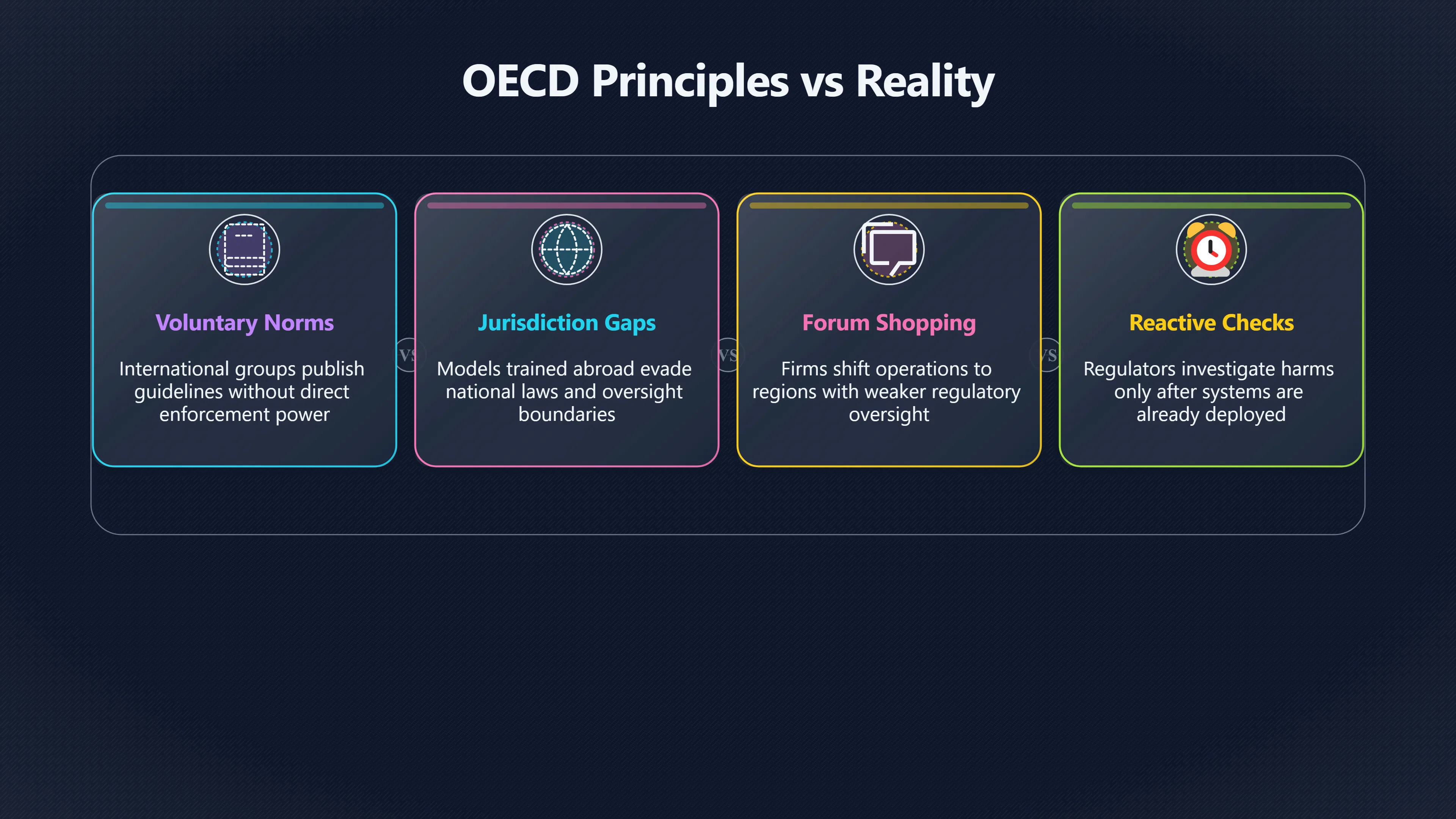
International agreements are influential but mostly voluntary
International organisations have developed extensive AI governance principles. The OECD AI Principles and UNESCO Recommendation on the Ethics of Artificial Intelligence are among the most influential examples. Both emphasise accountability, transparency, human oversight and risk management. [OECD]oecd.orggoverning with artificial intelligence 795de142 enGoverning with Artificial IntelligenceSep 18, 2025 — While national AI strategies are becoming more common, a lack of concrete guidance h… [UNESCO]unesco.orgEthics of Artificial IntelligenceAIHuman Oversight and Determination. Member States should ensure that AI systems do not displace ultimate human responsibility and accoun…
However, these frameworks largely depend on voluntary implementation by member states. They provide norms, guidance and coordination mechanisms rather than direct enforcement powers.
This creates a familiar pattern in global governance. Broad agreement often exists around high-level values, but much weaker agreement exists around inspections, sanctions, monitoring requirements or restrictions on strategic technologies.
For readers interested in AI doom debates, this distinction matters because existential-risk arguments typically concern low-probability but extremely high-consequence failures. Such risks may require stronger verification and enforcement systems than those traditionally used for ethical guidelines.
Consensus on principles does not mean consensus on action
Reviews of global AI governance frameworks have identified substantial convergence around concepts such as fairness, accountability and transparency. Yet agreement becomes weaker when translating principles into operational requirements. [arXiv]arxiv.orgarXivGoverning frontier general-purpose AI in the public sector: adaptive risk management and policy capacity under uncertainty through 2…
Questions that remain contested include:
- What capabilities should trigger mandatory safety evaluations?
- Who should have access to model internals?
- When should deployment be delayed?
- How should dangerous capability thresholds be defined?
- Which institutions should oversee frontier systems?
Without answers to these questions, accountability mechanisms can remain largely aspirational.
Reactive oversight often arrives after deployment
Most governance systems investigate incidents rather than prevent them
Many regulatory models are designed around visible harms. Authorities investigate complaints, examine incidents and impose penalties after problems occur.
That approach is often adequate for consumer protection or ordinary product regulation. It is less reassuring for risks that could scale rapidly or produce irreversible consequences.
Several governance researchers argue that frontier AI requires continuous monitoring rather than episodic review. Agentic systems, in particular, may challenge oversight structures that depend on periodic compliance checks instead of ongoing supervision. [arXiv]arxiv.orgarXivGoverning frontier general-purpose AI in the public sector: adaptive risk management and policy capacity under uncertainty through 2…
From an existential-risk perspective, the concern is straightforward: if catastrophic failures emerge faster than institutions can respond, post-hoc accountability may provide little protection.
Incident reporting remains incomplete
Another obstacle is the limited visibility regulators have into near misses and safety failures.
Aviation, nuclear power and some areas of medicine rely heavily on incident reporting systems that allow institutions to learn from failures before disasters occur. AI governance lacks similarly mature infrastructure in many jurisdictions.
The OECD has repeatedly emphasised the need for better tracking of AI incidents and stronger evidence bases for governance decisions. [OECD]oecd.orgOECDArtificial intelligenceTrustworthy AI calls for governments worldwide to develop interoperable risk-based approaches to AI governance…
Without systematic reporting, regulators may underestimate risks, fail to identify dangerous patterns or learn about problems only after public exposure.
The unresolved question: who is accountable when advanced AI causes harm?
The deepest accountability problem may be conceptual rather than legal.
Traditional regulatory systems assume that responsibility can be assigned to identifiable actors: manufacturers, operators, executives or institutions. Advanced AI systems complicate that assumption. Decisions emerge from interactions among developers, model providers, downstream deployers, users and automated processes.
As systems become more autonomous, responsibility can become increasingly diffuse. Companies may blame users, deployers may blame model providers and governments may struggle to establish causation.
For ordinary AI failures, this can already create practical enforcement difficulties. For scenarios discussed in AI doom debates—such as large-scale loss of control, dangerous autonomous behaviour or globally consequential misuse—the challenge becomes even sharper. Accountability systems built for conventional software may struggle to identify responsibility quickly enough, or clearly enough, to prevent escalation.
This is why many AI safety advocates increasingly focus not only on better rules, but on stronger institutions: specialist regulators, independent evaluation bodies, international monitoring arrangements, compute oversight mechanisms and incident-reporting systems capable of operating before catastrophic failures occur. The core concern is not merely that AI laws are incomplete. It is that existing enforcement structures may be too fragmented, too slow and too weakly coordinated to govern highly capable systems whose risks could cross borders far faster than regulatory responses.
Amazon book picks
Further Reading
Books and field guides related to Why AI Laws Fail to Enforce Safety Globally. Use these as the next step if you want deeper reading beyond the article.
Human Compatible
Explores why governance and oversight matter for controlling advanced AI systems.
The Oxford Handbook of AI Governance
Covers institutional capacity, regulation, and enforcement mechanisms.
The Alignment Problem
Examines practical difficulties translating AI principles into real-world outcomes.
The Coming Wave
Directly addresses global governance capacity and enforcement limits for powerful technologies.
eBay marketplace picks
Marketplace Samples
Example marketplace items related to this page. Use the search link to explore similar finds on eBay.








Endnotes
-
Source: oecd.ai
Link: https://oecd.ai/en/catalogue/tools/a-governance-framework-for-algorithmic-accountability-and-transparencySource snippet
A governance framework for algorithmic accountability and...May 22, 2023 — The study develops policy options for the governance of algor...
Published: May 22, 2023
-
Source: oecd.org
Link: https://www.oecd.org/en/topics/sub-issues/ai-principles.htmlSource snippet
OECDAI principlesThe OECD AI Principles are the first intergovernmental standard on AI. They promote innovative, trustworthy AI that resp...
-
Source: unesco.org
Title: Ethics of Artificial Intelligence
Link: https://www.unesco.org/en/artificial-intelligence/recommendation-ethicsSource snippet
AIHuman Oversight and Determination. Member States should ensure that AI systems do not displace ultimate human responsibility and accoun...
-
Source: arxiv.org
Link: https://arxiv.org/abs/2604.06215Source snippet
arXivGoverning frontier general-purpose AI in the public sector: adaptive risk management and policy capacity under uncertainty through 2...
-
Source: oecd.org
Title: governing with artificial intelligence 795de142 en
Link: https://www.oecd.org/en/publications/governing-with-artificial-intelligence_795de142-en.htmlSource snippet
Governing with Artificial IntelligenceSep 18, 2025 — While national AI strategies are becoming more common, a lack of concrete guidance h...
-
Source: sciencedirect.com
Link: https://www.sciencedirect.com/org/science/article/pii/S2334452026000044Source snippet
ScienceDirectAI Governance Capacity in Public Administration:by MG Özsavaş · 2026 — This study compares artificial intelligence (AI) gove...
-
Source: arxiv.org
Link: https://arxiv.org/abs/2206.04737Source snippet
arXivOutsider Oversight: Designing a Third Party Audit Ecosystem for AI GovernanceJune 9, 2022...
Published: June 9, 2022
-
Source: committees.parliament.uk
Link: https://committees.parliament.uk/writtenevidence/147589/pdf/Source snippet
UK Parliament Committeeswritten evidence submitted by institute for strategic ai...2 Aug 2025 — Jurisdictional Complexity Challenge: Cro...
-
Source: arxiv.org
Link: https://arxiv.org/abs/2206.11922Source snippet
arXivWorldwide AI Ethics: a review of 200 guidelines and recommendations for AI governanceJune 23, 2022...
Published: June 23, 2022
-
Source: arxiv.org
Title: arXiv Oversight Structures for Agentic AI in Public-Sector Organizations
Link: https://arxiv.org/abs/2506.04836Source snippet
arXivOversight Structures for Agentic AI in Public-Sector OrganizationsJune 5, 2025...
Published: June 5, 2025
-
Source: oecd.org
Link: https://www.oecd.org/en/topics/artificial-intelligence.htmlSource snippet
OECDArtificial intelligenceTrustworthy AI calls for governments worldwide to develop interoperable risk-based approaches to AI governance...
-
Source: oecd.ai
Link: https://oecd.ai/en/site/risk-accountabilitySource snippet
Risk & Accountability OverviewThe Expert Group on Risk and Accountability explores interoperability and policy coherence among leading ri...
-
Source: oecd.ai
Link: https://oecd.ai/Source snippet
The OECD Artificial Intelligence Policy Observatory - OECD.AIAI regulatory sandboxes in AI governance: benefits, design, global examples...
-
Source: oecd.ai
Title: Algorithmic Accountability for the Public Sector
Link: https://oecd.ai/en/catalogue/tools/algorithmic-accountability-for-the-public-sectorSource snippet
May 22, 2023 — This report presents evidence on the use of algorithmic accountability policies in different contexts from the perspective...
Published: May 22, 2023
-
Source: oecd.ai
Link: https://oecd.ai/en/gov/issues/justiceSource snippet
AI in Government: Issues > JusticeAI is reshaping how justice systems operate — offering new ways to improve efficiency, accessibility an...
-
Source: unesco.org
Link: https://www.unesco.org/enSource snippet
UNESCO: Building Peace through Education, Science and...UNESCO supports communities affected by conflict and natural disasters, ensurin...
-
Source: unesco.org
Link: https://www.unesco.org/ethics-ai/en/malaysiaSource snippet
Anchored in UNESCO's AI Ethics Recommendation, Malaysia has established a comprehensive, multi-stakeholder...Read more...
-
Source: oecd.org
Link: https://www.oecd.org/en/topics/ai-principles.htmlSource snippet
AI principlesThe OECD AI Principles are the first intergovernmental standard on AI. They promote innovative, trustworthy AI that respects...
-
Source: oecd.org
Link: https://www.oecd.org/content/dam/oecd/en/publications/reports/2026/02/oecd-ai-observatory-index_8f5fa0f2/32c01014-en.pdfSource snippet
tional comparison, and guide future...Read more...
-
Source: oecd.org
Title: governing with artificial intelligence 398fa287
Link: https://www.oecd.org/en/publications/2025/06/governing-with-artificial-intelligence_398fa287.htmlSource snippet
Governing with Artificial IntelligenceSep 18, 2025 — The report finds that 57% of cases support automating, streamlining or tailoring ser...
-
Source: digital-strategy.ec.europa.eu
Title: Digital Strategy Europe AI Act | Shaping Europe’s digital future
Link: https://digital-strategy.ec.europa.eu/en/policies/regulatory-framework-aiSource snippet
Digital Strategy EuropeAI Act | Shaping Europe's digital future - European UnionThe AI Act (Regulation (EU) 2024/1689 laying down harmoni...
-
Source: verifywise.ai
Title: Verify Wise OECD AI Principles explained
Link: https://verifywise.ai/ai-governance-library/governance-frameworks/oecd-ai-principlesSource snippet
OECD AI Principles explained - Governance frameworksEthics and compliance teams building internal AI review processes - the principles of...
-
Source: artificialintelligenceact.eu
Link: https://artificialintelligenceact.eu/high-level-summary/Source snippet
summary of the AI ActThis page aims to provide an overview of the EU AI Act's enforcement provisions relating to Chapter V, namely the pr...
-
Source: academy.evalcommunity.com
Title: key oecd ai governance initiatives
Link: https://academy.evalcommunity.com/key-oecd-ai-governance-initiatives/Source snippet
OECD AI governance initiativesFeb 16, 2026 — It produces practical guidance on risk management, public-sector AI, and accountability—incr...
-
Source: academy.evalcommunity.com
Title: unesco recommendation on ai ethics
Link: https://academy.evalcommunity.com/unesco-recommendation-on-ai-ethics/Source snippet
Recommendation on AI Ethics16 Dec 2025 — The UNESCO Recommendation on the Ethics of AI is the first global standard-setting instrument fo...
-
Source: academy.evalcommunity.com
Title: oecd ai principles
Link: https://academy.evalcommunity.com/oecd-ai-principles/Source snippet
AI PrinciplesDec 17, 2025 — AI governance frameworks should be flexible, risk-based, and interoperable across borders. This approach redu...
-
Source: aicc.co
Link: https://www.aicc.co/responsible-ai-hub/keep-up-to-date-with-responsible-ai/blog-posts/unescos-recommendation-on-ethics-of-ai-why-it-matters-for-northern-irelandSource snippet
UNESCO's Recommendation on Ethics of AIHuman Rights and Dignity: AI must respect foundation rights and freedoms, including privacy, equal...
-
Source: digital-skills-jobs.europa.eu
Link: https://digital-skills-jobs.europa.eu/en/latest/news/unesco-launches-global-ai-ethics-and-governance-observatory-2024-global-forum-ethicsSource snippet
launches Global AI Ethics and Governance...27 Jul 2024 — At its core, the Global AI Ethics and Governance Observatory aims to provide a...
-
Source: verifywise.ai
Link: https://verifywise.ai/ai-governance-library/international-and-multilateral/unesco-recommendation-on-the-ethics-of-artificial-intelligenSource snippet
UNESCO Recommendation on the Ethics of Artificial...The UNESCO Recommendation on the Ethics of Artificial Intelligence stands as the fir...
-
Source: unesco.org.uk
Link: https://unesco.org.uk/Source snippet
UNESCO in the UK | Building lasting peace through education...UNESCO Sites in the United Kingdom and its Overseas Territories and Crown...
-
Source: linkedin.com
Link: https://www.linkedin.com/posts/oecd-ai_oecd-aistandards-trustworthyai-activity-7437476528583733249-OVt4Source snippet
OECD.AI's Post... AI governance is no longer only a policy challenge. It is now an institutional readiness challenge. Across many regulat...
-
Source: linkedin.com
Title: UNESCOUNESC O
Link: https://www.linkedin.com/company/unescoSource snippet
UNESCOUNESCO - the United Nations Educational, Scientific and Cultural Organization (UNESCO) was founded on 16 November 1945.Read more...
Published: November 1945
-
Source: facebook.com
Link: https://www.facebook.com/unesco/Source snippet
unescoUNESCO supports effective literacy practices and promotes dynamic literate societies worldwide. Through its International Literacy...
-
Source: x.com
Link: https://x.com/UNESCOSource snippet
UNESCO 🏛️ #Education #Sciences #CultureUNESCO-designated sites provide a haven for more than 20,000 threatened species. From #WorldHerita...
-
Source: blog.exceeds.ai
Title: oecd ai principles guide governance
Link: https://blog.exceeds.ai/oecd-ai-principles-guide-governance/Source snippet
OECD AI Principles Guide AI Governance in 202616 Feb 2026 — The framework covers five value-based principles, which include inclusive gro...
-
Source: unesco.org.nz
Title: ethics of artificial intelligence recommendation
Link: https://unesco.org.nz/knowledge-hub/ethics-of-artificial-intelligence-recommendationSource snippet
26 Sept 2023 — In 2021 UNESCO produced the first-ever global standard on AI ethics – the 'Recommendation on the Ethics of Artificial Inte...
Additional References
-
Source: digitallibrary.un.org
Link: https://digitallibrary.un.org/record/4062376?ln=enSource snippet
Digital LibraryRecommendation on the ethics of artificial intelligenceThe protection of human rights and dignity is the cornerstone of th...
-
Source: twobirds.com
Link: https://www.twobirds.com/en/capabilities/artificial-intelligence/ai-legal-services/navigating-ai-governance-across-the-globeSource snippet
Navigating AI governance across the globeAs a result, AI compliance in the EU requires navigating a multi-layered framework that integrat...
-
Source: bsg.ox.ac.uk
Link: https://www.bsg.ox.ac.uk/blog/ai-acts-enforcement-gap-what-polands-new-regulator-reveals-about-europes-challengeSource snippet
AI Act's enforcement gap: what Poland's new regulator...24 Mar 2026 — The AI Act leaves Member States free to design their own national...
-
Source: waccglobal.org
Link: https://waccglobal.org/ten-core-principles-in-a-human-rights-centred-approach-to-the-ethics-of-ai/Source snippet
There should be oversight, impact assessment, audit and due diligence mechanisms in place to avoid conflicts with...Read more...
-
Source: academy.evalcommunity.com
Title: how do oecd ai principles support monitoring and evaluation me
Link: https://academy.evalcommunity.com/how-do-oecd-ai-principles-support-monitoring-and-evaluation-me/Source snippet
AI Principles in Monitoring and EvaluationFeb 16, 2026 — The OECD AI Principles support monitoring and evaluation (M&E) by establishing g...
-
Source: diplomacy.edu
Title: The gap between AI rules and AI reality
Link: https://www.diplomacy.edu/blog/the-gap-between-ai-rules-and-ai-reality/Source snippet
Diplo14 Apr 2026 — An analysis of why the EU AI Act's high-risk obligations are delayed by 16 months and how US federal intervention is d...
-
Source: bisi.org.uk
Title: global fragmentation of ai governance
Link: https://bisi.org.uk/reports/global-fragmentation-of-ai-governanceSource snippet
and Regulation30 Jan 2026 — Global AI governance has fragmented into competing regulatory philosophies, with the European Union (EU) enfo...
-
Source: jdsupra.com
Title: A I Watch: Global regulatory tracker
Link: https://www.jdsupra.com/legalnews/ai-watch-global-regulatory-tracker-oecd-2883883/Source snippet
AI Watch: Global regulatory tracker - OECD: The...May 11, 2026 — The OECD's AI Regulations intend to help shape a stable policy environ...
Published: May 11, 2026
-
Source: whitecase.com
Title: A I Watch: Global regulatory tracker
Link: https://www.whitecase.com/insight-our-thinking/ai-watch-global-regulatory-tracker-oecdSource snippet
AI Watch: Global regulatory tracker - OECDThe OECD's Expert Group on AI Futures explores potential AI impacts, guiding policymakers on cr...
-
Source: digital-strategy.ec.europa.eu
Title: ethics guidelines trustworthy ai
Link: https://digital-strategy.ec.europa.eu/en/library/ethics-guidelines-trustworthy-aiSource snippet
guidelines for trustworthy AI8 Apr 2019 — Human agency and oversight: AI systems should empower human beings, allowing them to make infor...
Topic Tree