Within Compute brakes
Why AI cannot instantly build more chips
Semiconductor fabs, memory supply and advanced packaging could limit how quickly compute expands.
On this page
- Why advanced semiconductor fabs are hard to scale
- Memory, packaging and networking shortages
- Could AI help remove its own hardware bottlenecks?
Page outline Jump by section
Introduction
One of the most important objections to rapid AI doom scenarios is that intelligence is not the same thing as manufacturing capacity. Even if an advanced AI became dramatically better at software engineering, machine learning research, or chip design, it would still depend on a physical industry that expands over years rather than days. Modern AI systems run on specialised chips produced through some of the most complex manufacturing processes ever developed.
 This matters for debates about recursive self-improvement and intelligence explosions. In the strongest versions of those scenarios, AI systems improve themselves, use those improvements to become even more capable, and repeat the cycle at increasing speed. Critics argue that this picture overlooks semiconductor realities. New fabs take years to build, critical manufacturing equipment comes from a small number of suppliers, advanced packaging capacity is limited, and shortages of memory and networking components can restrict deployment even when chip designs are available. The result is a potential brake on runaway growth: an AI may be able to design better hardware faster than humanity can manufacture it. [arXiv]arxiv.orgarXiv Will Compute Bottlenecks Prevent an Intelligence Explosion?arXivWill Compute Bottlenecks Prevent an Intelligence Explosion?July 31, 2025…
Why advanced semiconductor fabs are hard to scale
The modern AI industry depends on a remarkably concentrated supply chain. Leading-edge AI accelerators are manufactured using processes available from only a handful of firms, with the most advanced production concentrated in a small number of facilities.
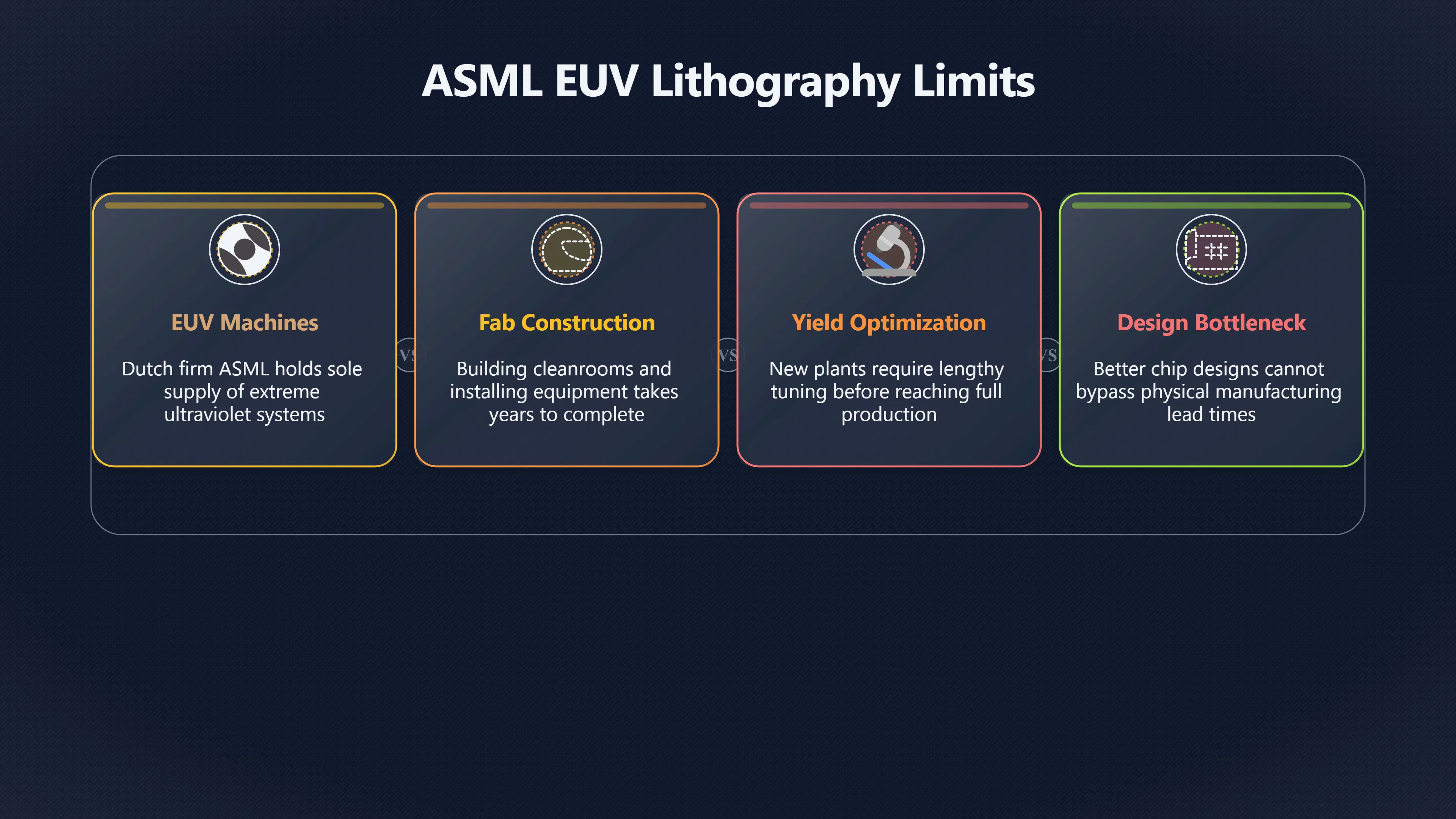
Building a cutting-edge semiconductor fabrication plant is not comparable to opening a new software company or adding more cloud servers. Advanced fabs require specialised buildings, ultra-clean environments, thousands of highly trained engineers, and vast amounts of capital. Construction and equipment installation often take years before commercial production begins. Even after a fab opens, yields and reliability must be improved through lengthy optimisation. This means that additional chip capacity cannot appear overnight in response to demand. [VaaSBlock]vaasblock.comVaaSBlockThe AI Compute Race Has Exposed the Semiconductor…Yesterday — 1 day ago — At 3 nanometre and 2 nanometre nodes — where the mo…
A particularly important bottleneck is lithography equipment. Advanced AI chips depend on extreme ultraviolet (EUV) lithography systems. The Dutch company ASML is effectively the sole supplier of these machines, and production of the machines themselves is constrained. As a result, the rate at which leading-edge chip capacity can expand is partly determined by how many lithography systems can be manufactured and delivered each year. [Enverus]enverus.comEnverusAI's Future: ASML EUV Lithography ChallengesLearn how ASML EUV lithography shapes the AI boom, constraining chip production while… [ASML]asml.comASML | The world's supplier to the semiconductor industryASML gives the world's leading chipmakers the power to mass produce patterns on…
For AI doom debates, the implication is straightforward. An AI system may discover a superior chip architecture, but translating that design into millions of physical chips still requires access to scarce fabrication capacity and specialised equipment. Intelligence alone does not instantly create manufacturing throughput.
Physical production follows industrial timelines
Supporters of fast-takeoff scenarios sometimes argue that sufficiently advanced AI could automate large portions of engineering and industrial planning. That could certainly help. However, automation does not eliminate physical lead times.
Factories need land, permits, construction materials, power connections, water infrastructure, specialised machinery, trained operators, and global supply chains. Many of these constraints remain stubbornly physical even if the design work becomes highly automated.
This distinction is important. Recursive software improvement could, in principle, happen very quickly. Recursive hardware expansion is constrained by industrial processes operating on timescales measured in months and years. Even a highly capable AI cannot instantly manufacture additional cleanrooms, photolithography systems, or semiconductor-grade supply chains.
Memory, packaging and networking shortages
A common mistake is to think of AI hardware bottlenecks as being purely about the main processor chip. In practice, modern AI systems depend on several tightly linked technologies, and shortages in any one of them can restrict growth.
In recent years, some of the most important constraints have not been logic chips themselves but advanced packaging and high-bandwidth memory (HBM). Advanced AI accelerators rely on extremely fast memory placed physically close to the compute chip. The memory and processor must be integrated through sophisticated packaging technologies that are far more complex than traditional semiconductor assembly. [Epoch AI]epoch.aiintroducing the ai chip components explorerAI Chip Supply Chain Bottlenecks and Capacity8 May 2026 — Advanced packaging constrained AI chip production in late 2024, followed by HBM…
Industry analysts and semiconductor researchers have repeatedly identified advanced packaging technologies such as CoWoS (Chip-on-Wafer-on-Substrate) as major constraints on AI hardware production. Even when chip wafers are available, packaging capacity can determine how many finished accelerators reach customers. [Epoch AI]epoch.aiintroducing the ai chip components explorerAI Chip Supply Chain Bottlenecks and Capacity8 May 2026 — Advanced packaging constrained AI chip production in late 2024, followed by HBM… [Medium Similarly]medium.comSemiconductors in 2026: The AI‑Driven Upswing Meets…However, this AI boom has strained supply chains: production of advanced AI GPUs i…, high-bandwidth memory has become a strategic bottleneck. AI accelerators require enormous memory bandwidth, and only a few manufacturers produce advanced HBM at scale. The industry’s rush to expand HBM production illustrates how growth can be limited by components other than the main processor. Reuters [Tom's Hardware]tomshardware.comThe agreement spans through December 2027 and is expected to secure up to 30 EUV machines, which will be used to expand SK hynix's capabi…
The practical consequence is that increasing AI compute is not a single problem but a chain of problems:
- Leading-edge wafer fabrication. [* Advanced memory production.]epoch.aiintroducing the ai chip components explorerAI Chip Supply Chain Bottlenecks and Capacity8 May 2026 — Advanced packaging constrained AI chip production in late 2024, followed by HBM… [* Packaging and chip integration.]epoch.aiintroducing the ai chip components explorerAI Chip Supply Chain Bottlenecks and Capacity8 May 2026 — Advanced packaging constrained AI chip production in late 2024, followed by HBM…
- High-speed networking equipment.
- Data-centre deployment.
The overall growth rate is often determined by whichever link in the chain is hardest to expand.

Why bottlenecks move rather than disappear
An important pattern in semiconductor history is that solving one constraint often exposes another.
When chip fabrication capacity expands, memory may become the limiting factor. When memory production increases, advanced packaging may become the bottleneck. When packaging catches up, power delivery or cooling infrastructure may become the next constraint. Recent industry analysis has documented exactly this pattern, with bottlenecks shifting from packaging to memory and increasingly toward energy efficiency and system integration. [Epoch AI]epoch.aiintroducing the ai chip components explorerAI Chip Supply Chain Bottlenecks and Capacity8 May 2026 — Advanced packaging constrained AI chip production in late 2024, followed by HBM… Reuters This does not mean AI growth stops. It means growth may be governed by industrial scaling dynamics rather than purely by software progress. [reuters.com]reuters.comThe company, which supplies critical tools for manufacturing advanced chips used by TSMC and Intel, has invested billions in EUV systems…
Could AI help remove its own hardware bottlenecks?
The strongest counterargument is that sufficiently capable AI might accelerate semiconductor development itself.
An advanced AI could potentially:
- Design more efficient chips. [medium.com]medium.comHBM: What It Is and Why It Matters in the Modern World of AIHBM's high bandwidth allows for quicker data feeding into the processing unit…
- Improve manufacturing processes.
- Optimise factory operations.
- Accelerate materials discovery.
- Improve supply-chain planning. [epoch.ai]epoch.aiintroducing the ai chip components explorerAI Chip Supply Chain Bottlenecks and Capacity8 May 2026 — Advanced packaging constrained AI chip production in late 2024, followed by HBM…
- Reduce engineering labour requirements.
If successful, these improvements could increase the rate at which hardware capacity grows. AI-assisted design is already being explored throughout the semiconductor industry. Some observers therefore argue that hardware constraints may weaken as AI systems become better engineering tools. [Reuters]reuters.comThe company, which supplies critical tools for manufacturing advanced chips used by TSMC and Intel, has invested billions in EUV systems…
However, removing a bottleneck is not the same as eliminating it.
Even dramatic improvements in chip design still require physical implementation. Better manufacturing software does not instantly create additional lithography machines. Improved factory scheduling does not eliminate construction timelines. Faster design cycles help, but they do not repeal the realities of industrial production.
This is why many analysts distinguish between accelerating growth and unconstrained growth. AI could substantially speed semiconductor development while still remaining limited by physical manufacturing capacity.
Hardware and software may improve together
Another possibility is that AI capabilities grow through a combination of software and hardware advances rather than a pure intelligence explosion.
In this view, recursive improvement resembles an industrial feedback loop. Better AI systems help produce better chips, which enable better AI systems, which help improve manufacturing further. Growth could still be extremely fast by historical standards, but it would remain tied to the speed at which physical infrastructure expands.
This scenario is compatible with significant AI risk. A system does not need infinite or instantly expanding compute to become dangerous. The question is whether hardware constraints merely slow capability growth or fundamentally prevent runaway self-improvement. That remains an open dispute within AI-risk discussions. [arXiv]arxiv.orgarXiv Will Compute Bottlenecks Prevent an Intelligence Explosion?arXivWill Compute Bottlenecks Prevent an Intelligence Explosion?July 31, 2025…
What this means for intelligence-explosion scenarios
For people concerned about AI doom, semiconductor bottlenecks are neither a complete solution nor an irrelevant detail.
The strongest case that chip manufacturing limits recursive AI growth rests on three observations:
- Advanced semiconductor production is extraordinarily difficult to expand quickly.
- Key technologies such as EUV lithography, HBM memory, and advanced packaging are concentrated in a small number of suppliers.
- Physical infrastructure scales much more slowly than software.
These factors create friction that pure software models of recursive self-improvement can underestimate. An AI may discover new ideas at digital speed, but implementing those ideas in the physical world requires factories, equipment, materials, energy, and time. [Enverus]enverus.comEnverusAI's Future: ASML EUV Lithography ChallengesLearn how ASML EUV lithography shapes the AI boom, constraining chip production while… [VaaSBlock At the same time]vaasblock.comVaaSBlockThe AI Compute Race Has Exposed the Semiconductor…Yesterday — 1 day ago — At 3 nanometre and 2 nanometre nodes — where the mo…, hardware constraints should not be confused with safety guarantees. AI systems could become highly capable long before manufacturing limits are reached, and AI-assisted engineering may gradually loosen some of today’s bottlenecks. The central question is therefore not whether chip manufacturing matters—it clearly does—but whether the pace of semiconductor expansion is slow enough to give humans meaningful time to detect warning signs, improve alignment techniques, and maintain control as AI capabilities continue to advance. [arXiv]arxiv.orgarXiv Will Compute Bottlenecks Prevent an Intelligence Explosion?arXivWill Compute Bottlenecks Prevent an Intelligence Explosion?July 31, 2025… [Epoch AI]epoch.aiintroducing the ai chip components explorerAI Chip Supply Chain Bottlenecks and Capacity8 May 2026 — Advanced packaging constrained AI chip production in late 2024, followed by HBM…

eBay marketplace picks
Marketplace Samples
Example marketplace items related to this page. Use the search link to explore similar finds on eBay.








Endnotes
-
Source: arxiv.org
Title: arXiv Will Compute Bottlenecks Prevent an Intelligence Explosion?
Link: https://arxiv.org/abs/2507.23181Source snippet
arXivWill Compute Bottlenecks Prevent an Intelligence Explosion?July 31, 2025...
Published: July 31, 2025
-
Source: enverus.com
Link: https://www.enverus.com/blog/scarce-machines-infinite-demand-asml-and-the-limits-of-the-ai-buildout-report/Source snippet
EnverusAI's Future: ASML EUV Lithography ChallengesLearn how ASML EUV lithography shapes the AI boom, constraining chip production while...
-
Source: vaasblock.com
Link: https://www.vaasblock.com/news/semiconductor-supply-chain-tsmc-chips-act-ai-demand-2026/Source snippet
VaaSBlockThe AI Compute Race Has Exposed the Semiconductor...Yesterday — 1 day ago — At 3 nanometre and 2 nanometre nodes — where the mo...
-
Source: asml.com
Link: https://www.asml.com/Source snippet
ASML | The world's supplier to the semiconductor industryASML gives the world's leading chipmakers the power to mass produce patterns on...
-
Source: reuters.com
Link: https://www.reuters.com/world/asia-pacific/asml-plots-future-chipmaking-tools-ai-beyond-euv-2026-03-02/Source snippet
The company, which supplies critical tools for manufacturing advanced chips used by TSMC and Intel, has invested billions in EUV systems...
-
Source: epoch.ai
Title: introducing the ai chip components explorer
Link: https://epoch.ai/latest/introducing-the-ai-chip-components-explorerSource snippet
AI Chip Supply Chain Bottlenecks and Capacity8 May 2026 — Advanced packaging constrained AI chip production in late 2024, followed by HBM...
Published: May 2026
-
Source: medium.com
Link: https://medium.com/%40adnanmasood/semiconductors-in-2026-the-ai-driven-upswing-meets-structural-bottlenecks-3568b004905bSource snippet
Semiconductors in 2026: The AI‑Driven Upswing Meets...However, this AI boom has strained supply chains: production of advanced AI GPUs i...
-
Source: reuters.com
Link: https://www.reuters.com/world/asia-pacific/samsung-electronics-ships-hbm4e-chip-samples-global-customers-2026-05-28/Source snippet
These chips, over 20% faster than their predecessors, utilize Samsung’s latest 1c DRAM process and 4-nanometer foundry logic base die. Th...
-
Source: reuters.com
Link: https://www.reuters.com/business/retail-consumer/energy-use-forcing-rethink-ai-chip-design-tsmc-says-2026-05-28/Source snippet
Kevin Zhang, TSMC’s Senior VP of Business Development, noted that customers — including those in mobile, IoT, and high-performance AI dat...
-
Source: medium.com
Link: https://medium.com/%40Elongated_musk/cowos-not-hbm-is-the-real-ai-supply-bottleneck-d0ae8f3f7ce4Source snippet
CoWoS, Not HBM, Is the Real AI Supply BottleneckCoWoS solves the physical problem that modern AI accelerators create: the compute die mus...
-
Source: medium.com
Link: https://medium.com/%40theserverguru42/hbm-what-it-is-and-why-it-matters-in-the-modern-world-of-ai-2bc31effc81aSource snippet
HBM: What It Is and Why It Matters in the Modern World of AIHBM's high bandwidth allows for quicker data feeding into the processing unit...
-
Source: midasanalytics.ai
Link: https://midasanalytics.ai/market-pulse/ai-expansion-bottleneck-semiconductor-supply-chain-not-just-chips-299Source snippet
AI Expansion Bottleneck: Semiconductor Supply Chain...17 Mar 2026 — ASML, the Dutch manufacturer of EUV (extreme ultraviolet) lithograph...
-
Source: hbm.com
Link: https://www.hbm.com/en/2166/solutions/Source snippet
HBMSince 1950, HBM (renamed HBK in 2020) has been a leader in precise and reliable test and measurement products. With branches in 30 cou...
-
Source: tomshardware.com
Link: https://www.tomshardware.com/tech-industry/semiconductors/sk-hynix-places-record-8-billion-order-for-asml-euv-lithography-machinesSource snippet
The agreement spans through December 2027 and is expected to secure up to 30 EUV machines, which will be used to expand SK hynix's capabi...
Published: December 2027
-
Source: uk.finance.yahoo.com
Link: https://uk.finance.yahoo.com/quote/HBM/Source snippet
(HBM) stock price, news, quote and...Hudbay Minerals Inc., a diversified mining company, focuses on the exploration, development, operat...
Additional References
-
Source: instagram.com
Link: https://www.instagram.com/p/DYwDRgqukA-/Source snippet
A $400 million machine is about to change chip...EUV machines use extremely short wavelengths of light to print incredibly small transis...
-
Source: linkedin.com
Link: https://www.linkedin.com/posts/robertquinn2020_semiconductor-aiinfrastructure-supplychain-activity-7434387073744125952-eEyySource snippet
ASML's Lithography & Packaging Dominance in AIBy combining EUV dominance with next-generation packaging, ASML is shaping how AI chips are...
-
Source: instagram.com
Link: https://www.instagram.com/reel/DW4foCYCENP/?hl=enSource snippet
CNBC on Instagram: "An underappreciated step in the...AI models require advanced semiconductors produced exclusively through layers like...
-
Source: micron.com
Link: https://www.micron.com/products/memory/hbmSource snippet
Micron TechnologyHigh-bandwidth memory (HBM)Explore Micron's portfolio of high-bandwidth memory (HBM) products designed to accelerate nex...
-
Source: markets.financialcontent.com
Link: https://markets.financialcontent.com/stocks/article/tokenring-2025-11-7-the-indispensable-core-why-tsmc-alone-powers-the-next-wave-of-ai-innovationSource snippet
TSMC Alone Powers the Next Wave of AI Innovation7 Nov 2025 — The company is also proactively utilizing AI to design more energy-efficient...
-
Source: linkedin.com
Link: https://www.linkedin.com/posts/ali-kamaly_semiconductors-asml-euv-activity-7431721042160672769-u8iM -
Source: reddit.com
Link: https://www.reddit.com/r/slatestarcodex/comments/1rtavgc/an_ai_skeptics_case_for_recursive_selfimprovement/ -
Source: linkedin.com
Link: https://www.linkedin.com/posts/erhaneren_most-people-still-think-ai-bottlenecks-are-activity-7427388474426642432-9SDcSource snippet
AI Bottlenecks Shift from GPUs to Memory and PackagingWhat doesn't exist at scale is: - High-Bandwidth Memory - Advanced packaging capaci...
-
Source: info.fusionww.com
Title: inside the ai bottleneck cowos hbm and 2 3nm capacity constraints through 2027
Link: https://info.fusionww.com/blog/inside-the-ai-bottleneck-cowos-hbm-and-2-3nm-capacity-constraints-through-2027Source snippet
Inside the AI Bottleneck: CoWoS, HBM, and 2–3nm...Dec 4, 2025 — Discover why CoWoS packaging, HBM supply, and 3nm wafer capacity are fal...
-
Source: youtube.com
Title: The AI Intelligence Explosion: Why Recursive Self-Improvement Changes Everything
Link: https://www.youtube.com/watch?v=xRQQFCWhobcSource snippet
How AI Is Pushing the Semiconductor Supply Chain to the Limit | Bloomberg Primer explains the physical limitations and structural constra...
Topic Tree