Within Current Benchmarks
Why AI Agents Struggle to Keep Track Over Long Tasks
AI agents often lose track of previous steps, causing failure in extended multi-stage projects.
On this page
- Examples from LongDS Bench showing late stage errors
- Mechanisms behind state loss in multi step tasks
- Implications for autonomous long term planning
Page outline Jump by section
Introduction
When people imagine future autonomous AI systems tackling multi‑stage real‑world projects — writing a book, managing research, or running a business process with minimal supervision — one practical question dominates the empirical debate: can today’s agents keep track of what they’re doing over long sequences of steps? Current research suggests they struggle not because they lack intelligence in individual steps, but because they consistently lose context and memory as tasks unfold. In benchmarks designed to stress these capabilities, performance drops markedly as sessions grow longer and internal state becomes harder to manage. These limitations are central to understanding how far current systems are from robust long‑horizon autonomy — and why many scenarios of future AI risk assume much stronger memory and planning than today’s models actually exhibit. [arXiv]arxiv.orgSource details in endnotes.
Where Context and Memory Break Down in Long Tasks
Research benchmarks created in 2026 reveal a consistent pattern: as a task stretches beyond a dozen or dozens of steps, agents fail not because they cannot reason per step, but because they fail to maintain a coherent evolving state. Two recent pieces of empirical work make this clear:
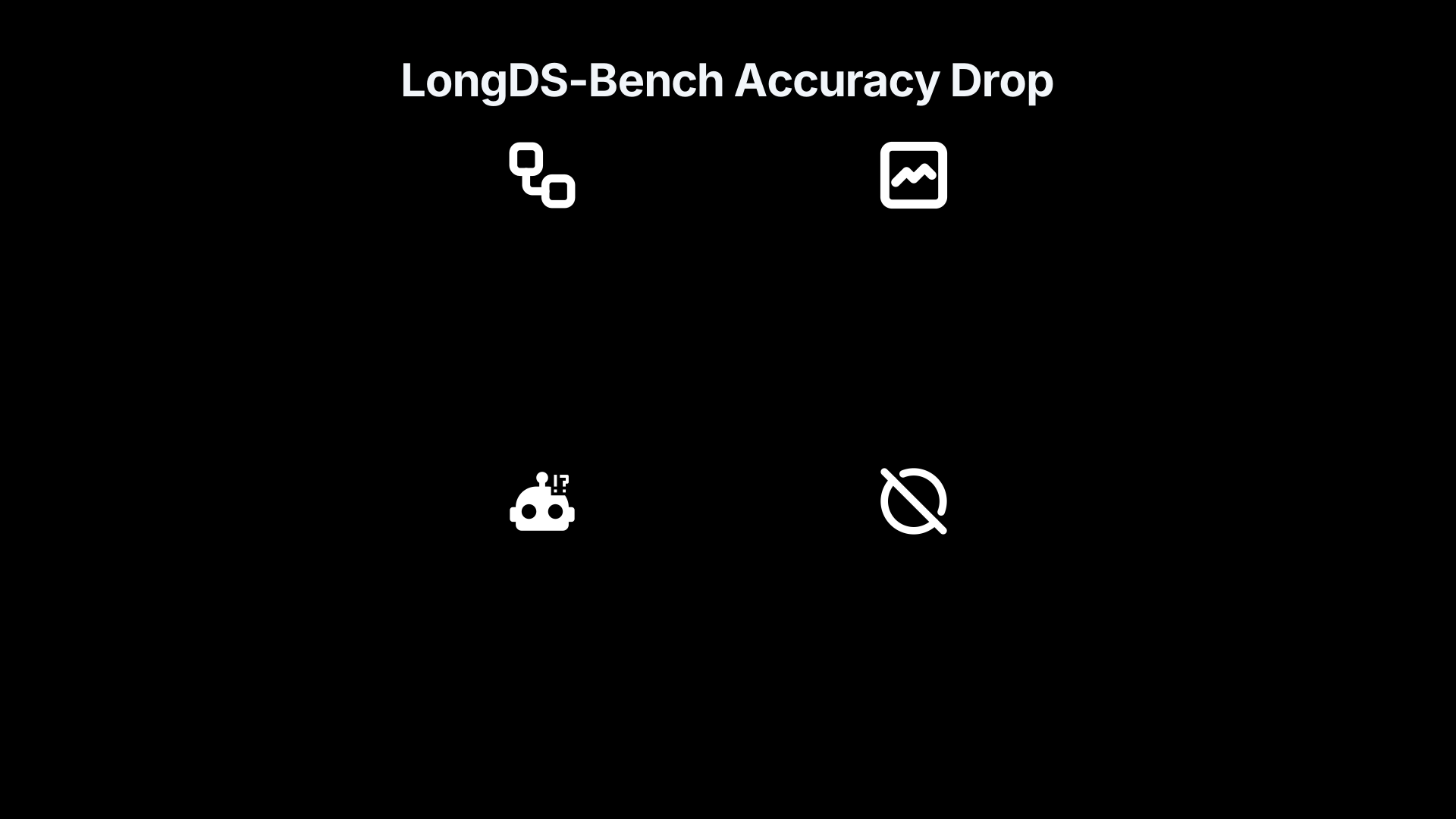
- LongDS‑Bench, a multi‑turn data‑analysis benchmark, shows that even the best current models drop from around ~48 % accuracy early in a workflow to far lower rates later, with long‑horizon errors accounting for the majority of failures. Crucially, adding more agent interaction steps doesn’t improve outcomes if the agent hasn’t maintained an accurate analytical state. [arXiv]arxiv.orgSource details in endnotes.
- LongMINT evaluates memory under repeated updates and interference across evolving contexts. Here, systems — including memory‑augmented frameworks — achieve low average accuracy (~28 %) when tasks demand retrieving and aggregating information spread across huge contexts (up to 1.8 million tokens). Performance deteriorates as intervening updates interfere with earlier facts, not merely because of context window size but because the memory mechanisms themselves struggle to recall and piece together past information properly. [arXiv]arxiv.orgSource details in endnotes.
These empirical results support a broader pattern identified in research and engineering discussions: long tasks expose amplifying state loss and compounding errors, not isolated reasoning errors at single steps.
Mechanisms Behind State Loss and Memory Failures
Understanding why context and memory failures happen requires looking at how current AI agents are built and where their inherent limitations lie:
Limited Context Windows and Decaying Relevance
Most large language models operate with a fixed context window — a sliding window of recent tokens the model “sees” at once. Even engines with very large windows (hundreds of thousands of tokens) accumulate noise as tasks progress:
- Early decisions and constraints become buried under later steps.
- Agents prioritise recent tokens, so old but still relevant information loses weight.
- As intermediate states pile up, models struggle to distinguish durable facts from ephemeral details.
This structural issue isn’t solved merely by expanding the window; it explains why researchers explore state models and memory layers that can summarise or selectively recall past information instead of just accumulating it. [Zylos]zylos.aiGoal Persistence and Goal Drift in Long-Horizon AI Agents | Zylos ResearchZylosGoal Persistence and Goal Drift in Long-Horizon AI Agents | Zylos ResearchApril 3, 2026…
Interference and Multi‑Target Memory Issues
In benchmarks like LongMINT, information updates can interfere with earlier context, leading to:
- “Interference” where later facts disrupt the recall of earlier ones.
- Memory systems that retrieve similar but contextually incorrect information.
- Difficulty in aggregating many relevant pieces across long histories.
This suggests that even advanced memory constructs (retrieval augmented, vector search, compressed storage) struggle when the task demands both deep recall and sophisticated integration over many items. [arXiv]arxiv.orgSource details in endnotes.
Goal Drift and Context Degradation Over Time
Beyond remembering facts, agents also often fail to keep objectives coherent:
- As agents break tasks into subtasks or handle interruptions, their internal representation of the original goal can shift subtly — a phenomenon called goal drift.
- Without a stable anchoring mechanism, the agent’s trajectory gradually changes to optimise for local, recent coherence rather than the overall objective.
- Multi‑session interruptions — common in realistic long‑horizon work — give repeated opportunities for context decay and drift. [Zylos]zylos.aiLong-Horizon Planning and Goal Decomposition in AI Agents | Zylos ResearchZylosLong-Horizon Planning and Goal Decomposition in AI Agents | Zylos ResearchMay 14, 2026…
This isn’t merely about storage — it’s about maintaining semantic meaning over time, which current architectures handle poorly compared to humans or even classical software systems.
Examples from Long‑Horizon Benchmarks
While many benchmarks exist, a few illustrate the scale and nature of these failures:
- LongCLI‑Bench, focused on command‑line programming tasks, reports pass rates below 20 % for agent workflows designed to mirror real engineering tasks. Most agents fail early and never recover, indicating that planning execution and sustained memory are core bottlenecks even in structured workflows. [HyperAI]hyper.aiHyperAILongCLI-Bench: A Preliminary Benchmark and Study for Long-horizon Agentic Programming in Command-Line Interfaces | Papers | HyperAI…
- Other long‑horizon plans — such as simulated research tasks, strategic planning benchmarks, and interactive environment rollouts — consistently show fragmentation of context, contradictory decisions, and stalls where agents cannot reconcile earlier decisions with later requirements. [Hugging Face]huggingface.coHugging Face Paper pageHugging FacePaper page - AgentLongBench: A Controllable Long Benchmark For Long-Contexts Agents via Environment RolloutsJanuary 28, 2026…
These concrete examples underscore a recurrent point: as workload complexity and horizon length increase, small memory or context lapses compound into large failures.
Why These Failures Matter for Risk and Autonomy
Understanding context and memory limitations isn’t an academic quibble — it directly bears on claims about AI autonomy and the potential for loss of control:
- Autonomous, long‑term planning — a common assumption in many future risk scenarios — hinges on stable internal state over extended sequences. If agents cannot maintain context reliably, their real autonomy remains fragile.
- Error accumulation amplifies uncertainty: a single small misremembered step can cascade into fundamentally wrong outcomes, undermining reliability.
- Goal drift challenges alignment. If agents progressively deviate from their original directives without humans noticing, even well‑intentioned long tasks can result in undesired behaviour.
In this sense, context and memory limitations are not minor engineering quirks but central constraints in assessing how far current systems are from genuinely robust long‑horizon autonomy — and how plausible certain speculative risk scenarios are under present technology trends.
What Researchers and Engineers Are Exploring
To overcome these bottlenecks, ongoing work points in several directions:
- Structured memory architectures that segment, summarise and selectively retrieve information more intelligently than raw token windows. [Cool Papers]papers.coolCool PapersStatePlane: A Cognitive State Plane for Long-Horizon AI Systems Under Bounded Context | Cool Papers - Immersive Paper Discover…
- Hierarchical planning and goal decomposition that make tasks into smaller chunks while preserving global alignment, helping mitigate drift. [Zylos]zylos.aiApril 21, 2026 — 2026-04-21 AGENT CONTEXT COMPACTION FOR LONG-RUNNING SESSIONS: TECHNIQUES AND TRADEOFFS ai-agents context-engineering co…
- Verification loops and explicit state tracking, where agents reevaluate earlier decisions or use checkpoints to avoid accumulating silent errors. [Reddit]reddit.comWhy do long-running agents degrade even if memory is well structured?RedditWhy do long-running agents degrade even if memory is well structured?April 7, 2026…
None of these are complete solutions, but they reflect active recognition that context and memory are design constraints, not peripheral details.
Implications for Long‑Horizon Agent Capability
In practical terms, context and memory failures impose a clear horizon beyond which current agents are unreliable without significant architectural support. Tasks that require:
- maintaining an evolving state,
- handling interruptions or multiple sessions,
- integrating new data while preserving old constraints,
- avoiding drift from original intent,
are precisely where agents fail most often today. This suggests that, while individual reasoning steps may be strong, the network of states and goals over time is the true limiting factor for long‑horizon autonomy. [arXiv]arxiv.orgSource details in endnotes.
By concentrating on the mechanisms by which state and memory falter over long sequences, researchers sharpen both empirical understanding and engineering priorities. For those assessing the pace of AI capability — and the distance to genuinely autonomous systems — context and memory limitations remain essential empirical constraints, not merely theoretical footnotes. [arXiv]arxiv.orgSource details in endnotes.
Amazon book picks
Further Reading
Books and field guides related to Why AI Agents Struggle to Keep Track Over Long Tasks. Use these as the next step if you want deeper reading beyond the article.
The Alignment Problem
Explains practical limitations and failures of machine-learning systems.
eBay marketplace picks
Marketplace Samples
Example marketplace items related to this page. Use the search link to explore similar finds on eBay.








Endnotes
-
Source: arxiv.org
Link: https://arxiv.org/abs/2605.30434 -
Source: arxiv.org
Link: https://arxiv.org/abs/2605.18565Source snippet
arXivLongMINT: Evaluating Memory under Multi-Target Interference in Long-Horizon Agent SystemsMay 18, 2026...
Published: May 18, 2026
-
Source: zylos.ai
Title: Goal Persistence and Goal Drift in Long-Horizon AI Agents | Zylos Research
Link: https://zylos.ai/research/2026-04-03-goal-persistence-drift-long-horizon-ai-agentsSource snippet
ZylosGoal Persistence and Goal Drift in Long-Horizon AI Agents | Zylos ResearchApril 3, 2026...
Published: April 3, 2026
-
Source: papers.cool
Link: https://papers.cool/arxiv/2603.13644Source snippet
Cool PapersStatePlane: A Cognitive State Plane for Long-Horizon AI Systems Under Bounded Context | Cool Papers - Immersive Paper Discover...
-
Source: zylos.ai
Title: Long-Horizon Planning and Goal Decomposition in AI Agents | Zylos Research
Link: https://zylos.ai/research/2026-05-14-long-horizon-planning-goal-decomposition-ai-agentsSource snippet
ZylosLong-Horizon Planning and Goal Decomposition in AI Agents | Zylos ResearchMay 14, 2026...
Published: May 14, 2026
-
Source: reddit.com
Title: Why do long-running agents degrade even if memory is well structured?
Link: https://www.reddit.com/r/AISystemsEngineering/comments/1sevnbt/why_do_longrunning_agents_degrade_even_if_memory/Source snippet
RedditWhy do long-running agents degrade even if memory is well structured?April 7, 2026...
Published: April 7, 2026
-
Source: papers.cool
Link: https://papers.cool/arxiv/2605.18565Source snippet
LongMINT: Evaluating Memory under Multi-Target Interference in Long-Horizon Agent Systems | Cool Papers - Immersive Paper DiscoveryMay 18...
-
Source: zylos.ai
Link: https://zylos.ai/en/research/2026-04-21-agent-context-compaction-long-running-sessionsSource snippet
April 21, 2026 — 2026-04-21 AGENT CONTEXT COMPACTION FOR LONG-RUNNING SESSIONS: TECHNIQUES AND TRADEOFFS ai-agents context-engineering co...
Published: April 21, 2026
-
Source: hyper.ai
Link: https://hyper.ai/en/papers/2602.14337Source snippet
HyperAILongCLI-Bench: A Preliminary Benchmark and Study for Long-horizon Agentic Programming in Command-Line Interfaces | Papers | HyperAI...
-
Source: huggingface.co
Title: Hugging Face Paper page
Link: https://huggingface.co/papers/2601.20730Source snippet
Hugging FacePaper page - AgentLongBench: A Controllable Long Benchmark For Long-Contexts Agents via Environment RolloutsJanuary 28, 2026...
Published: January 28, 2026
-
Source: huggingface.co
Title: Paper page
Link: https://huggingface.co/papers/2602.14337Source snippet
LongCLI-Bench: A Preliminary Benchmark and Study for Long-horizon Agentic Programming in Command-Line InterfacesFebruary 15, 2026 — arxiv...
Published: February 15, 2026
-
Source: huggingface.co
Title: Paper page
Link: https://huggingface.co/papers/2601.22311Source snippet
Why Reasoning Fails to Plan: A Planning-Centric Analysis of Long-Horizon Decision Making in LLM AgentsJanuary 29, 2026 — arxiv:2601.22311...
Published: January 29, 2026
-
Source: huggingface.co
Title: Paper page
Link: https://huggingface.co/papers/2509.09677Source snippet
The Illusion of Diminishing Returns: Measuring Long Horizon Execution in LLMsSeptember 11, 2025 — arxiv:2509.09677 Copy markdown THE ILLU...
Published: September 11, 2025
Additional References
-
Source: researchgate.net
Link: https://www.researchgate.net/publication/403912364_Temporal_Dynamics_of_LLM-Assisted_Decision-Making_How_Context_Window_Expansion_and_Long-Term_Memory_Mechanisms_Influence_Long-Horizon_Strategic_ChoicesSource snippet
zon Strategic ChoicesOctober 25, 2025 — Article PDF Available TEMPORAL DYNAMICS OF LLM-ASSISTED DECISION-MAKING: HOW CONTEXT WINDOW EXPAN...
Published: October 25, 2025
-
Source: liner.com
Link: https://liner.com/review/longclibench-preliminary-benchmark-and-study-for-longhorizon-agentic-programming-inSource snippet
LongCLI-Bench: A Preliminary Benchmark and Study for Long-horizon Agentic Programming in Command-Line Interfaces [Quick Review]February 1...
-
Source: gist.science
Link: https://gist.science/paper/2602.14337Source snippet
LongCLI-Bench: A Preliminary Benchmark and Study for Long-horizon Agentic Programming in Command-Line Interfaces | Gist.ScienceFebruary 2...
-
Source: microsoft.com
Link: https://www.microsoft.com/en-us/research/publication/on-training-large-language-models-for-long-horizon-tasks-an-empirical-study-of-horizon-length/Source snippet
Microsoft ResearchON TRAINING LARGE LANGUAGE MODELS FOR LONG-HORIZON TASKS: AN EMPIRICAL STUDY OF HORIZON LENGTH * Sunghwan Kim, * Junhe...
-
Source: researchgate.net
Link: https://www.researchgate.net/publication/404021178_LongBench_Evaluating_Robotic_Manipulation_Policies_on_Real-World_Long-Horizon_TasksSource snippet
(PDF) LongBench: Evaluating Robotic Manipulation Policies on Real-World Long-Horizon TasksApril 18, 2026 — LONGBENCH: EVALUATING ROBOTIC...
Published: April 18, 2026
-
Source: researchgate.net
Link: https://www.researchgate.net/publication/401228854_Field-Theoretic_Memory_for_AI_Agents_Continuous_Dynamics_for_Context_Preservation/downloadSource snippet
January 31, 2026 — FIELD-THEORETIC MEMORY FOR AI AGENTS: [CONTINUOUS]({{ 'continuous-control/' | relative_url }}) DYNAMICS FOR CONTEXT PRESERVATION * January 2026 DOI:10.48550/arXiv.2...
Published: January 31, 2026
-
Source: aimodels.fyi
Title: Scaling Long-Horizon LLM Agent via Context-Folding | AI Research Paper Details
Link: https://www.aimodels.fyi/papers/arxiv/scaling-long-horizon-llm-agent-via-contextSource snippet
SCALING LONG-HORIZON LLM AGENT VIA CONTEXT-FOLDING Published 10/15/2025 by Weiwei Sun, Miao Lu, Zhan Ling, Kang Liu, Xuesong Yao...
-
Source: aimodels.fyi
Link: https://www.aimodels.fyi/papers/arxiv/lost-maze-overcoming-context-limitations-long-horizonSource snippet
SEE HOW SLIM CONQUERS LONG-HORIZON SEARCH.? LOST IN THE MAZE: OVERCOMING CONTEXT LIMITATIONS IN LONG-HORIZON AGENTIC SEARCH Published 10/...
-
Source: redis.io
Title: Long-Horizon AI Agents: Memory & State Infrastructure
Link: https://redis.io/blog/long-horizon-ai-agents-memory-state-infrastructure/Source snippet
May 21, 2026 — LONG-HORIZON TASKS: BUILDING AGENTS THAT WORK OVER HOURS & DAYS May 21, 2026 9 minute read Image: Image Jim Allen Wallace...
Published: May 21, 2026
-
Source: ai.riera.co.uk
Title: riera.co.uk Long CL I-Bench
Link: https://ai.riera.co.uk/tools/benchmarking/longcli-bench/Source snippet
riera.co.ukLongCLI-Bench - Home-Office [Automation]({{ 'automation-bias/' | relative_url }}) & AI HubMarch 1, 2026 — Home-Office Automation & AI Hub LongCLI-Bench * [Input] LongCLI...
Published: March 1, 2026
Topic Tree