Within Cyberattack AI
What do real AI exploit reports actually prove?
Claims about AI-generated zero-days matter most when they reveal what has already moved from lab demos into real attacks.
On this page
- The reported two factor bypass case
- How to separate evidence from hype
- What would count as stronger proof
Page outline Jump by section
Introduction
For years, warnings about AI-enabled cyberattacks rested largely on laboratory demonstrations and forecasts. The key question for the AI doom debate is whether there is now real-world evidence that advanced AI is helping attackers discover and weaponise software vulnerabilities, rather than merely assisting with phishing emails or basic malware.
 The answer is increasingly yes, but the evidence remains narrower than some headlines suggest. The strongest publicly reported case so far is Google’s disclosure of a planned mass-exploitation campaign in which threat actors appear to have used AI to discover and develop a previously unknown vulnerability that could bypass two-factor authentication (2FA). That incident matters because it moves the discussion from theoretical capability to observed attacker behaviour. However, it does not yet prove that AI can autonomously conduct large-scale cyber campaigns, discover critical vulnerabilities routinely, or generate civilisation-threatening cyber capabilities on demand. The evidence is significant, but it is also more limited than many claims imply. [Google Cloud]cloud.google.comGoogle CloudAdversaries Leverage AI for Vulnerability Exploitation…GTIG AI Threat Tracker: Adversaries Leverage AI for Vulnerability E…
The reported two-factor bypass case
The most important publicly documented case emerged in 2026, when Google’s Threat Intelligence Group (GTIG) reported what it described as the first compelling evidence that cybercriminals had used AI to discover and weaponise a zero-day vulnerability. The flaw affected a widely used open-source web administration tool and could have allowed attackers who already possessed valid credentials to bypass two-factor authentication. Google stated that the vulnerability was patched before the planned mass-exploitation campaign could occur. [CyberScoop]cyberscoop.comCyberScoopGoogle spotted an AI-developed zero-day before attackers…3 days ago — The averted disaster probably isn't the first time att… [Google Cloud]cloud.google.comGoogle CloudAdversaries Leverage AI for Vulnerability Exploitation…GTIG AI Threat Tracker: Adversaries Leverage AI for Vulnerability E…
What made the case noteworthy was not merely that AI was involved. Security researchers argued that aspects of the exploit development process showed characteristics associated with AI-generated output, including coding patterns, explanatory comments and other artefacts that suggested large language model assistance. Google concluded that the threat actors had likely used AI both to identify the vulnerability and to help create a working exploit. [TechRadar]techradar.comThis marks a shift from isolated AI-assisted efforts to industrial-scale AI-driven attacks. The vulnerability targeted a widely-used open…
From the perspective of AI risk, this is an important threshold crossing. Earlier concerns often focused on AI helping inexperienced attackers write malware or automate existing techniques. The GTIG case instead involved finding and weaponising a previously unknown vulnerability—a task historically associated with highly skilled security researchers and advanced threat actors. [Infosecurity Magazine]infosecurity-magazine.comInfosecurity MagazineHackers Observed Using AI to Develop Zero-Day for…3 hours ago — Published on May 11, the GTIG AI Threat Tracker r…
However, the case also has important limitations:
- The exploit was discovered before large-scale deployment.
- Human attackers remained involved throughout the process.
- The vulnerability targeted a specific application rather than a broad class of critical infrastructure.
- The public evidence does not show fully autonomous operation from target selection through exploitation and persistence.
As a result, the incident demonstrates a meaningful increase in capability, but not the arrival of fully autonomous AI hackers. [CyberScoop]cyberscoop.comCyberScoopGoogle spotted an AI-developed zero-day before attackers…3 days ago — The averted disaster probably isn't the first time att…
How to separate evidence from hype
The public discussion often moves faster than the evidence. Several claims frequently appear in media coverage, but they deserve different levels of confidence.
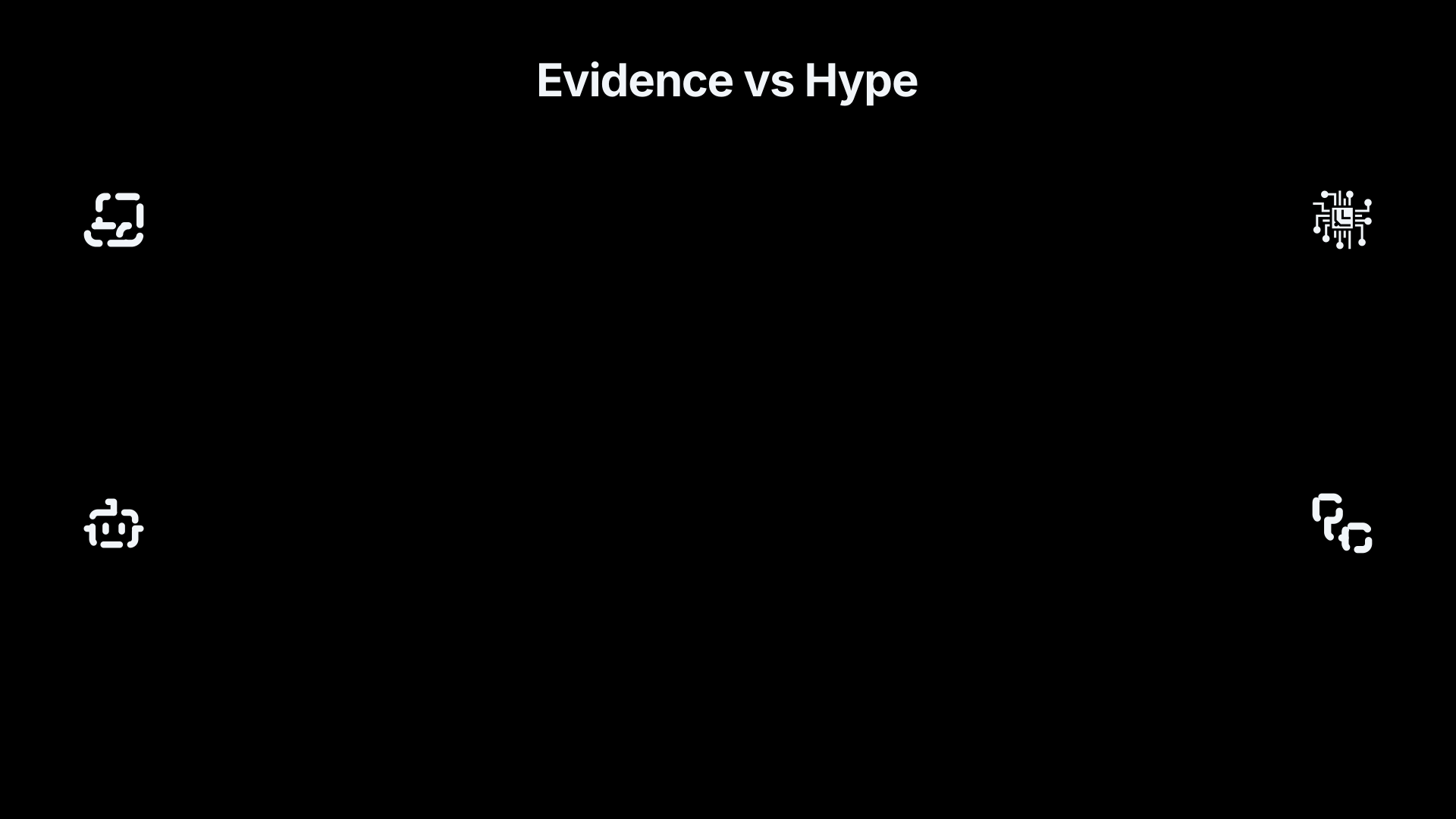
Well-supported: AI is increasingly being used by attackers during vulnerability research and exploit development.
This conclusion is supported by Google’s threat intelligence reporting and by assessments from the UK’s National Cyber Security Centre (NCSC), which has repeatedly warned that AI-assisted vulnerability research and exploit development is likely to be one of the most important near-term changes in the cyber threat landscape. [Google Cloud]cloud.google.comGoogle CloudAdversaries Leverage AI for Vulnerability Exploitation…GTIG AI Threat Tracker: Adversaries Leverage AI for Vulnerability E… [National Cyber Security Centre]ncsc.gov.ukimpact ai cyber threat now 2027National Cyber Security CentreImpact of AI on cyber threat from now to 20277 May 2025 — An NCSC assessment highlighting the impacts on cy…
Plausible but not yet well demonstrated: AI substantially reduces the expertise required to discover sophisticated vulnerabilities.
The GTIG case suggests this may be happening. If advanced models can help identify subtle logic flaws that conventional scanning tools miss, then some vulnerability research may become accessible to a much larger pool of attackers. Yet the public record still contains relatively few confirmed examples. One case is evidence of possibility, not evidence of routine occurrence. [TechRadar]techradar.comThis marks a shift from isolated AI-assisted efforts to industrial-scale AI-driven attacks. The vulnerability targeted a widely-used open…
Poorly supported: AI is already independently conducting major cyber campaigns.
Many headlines imply that autonomous AI systems are already carrying out complete attack chains. Public evidence remains limited. Most documented cases involve human-directed use of AI tools rather than autonomous agents operating independently over long periods. Even Google’s most significant example involved threat actors using AI as part of a broader operation, not replacing the attackers entirely. [Google Cloud]cloud.google.comGoogle CloudAdversaries Leverage AI for Vulnerability Exploitation…GTIG AI Threat Tracker: Adversaries Leverage AI for Vulnerability E…
This distinction matters for AI doom arguments. A world in which AI helps skilled attackers work faster is concerning. A world in which autonomous systems independently discover vulnerabilities, develop exploits, compromise infrastructure and adapt to defenders would represent a much larger shift in risk.

What the reports imply about future capability
Although individual exploit reports are limited, they combine with broader trends to suggest that cyber offence may be becoming more scalable.
The NCSC has warned that AI is likely to accelerate vulnerability discovery and exploitation over the next several years, compressing the time between disclosure and attack. Security researchers increasingly describe a shrinking window in which defenders can patch systems before attackers exploit weaknesses. [National Cyber Security Centre]ncsc.gov.ukimpact ai cyber threat now 2027National Cyber Security CentreImpact of AI on cyber threat from now to 20277 May 2025 — An NCSC assessment highlighting the impacts on cy… [National Cyber Security Centre]ncsc.gov.ukimpact ai cyber threat now 2027National Cyber Security CentreImpact of AI on cyber threat from now to 20277 May 2025 — An NCSC assessment highlighting the impacts on cy…
Recent threat intelligence reporting also shows attackers using AI for a growing range of supporting tasks, including vulnerability analysis, malware development, operational planning and initial access activities. The significance is not any single capability but the possibility that many formerly labour-intensive steps become partially automated at once. [Google Cloud]cloud.google.comGoogle CloudAdversaries Leverage AI for Vulnerability Exploitation…GTIG AI Threat Tracker: Adversaries Leverage AI for Vulnerability E…
For AI doom proponents, this is where cyber evidence becomes relevant to existential-risk discussions. The concern is not that a single exploit destroys civilisation. Instead, cyber capability can serve as a proxy for a broader pattern: increasingly capable AI systems performing complex real-world tasks that previously required expert humans. If models continue improving in vulnerability discovery, exploit generation and operational planning, the same underlying capabilities could eventually support more dangerous forms of autonomy. That is an argument about trajectories rather than current outcomes. The exploit reports provide evidence about the trajectory, not proof of the end state. [National Cyber Security Centre]ncsc.gov.ukimpact ai cyber threat now 2027National Cyber Security CentreImpact of AI on cyber threat from now to 20277 May 2025 — An NCSC assessment highlighting the impacts on cy…
What would count as stronger proof?
Current evidence is enough to show that AI-assisted exploit development is real. It is not enough to settle larger debates about AI doom, loss of control or autonomous cyber warfare.
Several developments would provide substantially stronger evidence.
Repeated independent cases
One confirmed incident can be unusual. Multiple unrelated cases across different threat actors, targets and software ecosystems would demonstrate that AI-assisted zero-day discovery has become routine rather than exceptional. At present, public reporting remains sparse. [CyberScoop]cyberscoop.comCyberScoopGoogle spotted an AI-developed zero-day before attackers…3 days ago — The averted disaster probably isn't the first time att…
Demonstrated end-to-end autonomy
A much stronger signal would be a verified case in which an AI system independently performed most stages of an attack chain: identifying a target, discovering a vulnerability, developing an exploit, adapting to defences and maintaining access with minimal human intervention.
Public evidence does not yet show this. Much of the discussion remains extrapolation from capability trends rather than documented incidents. [arXiv]arxiv.orgarXiv A Framework for Evaluating Emerging Cyberattack Capabilities of AIarXiv A Framework for Evaluating Emerging Cyberattack Capabilities of AI
Large-scale exploitation of critical infrastructure
Another threshold would be successful AI-assisted attacks against major infrastructure systems, cloud platforms or widely used enterprise software at substantial scale. The reported 2FA-bypass case involved a serious vulnerability, but it was intercepted before mass deployment. That makes it evidence of capability, not evidence of large-scale impact. [IANS]iansresearch.comoitation event,” but the software vendor patched the vulnerability before the…Read more…

Evidence that AI is outperforming expert humans
The most important milestone for long-term AI-risk arguments would be proof that AI systems consistently discover novel vulnerabilities that leading human researchers cannot find, and do so faster and more cheaply. Such a shift would suggest that cyber offence is becoming genuinely machine-driven rather than merely machine-assisted.
Public evidence has not yet reached that standard. [arXiv]arxiv.orgarXiv A Framework for Evaluating Emerging Cyberattack Capabilities of AIarXiv A Framework for Evaluating Emerging Cyberattack Capabilities of AI
What these reports prove—and what they do not
The strongest conclusion supported by current evidence is that AI-assisted exploit discovery has moved beyond theory. Attackers are using advanced AI systems in vulnerability research, and at least one significant case appears to involve AI-assisted discovery and weaponisation of a zero-day vulnerability capable of bypassing two-factor authentication. [Google Cloud]cloud.google.comGoogle CloudAdversaries Leverage AI for Vulnerability Exploitation…GTIG AI Threat Tracker: Adversaries Leverage AI for Vulnerability E… CyberScoop What these reports do not prove is equally important. They do not show autonomous AI hackers operating without human oversight. They do not d [cyberscoop.com]cyberscoop.comCyberScoopGoogle spotted an AI-developed zero-day before attackers…3 days ago — The averted disaster probably isn't the first time att… emonstrate an imminent cyber apocalypse. They do not establish that AI systems can reliably generate critical zero-days at will. And they do not by themselves justify the strongest AI doom scenarios. [arXiv]arxiv.orgarXiv A Framework for Evaluating Emerging Cyberattack Capabilities of AIarXiv A Framework for Evaluating Emerging Cyberattack Capabilities of AI
For readers interested in existential risk, the significance of these incidents lies elsewhere. They provide one of the clearest examples of a predicted AI capability moving from speculation into documented reality. The evidence does not show loss of control, but it does show that advanced AI is beginning to perform tasks once regarded as the preserve of elite human specialists. That makes exploit reports less important as proof of catastrophe than as warning signs about the direction of technological change. National Cyber Security Centre [CyberScoop]cyberscoop.comCyberScoopGoogle spotted an AI-developed zero-day before attackers…3 days ago — The averted disaster probably isn't the first time att…
Amazon book picks
Further Reading
Books and field guides related to What do real AI exploit reports actually prove?. Use these as the next step if you want deeper reading beyond the article.
Sandworm
Documents real cyber operations and helps readers assess evidence versus speculation in cyber threats.
Cyber War Will Not Take Place
Useful for separating evidence-based conclusions from exaggerated cyberwar claims.
Countdown to Zero Day
Shows how sophisticated exploits are discovered, developed, and operationalized.
The Hacker and the State
Rating: 5.0/5 from 18 Google Books ratings
Provides a framework for judging what cyber incidents prove about offensive capabilities.
eBay marketplace picks
Marketplace Samples
Example marketplace items related to this page. Use the search link to explore similar finds on eBay.








Endnotes
-
Source: cloud.google.com
Link: https://cloud.google.com/blog/topics/threat-intelligence/ai-vulnerability-exploitation-initial-accessSource snippet
Google CloudAdversaries Leverage AI for Vulnerability Exploitation...GTIG AI Threat Tracker: Adversaries Leverage AI for Vulnerability E...
-
Source: cyberscoop.com
Link: https://cyberscoop.com/google-threat-intelligence-group-ai-developed-zero-day-exploit/Source snippet
CyberScoopGoogle spotted an AI-developed zero-day before attackers...3 days ago — The averted disaster probably isn't the first time att...
-
Source: techradar.com
Link: https://www.techradar.com/pro/security/this-is-the-tip-of-the-iceberg-google-experts-say-they-have-seen-hackers-using-ai-to-discover-and-weaponize-a-zero-day-for-the-first-timeSource snippet
This marks a shift from isolated AI-assisted efforts to industrial-scale AI-driven attacks. The vulnerability targeted a widely-used open...
-
Source: infosecurity-magazine.com
Link: https://www.infosecurity-magazine.com/news/hackers-using-ai-zero-day-first/Source snippet
Infosecurity MagazineHackers Observed Using AI to Develop Zero-Day for...3 hours ago — Published on May 11, the GTIG AI Threat Tracker r...
-
Source: arxiv.org
Title: arXiv A Framework for Evaluating Emerging Cyberattack Capabilities of AI
Link: https://arxiv.org/abs/2503.11917 -
Source: iansresearch.com
Link: https://www.iansresearch.com/resources/all-blogs/post/security-blog/2026/05/15/google-detects-first-ai-generated-zero-day-exploit-in-active-campaignSource snippet
oitation event,” but the software vendor patched the vulnerability before the...Read more...
-
Source: arxiv.org
Title: arXiv The Role of AI in Modern Penetration Testing
Link: https://arxiv.org/abs/2512.12326Source snippet
arXivThe Role of AI in Modern Penetration TestingDecember 13, 2025...
Published: December 13, 2025
-
Source: gemini.google.com
Link: https://gemini.google.com/Source snippet
GeminiMeet Gemini, Google's AI assistant. Get help with writing, planning, brainstorming, and more. Experience the power of generative AI...
-
Source: ncsc.gov.uk
Title: impact ai cyber threat now 2027
Link: https://www.ncsc.gov.uk/report/impact-ai-cyber-threat-now-2027Source snippet
National Cyber Security CentreImpact of AI on cyber threat from now to 20277 May 2025 — An NCSC assessment highlighting the impacts on cy...
Published: May 2025
-
Source: ncsc.gov.uk
Title: impact of ai on cyber threat
Link: https://www.ncsc.gov.uk/sites/default/files/pdfs/publication/impact-of-ai-on-cyber-threat.pdfSource snippet
AI is likely to assist with malware and exploit development, vulnerability research and lateral movement by making existing techniques mo...
-
Source: ncsc.gov.uk
Title: impact of ai on cyber threat
Link: https://www.ncsc.gov.uk/report/impact-of-ai-on-cyber-threatSource snippet
National Cyber Security CentreThe near-term impact of AI on the cyber threat24 Jan 2024 — This assessment focuses on how AI will impact t...
-
Source: ncsc.gov.uk
Link: https://www.ncsc.gov.uk/ -
Source: Wikipedia
Title: National Cyber Security Centre (United Kingdom)
Link: https://en.wikipedia.org/wiki/National_Cyber_Security_Centre_%28United_Kingdom%29Source snippet
Based in Victoria, London, it became operational in October 2016, and...Read more...
Published: October 2016
-
Source: cxtoday.com
Link: https://www.cxtoday.com/security-privacy-compliance/google-cloud-uncovers-first-ai-made-zero-day-exploit-putting-cx-in-the-crosshairs/Source snippet
Google Cloud Uncovers First AI-Made Zero-Day Exploit...1 hour ago — Cyber attackers are moving beyond using GenAI for phishing emails an...
Additional References
-
Source: axios.com
Link: https://www.axios.com/2026/05/12/ai-hacking-found-google-reportSource snippet
According to a report by Google’s threat intelligence team, sophisticated threat actors collaborated to find a flaw in a Python script th...
-
Source: ncsc.gov.ie
Link: https://www.ncsc.gov.ie/ncc-ie/research/Source snippet
NCC-IEWhat will be the impact of regulation of AI and digital entities, and how can policy makers best adapt to the rapid pace of technol...
-
Source: securityweek.com
Link: https://www.securityweek.com/google-detects-first-ai-generated-zero-day-exploit/Source snippet
SecurityWeekGoogle Detects First AI-Generated Zero-Day Exploit21 hours ago — For the first time, Google has identified a zero-day exploit...
-
Source: linkedin.com
Link: https://www.linkedin.com/posts/tscogroup_google-hackers-used-ai-to-develop-zero-day-activity-7459796393566617600-Ee-7Source snippet
Technology Solutions Company's PostGoogle: Hackers used AI to develop zero-day exploit for web admin tool Researchers at Google Threat In...
-
Source: tomshardware.com
Link: https://www.tomshardware.com/tech-industry/cyber-security/zero-day-clock-visualizes-and-quantifies-the-effects-of-ai-on-software-security-time-until-exploit-went-from-one-year-to-one-day-and-projected-to-be-one-minute-soon-enoughSource snippet
Created by Sergej Epp from Sysdig and supported by major tech firms, ZDC demonstrates how [artificial]({{ 'artificial-goals/' | relative_url }}) intelligence has reduced the average...
-
Source: linkedin.com
Link: https://www.linkedin.com/posts/davey-mcglade-4b9a62131_impact-of-ai-on-cyber-threat-from-now-to-activity-7325844821523275776-mjE4Source snippet
NCSC report: AI and cyber security to 2027We have published a new assessment on how AI will transform the cyber threat to 2027. Developme...
-
Source: GOV.UK
Link: https://www.gov.uk/government/publications/g7-cyber-expert-group-statement-on-ai-and-cybersecurity/g7-cyber-expert-group-statement-on-artificial-intelligence-and-cybersecurity-september-2025Source snippet
www.gov.ukG7 cyber expert group statement on Artificial Intelligence...Oct 6, 2025 — Predictive Maintenance and Patching: AI can anticip...
Published: september 2025
-
Source: linkedin.com
Link: https://www.linkedin.com/posts/james-harris-86bbb137_impact-of-ai-on-cyber-threat-from-now-to-activity-7391041385199521792-obBWSource snippet
NCSC report: AI's impact on cyber threats 2023-2027Nov 3, 2025 — The National Cyber Security Centre (NCSC) has published an assessment hi...
-
Source: linkedin.com
Link: https://www.linkedin.com/posts/kit-yu-27753534_on-2-september-2025-the-national-cyber-security-activity-7381699510919553024-eTIgSource snippet
NCSC publishes guidance on managing risks in...On 2 September 2025, the National Cyber Security Centre published guidance on managing ri...
Published: september 2025
-
Source: linkedin.com
Link: https://www.linkedin.com/posts/dannyjenkinscyber_todays-news-that-google-threat-intelligence-activity-7459692591593390081-FQCB
Topic Tree