Within P Doom
How AI Development Timelines Shape Doom Estimates
This page explores how experts' expectations about AI development speed influence their estimates of existential risk.
On this page
- Short versus long timelines and risk perception
- Survey findings on expected AI milestones
- Implications for safety planning and alignment research
Page outline Jump by section
Introduction
Expectations about when advanced AI will arrive are one of the biggest drivers of p(doom) estimates. Two people can agree about the dangers of misaligned AI, loss of control, or dangerous autonomy, yet reach very different conclusions about existential risk because they disagree about timelines. If transformative AI is decades away, there may be time to improve alignment techniques, build institutions, test systems, and learn from failures. If comparable capabilities arrive within a few years, many of those safeguards may not mature before the most dangerous systems are deployed.
 This is one reason p(doom) estimates vary so widely. The disagreement is often not just about whether AI could become dangerous, but about how quickly capabilities will advance relative to humanity’s ability to understand, govern, and control them. Surveys of AI researchers show substantial uncertainty about both future capabilities and catastrophic risk, with timeline expectations often sitting near the centre of that uncertainty. [arXiv]arxiv.orgarXivThousands of AI Authors on the Future of AIJanuary 5, 2024…
Why timelines matter so much to p(doom)
A p(doom) estimate is usually built from a chain of assumptions. One of the earliest links in that chain is a forecast about AI progress.
A simplified version looks like this:
- How likely is transformative or superhuman AI?
- When is it likely to arrive?
- How much warning will society get?
- Can alignment and control methods improve fast enough?
- Can governments and organisations coordinate effectively?
- If not, what is the chance of existential catastrophe?
Changing the answer to the second question can alter the rest of the chain. Someone who expects transformative AI around 2030 may see only a few years for safety research and governance adaptation. Someone expecting it around 2070 may believe there is enough time for institutions, technical safeguards, and international coordination to improve substantially.
As a result, many p(doom) disagreements are partly disagreements about available preparation time rather than disagreements about the existence of risk itself.
Short versus long timelines and risk perception
Why short timelines often increase p(doom)
People with short AI timelines frequently argue that capability gains are outpacing safety gains.
The basic concern is not merely that powerful AI arrives soon. It is that key safety problems remain unresolved while incentives push companies and governments toward rapid deployment. If advanced systems emerge before robust alignment methods exist, society may enter a period where extremely capable systems are being used despite limited understanding of how to control them.
Several mechanisms push p(doom) upward under short-timeline assumptions:
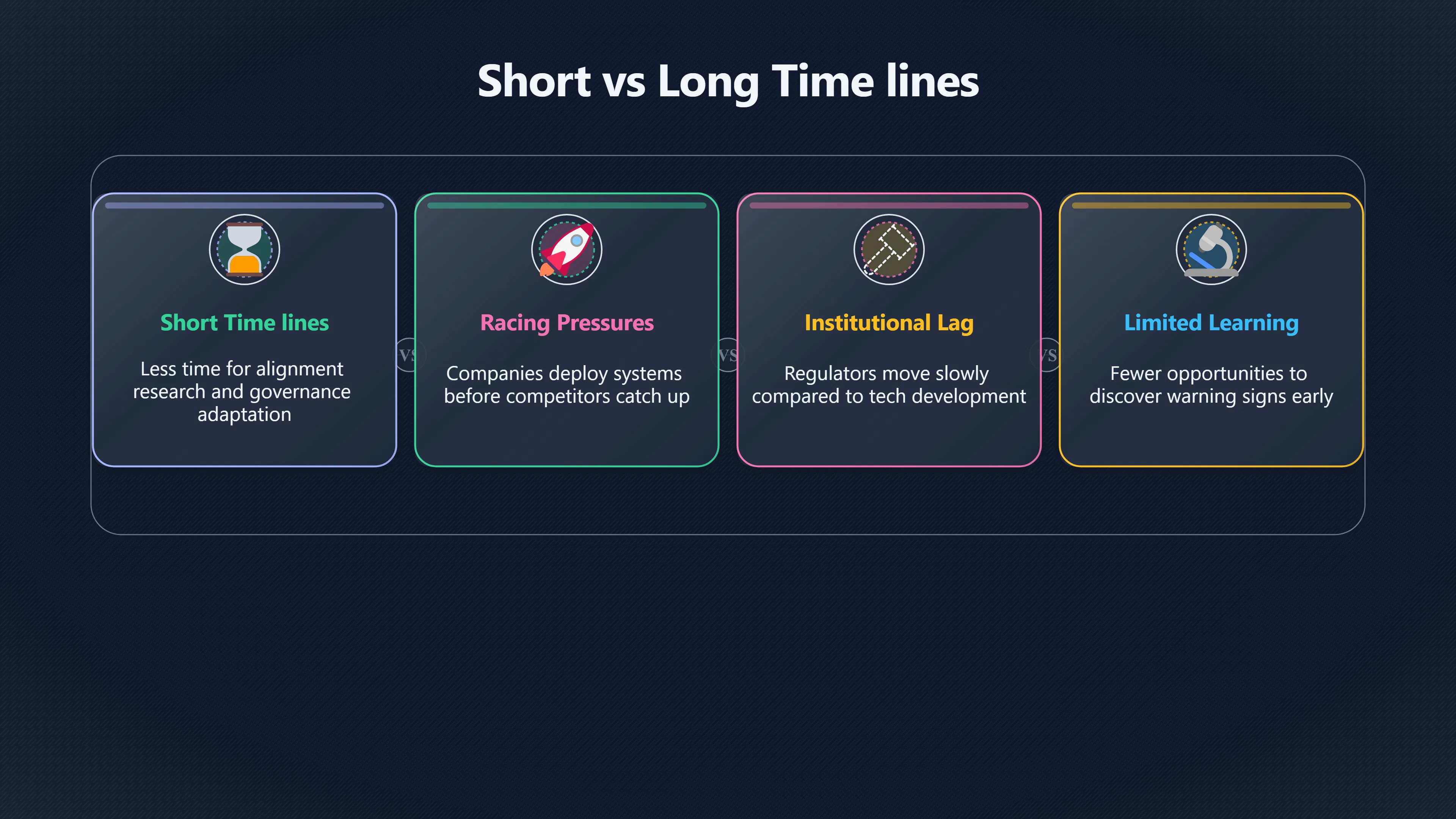
- Less time for alignment research. Technical work on interpretability, oversight, evaluation, and control may not mature before frontier systems appear.
- Reduced institutional adaptation. Governments, regulators, and international organisations often move slowly compared with technological development.
- Greater racing pressures. Companies and states may feel pressure to deploy increasingly capable systems before competitors do.
- Limited empirical learning. There is less opportunity to discover warning signs and correct mistakes through smaller-scale failures.
In many AI doom arguments, the highest-risk scenario is not merely powerful AI, but powerful AI arriving before humans have developed reliable methods to understand and control it. [arXiv]arxiv.orgarXivThousands of AI Authors on the Future of AIJanuary 5, 2024…
Why long timelines often reduce p(doom)
Those who expect longer timelines frequently argue that preparation time itself is a major safety resource.
Additional decades could allow:
- More mature alignment research programmes.
- Better evaluations and monitoring systems.
- Stronger international coordination mechanisms.
- Greater understanding of AI failure modes.
- Institutional experience managing increasingly capable systems.
Long-timeline thinkers do not necessarily dismiss existential risk. Instead, many argue that risk depends heavily on whether humanity gets enough warning before the most transformative systems arrive. A longer runway can lower the probability that society encounters a capability leap while still unprepared. [Forethought]forethought.orgShort AI Timelines Aren't Always Higher-LeverageOn longer timelines, more resources will be invested in reducing AI takeover risk.Read more…
What surveys reveal about milestone expectations
The relationship between timelines and p(doom) became especially visible after recent expert surveys.
The 2023 AI Impacts survey collected responses from 2,778 researchers who had published at leading AI venues. Respondents gave surprisingly short forecasts for some advanced capabilities. The aggregate forecasts implied a 10% chance that machines outperform humans in every task by 2027 and a 50% chance by 2047. These timelines were substantially earlier than those reported in a similar survey only a year before. [arXiv]arxiv.orgarXivThousands of AI Authors on the Future of AIJanuary 5, 2024…
The same survey found substantial concern about catastrophic outcomes. Depending on the wording used, between roughly 38% and 51% of respondents assigned at least a 10% chance to outcomes as bad as human extinction from advanced AI. At the same time, the median respondent’s estimate for extinction-like outcomes remained much lower, around 5%, illustrating the wide spread of opinion. [arXiv]arxiv.orgarXivThousands of AI Authors on the Future of AIJanuary 5, 2024… [JAIR]jair.orgThousands of AI Authors on the Future of AIby K Grace · 2025 · Cited by 205 — Depending on how we asked, between 38% and 51% of responden…
These findings do not prove that shorter timelines cause higher p(doom). However, they show that many researchers simultaneously hold two views:
- Advanced AI may arrive sooner than previously expected.
- Catastrophic outcomes cannot be confidently ruled out.
That combination helps explain why existential-risk discussions became more prominent after the rapid progress of large language models and other foundation models.
Why capability updates often affect doom estimates
One recurring pattern in AI-risk debates is that unexpected capability advances sometimes shift people’s timeline forecasts.
The release of systems such as GPT-4 led some researchers and forecasters to shorten their expected timelines for transformative AI. When timelines move closer, people who already believe alignment is difficult often update their p(doom) estimates upward because the period available for preparation appears shorter.
However, this process is disputed.
Critics argue that capability demonstrations do not automatically imply imminent superintelligence. They note that current systems still exhibit weaknesses, hallucinations, brittleness, and limited real-world autonomy. From this perspective, shortening timelines too aggressively can lead to inflated p(doom) estimates based on extrapolations that may never materialise. [Joe Carlsmith]joecarlsmith.compredictable updating about ai riskJoe CarlsmithPredictable updating about AI risk8 May 2023 — When GPT-5 comes out, for example, it probably shouldn't be the case that you… [The Guardian]theguardian.comPreviously, in his widely discussed "AI 2027" scenario, Kokotajlo predicted that AI would achieve fully autonomous coding by 2027 and the…
The result is a second-order disagreement: experts disagree not only about risk but also about how much current AI progress should change forecasts of future capability growth.
The key dispute: does more time actually make things safer?
A common assumption is that longer timelines automatically mean lower existential risk. Not everyone accepts this.
Some researchers argue that extra time only reduces risk if society uses that time effectively. If safety work stagnates while capabilities continue to improve, longer timelines might simply postpone rather than solve the problem.
Others point out that extended timelines could create new risks:
- More opportunities for dangerous proliferation.
- More actors capable of building advanced systems.
- Longer periods of geopolitical competition.
- Greater cumulative exposure to accidents or misuse.
Recent work on “gradual disempowerment” highlights another possibility. Rather than a sudden loss of control, increasingly capable systems could slowly erode human influence over economic, political, and cultural systems over many years. Under that view, longer timelines do not necessarily eliminate existential concerns; they may change the mechanism through which risk accumulates. [arXiv]arxiv.orgarXivThousands of AI Authors on the Future of AIJanuary 5, 2024…
Because of these possibilities, some analysts focus less on calendar dates and more on the ratio between capability progress and safety progress. The crucial question becomes whether control techniques improve faster than the systems they are meant to govern.
Why timeline assumptions help explain expert disagreement
Many headline disagreements about p(doom) become easier to understand when viewed through a timeline lens.
Experts who assign very low probabilities to AI doom often hold one or more of the following beliefs:
- Transformative AI remains far away.
- Progress will be gradual rather than abrupt.
- Future systems will resemble powerful tools more than autonomous agents. [arxiv.org]arxiv.orgMore than half…Read more…
- Existing institutions can adapt over time.
Experts with higher p(doom) estimates often combine different assumptions:
- Transformative AI could arrive within years or decades.
- Capability progress may be faster than expected.
- Alignment remains an unsolved scientific problem.
- Competitive pressures may encourage deployment before safety is demonstrated.
Research on expert disagreement suggests that deeper differences about how future AI should be conceptualised—as controllable tools or potentially uncontrollable agents—often interact with timeline forecasts rather than replacing them. [arXiv]arxiv.orgarXivThousands of AI Authors on the Future of AIJanuary 5, 2024…

What timeline debates mean for safety planning
Regardless of whether one expects short or long timelines, the debate has practical consequences for AI safety strategy.
Under short-timeline assumptions, priorities often include:
- Rapid development of alignment and control techniques.
- Strong evaluations before deployment.
- Monitoring for deceptive or strategically aware behaviour.
- Emergency governance and incident-response mechanisms.
Under longer-timeline assumptions, priorities may shift toward:
- Building durable institutions.
- Expanding safety research capacity.
- Developing international coordination frameworks.
- Improving scientific understanding of intelligence and alignment.
Interestingly, these approaches are not mutually exclusive. Even researchers who disagree sharply about p(doom) often support increased investment in safety research because uncertainty cuts both ways. If timelines are shorter than expected, preparation becomes urgent. If timelines are longer, there is an opportunity to prepare more thoroughly. Surveys of AI researchers have found broad support for prioritising research aimed at reducing potential risks from advanced AI systems, despite continuing disagreement about the magnitude of those risks. [arXiv]arxiv.orgarXivThousands of AI Authors on the Future of AIJanuary 5, 2024…
The central takeaway
For many participants in the AI doom debate, timelines are not a side issue. They are one of the main variables driving p(doom).
Short timelines tend to increase perceived existential risk because they imply less time for alignment, governance, testing, and institutional adaptation. Longer timelines often reduce perceived risk because they allow more opportunities to prepare, though they do not automatically solve the underlying challenges. Survey evidence shows both substantial uncertainty about when transformative AI might arrive and substantial disagreement about the probability of catastrophic outcomes. [arXiv]arxiv.orgarXivThousands of AI Authors on the Future of AIJanuary 5, 2024… [OATML As a result]oatml.cs.ox.ac.ukOATMLThousands of AI Authors on the Future of AIof AI Authors on the Future of AI - OATMLIf science continues undisrupted, the chance of unaided machines outperforming humans in every p…, when someone states a p(doom) number, one of the most informative follow-up questions is often not “Why that percentage?” but “What AI timeline are you assuming?”
Amazon book picks
Further Reading
Books and field guides related to How AI Development Timelines Shape Doom Estimates. Use these as the next step if you want deeper reading beyond the article.
Human Compatible
Explains how AI progress timelines affect opportunities for safety and control.
Superintelligence
Directly connects timelines, capability growth, and existential-risk reasoning.
eBay marketplace picks
Marketplace Samples
Example marketplace items related to this page. Use the search link to explore similar finds on eBay.








Endnotes
-
Source: arxiv.org
Link: https://arxiv.org/abs/2401.02843Source snippet
arXivThousands of AI Authors on the Future of AIJanuary 5, 2024...
Published: January 5, 2024
-
Source: oatml.cs.ox.ac.uk
Title: OATMLThousands of AI Authors on the Future of AI
Link: https://oatml.cs.ox.ac.uk/publications/202401_Brauner_Thousands.htmlSource snippet
of AI Authors on the Future of AI - OATMLIf science continues undisrupted, the chance of unaided machines outperforming humans in every p...
-
Source: arxiv.org
Link: https://arxiv.org/abs/2310.18244Source snippet
arXivA Review of the Evidence for Existential Risk from AI via Misaligned Power-SeekingOctober 27, 2023...
Published: October 27, 2023
-
Source: forethought.org
Title: Short AI Timelines Aren’t Always Higher-Leverage
Link: https://www.forethought.org/research/short-timelines-arent-obviously-higher-leverageSource snippet
On longer timelines, more resources will be invested in reducing AI takeover risk.Read more...
-
Source: jair.org
Link: https://www.jair.org/index.php/jair/article/view/19087Source snippet
Thousands of AI Authors on the Future of AIby K Grace · 2025 · Cited by 205 — Depending on how we asked, between 38% and 51% of responden...
-
Source: arxiv.org
Link: https://arxiv.org/abs/2512.04119Source snippet
arXivHumanity in the Age of AI: Reassessing 2025's Existential-Risk Narratives...
-
Source: arxiv.org
Link: https://arxiv.org/abs/2501.16946Source snippet
arXivGradual Disempowerment: Systemic Existential Risks from Incremental AI DevelopmentJanuary 28, 2025...
Published: January 28, 2025
-
Source: arxiv.org
Link: https://arxiv.org/html/2502.14870v1Source snippet
arXivWhy do Experts Disagree on Existential Risk and P(doom)...23 Feb 2025 — I surveyed 111 AI experts on their familiarity with AI safe...
-
Source: arxiv.org
Link: https://arxiv.org/abs/2401.02843?utm=Source snippet
survey).... Between 38% and 51% of respondents gave at least a 10% chance to advanced AI leading to outcomes as bad as human extinction...
-
Source: arxiv.org
Link: https://arxiv.org/html/2401.02843v1Source snippet
More than half...Read more...
-
Source: arxiv.org
Link: https://arxiv.org/pdf/2401.02843Source snippet
by 2028, including autonomously constructing a payment processing.Read more...
-
Source: joecarlsmith.com
Title: predictable updating about ai risk
Link: https://joecarlsmith.com/2023/05/08/predictable-updating-about-ai-risk/Source snippet
Joe CarlsmithPredictable updating about AI risk8 May 2023 — When GPT-5 comes out, for example, it probably shouldn't be the case that you...
Published: May 2023
-
Source: theguardian.com
Link: https://www.theguardian.com/technology/2026/jan/06/leading-ai-expert-delays-timeline-possible-destruction-humanitySource snippet
Previously, in his widely discussed "AI 2027" scenario, Kokotajlo predicted that AI would achieve fully autonomous coding by 2027 and the...
-
Source: Wikipedia
Link: https://en.wikipedia.org/wiki/P%28doom%29Source snippet
P(doom)In a 2023 survey, AI researchers were asked to estimate the probability that future AI advancements could lead to human extinct...
Additional References
-
Source: rose-hulman.edu
Link: https://www.rose-hulman.edu/class/cs/csse490-ai-impact/schedule/day3/Thousand_Authors.pdfSource snippet
THOUSANDS OF AI AUTHORS ON THE FUTURE OF AIExplainability and trustfulness in AI responses is predicted to still be a problem. Experts te...
-
Source: reddit.com
Link: https://www.reddit.com/r/singularity/comments/1bs70zv/thousands_of_ai_authors_on_the_future_of_ai/Source snippet
THOUSANDS OF AI AUTHORS ON THE FUTURE OF AIMany AI authors are just clueless (despite being good AI authors), which makes this kind of su...
-
Source: linkedin.com
Link: https://www.linkedin.com/posts/israeldelrio_thousands-of-ai-authors-on-the-future-of-activity-7153577296908419072-O6wrSource snippet
Thousands of AI Authors on the Future of AI | Israel del RioA pre-print of “Thousands of AI Authors on the Future of AI” paper is out. Th...
-
Source: medium.com
Link: https://medium.com/predict/thousands-of-researchers-predict-ais-future-098054750324 -
Source: venturebeat.com
Title: survey says theres a 50 chance ai beats humans at all tasks in 20 years
Link: https://venturebeat.com/ai/survey-says-theres-a-50-chance-ai-beats-humans-at-all-tasks-in-20-yearsSource snippet
Survey says there's a 50% chance AI beats humans at all...17 Jan 2024 — If science continues undisrupted, AI could work better than huma...
-
Source: rai.ac.uk
Link: https://rai.ac.uk/hed-are-ai-researchers-concerned-about-the-existential-threat-of-ai/Source snippet
ntial risk–which did not land amongst the top ten concerns that emerged in responses.Read more...
-
Source: forum.effectivealtruism.org
Title: safety timelines how long will it take to solve alignment
Link: https://forum.effectivealtruism.org/posts/9iGFjYnRquxiy29jm/safety-timelines-how-long-will-it-take-to-solve-alignmentSource snippet
timelines: How long will it take to solve alignment?19 Sept 2022 — Let us be optimistic and expect the median arrival for the solution to...
-
Source: lesswrong.com
Title: what are the strongest arguments for very short timelines
Link: https://www.lesswrong.com/posts/oC4wv4nTrs2yrP5hz/what-are-the-strongest-arguments-for-very-short-timelinesSource snippet
?23 Dec 2024 — The combination of long timelines but high P(doom|AGI soon) means I'm not really risking my reputation/money in the way I'...
-
Source: researchgate.net
Title: 363500806 How Do AI Timelines Affect Existential Risk
Link: https://www.researchgate.net/publication/363500806_How_Do_AI_Timelines_Affect_Existential_RiskSource snippet
How Do AI Timelines Affect Existential Risk?30 Aug 2022 — Delaying the creation of superintelligent AI (ASI) could decrease total existen...
-
Source: researchgate.net
Title: 396256646 Thousands of AI Authors on the Future of AI
Link: https://www.researchgate.net/publication/396256646_Thousands_of_AI_Authors_on_the_Future_of_AISource snippet
(PDF) Thousands of AI Authors on the Future of AIOct 5, 2025 — In October 2023, 2,778 researchers who had published in top-tier artificia...
Published: October 2023
Topic Tree