Within Weak evidence
Why AutoML Cannot Independently Drive Machine Learning Research
AutoML automates model selection and tuning but still depends on humans for defining objectives, architectures, and evaluation metrics.
On this page
- Automated model design and hyperparameter tuning
- Role of human oversight and objective specification
- Limits for recursive AI self improvement claims
Page outline Jump by section
Introduction
AutoML — automated machine learning — is often discussed in both AI research and practical data‑science communities as a way to reduce human effort in building models. In the context of arguments about recursive self‑improvement and risk from advanced AI, some people point to AutoML and similar tools as signs that machines can meaningfully automate their own development. That impression overstates what current AutoML actually does. In reality, AutoML systems automate specific optimisation tasks such as hyperparameter tuning or model selection within a well‑defined space, but they require human‑defined objectives, constraints and oversight at every stage and cannot autonomously set research goals or expand their own design space. This article explains those limits and why they matter for assessing claims about machine‑driven improvement loops.

Automated model design and hyperparameter tuning
At its core, AutoML encompasses methods that automate parts of the machine‑learning workflow that were traditionally done by human engineers. Examples include searching over hyperparameter settings, comparing candidate model architectures, feature engineering, and evaluating performance. Neural architecture search (NAS), for instance, uses algorithmic search techniques to find effective neural network structures for a given task. These methods can yield models that perform as well or better than hand‑designed ones on that task and in that constrained space. They are a genuine efficiency gain for practitioners and can lower barriers to building effective models.
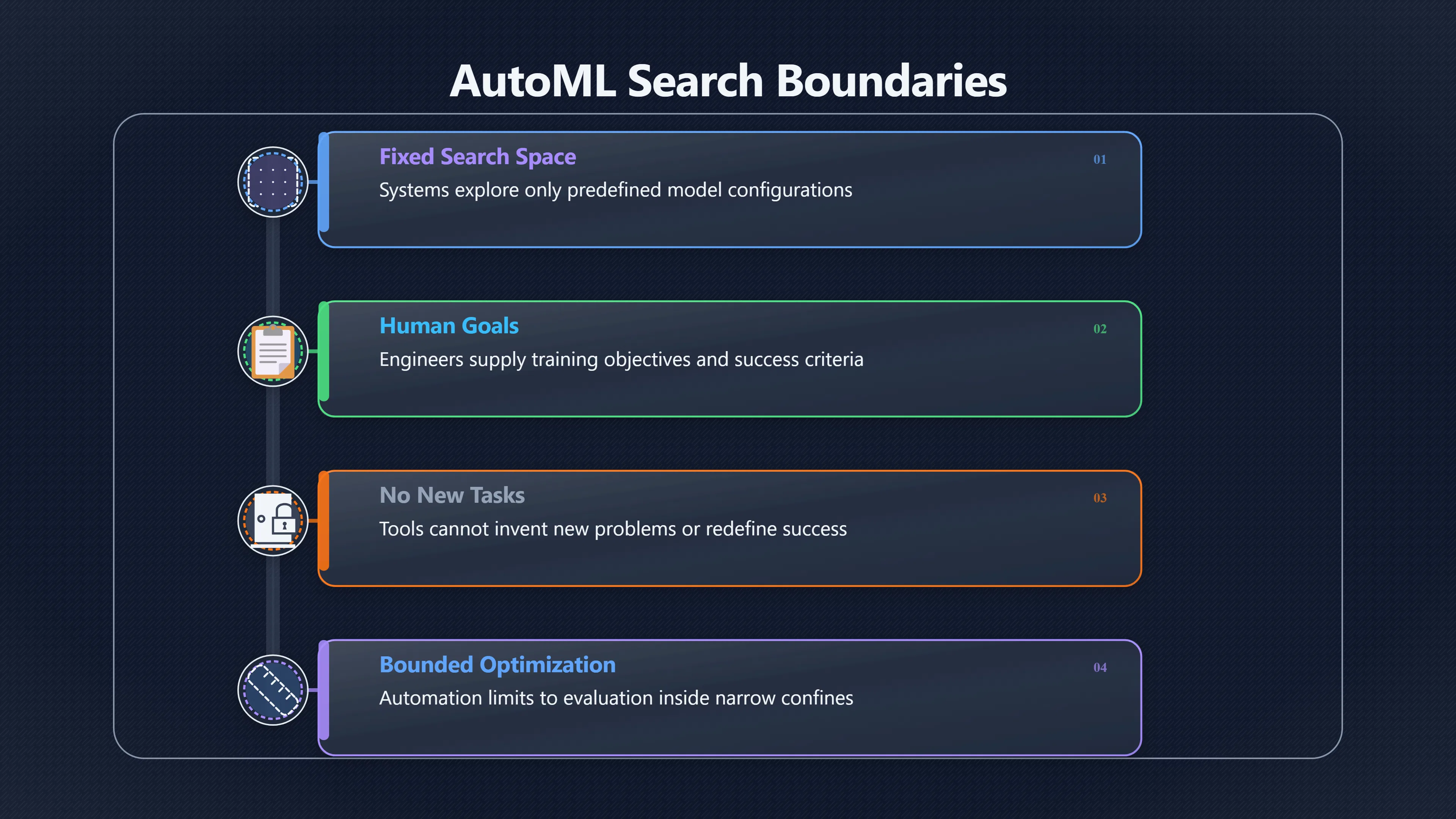
However, the automation applies to optimisation within a predefined problem specification. The training objective, the data, the metric used to compare models, and the search space itself are all supplied by humans. AutoML systems search for good solutions within that space but do not invent new tasks, redefine what counts as success, or autonomously alter their own objectives. In other words, the “automation” pertains to exploration and evaluation in a bounded configuration space rather than open‑ended research or self‑generated goals.
Recent literature on AutoML explicitly recognises these boundaries. Although advanced systems increasingly integrate meta‑learning and constraint handling, state‑of‑the‑art AutoML cannot adapt its own meta‑configuration — its own search heuristics or design space — without human guidance, nor can it reconcile competing high‑level goals unless those are encoded by the user in advance. For example, in constrained scenarios, AutoML cannot automatically incorporate novel application constraints beyond those it was programmed to consider without external input. [Springer]link.springer.comSpringerAutoML in heavily constrained applications | The VLDB Journal | Springer Nature LinkNovember 17, 2023…
Role of human oversight and objective specification
A recurring theme in research and practice is that AutoML tools augment rather than replace skilled human involvement. Reviews of industry AutoML tools find that they require domain knowledge to be effectively configured and interpreted, and that “human agency” remains central to successful application. Users often need to adjust settings, assess the meaningfulness of results, interpret outcomes in context, and decide how to handle trade‑offs such as performance versus explainability or fairness. [ScienceDirect]sciencedirect.comScienceDirectA multivocal literature review on the benefits and limitations of industry-leading AutoML tools - ScienceDirectFebruary 1, 2025…
Indeed, several authors argue for a “human‑centred” rather than purely “machine‑centred” AutoML paradigm, precisely because current systems lack the flexibility, context awareness and iterative interaction that expert human practitioners bring. Under this paradigm, humans remain responsible for specifying objectives, injecting domain knowledge, and steering optimisation according to broader organisational or ethical constraints, while the automated components handle well‑defined optimisation searches. [AutoML]automl.orgAutoMLAutoML | Rethinking AutoML: Advancing from a Machine-Centered to Human-Centered ParadigmNovember 30, 2022…
This human‑in‑the‑loop requirement reflects a broader reality: automated procedures like hyperparameter tuning or NAS are essentially optimisation engines that explore a search space defined by engineers. They do not generate new research directions, conceptualise new types of problems to solve, or update their own objective functions based on autonomous reflection. Without explicit, human‑provided goals and evaluation metrics, AutoML has no innate basis for deciding what constitutes “improvement” or “desirable” change.

Limits for recursive AI self‑improvement claims
Arguments about existential risk from recursive self‑improvement often hinge on the idea of systems that can autonomously bootstrap increasingly powerful versions of themselves. To substantiate that claim, one would need evidence that an AI can: (1) define new, higher‑level goals beyond immediate optimisation criteria, (2) restructure its own learning algorithms or objectives, and (3) identify and implement changes that meaningfully expand its capabilities across domains.
Real‑world AutoML systems fall markedly short of these criteria. Their automation is confined to optimising within fixed problem formulations, and they rely on human engineers to set those formulations and interpret the results. An AutoML pipeline cannot decide to itself explore new areas of research — only an engineer with domain expertise can do that. Researchers have noted that while automation assists practitioners and can speed up routine optimisation, it does not replace the need for iterative human decisions and contextual understanding. [Snowflake]snowflake.comWhat Is Auto ML? A Guide to Automated Machine LearningSnowflakeWhat Is AutoML? A Guide to Automated Machine Learning…
In practical settings, moreover, users routinely exercise agency to cope with AutoML’s limitations. Studies of real‑world practitioners show that customisation, transparency and privacy concerns lead people to intervene, sometimes ceasing to use automated tools when their constraints or preferences are not adequately captured. [SUNY Research Connect]researchconnect.suny.eduResearch Connect Auto ML in The Wild: Obstacles, Workarounds, and ExpectationsSUNY Research ConnectAutoML in The Wild: Obstacles, Workarounds, and Expectations - SUNY Research Connect…
Taken together, these patterns underscore a central limitation: AutoML assists within boundaries defined by human goals, and does not independently extend or redefine those goals. This makes it a weak form of machine self‑improvement relative to the open‑ended recursive loops posited in some risk scenarios. AutoML can automate discrete optimisation tasks in narrow domains, but it cannot autonomously set its own research agenda, establish new objectives, or drive broad, self‑directed capability increases.
Why the distinction matters in debates about AI risk
For readers thinking about AI doom arguments, it’s important to separate two ideas: (1) machines can increasingly help build better models within specified tasks and (2) machines can autonomously improve their own underlying objectives and capabilities across arbitrary domains. AutoML clearly supports the first — it automates parts of optimisation inside narrow confines defined by human engineers. But it does not substantiate the second. Claims that AutoML demonstrates or significantly supports recursive self‑improvement tend to overstate what the technology actually achieves.
Understanding these limits helps ground discussions about advanced AI and existential risk in the actual capabilities of current systems. AutoML’s progress is real and practically useful, but its dependence on human input for defining goals, constraints and evaluation criteria places a hard boundary around how “self‑improving” it truly is in the sense relevant to long‑term risk debates. That boundary matters not just for technical accuracy but for policy and governance conversations about where real risks and uncertainties lie.
Amazon book picks
Further Reading
Books and field guides related to Why AutoML Cannot Independently Drive Machine Learning Research. Use these as the next step if you want deeper reading beyond the article.
Hands-on Machine Learning with Scikit-Learn, Keras, and Tenso...
Explains model building, hyperparameter tuning, and the human-directed workflows that AutoML helps automate.
The Hundred-page Machine Learning Book
Provides concise coverage of machine-learning methods that AutoML tools operate over.
Machine Learning Engineering
Shows the broader engineering process that still requires human judgment beyond automated optimization.
Artificial Intelligence
Rating: 4.5/5 from 10 Google Books ratings
Provides technical grounding for self-play, AutoML and AI capabilities.
eBay marketplace picks
Marketplace Samples
Example marketplace items related to this page. Use the search link to explore similar finds on eBay.


Endnotes
-
Source: link.springer.com
Link: https://link.springer.com/article/10.1007/s00778-023-00820-1Source snippet
SpringerAutoML in heavily constrained applications | The VLDB Journal | Springer Nature LinkNovember 17, 2023...
Published: November 17, 2023
-
Source: sciencedirect.com
Link: https://www.sciencedirect.com/science/article/pii/S0950584924002131Source snippet
ScienceDirectA multivocal literature review on the benefits and limitations of industry-leading AutoML tools - ScienceDirectFebruary 1, 2025...
Published: February 1, 2025
-
Source: researchconnect.suny.edu
Title: Research Connect Auto ML in The Wild: Obstacles, Workarounds, and Expectations
Link: https://researchconnect.suny.edu/en/publications/automl-in-the-wild-obstacles-workarounds-and-expectations/Source snippet
SUNY Research ConnectAutoML in The Wild: Obstacles, Workarounds, and Expectations - SUNY Research Connect...
-
Source: automl.org
Link: https://www.automl.org/rethinking-automl-advancing-from-a-machine-centered-to-human-centered-paradigm/Source snippet
AutoMLAutoML | Rethinking AutoML: Advancing from a Machine-Centered to Human-Centered ParadigmNovember 30, 2022...
Published: November 30, 2022
-
Source: automl.org
Link: https://www.automl.org/position-a-call-to-action-for-a-human-centered-automl-paradigm/Source snippet
AutoML | Position: A Call to Action for a Human-Centered AutoML ParadigmJuly 18, 2024 — POSITION: A CALL TO ACTION FOR A HUMAN-CENTERED A...
Published: July 18, 2024
-
Source: snowflake.com
Title: What Is Auto ML? A Guide to Automated Machine Learning
Link: https://www.snowflake.com/en/fundamentals/automl/Source snippet
SnowflakeWhat Is AutoML? A Guide to Automated Machine Learning...
-
Source: link.springer.com
Link: https://link.springer.com/article/10.1007/s43681-026-01147-7Source snippet
meaningful [human oversight]({{ 'human-oversight/' | relative_url }}) in AI | AI and Ethics | Springer Nature LinkMay 4, 2026 — 2 RELATED WORK A wide range of AI ethics guidelines...
Published: May 4, 2026
-
Source: sciencedirect.com
Title: Is human oversight to AI systems still possible?
Link: https://www.sciencedirect.com/science/article/pii/S1871678424005636Source snippet
ScienceDirectMarch 25, 2025 — CHALLENGES OF HUMAN OVERSIGHT IN AI SYSTEMS Human oversight in AI systems faces several significant challen...
Published: March 25, 2025
-
Source: link.springer.com
Link: https://link.springer.com/article/10.1007/s10462-024-10726-1Source snippet
machine learning: past, present and future | Artificial Intelligence Review | Springer Nature LinkApril 18, 2024 — AUTOMATED MACHINE LEAR...
Published: April 18, 2024
-
Source: automl.org
Title: It seems only natural to ask whether it would be possible
Link: https://www.automl.org/can-fairness-be-automated/Source snippet
AutoML | Can Fairness be Automated?April 3, 2023 — The field of AutoML increasingly focuses on incorporating objectives other than predic...
Published: April 3, 2023
-
Source: link.springer.com
Link: https://link.springer.com/article/10.1007/s00146-023-01635-ySource snippet
in artificial intelligence: what it is and how it works | AI & SOCIETY | Springer Nature LinkFebruary 7, 2023 — ACCOUNTABILITY IN ARTIFIC...
Published: February 7, 2023
-
Source: sciencedirect.com
Title: Auto M L: A survey of the state-of-the-art
Link: https://www.sciencedirect.com/science/article/pii/S0950705120307516Source snippet
AutoML: A survey of the state-of-the-art - ScienceDirectJanuary 5, 2021 — KNOWLEDGE-BASED SYSTEMS Volume 212, 5 January 2021, 106622 AUTO...
Published: January 5, 2021
-
Source: pure.psu.edu
Title: automl in the wild obstacles workarounds and expectations
Link: https://pure.psu.edu/en/publications/automl-in-the-wild-obstacles-workarounds-and-expectationsSource snippet
in The Wild: Obstacles, Workarounds, and Expectations - Penn StateApril 19, 2023 — AUTOML IN THE WILD: OBSTACLES, WORKAROUNDS, AND EXPECT...
Published: April 19, 2023
-
Source: pmc.ncbi.nlm.nih.gov
Title: However, some AI systems have yielded unexpected or undesirable outcomes or h
Link: https://pmc.ncbi.nlm.nih.gov/articles/PMC11638207/Source snippet
and evaluating trustworthy AI: overview and research challenges - PMCNovember 29, 2024 — ABSTRACT Artificial intelligence (AI) technologi...
Published: November 29, 2024
-
Source: frontiersin.org
Link: https://www.frontiersin.org/articles/10.3389/fcomp.2026.1737008Source snippet
May 1, 2026 — 6 XAI PRACTICES FOR REGULATORY REQUIREMENTS (RQ4) This section examines the degree of prospective alignment between the rev...
Published: May 1, 2026
-
Source: researchgate.net
Title: (PDF) Limits of Safe AI [Deployment]({{ ‘release-gates/’ | relative_url }}): Differentiating Oversight and Control
Link: https://www.researchgate.net/publication/393478318_Limits_of_Safe_AI_Deployment_Differentiating_Oversight_and_ControlSource snippet
July 4, 2025 — LIMITS OF SAFE AI DEPLOYMENT: DIFFERENTIATING OVERSIGHT AND CONTROL * July 2025 DOI:10.48550/arXiv.2507.03525 * License *...
Published: July 4, 2025
-
Source: youtube.com
Link: https://www.youtube.com/watch?v=cZeiNlIMoJ4Source snippet
[AI Experts Series by IP Paris ] Prof. Eric Xing, President of MBZUAI - YouTube [AI Experts Series by IP Paris ] Prof. Eric Xing, Preside...
-
Source: researchgate.net
Title: (PDF) Auto ML in Heavily Constrained Applications
Link: https://www.researchgate.net/publication/371954266_AutoML_in_Heavily_Constrained_ApplicationsSource snippet
(PDF) AutoML in Heavily Constrained ApplicationsJune 30, 2023 — AUTOML IN HEAVILY CONSTRAINED APPLICATIONS * June 2023 DOI:10.48550/arXiv...
Published: June 30, 2023
-
Source: researchgate.net
Title: (PDF) Can Fairness be Automated?
Link: https://www.researchgate.net/publication/378367242_Can_Fairness_be_Automated_Guidelines_and_Opportunities_for_Fairness-aware_AutoMLSource snippet
Guidelines and Opportunities for Fairness-aware AutoMLArticle PDF Available CAN FAIRNESS BE AUTOMATED? GUIDELINES AND OPPORTUNITIES FOR F...
-
Source: youtube.com
Title: AI Just Replicated Itself
Link: https://www.youtube.com/watch?v=Ia_UKehYysASource snippet
tinyML Summit 2022: Automated Machine Learning under model's deployability on tiny devices...
-
Source: youtube.com
Link: https://www.youtube.com/watch?v=PPOTCulM5EUSource snippet
AI Just Replicated Itself - Here's What That Means | Warning Shots #41...
-
Source: youtube.com
Title: [AI Experts Series by IP Paris ] Prof. Eric Xing, President of MBZUAI
Link: https://www.youtube.com/watch?v=i47H72s8LQMSource snippet
MLconf SF 2022: A Generative AutoML for Tabular Data by Dr. Mehdi Bahrami @Fujitsu...
-
Source: youtube.com
Title: NOT-Recursive NOT-Self Improvement: autoresearch isn’t Super AI’s next step
Link: https://www.youtube.com/watch?v=AkadGXzDqBwSource snippet
[AI Experts Series by IP Paris ] Prof. Eric Xing, President of MBZUAI...
Topic Tree