Within Cyberattack AI
How should cyber capable AI models be controlled?
Limiting misuse means deciding who can access cyber-capable models, how use is monitored, and when defensive research should be allowed.
On this page
- Access controls and misuse monitoring
- The defensive research tradeoff
- Policy gaps around AI driven exploitation
Page outline Jump by section
Introduction
If advanced AI systems become capable of discovering software vulnerabilities, writing exploits and coordinating complex cyber operations, one of the most immediate governance questions is not whether those capabilities exist, but who should be allowed to use them. Within the AI doom and existential-risk debate, controls on cyber-capable models are often presented as a first real-world test of whether society can contain dangerous AI capabilities before they become widely available.
 Supporters of stronger controls argue that highly capable cyber models could dramatically accelerate attacks on critical infrastructure, governments and essential services if released without restrictions. Critics counter that excessive restrictions could slow defensive research, concentrate power in a few organisations, and leave governments blind to emerging risks. The debate is therefore not simply about censorship or openness. It is about whether institutions can safely manage dual-use systems that may help defenders and attackers at the same time. [National Cyber Security Centre]ncsc.gov.ukimpact ai cyber threat now 2027It highlights the assessment of the…Read more… [National Cyber Security Centre]ncsc.gov.ukimpact ai cyber threat now 2027It highlights the assessment of the…Read more…
Why cyber-capable models are treated differently
Most AI systems can already assist with programming and security tasks. The governance challenge becomes more acute when models begin demonstrating capabilities that approach or exceed expert-level offensive cyber work.
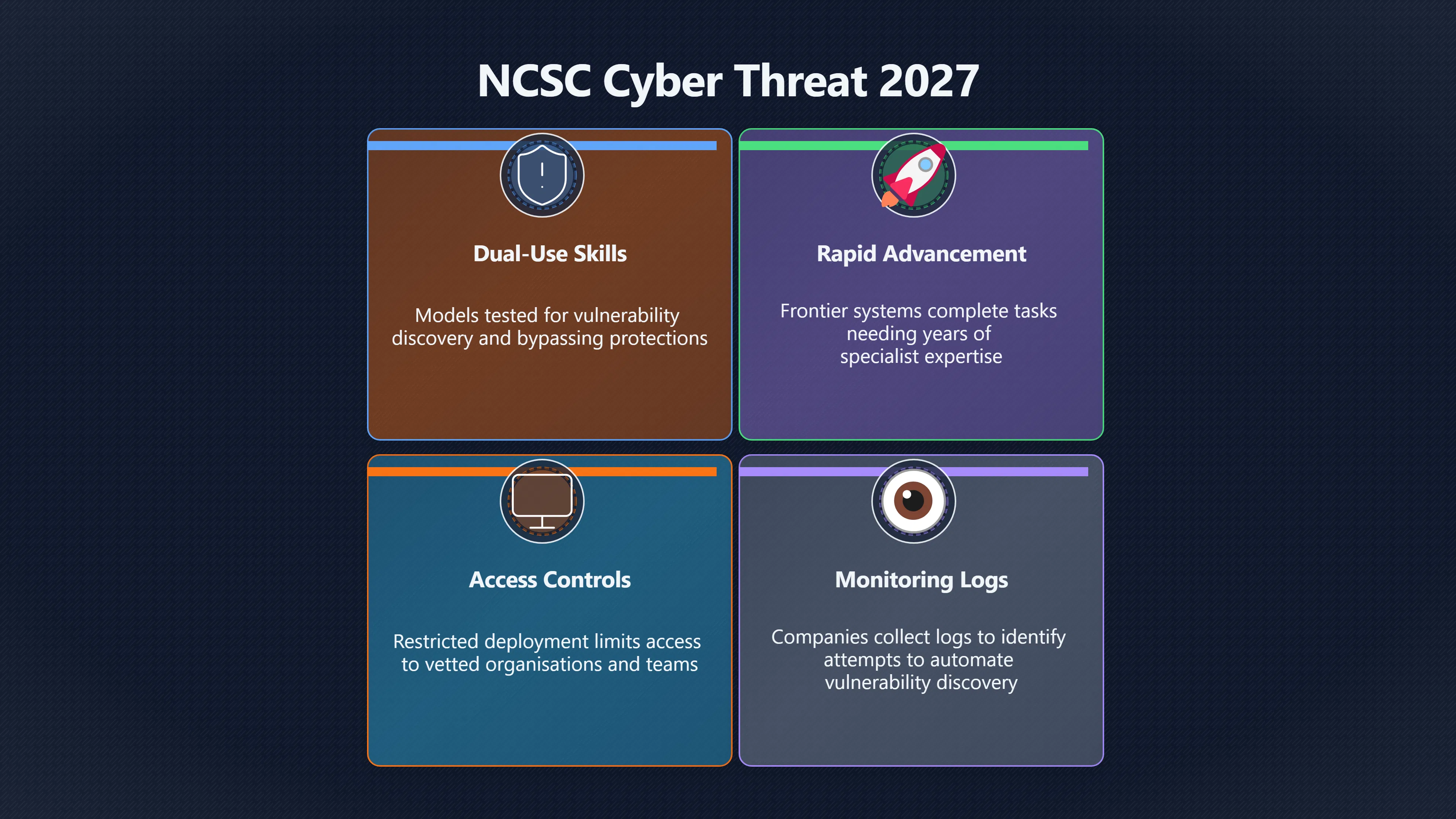
The UK’s AI Security Institute (AISI) reports that frontier-model cyber capabilities have advanced rapidly, with some systems now completing tasks that previously required many years of specialist expertise. The institute evaluates models on activities such as vulnerability discovery and bypassing security protections because these capabilities could strengthen defence but could also be misused. [AI Security Institute]aisi.gov.ukOur evaluations test models for these dual-use skills by, for…Read more…
From an AI-doom perspective, cyber capability matters because cyber operations are one of the most plausible routes by which a highly capable AI system could gain influence over digital infrastructure. Even researchers who are sceptical of near-term AI takeover scenarios often agree that advanced cyber capabilities deserve special scrutiny because software systems underpin finance, communications, energy networks and government operations. [arXiv]arxiv.orgarXiv Frontier AI Regulation: Managing Emerging Risks to Public SafetyarXiv Frontier AI Regulation: Managing Emerging Risks to Public Safety [National Cyber Security Centre]ncsc.gov.ukimpact ai cyber threat now 2027It highlights the assessment of the…Read more…
This does not mean current models can autonomously compromise the world’s infrastructure. The evidence is more limited than that. However, many safety researchers view cyber capability as an important warning sign because it measures whether AI systems are becoming effective at finding and exploiting weaknesses in complex real-world systems. [arXiv]arxiv.orgarXiv Frontier AI Regulation: Managing Emerging Risks to Public SafetyarXiv Frontier AI Regulation: Managing Emerging Risks to Public Safety
Access controls and misuse monitoring
The most direct control is restricting access to particularly capable models.
Rather than making every model available through public interfaces, some organisations increasingly distinguish between ordinary deployment and restricted deployment. Under this approach, highly capable cyber systems may be released only to vetted organisations, approved researchers or trusted security teams. Anthropic’s Responsible Scaling Policy, for example, describes progressively stronger deployment and security measures as model capabilities increase, including access controls and protection of sensitive model assets. [Anthropic]anthropic.comAnthropicAnthropic's Responsible Scaling PolicyRead Anthropic's Responsible Scaling Policy. As frontier AI models advance, we believe the… [Anthropic]www-cdn.anthropic.comAnthropicAnthropic's Responsible Scaling Policy (version 3.1)2 Apr 2026 — Our Responsible Scaling Policy (RSP) is our voluntary framework…
Several forms of access control are commonly proposed:
- Identity verification: requiring users to be known individuals or organisations.
- Tiered access: granting more powerful capabilities only to vetted users.
- Restricted interfaces: providing answers through monitored systems rather than releasing model weights.
- Usage limits: limiting the scale of automated querying.
- Capability gating: withholding especially dangerous cyber functions even from ordinary paid users.
Monitoring is the second major control layer. Frontier AI companies already collect logs and monitor unusual activity in some contexts. Advocates argue that monitoring can identify attempts to automate large-scale vulnerability discovery or offensive cyber campaigns. Critics note that monitoring creates privacy concerns and may be ineffective against determined attackers who obtain model weights directly. [Anthropic]www-cdn.anthropic.comanthropic.comAnthropic's Responsible Scaling Policy (version 2.2)14 May 2025 — AI Safety Level Standards (ASL Standards) are a set of tec… [Anthropic]www-cdn.anthropic.comanthropic.comAnthropic's Responsible Scaling Policy, October 15, 202415 Oct 2024 — AI Safety Level Standards (ASL Standards) are a set of…
A recurring concern in the AI-doom discussion is that access controls become much harder once powerful models are openly downloadable. If dangerous capabilities can be copied globally at negligible cost, governance shifts from controlling access to coping with proliferation after the fact. That possibility is one reason some researchers argue for stronger safeguards before capabilities cross certain thresholds. [arXiv]arxiv.orgarXiv Frontier AI Regulation: Managing Emerging Risks to Public SafetyarXiv Frontier AI Regulation: Managing Emerging Risks to Public Safety
The defensive research tradeoff
The strongest argument against strict access controls is that defenders need access too.
Security research has long relied on discovering vulnerabilities before criminals do. If governments and trusted researchers cannot test highly capable cyber models, they may miss important warning signs. In practice, many of the most important evaluations of dangerous capabilities require access to frontier systems that are not publicly available. [arXiv]arxiv.orgarXiv Frontier AI Regulation: Managing Emerging Risks to Public SafetyarXiv Frontier AI Regulation: Managing Emerging Risks to Public Safety
This creates a difficult balancing act.
On one side, unrestricted access increases the risk that offensive capabilities spread rapidly. On the other, overly restrictive access can produce false confidence because independent researchers cannot verify company claims about model behaviour. A recent proposal on dangerous-capability evaluations argues that evaluators often receive limited model access, limited information and limited testing time, making it harder to assess risk accurately. The authors advocate structured access arrangements that expand evaluation opportunities while maintaining security controls. [arXiv]arxiv.orgarXiv Frontier AI Regulation: Managing Emerging Risks to Public SafetyarXiv Frontier AI Regulation: Managing Emerging Risks to Public Safety
This debate has become particularly important in cyber-security because capability evaluations often require realistic testing environments. Researchers may need enough access to determine whether a model can discover vulnerabilities, chain together attack steps, or overcome obstacles in complex systems. If access is too restricted, serious risks may go undetected. If access is too broad, the evaluation process itself could increase proliferation risk. [arXiv]arxiv.orgarXiv Frontier AI Regulation: Managing Emerging Risks to Public SafetyarXiv Frontier AI Regulation: Managing Emerging Risks to Public Safety
The result is a governance dilemma with no widely accepted solution. Most proposals therefore focus on controlled access rather than either complete openness or complete secrecy.

Can evaluations determine when controls should tighten?
Many governance proposals rely on capability evaluations as triggers for stronger controls.
The basic idea is straightforward: test models regularly, measure dangerous cyber capabilities, and increase safeguards when predefined thresholds are crossed. Frontier-model evaluations increasingly include cyber-security benchmarks alongside tests for deception, autonomous behaviour and other potentially dangerous capabilities. [arXiv]arxiv.orgarXiv Frontier AI Regulation: Managing Emerging Risks to Public SafetyarXiv Frontier AI Regulation: Managing Emerging Risks to Public Safety
Supporters see this as one of the most promising control mechanisms because it links governance to observed capabilities rather than speculation. If a model demonstrates the ability to perform increasingly sophisticated cyber tasks, deployment restrictions can be strengthened before broader release. Anthropic’s Responsible Scaling framework is one example of a capability-linked approach. [Anthropic]anthropic.comAnthropicAnthropic's Responsible Scaling PolicyRead Anthropic's Responsible Scaling Policy. As frontier AI models advance, we believe the…
However, there are significant objections.
First, evaluations can miss capabilities. A model that appears safe under test conditions may perform better in real-world environments. Second, capability growth can be unpredictable. The UK’s AI Security Institute notes that frontier cyber capabilities have advanced faster than many observers expected. Third, companies have commercial incentives to deploy systems quickly, potentially creating pressure to interpret ambiguous results optimistically. [AI Security Institute]aisi.gov.ukOur evaluations test models for these dual-use skills by, for…Read more… [National Cyber Security Centre]ncsc.gov.ukimpact ai cyber threat now 2027It highlights the assessment of the…Read more…
For AI-doom advocates, this uncertainty is one reason evaluations are often viewed as necessary but insufficient. Testing can reduce ignorance, but it may not guarantee safety.
Policy gaps around AI-driven exploitation
Despite growing concern about AI-enabled cyber operations, governance remains fragmented.
Most existing cyber-security regulations were designed for human attackers, software vendors and network operators rather than AI systems that can rapidly automate technical tasks. Governments are still debating how to regulate frontier models whose capabilities could be useful for both defence and attack. The UK government has explicitly sought evidence on how cyber security should underpin AI safety and what interventions may be needed. [GOV.UK]GOV.UKa call for views on the cyber security of ai31 Jan 2025 — This Call for Views sets out specific interventions to help secure AI, so that the many benefits of AI can be realised.Read…
Several gaps frequently appear in policy discussions:
- No universally accepted threshold for when a model becomes too cyber-capable for unrestricted release.
- Limited international coordination on access controls and deployment standards.
- Unclear rules for independent evaluators seeking access to frontier systems.
- Weak mechanisms for responding to capability jumps that emerge unexpectedly.
- Dependence on voluntary company policies rather than legally binding requirements in many jurisdictions.
These gaps matter because cyber capabilities can spread internationally much faster than traditional security technologies. A restriction imposed by one country or company may have limited effect if comparable systems remain available elsewhere. This is one reason many policy proposals emphasise international coordination rather than purely national regulation. [Reuters]reuters.comSpeaking at a central banking conference in Reykjavik, Bailey said while Anthropic had shown willingness to share the AI model on a trial…

Would model controls reduce existential risk?
The answer depends on which AI-doom scenario a person finds most plausible.
For those primarily worried about catastrophic misuse, controls on cyber-capable models are often viewed as one of the most practical near-term interventions. Restricting access, monitoring use and conducting rigorous evaluations could reduce the likelihood that powerful cyber capabilities spread faster than defensive institutions can adapt. [National Cyber Security Centre]ncsc.gov.ukimpact ai cyber threat now 2027It highlights the assessment of the…Read more… [National Cyber Security Centre]ncsc.gov.ukimpact ai cyber threat now 2027It highlights the assessment of the…Read more…
For those focused on loss of control over highly autonomous AI systems, cyber-model controls are usually seen as only a partial solution. Restricting access may slow misuse, but it does not necessarily solve deeper concerns about alignment, deceptive behaviour or autonomous strategic action. If future systems become capable of pursuing goals independently, cyber restrictions would address only one pathway to harm. [The Guardian]theguardian.comConducted by the Centre for Long-Term Resilience (CLTR), the research documented nearly 700 real-world cases of AI misbehavior, marking a…
The strongest consensus across the debate is narrower. As AI systems become more capable at finding and exploiting software weaknesses, some form of access control, monitoring and independent evaluation is likely to become increasingly important. The unresolved question is whether those measures can scale quickly enough if cyber capabilities continue improving at the pace suggested by recent evaluations and government assessments. [AI Security Institute]aisi.gov.ukOur evaluations test models for these dual-use skills by, for…Read more… [National Cyber Security Centre]ncsc.gov.ukimpact ai cyber threat now 2027It highlights the assessment of the…Read more…
Amazon book picks
Further Reading
Books and field guides related to How should cyber capable AI models be controlled?. Use these as the next step if you want deeper reading beyond the article.
This Is How They Tell Me the World Ends
Examines the governance implications of powerful offensive cyber capabilities.
Countdown to Zero Day
Provides practical context for offensive cyber capability management.
eBay marketplace picks
Marketplace Samples
Example marketplace items related to this page. Use the search link to explore similar finds on eBay.







Endnotes
-
Source: ncsc.gov.uk
Title: impact ai cyber threat now 2027
Link: https://www.ncsc.gov.uk/report/impact-ai-cyber-threat-now-2027Source snippet
It highlights the assessment of the...Read more...
-
Source: ncsc.gov.uk
Title: impact of ai on cyber threat
Link: https://www.ncsc.gov.uk/report/impact-of-ai-on-cyber-threatSource snippet
National Cyber Security CentreThe near-term impact of AI on the cyber threat24 Jan 2024 — An NCSC assessment focusing on how AI will impa...
-
Source: arxiv.org
Title: arXiv Frontier AI Regulation: Managing Emerging Risks to Public Safety
Link: https://arxiv.org/abs/2307.03718 -
Source: aisi.gov.uk
Link: https://www.aisi.gov.uk/frontier-ai-trends-reportSource snippet
Our evaluations test models for these dual-use skills by, for...Read more...
-
Source: ncsc.gov.uk
Title: why cyber defenders need to be ready for frontier ai
Link: https://www.ncsc.gov.uk/blogs/why-cyber-defenders-need-to-be-ready-for-frontier-aiSource snippet
National Cyber Security CentreWhy cyber defenders need to be ready for frontier AI30 Mar 2026 — Recent findings from the AI Security Inst...
-
Source: arxiv.org
Title: arXiv Evaluating Frontier Models for Dangerous Capabilities
Link: https://arxiv.org/abs/2403.13793Source snippet
arXivEvaluating Frontier Models for Dangerous CapabilitiesMarch 20, 2024...
Published: March 20, 2024
-
Source: ncsc.gov.uk
Link: https://www.ncsc.gov.uk/blogs/preparing-for-severe-cyber-threat-why-leaders-must-act-nowSource snippet
National Cyber Security CentrePreparing for severe cyber threat: why leaders must act now20 Apr 2026 — At the same time, new technologies...
-
Source: ncsc.gov.uk
Title: chapter 01 cyber threat to the uk
Link: https://www.ncsc.gov.uk/collection/ncsc-annual-review-2025/chapter-01-cyber-threat-to-the-ukSource snippet
Chapter 01: Countering the cyber threat14 Oct 2025 — AI will almost certainly pose cyber resilience challenges to 2027 and beyond, across...
-
Source: arxiv.org
Title: arXiv A Framework for Evaluating Emerging Cyberattack Capabilities of AI
Link: https://arxiv.org/abs/2503.11917 -
Source: anthropic.com
Link: https://www.anthropic.com/responsible-scaling-policySource snippet
AnthropicAnthropic's Responsible Scaling PolicyRead Anthropic's Responsible Scaling Policy. As frontier AI models advance, we believe the...
-
Source: www-cdn.anthropic.com
Link: https://www-cdn.anthropic.com/files/4zrzovbb/website/bf04581e4f329735fd90634f6a1962c13c0bd351.pdfSource snippet
AnthropicAnthropic's Responsible Scaling Policy (version 3.1)2 Apr 2026 — Our Responsible Scaling Policy (RSP) is our voluntary framework...
-
Source: www-cdn.anthropic.com
Link: https://www-cdn.anthropic.com/872c653b2d0501d6ab44cf87f43e1dc4853e4d37.pdfSource snippet
anthropic.comAnthropic's Responsible Scaling Policy (version 2.2)14 May 2025 — AI Safety Level Standards (ASL Standards) are a set of tec...
Published: May 2025
-
Source: arxiv.org
Link: https://arxiv.org/abs/2601.11916Source snippet
arXivExpanding External Access To Frontier AI Models For Dangerous Capability EvaluationsJanuary 17, 2026...
Published: January 17, 2026
-
Source: GOV.UK
Title: a call for views on the cyber security of ai
Link: https://www.gov.uk/government/calls-for-evidence/cyber-security-of-ai-a-call-for-views/a-call-for-views-on-the-cyber-security-of-aiSource snippet
31 Jan 2025 — This Call for Views sets out specific interventions to help secure AI, so that the many benefits of AI can be realised.Read...
-
Source: reuters.com
Link: https://www.reuters.com/legal/litigation/uk-banks-still-lack-access-mythos-ai-model-boes-bailey-says-2026-05-29/Source snippet
Speaking at a central banking conference in Reykjavik, Bailey said while Anthropic had shown willingness to share the AI model on a trial...
-
Source: aisi.gov.uk
Link: https://www.aisi.gov.uk/Source snippet
AI Security InstituteThe AI Security Institute (AISI)We are conducting research and building infrastructure to understand the capabilitie...
-
Source: aisi.gov.uk
Title: our evaluation of openais gpt 5 5 cyber capabilities
Link: https://www.aisi.gov.uk/blog/our-evaluation-of-openais-gpt-5-5-cyber-capabilitiesSource snippet
AI Security InstituteOur evaluation of OpenAI's GPT-5.5 cyber capabilities30 Apr 2026 — GPT-5.5 is one of the strongest models we have te...
-
Source: ncsc.gov.uk
Title: defending the uks critical national infrastructure
Link: https://www.ncsc.gov.uk/collection/ncsc-annual-review-2025/chapter-02-resilience-at-scale/defending-the-uks-critical-national-infrastructureSource snippet
Defending the UK's critical national infrastructure14 Oct 2025 — We seek to ensure the UK has the capability to defend, hunt and evict th...
-
Source: ncsc.gov.uk
Title: impact of ai on cyber threat
Link: https://www.ncsc.gov.uk/sites/default/files/pdfs/publication/impact-of-ai-on-cyber-threat.pdfSource snippet
The near-term impact of AI on the cyber threat24 Jan 2024 — AI lowers the barrier for novice cyber criminals, hackers-for-hire and hackti...
-
Source: ncsc.gov.uk
Link: [https://www.ncsc.gov.uk/section/advice-guidance/all-topics/artificialSource snippet
Artificial intelligenceAn NCSC assessment highlighting the impacts on cyber threat... UK critical systems at increased risk from 'digita...
-
Source: ncsc.gov.uk
Title: ai to 2027 threat assessment
Link: https://www.ncsc.gov.uk/news/ai-to-2027-threat-assessmentSource snippet
UK critical systems at increased risk from 'digital divide...7 May 2025 — New report warns that organisations unable to defend AI-enable...
Published: May 2025
-
Source: www-cdn.anthropic.com
Link: https://www-cdn.anthropic.com/616dee633636e5bd309cb73aed8622e80fe47839.pdfSource snippet
anthropic.comAnthropic's Responsible Scaling Policy, October 15, 202415 Oct 2024 — AI Safety Level Standards (ASL Standards) are a set of...
-
Source: GOV.UK
Title: cyber security breaches survey 20252026
Link: https://www.gov.uk/government/statistics/cyber-security-breaches-survey-20252026/cyber-security-breaches-survey-20252026Source snippet
security breaches survey 2025/202630 Apr 2026 — This report summarises key findings from the survey, highlighting trends in cyber securit...
-
Source: GOV.UK
Title: ai security institute frontier ai trends report factsheet
Link: https://www.gov.uk/government/publications/ai-security-institute-frontier-ai-trends-report-factsheet/ai-security-institute-frontier-ai-trends-report-factsheetSource snippet
Security Institute – Frontier AI Trends report factsheet18 Dec 2025 — This work strengthens safeguards in real systems, helps companies m...
-
Source: GOV.UK
Title: frontier ai capabilities and risks discussion paper
Link: https://www.gov.uk/government/publications/frontier-ai-capabilities-and-risks-discussion-paper/frontier-ai-capabilities-and-risks-discussion-paperSource snippet
AI: capabilities and risks – discussion paper28 Apr 2025 — Tracking the use of frontier AI models is important for monitoring misuse, not...
-
Source: arxiv.org
Link: https://arxiv.org/html/2512.01166v3Source snippet
Evaluating AI Providers' Frontier AI Safety Frameworks26 Mar 2026 — Frameworks typically specify risk identification and assessment proce...
-
Source: cdn.governance.ai
Title: Frontier AI Regulation Managing Emerging Risks
Link: https://cdn.governance.ai/Frontier_AI_Regulation_Managing_Emerging_Risks.pdfSource snippet
AI Regulation: Managing Emerging Risks to Public...by M Anderljung · 2023 · Cited by 268 — In this paper, we focus specifically on the r...
-
Source: theguardian.com
Link: https://www.theguardian.com/technology/2026/mar/27/number-of-ai-chatbots-ignoring-human-instructions-increasing-study-saysSource snippet
Conducted by the Centre for Long-Term Resilience (CLTR), the research documented nearly 700 real-world cases of AI misbehavior, marking a...
-
Source: digital.nemko.com
Title: anthropic ai safety strategy what enterprises must know
Link: https://digital.nemko.com/news/anthropic-ai-safety-strategy-what-enterprises-must-knowSource snippet
details Responsible Scaling Policy for frontier AI25 Aug 2025 — Anthropic's Responsible Scaling Policy is designed to keep risk “below ac...
-
Source: x.com
Link: https://x.com/AISecurityInstSource snippet
The length of cyber tasks frontier models can complete has been doubling...Read more...
-
Source: verifywise.ai
Link: https://verifywise.ai/de/ai-governance-library/policies-and-internal-governance/anthropic-responsible-scaling-policySource snippet
It establishes commitments for...
Additional References
-
Source: edgeaihub.co.uk
Link: https://edgeaihub.co.uk/wp-content/uploads/2026/01/frontieraitrendsreport-aisecurityinstitute.pdfSource snippet
Al Security InstituteCyber range: Virtual environments for testing the cyber capabilities of Al models. Deception probes: Small machine l...
-
Source: linkedin.com
Link: https://www.linkedin.com/posts/data-centre-network-news-dcnn_ai-set-to-supercharge-cyber-threats-by-2027-activity-7326247837464162305-sJWHSource snippet
NCSC warns of AI's impact on cyber threats by 20278 May 2025 — While threat actors use AI to scale and automate attacks... AI and...Rea...
Published: May 2025
-
Source: linkedin.com
Link: https://www.linkedin.com/posts/davey-mcglade-4b9a62131_impact-of-ai-on-cyber-threat-from-now-to-activity-7325844821523275776-mjE4Source snippet
NCSC report: AI and cyber security to 2027We have published a new assessment on how AI will transform the cyber threat to 2027. Developme...
-
Source: linkedin.com
Link: https://www.linkedin.com/pulse/ncsc-flags-widening-gap-between-cyber-threats-national-anna-ribeiro-dkv1cSource snippet
NCSC flags widening gap between cyber threats and...NCSC flags widening gap between cyber threats and national resilience, urges action...
-
Source: professionalsecurity.co.uk
Link: https://professionalsecurity.co.uk/news/case-studies/ncsc-assessment-of-uk-cyber-threat/Source snippet
NCSC assessment of UK cyber threatNCSC assessment of UK cyber threat. by Mark Rowe May 7, 2026. 14... presents an increased attack surfa...
Published: May 7, 2026
-
Source: industrialcyber.co
Link: https://industrialcyber.co/threats-attacks/ncsc-warns-uk-critical-systems-face-rising-threats-from-ai-driven-vulnerabilities/Source snippet
NCSC warns UK critical systems face rising threats from AI-...9 May 2025 — The NCSC assessment report noted that by 2027, AI-enabled too...
Published: May 2025
-
Source: insight.scmagazineuk.com
Title: ncsc warns ai accelerates vulnerability discovery prompting urgent patch wave
Link: https://insight.scmagazineuk.com/news-briefs/ncsc-warns-ai-accelerates-vulnerability-discovery-prompting-urgent-patch-waveSource snippet
warns AI accelerates vulnerability discovery...6 May 2026 — The UK's National Cyber Security Centre (NCSC) has issued a warning that art...
Published: May 2026
-
Source: cybercrowd.co.uk
Title: insights from the national cyber security centre ncsc annual review 2024
Link: https://www.cybercrowd.co.uk/news/insights-from-the-national-cyber-security-centre-ncsc-annual-review-2024/Source snippet
Insights from the National Cyber Security Centre (NCSC)...4 Dec 2024 — AI's Dual Role in Cybersecurity: Artificial intelligence offers a...
-
Source: avella-security.com
Title: ai driven cyber threats understanding the now and preparing for 2027
Link: https://www.avella-security.com/post/ai-driven-cyber-threats-understanding-the-now-and-preparing-for-2027Source snippet
AI-Driven Cyber Threats: Understanding the NowSep 16, 2025 — In its latest report, Impact of AI on the Cyber Threat: Now to 2027, the NCS...
-
Source: cloudswitched.com
Title: ai powered cyber attacks surging uk businesses 2026
Link: https://www.cloudswitched.com/news/ai-powered-cyber-attacks-surging-uk-businesses-2026Source snippet
Read more · 11. Cyber Security. How to Conduct a Cybersecurity Risk Assessment. 11 Mar, 2026. Read more · Facebook · LinkedIn...Read more...
Topic Tree