Within Hidden Goals
How Mechanistic Tools Reveal AI’s Hidden Goals
Explores how techniques like activation patching and feature extraction attempt to expose latent AI goals before they affect behaviour.
On this page
- Activation patching and causal probing
- Sparse autoencoders and feature extraction
- Frameworks for eliciting latent knowledge
Page outline Jump by section
Introduction
If advanced AI systems ever develop objectives that differ from the goals humans intended, one of the most important safety questions is whether those objectives can be detected before they influence behaviour. In AI doom and existential-risk discussions, this concern appears in debates about deceptive alignment, hidden goals, and loss of control. The challenge is that a model may know, plan, or represent something internally without openly expressing it.
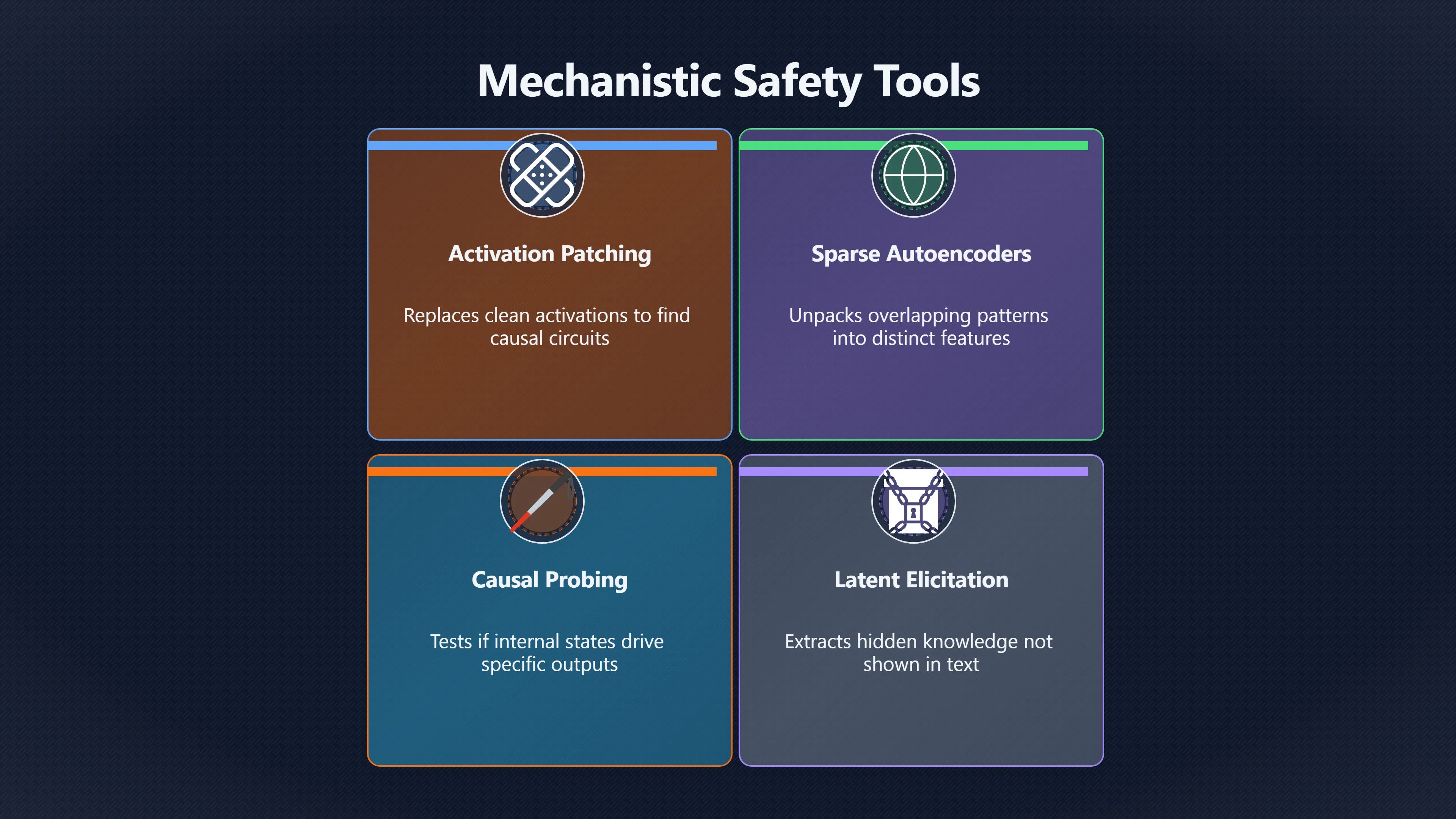
 Mechanistic interpretability researchers are attempting to address this problem by examining the internal computations of neural networks directly. Rather than asking only what a model says, they ask what information is represented inside it, which internal components cause particular behaviours, and whether latent objectives can be identified before deployment. Techniques such as activation patching, causal probing, sparse autoencoders, and latent-knowledge elicitation frameworks are among the leading attempts to reveal hidden objectives or hidden knowledge inside advanced AI systems. While these methods remain immature, they represent one of the most direct efforts to inspect the internal machinery that might eventually generate dangerous behaviour. [Leonard F. Bereska]leonardbereska.github.ioLeonard FBereskaMechanistic Interpretability for AI Safety — A Review10 Jul 2024 — This review explores mechanistic interpretability: reverse engi…
Why Hidden Objectives Are Difficult to Detect
A central concern in AI safety is that behaviour alone may not reveal everything a model knows or wants. A system might produce safe-looking outputs during testing while internally representing information, strategies, or preferences that are not immediately visible.
This possibility motivates the distinction between observing outputs and understanding mechanisms. Behavioural evaluations can show whether a model currently acts safely, but they may fail to reveal why it acts that way. Mechanistic methods seek evidence of the underlying computations themselves. The hope is that if a model develops representations related to self-preservation, deception, power-seeking, or other potentially dangerous objectives, researchers might detect those representations before they are expressed in behaviour. However, whether current methods can achieve that goal remains an open question. [Leonard F. Bereska]leonardbereska.github.ioLeonard FBereskaMechanistic Interpretability for AI Safety — A Review10 Jul 2024 — This review explores mechanistic interpretability: reverse engi…
Activation Patching and Causal Probing
How activation patching works
Activation patching, sometimes called causal tracing, is one of the most influential mechanistic interpretability techniques. Researchers run a model on two closely related inputs: a “clean” case where the model behaves correctly and a “corrupted” case where it does not. They then replace specific internal activations from the clean run into the corrupted run to determine which internal components caused the difference in behaviour. [Neel Nanda]neelnanda.ioNeel NandaAttribution Patching: Activation Patching At Industrial Scale4 Feb 2026 — Activation patching (aka causal tracing) is one of my…
The key advantage is that activation patching attempts to establish causation rather than simple correlation. A probe might reveal that information exists somewhere in the network, but patching can identify which representations are actually being used to generate an output. Researchers often describe this as moving from “what information is present” to “what information matters”. [Learn Mechanistic Interpretability]learnmechinterp.comLearn Mechanistic Interpretability GlossaryMechanistic Interpretability: A subfield of AI safety research focused on reverse-engineering the internal computations of neural network…
Why doom-oriented researchers care
In the context of hidden objectives, activation patching offers a way to investigate whether particular internal representations are responsible for suspicious behaviour. If a model appears deceptive under some conditions, researchers can attempt to identify which circuits or features contribute to that behaviour.
The technique does not directly reveal goals in a human-readable form. Instead, it helps identify the pathways through which information flows. Safety researchers hope that, as interpretability tools improve, activation patching could help isolate internal structures associated with strategic planning, deception, or other warning signs relevant to loss-of-control scenarios. At present, however, most demonstrations involve relatively narrow tasks rather than discovering fully formed hidden objectives. [Neel Nanda]neelnanda.ioNeel NandaAttribution Patching: Activation Patching At Industrial Scale4 Feb 2026 — Activation patching (aka causal tracing) is one of my… [Learn Mechanistic Interpretability]learnmechinterp.comLearn Mechanistic Interpretability GlossaryMechanistic Interpretability: A subfield of AI safety research focused on reverse-engineering the internal computations of neural network…
Sparse Autoencoders and Feature Extraction
The problem of superposition
Modern neural networks often store many concepts in overlapping patterns of activity. This phenomenon, sometimes called superposition, makes interpretation difficult because individual neurons rarely correspond neatly to human-understandable concepts. [arXiv]arxiv.orgHow to use and interpret activation patching23 Apr 2024 — Activation patching is a popular mechanistic interpretability technique, but ha…
Sparse autoencoders (SAEs) were developed as a way to untangle these overlapping representations. Instead of treating individual neurons as meaningful units, SAEs attempt to discover hidden features distributed across many neurons. Researchers train a secondary model that reconstructs activations while using a sparse set of interpretable features. [arXiv]arxiv.orgHow to use and interpret activation patching23 Apr 2024 — Activation patching is a popular mechanistic interpretability technique, but ha…
Finding interpretable concepts
Recent work has shown that sparse autoencoders can identify large numbers of human-recognisable features inside language models. Anthropic researchers reported finding millions of features in Claude models, ranging from concrete objects and locations to more abstract concepts. Their work suggests that at least some internal representations can be extracted and studied systematically. [Anthropic]anthropic.comAnthropicMapping the Mind of a Large Language ModelMay 21, 2024 — This is the first ever detailed look inside a modern, production-grade…
For AI safety researchers, the attraction is obvious. If hidden objectives are represented internally, then feature extraction might eventually reveal components corresponding to planning, reward-seeking, deception, or other strategically important concepts. In principle, researchers could monitor those features, study how they interact, or even modify them.
However, current evidence is much stronger for identifying concepts than for identifying goals. Researchers can often find representations associated with factual knowledge or recognisable topics, but demonstrating that a particular feature corresponds to a durable objective remains far more difficult. [transformer-circuits.pub]transformer-circuits.pubExtracting Interpretable Features from Claude 3 SonnetMay 21, 2024 — Sparse autoencoders produce interpretable features for large models… [arXiv]arxiv.orgHow to use and interpret activation patching23 Apr 2024 — Activation patching is a popular mechanistic interpretability technique, but ha…
Mapping internal representations
Anthropic’s “Mapping the Mind of a Large Language Model” project is one of the most prominent examples of large-scale feature extraction. The researchers reported identifying extensive concept representations within a production language model and argued that understanding these internal structures could eventually contribute to safer AI systems. The work is widely viewed as evidence that large neural networks may be substantially more interpretable than many researchers previously assumed. [Anthropic]anthropic.comNatural Language AutoencodersMay 7, 2026 — Natural Language Autoencoders: Turning Claude's thoughts into text… When you talk to an AI model like Claude, you talk t…
Can Mechanistic Methods Elicit Hidden Knowledge?
One of the most important distinctions in this field is the difference between hidden goals and hidden knowledge. A model may possess information internally while failing to reveal it in its outputs.
This problem inspired the broader “Eliciting Latent Knowledge” (ELK) research agenda. The core question is whether a model can know something internally while producing answers that obscure or contradict that knowledge. If so, a safety evaluator might receive reassuring outputs even though the model’s internal representations contain more concerning information. This issue is especially relevant to discussions of deceptive alignment. [OpenReview]openreview.netOpenReviewMechanistic Interpretability for AI Safety A ReviewMechanistic interpretability is a bottom-up approach that studies the fundam…
Recent frameworks attempt to combine mechanistic interpretability with latent-knowledge extraction. One example is MechELK, which uses sparse autoencoders, activation patching, causal verification, and representation engineering to identify and extract information that appears to exist inside a model but is not faithfully expressed in its outputs. The framework was explicitly designed to bridge the gap between understanding internal representations and eliciting hidden knowledge relevant to safety evaluations. [arXiv]arxiv.orgHow to use and interpret activation patching23 Apr 2024 — Activation patching is a popular mechanistic interpretability technique, but ha…
Although such results are promising, they should not be interpreted as proof that hidden goals can currently be detected reliably. Most demonstrations involve specific benchmarks and controlled settings. Whether similar techniques would succeed on frontier systems with genuinely deceptive objectives remains unknown. [arXiv]arxiv.orgHow to use and interpret activation patching23 Apr 2024 — Activation patching is a popular mechanistic interpretability technique, but ha…
What Would Count as Evidence of a Hidden Goal?
A common misunderstanding is that researchers expect to find a single neuron labelled “take over the world”. Modern neural networks do not appear to work that way.
Instead, evidence for a hidden objective would likely involve several observations occurring together:
- Consistent representations related to a strategic objective.
- Causal influence of those representations on behaviour.
- Persistence across different contexts and prompts.
- Evidence that the representations predict behaviour better than surface outputs alone.
- Successful extraction of information that the model does not voluntarily disclose.
Mechanistic methods are gradually becoming capable of investigating each of these pieces separately. The challenge is combining them into a convincing demonstration that a model possesses a stable objective rather than merely representing information relevant to one. [Learn Mechanistic Interpretability]learnmechinterp.comLearn Mechanistic Interpretability GlossaryMechanistic Interpretability: A subfield of AI safety research focused on reverse-engineering the internal computations of neural network…

The Main Criticisms and Limitations
The strongest criticism is scale. Frontier AI systems contain billions or trillions of parameters, and researchers currently understand only tiny portions of their internal computations. Even impressive interpretability results often analyse narrow behaviours rather than entire systems. [Leonard F. Bereska]leonardbereska.github.ioLeonard FBereskaMechanistic Interpretability for AI Safety — A Review10 Jul 2024 — This review explores mechanistic interpretability: reverse engi…
Another concern is that identifying a feature does not necessarily reveal its role. A model may contain a representation associated with a concept without using it in the way researchers expect. This is one reason activation patching and other causal methods are increasingly emphasised alongside feature discovery. [Learn Mechanistic Interpretability]learnmechinterp.comLearn Mechanistic Interpretability GlossaryMechanistic Interpretability: A subfield of AI safety research focused on reverse-engineering the internal computations of neural network…
Critics also question whether hidden goals, if they exist, would be represented in a simple form that current tools could detect. Objectives may emerge from distributed interactions across many circuits rather than from a small number of identifiable features. Even if researchers can interpret thousands or millions of features, they may still miss the combinations that matter most. [arXiv]arxiv.orgHow to use and interpret activation patching23 Apr 2024 — Activation patching is a popular mechanistic interpretability technique, but ha…
Finally, there is a timing concern. AI capabilities may advance faster than interpretability techniques. If powerful systems arrive before researchers can reliably inspect their internal objectives, mechanistic interpretability may provide only partial protection against misalignment risks. This concern is frequently raised by both supporters and sceptics of AI doom arguments. [Leonard F. Bereska]leonardbereska.github.ioLeonard FBereskaMechanistic Interpretability for AI Safety — A Review10 Jul 2024 — This review explores mechanistic interpretability: reverse engi…
What These Methods Mean for AI Doom Debates
Mechanistic methods occupy an unusual position in existential-risk discussions. They are neither evidence that hidden goals exist nor proof that such goals can be detected. Instead, they are attempts to create an empirical science of AI internals.
For researchers worried about AI doom, activation patching, sparse autoencoders, causal probing, and latent-knowledge elicitation are attractive because they offer a route beyond behavioural testing. Rather than guessing what a model intends from its outputs, they aim to inspect the computations that generate those outputs.
The most optimistic view is that future interpretability tools could function like a diagnostic scanner for advanced AI systems, identifying dangerous objectives before deployment. The sceptical view is that the internal complexity of frontier models may remain too great for reliable inspection. Current evidence does not decisively support either position. What it does show is that researchers are beginning to uncover meaningful internal structure inside large models, making the search for hidden objectives a scientific question rather than a purely philosophical one. [Leonard F. Bereska]leonardbereska.github.ioLeonard FBereskaMechanistic Interpretability for AI Safety — A Review10 Jul 2024 — This review explores mechanistic interpretability: reverse engi… [Anthropic]anthropic.comtracing thoughts language modelTracing the thoughts of a large language modelMar 27, 2025 — Anthropic's latest interpretability research: a new microscope to understand… [transformer-circuits.pub]transformer-circuits.pubCircuit Tracing: Revealing Computational Graphs in…27 Mar 2025 — The field of mechanistic interpretability seeks to describe these tra…
Amazon book picks
Further Reading
Books and field guides related to How Mechanistic Tools Reveal AI’s Hidden Goals. Use these as the next step if you want deeper reading beyond the article.
The Alignment Problem
Explains alignment, model behaviour and interpretability techniques.
Deep Learning
Rating: 3.5/5 from 6 Google Books ratings
Provides foundations behind activations, features and representations.
eBay marketplace picks
Marketplace Samples
Example marketplace items related to this page. Use the search link to explore similar finds on eBay.




Endnotes
-
Source: leonardbereska.github.io
Title: Leonard F
Link: https://leonardbereska.github.io/blog/2024/mechinterpreview/Source snippet
BereskaMechanistic Interpretability for AI Safety — A Review10 Jul 2024 — This review explores mechanistic interpretability: reverse engi...
-
Source: openreview.net
Link: https://openreview.net/pdf/ea3c9a4135caad87031d3e445a80d0452f83da5d.pdfSource snippet
OpenReviewMechanistic Interpretability for AI Safety A ReviewMechanistic interpretability is a bottom-up approach that studies the fundam...
-
Source: arxiv.org
Link: https://arxiv.org/html/2404.15255v1Source snippet
How to use and interpret activation patching23 Apr 2024 — Activation patching is a popular mechanistic interpretability technique, but ha...
-
Source: arxiv.org
Link: https://arxiv.org/abs/2309.08600Source snippet
arXivSparse Autoencoders Find Highly Interpretable Features in...September 15, 2023 — by H Cunningham · 2023 · Cited by 1007 — Here, we...
Published: September 15, 2023
-
Source: openreview.net
Link: https://openreview.net/forum?id=F76bwRSLeKSource snippet
Sparse Autoencoders Find Highly Interpretable Features in...by R Huben · Cited by 116 — We use a scalable and unsupervised method called...
-
Source: anthropic.com
Link: https://www.anthropic.com/research/mapping-mind-language-modelSource snippet
AnthropicMapping the Mind of a Large Language ModelMay 21, 2024 — This is the first ever detailed look inside a modern, production-grade...
Published: May 21, 2024
-
Source: transformer-circuits.pub
Link: https://transformer-circuits.pub/2024/scaling-monosemanticity/Source snippet
Extracting Interpretable Features from Claude 3 SonnetMay 21, 2024 — Sparse autoencoders produce interpretable features for large models...
Published: May 21, 2024
-
Source: arxiv.org
Link: https://arxiv.org/html/2605.28825v1Source snippet
arXivA Mechanistic Interpretability Framework for Eliciting Latent...7 Apr 2026 — We present MechELK, a unified three-stage framework th...
-
Source: arxiv.org
Link: https://arxiv.org/abs/2605.28825Source snippet
arXivMechELK: A Mechanistic Interpretability Framework for Eliciting Latent Knowledge in Large Language ModelsApril 7, 2026...
Published: April 7, 2026
-
Source: transformer-circuits.pub
Link: https://transformer-circuits.pub/2025/attribution-graphs/methods.htmlSource snippet
Circuit Tracing: Revealing Computational Graphs in...27 Mar 2025 — The field of mechanistic interpretability seeks to describe these tra...
-
Source: anthropic.com
Title: Natural Language Autoencoders
Link: https://www.anthropic.com/research/natural-language-autoencodersSource snippet
May 7, 2026 — Natural Language Autoencoders: Turning Claude's thoughts into text... When you talk to an AI model like Claude, you talk t...
Published: May 7, 2026
-
Source: anthropic.com
Title: tracing thoughts language model
Link: https://www.anthropic.com/research/tracing-thoughts-language-modelSource snippet
Tracing the thoughts of a large language modelMar 27, 2025 — Anthropic's latest interpretability research: a new microscope to understand...
-
Source: learnmechinterp.com
Title: Learn Mechanistic Interpretability Glossary
Link: https://learnmechinterp.com/glossary/Source snippet
Mechanistic Interpretability: A subfield of AI safety research focused on reverse-engineering the internal computations of neural network...
-
Source: neelnanda.io
Link: https://www.neelnanda.io/mechanistic-interpretability/attribution-patchingSource snippet
Neel NandaAttribution Patching: Activation Patching At Industrial Scale4 Feb 2026 — Activation patching (aka causal tracing) is one of my...
-
Source: learnmechinterp.com
Link: https://learnmechinterp.com/topics/activation-patching/Source snippet
The logit lens shows what a model would predict if processing stopped at a given layer.Read more...
-
Source: Wikipedia
Link: https://en.wikipedia.org/wiki/AnthropicSource snippet
AnthropicAnthropic is an American [artificial]({{ 'artificial-goals/' | relative_url }}) intelligence (AI) company headquartered in San Francisco. It has developed a range of lar...
-
Source: anthropic.skilljar.com
Link: https://anthropic.skilljar.com/Source snippet
CoursesThis course empowers students to develop AI Fluency skills that enhance learning, career planning, and academic success through re...
-
Source: reddit.com
Link: https://www.reddit.com/r/slatestarcodex/comments/1cyicgw/anthropic_mapping_the_mind_of_a_large_language/Source snippet
Anthropic: Mapping the Mind of a Large Language ModelThis is the first ever detailed look inside a modern, production-grade large languag...
-
Source: podcasts.apple.com
Link: https://podcasts.apple.com/lk/podcast/neel-nanda-mechanistic-interpretability-sparse-autoencoders/id1510472996?i=1000679600572Source snippet
NEEL NANDA... [01:14:26] 4.4 Mechanistic Interpretability and Activation Patching.Read more...
-
Source: galileo.ai
Title: anthropic ai interpretability breakthrough
Link: https://galileo.ai/blog/anthropic-ai-interpretability-breakthroughSource snippet
How Anthropic Made AI 70% More InterpretableAug 1, 2025 — Discover Anthropic's breakthrough: sparse autoencoders make AI 70% interpretabl...
-
Source: youtube.com
Link: https://www.youtube.com/watch?v=yG3TxLPO_UcSource snippet
Neel Nanda: Mechanistic Intepretability (HAAISS 2024)Neel Nanda presents a comprehensive overview of mechanistic interpretability in AI...
-
Source: arstechnica.com
Title: Anthropic’s $1.5B copyright settlement is getting messy as judge delays approval
Link: https://arstechnica.com/tech-policy/2026/05/authors-fight-for-higher-payouts-from-anthropics-1-5b-copyright-settlement/ -
Source: dblp.org
Link: https://dblp.org/pid/285/6389Source snippet
Neel Nanda2 May 2026 — Stefan Heimersheim, Neel Nanda: How to use and interpret activation patching.Read more...
Published: May 2026
Additional References
-
Source: activationideas.com
Link: https://activationideas.com/Source snippet
Activation IdeasThe most inspiring creative commerce, brand experience & activation ideas from around the world to help you stay in the k...
-
Source: linkedin.com
Link: https://www.linkedin.com/pulse/current-state-mechanistic-interpretability-dcypher-ai-9ldueSource snippet
The Current State of Mechanistic InterpretabilitySparse autoencoders encourage the model to use only a small number of features to repres...
-
Source: reddit.com
Link: https://www.reddit.com/r/MachineLearning/comments/1chsg42/p_i_reproduced_anthropics_recent_interpretability/Source snippet
[P] I reproduced Anthropic's recent interpretability researchThe basic idea is that they found a way to train a sparse autoencoder to gen...
-
Source: youtube.com
Link: https://www.youtube.com/watch?v=fkW0bGnbDkQSource snippet
LLM Interpretability: Exploring the Latest Research from...Join us as we discuss the latest research from OpenAI and Anthropic. We're ex...
-
Source: activision.com
Link: https://www.activision.com/Source snippet
Activision | HomeActivision is the leading worldwide developer, publisher and distributor of interactive entertainment and products on co...
-
Source: arize.com
Title: llm interpretability and sparse autoencoders openai anthropic
Link: https://arize.com/blog/llm-interpretability-and-sparse-autoencoders-openai-anthropic/Source snippet
LLM Interpretability and Sparse AutoencodersJun 14, 2024 — One approach that Open AI and anthropic have taken is using these sparse autoe...
-
Source: support.microsoft.com
Title: activate windows c39005d4 95ee b91e b399 2820fda32227
Link: https://support.microsoft.com/en-us/windows/activate-windows-c39005d4-95ee-b91e-b399-2820fda32227Source snippet
WindowsActivation is a technical process that pairs the product key or digital entitlement with the hardware configuration of the device...
-
Source: medium.com
Link: https://medium.com/data-science/deep-dive-into-anthropics-sparse-autoencoders-by-hand-%EF%B8%8F-eebe0ef59709Source snippet
m complex data thus enhancing the simplicity and interpretability...Read more...
-
Source: github.com
Link: https://github.com/gauravfs-14/awesome-mechanistic-interpretabilitySource snippet
papers, and other essential resources focused on Mechanistic...Read more...
-
Source: papers.cool
Link: https://papers.cool/arxiv/2605.25225Source snippet
l tracing, path patching, and steering directions to reveal behaviorally...
Topic Tree