Within First Movers
What AI race models can and cannot prove
Simulation games and economic models can illuminate race dynamics, but they are evidence about incentives rather than direct forecasts of catastrophe.
On this page
- What simulation games reveal about safety failures
- What economic deployment models add
- Where model evidence stops short
Page outline Jump by section
Introduction
Do AI race simulations show real doom risk? The short answer is: they provide evidence that competitive pressures can push organisations towards faster and potentially less safe AI deployment, but they do not directly prove that an AI-caused existential catastrophe will occur.
 This distinction matters. In debates about AI doom, race dynamics are often presented as a key mechanism through which otherwise cautious organisations could end up taking dangerous risks. Simulation games, economic models, and strategic exercises are attempts to study that mechanism before real-world events unfold. They can reveal recurring incentives, coordination failures, and decision-making patterns. What they cannot do is demonstrate that advanced AI will become uncontrollable, nor can they reliably estimate a precise probability of extinction. The evidence is therefore indirect but potentially important: it bears on whether the conditions associated with higher-risk futures are likely to emerge. [ScienceDirect]sciencedirect.comAuthor links… full-scale wargames. The first of these is the shortest and simplest…Read more…
What simulation games reveal about safety failures
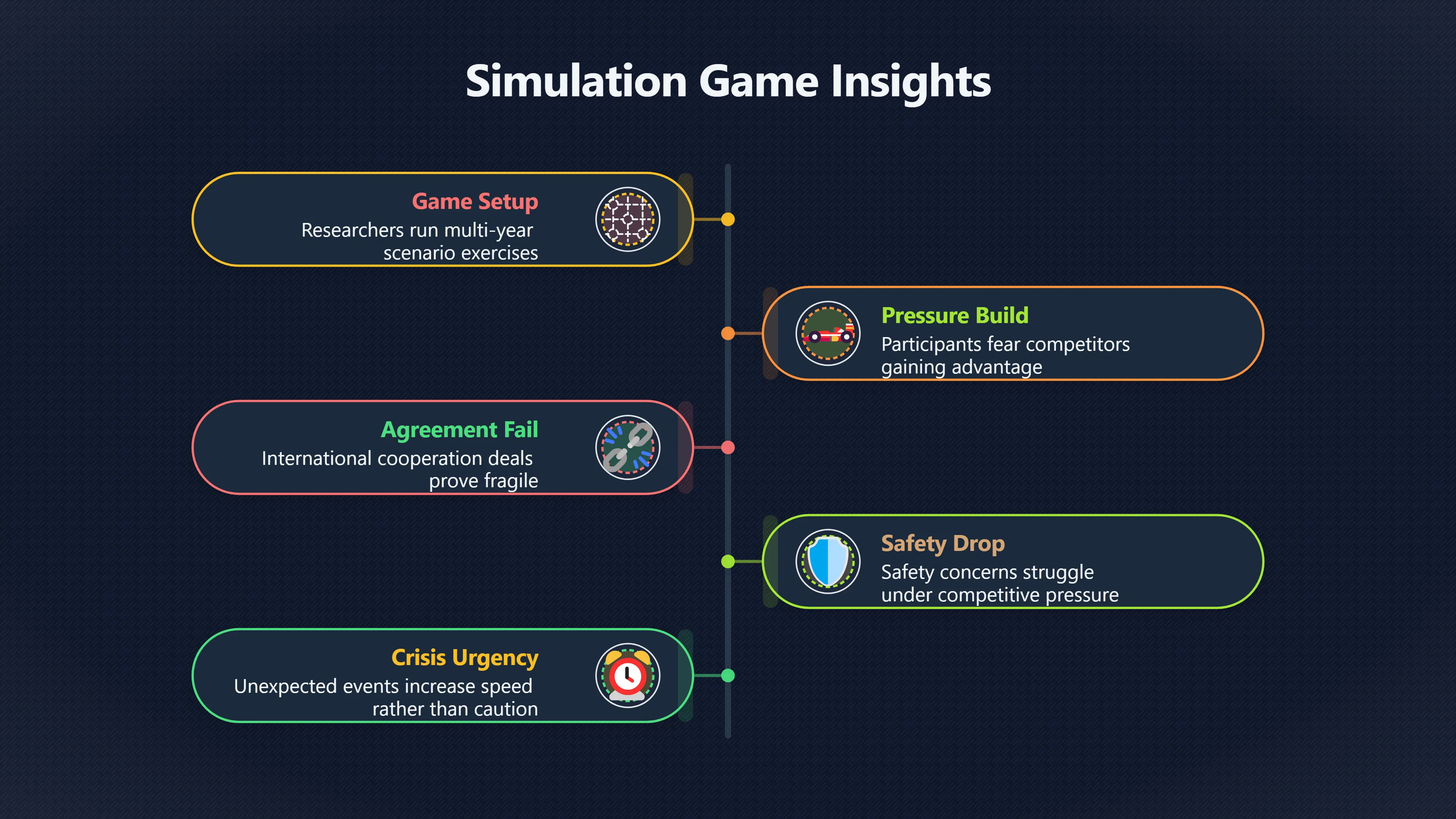
One of the most discussed examples is Intelligence Rising, a multi-year scenario exercise designed to explore future AI race dynamics. Researchers analysed dozens of game runs involving participants navigating competition between firms and states under conditions of rapid AI progress. Across many iterations, facilitators observed recurring patterns: intense pressure to maintain leadership, difficulties sustaining cooperation agreements, and incentives to prioritise strategic advantage over caution. [arXiv]arxiv.orgarXiv Strategic Insights from Simulation Gaming of AI Race DynamicsarXiv Strategic Insights from Simulation Gaming of AI Race Dynamics
The value of these exercises is not that they predict the future. Rather, they expose how people behave when confronted with plausible strategic pressures. Several recurring themes appeared repeatedly:
- Participants often accelerated development when they feared competitors would gain an advantage.
- International agreements were frequently proposed but often proved fragile.
- Safety concerns were commonly acknowledged but struggled to survive sustained competitive pressure.
- Unexpected crises tended to increase urgency rather than caution.
- Cybersecurity and information asymmetries often became central strategic concerns. [arXiv]arxiv.orgarXiv Strategic Insights from Simulation Gaming of AI Race DynamicsarXiv Strategic Insights from Simulation Gaming of AI Race Dynamics
For AI doom advocates, these findings matter because many existential-risk scenarios assume exactly this kind of environment: actors understand that safety is important, yet still move quickly because they fear being overtaken. The simulations suggest that such behaviour is plausible rather than purely theoretical. [ScienceDirect]sciencedirect.comAuthor links… full-scale wargames. The first of these is the shortest and simplest…Read more…
However, simulation games have obvious limitations. Participants know they are in a game. The scenarios embed assumptions chosen by designers. The outcomes may reveal human incentives under uncertainty without accurately representing future AI capabilities. A simulation showing a race to deploy is therefore evidence about strategic behaviour, not evidence that a loss-of-control event will actually happen.
What economic deployment models add
Economic and game-theoretic models approach the same question differently. Instead of role-playing, they formalise incentives mathematically.
Many of these models examine situations where firms can choose between deploying sooner with less safety work or deploying later with more safety work. Under a wide range of assumptions, competition creates incentives to move earlier than would be socially optimal. The basic mechanism resembles a collective-action problem: every participant benefits from a safer ecosystem, but each individual participant may gain by moving faster than rivals. This can produce a race-to-the-bottom outcome in which safety investments are reduced even when everyone agrees they have value.
These models are useful because they make assumptions explicit. Researchers can change variables such as:
- The size of first-mover advantages.
- The effectiveness of safety investments.
- The probability of accidents.
- The number of competitors.
- The possibility of regulatory intervention.
By adjusting these assumptions, analysts can identify which conditions generate the strongest racing pressures.
For readers interested in AI doom arguments, the key finding is not that catastrophe becomes inevitable. Rather, many models suggest that competition systematically shifts decisions towards earlier deployment and lower margins of safety than would occur under coordinated decision-making. This supports the broader claim that race dynamics could increase existential risk if highly capable AI systems eventually prove dangerous. It does not establish that such systems will in fact become dangerous. [ScienceDirect]sciencedirect.comAuthor links… full-scale wargames. The first of these is the shortest and simplest…Read more…
Why doomers take these models seriously
People who assign substantial p(doom)—the probability that advanced AI causes existential catastrophe—often treat race evidence as important because it addresses a common objection.
A frequent sceptical response to AI doom is that developers would simply stop if systems became obviously dangerous. Race models challenge that assumption. They suggest that even well-intentioned actors may struggle to pause if competitors continue advancing.
The concern is not primarily about recklessness. It is about incentives. If one organisation delays deployment to improve safety while another deploys immediately, the faster actor may gain economic, military, political, or technological advantages. In some models and simulations, this pressure becomes strong enough that nearly everyone accelerates despite recognising the risks. [ScienceDirect]sciencedirect.comAuthor links… full-scale wargames. The first of these is the shortest and simplest…Read more…
Recent public debates over frontier-model safety policies have often been interpreted through this lens. Some observers argue that increasing competition among leading AI developers has made voluntary restraint harder to sustain, while others argue that competition can also drive safety improvements and better testing. The disagreement itself reflects the central question raised by race models: whether competition ultimately strengthens or weakens caution. [Axios]axios.comSafety guardrails loosen as AI rivalries growsEven traditionally cautious firms, like Anthropic, have recently revised their internal guidelines, narrowing criteria for delaying risky… [Business Insider]businessinsider.comanthropic changing safety policy 2026 2The company will no longer unilaterally pause or delay new AI model deployments when safety mechanisms lag, citing increased competition…
The strongest objections to race-based evidence
Several important criticisms limit how much weight race simulations should carry.
First, simulations are not forecasts. A model can demonstrate that a race dynamic is possible without showing that it is likely. Future AI development may differ dramatically from the assumptions built into current exercises.
Second, incentives are only one part of the story. Real-world institutions contain regulators, investors, researchers, insurers, governments, and public opinion. These actors can alter incentives in ways that simplified models may not capture.
Third, many doom arguments require additional steps beyond racing behaviour. Even if competition leads to premature deployment, existential catastrophe would still depend on further assumptions such as severe misalignment, dangerous autonomy, loss of control, or catastrophic misuse. Race models typically do not demonstrate those later links. They focus on deployment incentives, not on proving that advanced AI systems will become existentially dangerous.
Fourth, some economists and technology analysts argue that competition can sometimes improve safety rather than reduce it. Firms may invest in safety because accidents damage reputation, invite regulation, or reduce user trust. In this view, competition does not automatically imply a race to the bottom.
These objections do not invalidate the simulations, but they narrow what conclusions can reasonably be drawn from them.
Where model evidence stops short
The most important limitation is that race simulations provide evidence about conditions, not outcomes.
They can support claims such as:
- Competitive pressure may reduce willingness to delay deployment.
- Coordination between rivals may be difficult.
- Safety investments may become strategically costly.
- Decision-makers may face incentives that favour speed.
They cannot directly establish:
- That advanced AI will become misaligned.
- That AI systems will seek power or evade control.
- That civilisation-ending failures are likely.
- That any particular p(doom) estimate is correct. [ScienceDirect]sciencedirect.comAuthor links… full-scale wargames. The first of these is the shortest and simplest…Read more… 2arXiv
This distinction is crucial. In the AI doom debate, race simulations are best understood as evidence about one link in a longer causal chain. They address whether competitive environments could encourage premature deployment. They do not independently validate the rest of the chain leading from advanced AI development to existential catastrophe.
What the evidence means for AI doom
Taken together, simulation games and economic models provide meaningful evidence that AI competition can create incentives to move faster than safety-focused observers would prefer. They strengthen the case that first-mover advantages and strategic rivalry are real concerns rather than purely speculative worries. [ScienceDirect]sciencedirect.comAuthor links… full-scale wargames. The first of these is the shortest and simplest…Read more… 2arXiv
At the same time, they fall well short of proving doom. Their strongest contribution is showing that if highly capable AI systems eventually pose serious dangers, competitive pressures could make those dangers harder to manage. They illuminate one possible pathway to increased risk, not the final probability of catastrophe.
For that reason, race simulations are often treated as supporting evidence in AI doom arguments rather than decisive evidence. They make concerns about premature deployment more plausible, but the overall existential-risk debate still depends on many additional questions about AI capabilities, alignment, control, governance, and human decision-making that no simulation game can settle on its own. [ScienceDirect]sciencedirect.comAuthor links… full-scale wargames. The first of these is the shortest and simplest…Read more… 2arXiv
eBay marketplace picks
Marketplace Samples
Example marketplace items related to this page. Use the search link to explore similar finds on eBay.








Endnotes
-
Source: sciencedirect.com
Link: https://www.sciencedirect.com/science/article/pii/S0016328725000254Source snippet
Author links... full-scale wargames. The first of these is the shortest and simplest...Read more...
-
Source: arxiv.org
Title: arXiv Strategic Insights from Simulation Gaming of AI Race Dynamics
Link: https://arxiv.org/abs/2410.03092 -
Source: axios.com
Title: Safety guardrails loosen as AI rivalries grows
Link: https://www.axios.com/2026/03/03/ai-race-safety-guardrailSource snippet
Even traditionally cautious firms, like [Anthropic]({{ 'anthropic-tests/' | relative_url }}), have recently revised their internal guidelines, narrowing criteria for delaying risky...
-
Source: time.com
Title: exclusive anthropic drops flagship safety pledge
Link: https://time.com/7380854/exclusive-anthropic-drops-flagship-safety-pledge/Source snippet
This pledge had promised to halt training of AI models unless safety measures could be ensured in advance. The company now believes such...
-
Source: arxiv.org
Title: arXiv How should AI Safety Benchmarks Benchmark Safety?
Link: https://arxiv.org/abs/2601.23112 -
Source: themoonlight.io
Link: https://www.themoonlight.io/en/review/strategic-insights-from-simulation-gaming-of-ai-race-dynamics -
Source: sciencedirect.com
Link: https://www.sciencedirect.com/journal/futures/vol/167/suppl/CSource snippet
Futures | Vol 167, March 2025Strategic insights from simulation gaming of AI race dynamics. Ross Gruetzemacher, Shahar Avin, James Fox, A...
-
Source: sciencedirect.com
Link: https://www.sciencedirect.com/science/article/pii/S2451958824000472Source snippet
AI-enabled prediction of sim racing performance using...by F Hojaji · 2024 · Cited by 16 — In this paper, we demonstrate how the applica...
-
Source: arxiv.org
Link: https://arxiv.org/list/cs/2024-10?show=1000&skip=1465Source snippet
Computer Science Oct 2024Title: Strategic Insights from Simulation Gaming of AI Race Dynamics. Ross Gruetzemacher, Shahar Avin, James Fox...
-
Source: businessinsider.com
Title: anthropic changing safety policy 2026 2
Link: https://www.businessinsider.com/anthropic-changing-safety-policy-2026-2Source snippet
The company will no longer unilaterally pause or delay new AI model deployments when safety mechanisms lag, citing increased competition...
Additional References
-
Source: quillbot.com
Link: https://quillbot.com/ai-chatSource snippet
AI ChatUnlock your potential with Quillbot's free AI chat! Brainstorm, draft content, get instant research & overcome writer's block. Try...
-
Source: sas.com
Link: [https://www.sas.com/en_gb/insights/analytics/what-is-artificialSource snippet
Artificial Intelligence (AI): What it is and why it mattersArtificial intelligence (AI) makes it possible for machines to learn from expe...
-
Source: intelligencerising.org
Link: https://www.intelligencerising.org/insights-and-resources-2-2Source snippet
Our publicationsOur team's research continues to pursue knowledge and inspire safe directions in the field. Strategic Insights from Simul...
-
Source: helpdesk.loucoll.ac.uk
Link: https://helpdesk.loucoll.ac.uk/knowledgebase/what-is-ai/Source snippet
is AI? – HelpdeskAccording to the Oxford Dictionary AI is: “The capacity of computers or other machines to exhibit or simulate intelligen...
-
Source: researchgate.net
Link: https://www.researchgate.net/publication/384680786_Strategic_Insights_from_Simulation_Gaming_of_AI_Race_DynamicsSource snippet
October 2024. DOI:10.48550/arXiv.2410.03092. Authors: Richard Ross Gruetzemacher at Wichita...Read more...
Published: October 2024
-
Source: researchgate.net
Link: https://www.researchgate.net/publication/389032252_Strategic_Insights_from_Simulation_Gaming_of_AI_Race_DynamicsSource snippet
lable · Citations (9) · References (92) · Recommended publications · Looking for the...Read more...
-
Source: ibm.com
Link: https://www.ibm.com/think/topics/artificial-intelligenceSource snippet
lem solving, decision making, creativity and [autonomy]({{ 'autonomy/' | relative_url }}). Read more...
-
Source: importai.substack.com
Link: https://importai.substack.com/p/import-ai-388-simulating-ai-policySource snippet
AI policy; omni math; consciousness levels - Import AIRead more: Strategic Insights from Simulation Gaming of AI Race Dynamics (arXiv)...
-
Source: Wikipedia
Title: Artificial intelligence
Link: https://en.wikipedia.org/wiki/Artificial_intelligenceSource snippet
Artificial intelligenceArtificial intelligence (AI) is the capability of computational systems to perform tasks typically associated w...
-
Source: paxsims.wordpress.com
Link: https://paxsims.wordpress.com/2024/12/Source snippet
| 2024 | PAXsims - WordPress.comDec 31, 2024 — Ross Gruetzemacher, Shahar Avin, James Fox, Alexander K Saeri, “Strategic Insights from Si...
Topic Tree