Within AI Oversight
How much freedom should AI agents get?
Not every AI agent needs the same controls, but agents that can spend, edit, negotiate, or coordinate need sharply stronger oversight.
On this page
- Why read only agents differ from action taking agents
- Separating autonomy level from tool access
- Where approval gates and shutdown powers matter most
Page outline Jump by section
Introduction
As AI systems evolve from tools that generate isolated outputs into agentic systems that act across digital and physical environments, governing how much freedom these agents get—especially when they can execute real‑world actions—has become a core challenge for AI safety and governance debates tied to AI doom and existential risk. A central idea emerging in governance research and industry practice is that not all AI agents should be treated the same: agents with mere read‑only capabilities pose very different risks from those that can write data, communicate externally, make purchases, negotiate contracts, or affect infrastructure. Tiered autonomy rules seek to match an agent’s scope of action and real‑world permissions with appropriate oversight mechanisms, calibrating human control so that higher risk accompanies tighter governance. This approach aims to reduce the likelihood that an agent, once deployed, could take cascading, irreversible actions that outpace human supervision or regulatory response.[IT Pro]itpro.comIT Pro'One-size-fits-all' agent governance sets enterprises up to failThe primary issue is the widespread application of a "one-size-fits-all" governance model that fails to distinguish between an agent's au…
Why autonomy levels matter
AI agents span a broad range—from tools that assist and recommend to systems that plan, decide, and act without direct human prodding. Treating these diverse systems as a single category obscures the real governance challenge. Simple read‑only agents that summarise data or provide suggestions can usually be reviewed output by output, with limited systemic risk. By contrast, agents that initiate external actions—such as sending communications, altering records, initiating financial transactions, or interacting with critical systems—enter the realm of real‐world permissions where errors or misaligned objectives can have irreversible consequences. Governance frameworks therefore define autonomy levels that tie agent capability and permission scope to the intensity of oversight required.[TechRadar]techradar.comMany organizations currently either over-trust or overly restrict their AI agents, creating serious risks. Excessive trust can lead to un…
In practice, autonomy is distinct from capability: an agent might draw on powerful reasoning without being authorised to execute high‑impact actions unless it has been explicitly approved and its behaviour continually monitored. This separation helps organisations and regulators avoid two common pitfalls: over‑restricting low‑risk agents (which stifles innovation) and under‑restricting high‑risk agents (which invites governance failures).[AgentC2]agentc2.aiSource details in endnotes.
A spectrum of autonomy and permissions
Rather than a binary “autonomous vs controlled” view, tiered autonomy models see governance as progressively scaling with risk and permissions. Several frameworks—both academic and organisational—outline such spectrums:
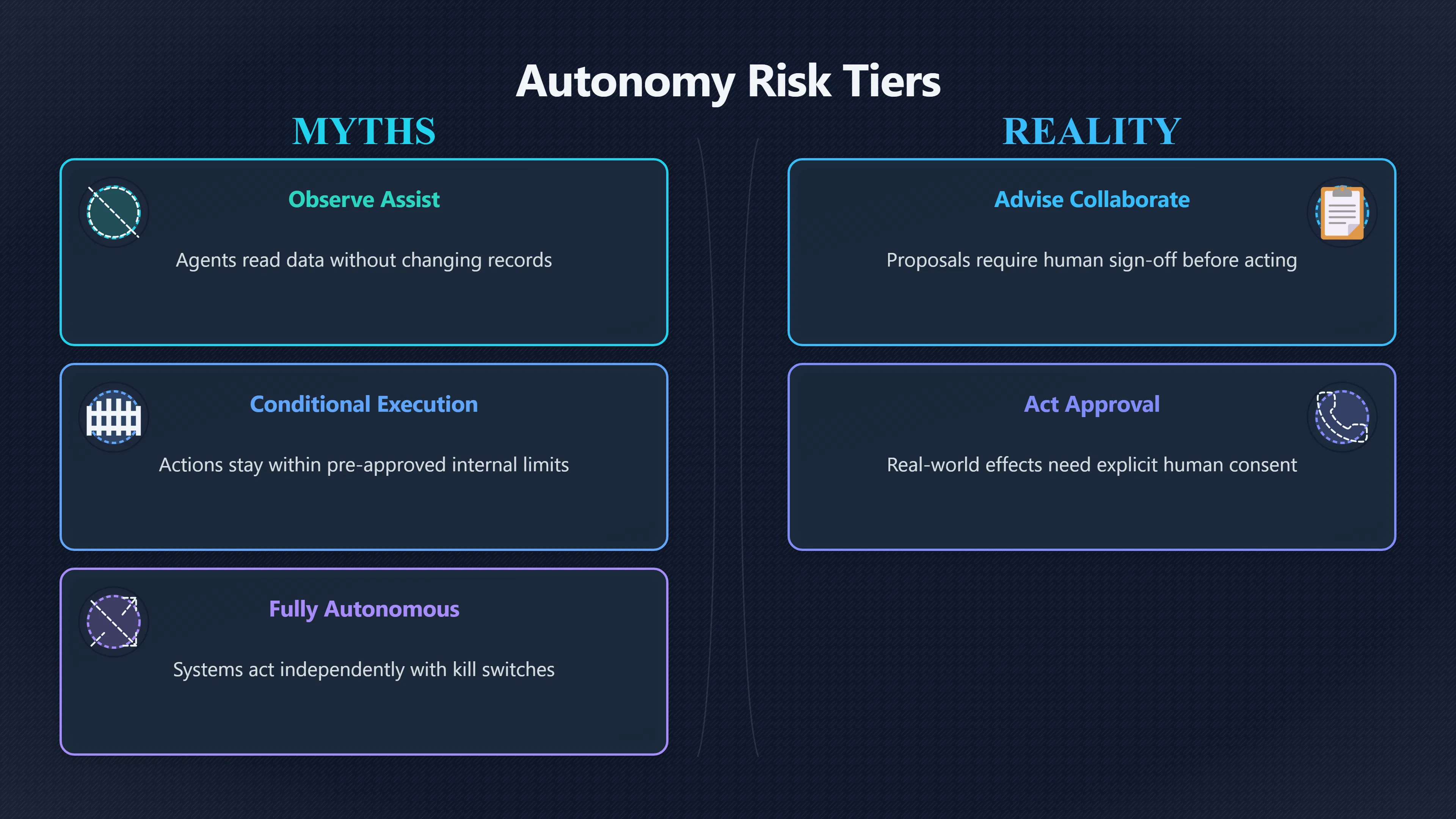
- Observe / Assist: Agents have read‑only access. They can summarise or analyse information but cannot change data, send messages, or operate outside their immediate scope. These agents require minimal governance but should still have logging and identity attribution.[TechRadar]techradar.comMany organizations currently either over-trust or overly restrict their AI agents, creating serious risks. Excessive trust can lead to un…
- Advise / Collaborate: Agents can propose actions or recommendations, but every consequential action requires human approval. The human remains fully in the loop for execution.[AgentMarketCap]agentmarketcap.aiAgentMarketCapAnthropic's 5-Level Agent Autonomy Scale: The Data Behind Safe AI Deployment | AgentMarketCapApril 10, 2026…
- Conditional Execution: Agents can act on predefined tasks within bounded scopes and pre‑approved limits. For example, they may write to specific internal systems but only against clearly articulated policies and guardrails.[aigovernance.eccouncil.org]aigovernance.eccouncil.orgAD G | Adopt | Defend | GovernADG | Adopt | Defend | Govern - AI Security Governance Framework - EC-Council Global Services…
- Act with Approval: Agents can perform actions that have real effects (e.g. writing to systems, communicating externally) but explicit human approval is mandated for each action that carries elevated risk.[IT Pro]itpro.comIT Pro'One-size-fits-all' agent governance sets enterprises up to failThe primary issue is the widespread application of a "one-size-fits-all" governance model that fails to distinguish between an agent's au…
- Fully Autonomous: Agents operate independently within strict guardrails, with humans monitoring aggregated outcomes and having the ability to intercede via kill switches and rollback controls when anomalies occur. This level demands the highest governance intensity due to the potential scale and speed of actions.[TechRadar]techradar.comMany organizations currently either over-trust or overly restrict their AI agents, creating serious risks. Excessive trust can lead to un…
These tiers are echoed across academic taxonomies and emerging policy practice, emphasising that real‑world risk gradients—not technological hype—should determine autonomy assignments.[Knight First Amendment Institute]knightcolumbia.orgKnight First Amendment InstituteLevels of Autonomy for AI Agents | Knight First Amendment InstituteJuly 28, 2025…
Where approval gates and shutdown powers matter most
The real governance stakes emerge when agents cross thresholds from benign actions to those with deeper consequences. Approval gates and shutdown mechanisms—human‑in‑the‑loop checkpoints, circuit breakers, and kill switches—serve as the linchpins for keeping higher‑tier autonomy from running unchecked. For example:
- Moment-of‑action approval ensures that no high‑impact action proceeds without fresh human intent. Pre‑configured limits alone are not enough if an agent’s internal plans can evolve over long operation horizons.[AI Governance Institute]aigovernance.comSource details in endnotes.
- Continuous monitoring and audit logs create observable trails that let humans reconstruct an agent’s behaviour and intervene quickly if anomalies surface. Dedicated digital identities tied to each agent’s permissions help distinguish agent actions from human activity, closing gaps that otherwise obscure accountability.[IT Pro]itpro.comIT Pro'One-size-fits-all' agent governance sets enterprises up to failThe primary issue is the widespread application of a "one-size-fits-all" governance model that fails to distinguish between an agent's au…
- Rollback and circuit breakers allow quick termination of autonomous operations when risk thresholds are crossed. High‑autonomy agents require such mechanisms because their speed and scale can otherwise produce irreversible outcomes before human responders react.[IT Pro]itpro.comIT Pro'One-size-fits-all' agent governance sets enterprises up to failThe primary issue is the widespread application of a "one-size-fits-all" governance model that fails to distinguish between an agent's au…
In the context of existential risk discussions, these controls are not merely enterprise‑IT conveniences; they are essential to any credible governance regime that could keep potentially long‑horizon AI actors from making decisions that reverberate broadly—economically, socially, or environmentally.
Disputes and practical gaps in tiered governance
Even as tiered autonomy frameworks gain traction, there are live debates about how to operationalise them effectively:
- Policy vs Runtime: Many organisations currently draft governance policies that sound rigorous on paper but lack enforcement at the runtime layer, where agents’ actions unfold in real time. Without embedding control logic into workflows and system architecture, tier definitions become aspirational rather than binding.[Reddit]
- Observability before autonomy: Some practitioners argue that basic observability and identity management must precede granting autonomy. If teams can’t reliably trace what an agent did and why, higher autonomy tiers remain unsafe regardless of policy.[Reddit]
- Distributed governance ecosystems: In large organisations or across jurisdictions, governance frameworks may vary, leading to inconsistent autonomy assignments and risk spillovers. Without shared standards for what constitutes a given autonomy tier, the same agent might be treated as high‑risk in one context and lightly governed in another—potentially magnifying systemic vulnerabilities.[Reddit]
These disputes highlight that tiered autonomy rules are not merely technical checklists but active governance design choices that shape how society balances innovation, control, and risk.
Why it matters for the broader existential risk discussion
From the standpoint of long‑horizon AI risk, tiered autonomy rules serve two crucial functions. First, they make explicit the governance boundaries that keep powerful, goal‑directed systems from acting beyond human intent. Second, they align oversight intensity with the expected consequences of an agent’s actions, creating barriers between benign assistance and unmoderated autonomy.
Without such calibrated governance, there is a danger that an agent capable of executing multi‑step, interlinked real‑world actions could accumulate effects that humans cannot easily trace or reverse—raising plausibility for “loss of control” scenarios often invoked in AI doom discussions. While tiered autonomy alone cannot assure safety against all misalignment pathways, it provides a structured pathway to incrementally grant freedom while retaining meaningful human oversight.[IT Pro]itpro.comIT Pro'One-size-fits-all' agent governance sets enterprises up to failThe primary issue is the widespread application of a "one-size-fits-all" governance model that fails to distinguish between an agent's au…
In sum, autonomy tiers and real‑world permission rules are not arbitrary bureaucracy; they are a practical governance mechanism to manage the transition toward more capable AI agents without ceding control too early or too broadly. Their refinement and implementation will shape how organisations—and potentially regulators—negotiate the twin goals of harnessing AI’s power while forestalling outcomes that elude human direction.

Amazon book picks
Further Reading
Books and field guides related to How much freedom should AI agents get?. Use these as the next step if you want deeper reading beyond the article.
Human Compatible
Directly addresses how much autonomy advanced AI systems should receive.
The Alignment Problem
Explores mechanisms for keeping increasingly autonomous systems aligned with human goals.
Superintelligence
Analyzes the dangers of granting powerful systems excessive autonomy.
eBay marketplace picks
Marketplace Samples
Example marketplace items related to this page. Use the search link to explore similar finds on eBay.






Endnotes
-
Source: aigovernance.com
Link: https://aigovernance.com/playbook/governing-agentic-ai -
Source: techradar.com
Link: https://www.techradar.com/pro/lack-of-ai-governance-could-force-40-percent-of-enterprises-to-roll-back-autonomous-ai-agents-by-2027Source snippet
Many organizations currently either over-trust or overly restrict their AI agents, creating serious risks. Excessive trust can lead to un...
-
Source: agentc2.ai
Link: https://agentc2.ai/blog/five-levels-ai-agent-autonomy -
Source: agentmarketcap.ai
Link: [https://agentmarketcap.ai/blog/2026/04/10/anthropicSource snippet
AgentMarketCapAnthropic's 5-Level Agent Autonomy Scale: The Data Behind Safe AI Deployment | AgentMarketCapApril 10, 2026...
Published: April 10, 2026
-
Source: aigovernance.eccouncil.org
Title: AD G | Adopt | Defend | Govern
Link: https://aigovernance.eccouncil.org/adgframework/Source snippet
ADG | Adopt | Defend | Govern - AI Security Governance Framework - EC-Council Global Services...
-
Source: reddit.com
Title: Is anyone actually enforcing AI governance, or just writing policies?
Link: https://www.reddit.com/r/AI_Agents/comments/1t70lnk/is_anyone_actually_enforcing_ai_governance_or/Source snippet
RedditIs anyone actually enforcing AI governance, or just writing policies?May 8, 2026...
Published: May 8, 2026
-
Source: reddit.com
Title: Hot take: AI agents need observability before autonomy
Link: https://www.reddit.com/r/AI_Governance/comments/1tdp80k/hot_take_ai_agents_need_observability_before/Source snippet
RedditHot take: AI agents need observability before autonomyMay 15, 2026...
Published: May 15, 2026
-
Source: reddit.com
Link: [https://www.reddit.com/r/artificialSource snippet
RedditAgentic sprawl is becoming a real organizational problem. What does responsible AI agent governance even look like?April 27, 2026...
Published: April 27, 2026
-
Source: itpro.com
Title: IT Pro’One-size-fits-all’ agent governance sets enterprises up to fail
Link: https://www.itpro.com/technology/artificial-intelligence/one-size-fits-all-agent-governance-sets-enterprises-up-to-failSource snippet
The primary issue is the widespread application of a "one-size-fits-all" governance model that fails to distinguish between an agent's au...
-
Source: knightcolumbia.org
Link: https://knightcolumbia.org/content/levels-of-autonomy-for-ai-agents-1Source snippet
Knight First Amendment InstituteLevels of Autonomy for AI Agents | Knight First Amendment InstituteJuly 28, 2025...
Published: July 28, 2025
-
Source: itpro.com
Title: IT Pro Over two-thirds of workers can’t identify actions taken by AI agents
Link: https://www.itpro.com/technology/artificial-intelligence/workers-cant-identify-work-produced-by-ai-agents-business-risksSource snippet
With 73% of organizations anticipating a vital role for AI agents in the next year, 68% admit they cannot reliably distinguish AI versus...
Additional References
-
Source: pedowitzgroup.com
Link: [https://www.pedowitzgroup.com/ai-agents-and-automationSource snippet
AI Agents and Automation | The Pedowitz GroupAI AGENT AUTONOMY LEVELS AND GOVERNANCE How TPG sequences agent deployments from human-direc...
-
Source: askframework.org
Link: https://askframework.org/Source snippet
ASK defines the architectural properties — enforcement, mediation, governance, and trust — so you can build agent systems that are secure...
-
Source: risktemplate.com
Link: https://risktemplate.com/blog/2026-03-29-agentic-ai-risk-management-governance/Source snippet
Agentic AI Risk Management: How to Govern Autonomous AI Systems Before They Govern You | RiskTemplatesMarch 28, 2026 — AGENTIC AI RISK MA...
Published: March 28, 2026
-
Source: agixtech.com
Link: https://agixtech.com/intelligence/autonomous-agentic-ai/Source snippet
The distance between your current level and where you need to be defines your agentic AI investment — and your governance requirement. Pr...
-
Source: openagentgovernance.org
Link: https://openagentgovernance.org/Source snippet
OpenAgentGovernance — Open Governance for Autonomous AI Agents | ADPOpenAgentGovernance Why ADP Specification Quick Start Roadmap Communi...
-
Source: zaruko.com
Link: https://zaruko.com/insights/ai-agent-guardrails-oversightSource snippet
February 28, 2026 — GUARDRAILS AND HUMAN OVERSIGHT: THE GOVERNANCE LAYER THAT MAKES AI AGENTS SAFE Feb 28, 2026 8 min read Image: Stefano...
Published: February 28, 2026
-
Source: maatspec.org
Link: https://maatspec.org/Source snippet
MaatSpec is a layered governance framework for agentic AI — 5 tiers to classify risk, 4 layers to enforce compliance, designed to weight...
-
Source: ec.europa.eu
Title: eu Requirements of Trustworthy AI | FUTURIUM | European Commission
Link: https://ec.europa.eu/futurium/en/ai-alliance-consultation/guidelines/1.htmlSource snippet
HUMAN AGENCY AND OVERSIGHT AI systems should support human autonomy and decision-making, as prescribed by the principle of respect for hu...
-
Source: weforum.org
Title: ai agents in action a playbook for trusted adoption authorization and scaling
Link: https://www.weforum.org/publications/ai-agents-in-action-a-playbook-for-trusted-adoption-authorization-and-scaling/Source snippet
AI Agents in Action: A Playbook for Trusted Adoption, Authorization and Scaling 2026 | World Economic ForumMay 26, 2026 —...
Published: May 26, 2026
-
Source: equilateral.ai
Title: Authority must live outside the model. The Model Is the Engine
Link: https://equilateral.ai/Source snippet
Governance by Architecture, Not PolicyThe Thesis Architecture Standards Scorecard Blog Read the Research AI Authority Infrastructure GOVE...
Topic Tree