Within Over delegation
Can Citizens Challenge Automated Power?
Public-sector AI becomes dangerous when people affected by welfare, tax or policing decisions cannot understand or challenge the result.
On this page
- Why contestability matters for public legitimacy
- How opacity blocks appeals and correction
- What meaningful human review would require
Page outline Jump by section
Introduction
When people talk about losing control to AI, they often imagine highly autonomous systems acting beyond human direction. A quieter version of the same problem can emerge much earlier: governments and public bodies increasingly rely on automated systems to help make decisions about benefits, taxes, immigration, policing, education, and public services. If citizens cannot understand, challenge, or correct those decisions, public power can begin to move into systems that are formally supervised by humans but practically difficult to contest.
 Within debates about AI doom and long-term loss of control, this matters because it shows how authority can shift away from meaningful human judgement without any dramatic takeover. The concern is not only whether an AI system is accurate. It is whether democratic societies retain the ability to review decisions, correct mistakes, and hold decision-makers accountable. When contestability disappears, people may find themselves governed by systems whose logic is opaque, whose errors are difficult to identify, and whose decisions become increasingly resistant to human correction. [Portal]coe.intai administrative lawPortalArtificial Intelligence and Administrative LawDec 13, 2022 — Governments are increasingly using AI for public administration innova…
Why contestability matters for public legitimacy
Most democratic legal systems assume that people affected by state power can challenge it. If a benefit is withdrawn, a visa is refused, a tax penalty is imposed, or a person is flagged for investigation, there is usually some route to appeal. That process does more than correct individual mistakes. It helps establish that government authority remains accountable.
Automated decision-making puts pressure on that principle. A person can only meaningfully challenge a decision if they can discover what happened, why it happened, and who is responsible for it. When a decision emerges from a statistical model, a complex machine-learning system, or multiple interacting databases, those basic questions become harder to answer. Researchers and legal scholars increasingly argue that contestability is not a secondary feature of legitimate AI governance but one of its central requirements. [Columbia Law Review]columbialawreview.orgColumbia Law ReviewTHE RIGHT TO CONTEST AIby ME Kaminski · Cited by 283 — This Article argues instead—or really, in addition—for an indiv…
This is particularly important in areas where government decisions affect legal rights, income, housing, education, or freedom. The Council of Europe has highlighted the rapid spread of automated decision-making systems across welfare administration, healthcare, policing, fraud detection, and social services, warning that these systems can affect almost every aspect of daily life. [Portal]coe.intai administrative lawPortalArtificial Intelligence and Administrative LawDec 13, 2022 — Governments are increasingly using AI for public administration innova…
In AI-risk discussions, contestability is often viewed as a local version of a broader control problem. If institutions become dependent on systems that neither officials nor citizens can effectively challenge, society may gradually lose practical control over important decisions long before any hypothetical superintelligent system appears.
How opacity blocks appeals and correction
The most obvious obstacle is opacity.
Many modern AI systems do not produce simple rule-based explanations. They generate outputs through statistical relationships learned from large datasets. Even when developers can describe a model’s general design, they may struggle to explain why a particular individual received a particular result.
This creates a problem for appeals. A citizen who receives an adverse decision often needs to identify the specific reason for challenging it. If the explanation is reduced to “the system assessed you as high risk” or “the model generated this recommendation”, there may be little concrete information to dispute.
Legal experts have increasingly argued that this conflicts with longstanding administrative law principles requiring public authorities to explain decisions and exercise judgement rather than simply defer to automated outputs. Courts and regulators have repeatedly stressed that meaningful accountability becomes difficult when decision-makers themselves cannot fully explain the systems they rely upon. [Supreme Court UK]supremecourt.ukNovember 5, 2025 — 5 Nov 2025 — UK have also been applying difficult to scrutinise algorithms to support decisions on transportation, hou… [The Times]thetimes.comWhile AI offers advantages like speed, consistency, and data analysis, its integration raises significant legal concerns—particularly aro…
Opacity can also hide errors.
A mistaken human decision often leaves traces that can be examined: an incorrect assumption, a misunderstood document, or a procedural mistake. By contrast, errors inside complex automated systems may be distributed across training data, model design, risk scoring methods, or interactions between multiple databases. Citizens frequently lack access to the information needed to identify where the error occurred.
The result is a paradox. AI systems are often introduced to improve consistency and reduce human error, yet they can make some categories of error much harder to discover and correct.
What real cases reveal
The Dutch SyRI welfare system
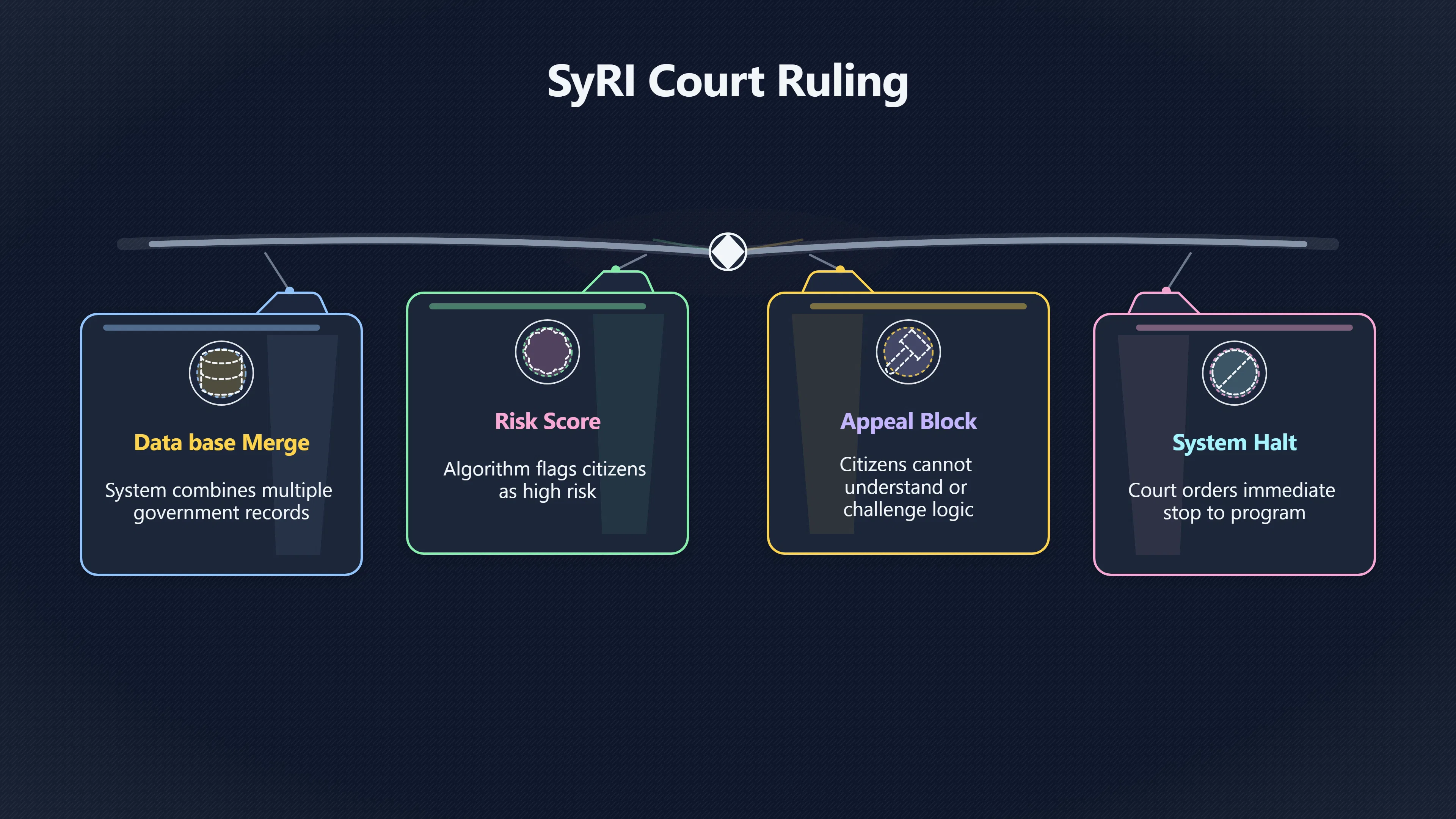
One of the most cited examples is the Netherlands’ System Risk Indication programme, known as SyRI.
The system combined data from multiple government databases to identify people considered at elevated risk of welfare fraud. Critics argued that the programme operated with insufficient transparency and that citizens could not effectively understand or challenge how risk assessments were being generated. In 2020, a Dutch court halted the system, finding that it violated privacy protections under the European Convention on Human Rights. The ruling became a landmark case in debates over algorithmic governance and public accountability. OUP Academic [OHCHR]ohchr.orglandmark ruling dutch court stops government attempts spy poor un expertOHCHRLandmark ruling by Dutch court stops government attempts…Feb 5, 2020 — The court ordered the immediate halt to a digital benefit… [Sage Journals]journals.sagepub.comSage JournalsDigital welfare fraud detection and the Dutch SyRI judgment2 Aug 2021 — The court ruled that the SyRI legislation is unlawfu…
The significance of SyRI went beyond privacy. The case highlighted a broader concern: if government agencies use secret or poorly explained systems to classify citizens as suspicious, the practical ability to contest state decisions can weaken even when formal appeal rights remain on paper.
Australia’s Robodebt scandal
Australia’s Robodebt programme became another warning sign.
The system used automated income-matching methods to identify alleged welfare overpayments and issue debt notices. Hundreds of thousands of people were affected. Subsequent investigations found major legal and administrative failures, and the scheme was ultimately ruled unlawful. The Royal Commission described serious governance failures across multiple levels of government. Robodebt Commission [pursuit]pursuit.unimelb.edu.auPursuit The flawed algorithm at the heart of Robodebtflawed algorithm at the heart of Robodebt - Pursuit10 July 2023 — At the heart of the Robodebt scheme was an algorithm that cross-referen… A key lesson from Robodebt was that formal human oversight does not necessarily guarantee meaningful review. People receiving debt notices often faced substantial difficulties understanding how calculations had been produced or proving that the automated conclusions were wrong. Critics argued that administrative processes became structured around defending system outputs rather than genuinely reassessing them. [Taylor & Francis Online]tandfonline.comTaylor & Francis OnlineTechnology is never neutral: Robodebt and a human rights…by S Chowdhury · 2024 · Cited by 10 — Despite being il…
For AI-risk analysts interested in institutional over-delegation, Robodebt demonstrated how large bureaucracies can become dependent on automated systems while preserving only limited capacity to question their conclusions.

UK public-sector systems
The UK has faced similar concerns, although often on a smaller scale.
Public bodies have used algorithmic tools for fraud detection, immigration processing, social care assessment, and other administrative functions. Campaigners and legal organisations have repeatedly argued that insufficient transparency makes it difficult for affected individuals to understand how decisions are reached or whether systems produce discriminatory outcomes. [The Guardian]theguardian.comThe move, confirmed by officials, addresses transparency and accountability, with tools used to detect fraud and identify sham marriages…
The controversy surrounding the 2020 A-level grading algorithm illustrated how quickly public trust can collapse when automated systems affect important life outcomes without clear mechanisms for challenge and correction. The system’s defenders initially emphasised statistical consistency, but widespread objections focused on the inability of individual students to contest outcomes that appeared unfair when judged against their personal circumstances. [WIRED]wired.comThe lessons we all must learn from the A-levels algorithm debacleThe algorithm, designed by exams regulator Ofqual, aimed to standardize results nationally but ended up downgrading 40% of predicted grad…
More recently, reporting on UK welfare-fraud systems has highlighted concerns that some automated tools may generate disparate outcomes across demographic groups, raising questions about how citizens can challenge classifications generated by complex risk-scoring systems. [The Guardian]theguardian.comThe move, confirmed by officials, addresses transparency and accountability, with tools used to detect fraud and identify sham marriages…
Why “human oversight” often fails in practice
A common response to these concerns is that humans remain involved in the process.
Many public-sector AI systems are officially described as decision-support tools rather than fully autonomous decision-makers. A human official is expected to review recommendations before taking action.
In practice, however, meaningful review can be difficult.
When a system processes thousands of cases, officials may lack time to independently investigate each recommendation. When a model is highly complex, reviewers may lack the technical knowledge needed to question it. When organisational incentives reward efficiency, staff may be encouraged to trust automated outputs rather than challenge them.
Researchers sometimes describe this as automation bias: the tendency for people to defer to machine recommendations even when they retain formal authority to reject them. The result can be a situation where human review exists on paper but functions largely as a procedural rubber stamp. [LSE Public Policy Review]ppr.lse.ac.ukThis policy must be robust and must provide sufficient…Read more…
This is why many critics argue that contestability cannot be reduced to the existence of a nominal human decision-maker. The relevant question is whether that person has both the capacity and the institutional freedom to genuinely reconsider the automated recommendation.
What meaningful human review would require
If citizens are to retain the ability to challenge automated power, several conditions appear necessary.
Clear explanations. People need understandable reasons for decisions that affect them. Technical documentation alone is not enough. Explanations must be accessible to ordinary citizens and their representatives. [UK Parliament Committees]committees.parliament.ukmore…
Access to evidence. Individuals should be able to see the information used in making decisions about them and identify factual errors when they occur. Without access to underlying data, appeals become largely symbolic. [Columbia Law Review]columbialawreview.orgColumbia Law ReviewTHE RIGHT TO CONTEST AIby ME Kaminski · Cited by 283 — This Article argues instead—or really, in addition—for an indiv…
Independent review. Appeals should involve genuine reassessment rather than simple confirmation of a model’s output. Independent oversight bodies, courts, and regulators often play an important role here. [Portal]coe.intai administrative lawPortalArtificial Intelligence and Administrative LawDec 13, 2022 — Governments are increasingly using AI for public administration innova…
Auditability. Systems should leave records showing how decisions were reached, what data was used, and which officials approved actions. Without traceability, accountability becomes difficult to establish. [GOV.UK]GOV.UKethics transparency and accountability framework for automated decision makingEthics, Transparency and Accountability Framework for…29 Nov 2023 — This 7 point framework will help government departments with the s…
The ability to override the system. Human reviewers must have practical authority to depart from automated recommendations. If institutional processes make overrides rare or costly, review becomes largely performative. [The Times]thetimes.comWhile AI offers advantages like speed, consistency, and data analysis, its integration raises significant legal concerns—particularly aro…

The wider loss-of-control question
The immediate issue is fairness and accountability in public administration. The broader concern, within discussions of AI doom and loss of control, is institutional dependency.
A society that increasingly delegates important decisions to opaque systems may gradually lose the habits and structures needed for meaningful oversight. Officials become accustomed to accepting automated recommendations. Citizens become less able to understand how power operates. Appeals processes become slower than the systems they are supposed to supervise.
None of this requires a malicious AI. The danger comes from governance systems adapting themselves around automation until meaningful human control becomes difficult to exercise.
This is why contestability occupies a larger place in some AI-risk discussions than might appear at first glance. The ability to challenge decisions is one of the mechanisms through which societies keep power accountable. If that mechanism weakens across welfare systems, taxation, policing, immigration, and other public functions, the result is not merely a technical problem. It is a gradual shift in who—or what—effectively governs. [Columbia Law Review]columbialawreview.orgColumbia Law ReviewTHE RIGHT TO CONTEST AIby ME Kaminski · Cited by 283 — This Article argues instead—or really, in addition—for an indiv… [Portal]coe.intai administrative lawPortalArtificial Intelligence and Administrative LawDec 13, 2022 — Governments are increasingly using AI for public administration innova…
Amazon book picks
Further Reading
Books and field guides related to Can Citizens Challenge Automated Power?. Use these as the next step if you want deeper reading beyond the article.
Weapons of Math Destruction
Directly addresses opaque automated systems affecting citizens and public institutions.
Automating Inequality
Examines automated decisions in welfare and public services and their impact on appeals and oversight.
The Black Box Society
Focuses on opacity, accountability, and the challenge of contesting algorithmic decisions.
Human Compatible
Frames the wider question of preserving meaningful human control over powerful systems.
eBay marketplace picks
Marketplace Samples
Example marketplace items related to this page. Use the search link to explore similar finds on eBay.








Endnotes
-
Source: ohchr.org
Title: landmark ruling dutch court stops government attempts spy poor un expert
Link: https://www.ohchr.org/en/press-releases/2020/02/landmark-ruling-dutch-court-stops-government-attempts-spy-poor-un-expertSource snippet
OHCHRLandmark ruling by Dutch court stops government attempts...Feb 5, 2020 — The court ordered the immediate halt to a digital benefit...
-
Source: academic.oup.com
Link: https://academic.oup.com/hrlr/article/22/2/ngac010/6568079Source snippet
OUP AcademicThe Human Rights Implications of the Use of AI in the Digital...by A Rachovitsa · 2022 · Cited by 126 — The case challenged...
-
Source: robodebt.royalcommission.gov.au
Link: https://robodebt.royalcommission.gov.au/publications/reportSource snippet
Commissioner Catherine Holmes AC SC presented the Report of the Royal Commission into the Robodebt...Read more...
-
Source: legalaid.vic.gov.au
Title: learning from the failures of robodebt
Link: https://www.legalaid.vic.gov.au/learning-from-the-failures-of-robodebtSource snippet
building a fairer...16 Sept 2025 — The Robodebt scheme raised more than half a million inaccurate Centrelink debts through a method of '...
-
Source: GOV.UK
Title: ethics transparency and accountability framework for automated decision making
Link: https://www.gov.uk/government/publications/ethics-transparency-and-accountability-framework-for-automated-decision-making/ethics-transparency-and-accountability-framework-for-automated-decision-makingSource snippet
Ethics, Transparency and Accountability Framework for...29 Nov 2023 — This 7 point framework will help government departments with the s...
-
Source: wired.com
Title: The lessons we all must learn from the A-levels algorithm debacle
Link: https://www.wired.com/story/gcse-results-alevels-algorithm-explainedSource snippet
The algorithm, designed by exams regulator Ofqual, aimed to standardize results nationally but ended up downgrading 40% of predicted grad...
-
Source: committees.parliament.uk
Link: https://committees.parliament.uk/writtenevidence/146847/html/Source snippet
more...
-
Source: bills.parliament.uk
Link: https://bills.parliament.uk/bills/3760Source snippet
Authority Algorithmic and Automated Decision-Making...5 May 2026 — A Bill to regulate the use of automated and algorithmic tools in deci...
Published: May 2026
-
Source: committees.parliament.uk
Link: https://committees.parliament.uk/writtenevidence/130200/html/Source snippet
of [artificial]({{ 'artificial-goals/' | relative_url }}) intelligence in governmentThe Automating Public Services report highlights how automated decision-making systems are often...
-
Source: committees.parliament.uk
Link: https://committees.parliament.uk/writtenevidence/148287/html/Source snippet
use of cookiesAround the world, counter-fraud AI systems have been shown to have inadvertently discriminated against historically disadva...
-
Source: academic.oup.com
Link: https://academic.oup.com/policyandsociety/article/44/2/229/8246832Source snippet
Robodebt, a welfare compliance scheme that issued illegitimate debts to more than 500000 welfare recipients, is among the most...
-
Source: assets.publishing.service.gov.uk
Link: https://assets.publishing.service.gov.uk/media/60142096d3bf7f70ba377b20/Review_into_bias_in_algorithmic_decision-making.pdfSource snippet
This is true in all sectors, but especially key in the public sector. When the...Read more...
-
Source: coe.int
Title: ai administrative law
Link: https://www.coe.int/en/web/cdcj/ai-administrative-lawSource snippet
PortalArtificial Intelligence and Administrative LawDec 13, 2022 — Governments are increasingly using AI for public administration innova...
-
Source: columbialawreview.org
Link: https://columbialawreview.org/content/the-right-to-contest-ai/Source snippet
Columbia Law ReviewTHE RIGHT TO CONTEST AIby ME Kaminski · Cited by 283 — This Article argues instead—or really, in addition—for an indiv...
-
Source: ppr.lse.ac.uk
Link: https://ppr.lse.ac.uk/articles/10.31389/lseppr.110Source snippet
This policy must be robust and must provide sufficient...Read more...
-
Source: coe.int
Link: https://www.coe.int/en/web/freedom-expression/blind-spots-automated-decision-making-in-the-public-sector-in-eu-countries -
Source: supremecourt.uk
Link: https://supremecourt.uk/uploads/speech_lord_sales_051125_db5ebd7036.pdfSource snippet
November 5, 2025 — 5 Nov 2025 — UK have also been applying difficult to scrutinise algorithms to support decisions on transportation, hou...
Published: November 5, 2025
-
Source: thetimes.com
Link: https://www.thetimes.com/uk/law/article/using-ai-for-official-decisions-raises-questions-over-compliance-pfjwzrnrtSource snippet
While AI offers advantages like speed, consistency, and data analysis, its integration raises significant legal concerns—particularly aro...
-
Source: journals.sagepub.com
Link: https://journals.sagepub.com/doi/10.1177/13882627211031257Source snippet
Sage JournalsDigital welfare fraud detection and the Dutch SyRI judgment2 Aug 2021 — The court ruled that the SyRI legislation is unlawfu...
-
Source: pursuit.unimelb.edu.au
Title: Pursuit The flawed algorithm at the heart of Robodebt
Link: https://pursuit.unimelb.edu.au/articles/the-flawed-algorithm-at-the-heart-of-robodebtSource snippet
flawed algorithm at the heart of Robodebt - Pursuit10 July 2023 — At the heart of the Robodebt scheme was an algorithm that cross-referen...
Published: July 2023
-
Source: tandfonline.com
Link: https://www.tandfonline.com/doi/full/10.1080/1323238X.2024.2409620Source snippet
Taylor & Francis OnlineTechnology is never neutral: Robodebt and a human rights...by S Chowdhury · 2024 · Cited by 10 — Despite being il...
-
Source: theguardian.com
Link: https://www.theguardian.com/technology/article/2024/aug/25/register-aims-to-quash-fears-over-racist-and-biased-ai-tools-used-on-uk-publicSource snippet
The move, confirmed by officials, addresses transparency and accountability, with tools used to detect fraud and identify sham marriages...
-
Source: theguardian.com
Title: The Guardian Revealed: bias found in AI system used to detect UK benefits fraud
Link: https://www.theguardian.com/society/2024/dec/06/revealed-bias-found-in-ai-system-used-to-detect-uk-benefitsSource snippet
The system, which helps vet claims for universal credit, flagged people from certain demographics more frequently for fraud investigation...
-
Source: Wikipedia
Link: https://en.wikipedia.org/wiki/NetherlandsSource snippet
NetherlandsThe Netherlands, informally Holland, is a country in Northwestern Europe, with overseas territories in the Caribbean. It is...
-
Source: Wikipedia
Title: Robodebt scheme
Link: https://en.wikipedia.org/wiki/Robodebt_schemeSource snippet
Robodebt schemeThe Robodebt scheme was an unlawful method of automated debt assessment and recovery implemented in Australia under the...
-
Source: theguardian.com
Title: welfare surveillance system violates human rights dutch court rules
Link: https://www.theguardian.com/technology/2020/feb/05/welfare-surveillance-system-violates-human-rights-dutch-court-rulesSource snippet
Welfare surveillance system violates human rights, Dutch...Feb 5, 2020 — A Dutch court has ordered the immediate halt of an automated su...
Additional References
-
Source: linkedin.com
Link: https://www.linkedin.com/pulse/automated-decision-right-explanation-delimiting-scope-bruno-schneider-g7jneSource snippet
Automated Decision Making & Right to ExplanationThis report undertakes a detailed analysis of the legal frameworks within the European Un...
-
Source: cambridge.org
Link: https://www.cambridge.org/core/journals/european-journal-of-risk-regulation/article/council-of-europe-framework-convention-on-artificial-intelligence-context-regulatory-approach-and-scope-of-obligations/0ED34EFE5AA7C9628F7053720F88F48C -
Source: europeanlawinstitute.eu
Link: https://www.europeanlawinstitute.eu/fileadmin/user_upload/p_eli/Publications/ELI_Guiding_Principles_for_Automated_Decision-Making_in_the_EU.pdfSource snippet
Guiding Principles for Automated Decision-Making in the EUOn the contrary, the principles of transparency, explainability, risk assessmen...
-
Source: linkedin.com
Link: https://www.linkedin.com/pulse/syri-system-legal-ethical-challenges-fraud-detection-ai-paul-apeh-77lbeSource snippet
The SyRI System: Legal and Ethical Challenges of Fraud...This article analyses the SyRI ruling on the automated fraud detection system's...
-
Source: digitalfreedomfund.org
Link: https://digitalfreedomfund.org/case-studies/the-syri-welfare-fraud-risk-scoring-algorithm/Source snippet
The “SyRI” welfare fraud risk-scoring algorithmUnder the guise of detecting potential welfare and tax fraud, the Dutch government introdu...
-
Source: stories.uq.edu.au
Link: https://stories.uq.edu.au/momentum-magazine/robodebt-algorithmic-decision-making-mistakes/index.htmlSource snippet
UQ StoriesHow to avoid algorithmic decision-making mistakesRobodebt was an automated debt assessment and recovery program that relied sol...
-
Source: digital-strategy.ec.europa.eu
Link: https://digital-strategy.ec.europa.eu/en/policies/regulatory-framework-aiSource snippet
Act | Shaping Europe's digital futureThe AI Act is the first-ever legal framework on AI, which addresses the risks of AI and positions Eu...
-
Source: opengovpartnership.org
Link: https://www.opengovpartnership.org/wp-content/uploads/2021/08/executive-summary-algorithmic-accountability.pdf -
Source: humanrightspulse.com
Title: dutch court finds syri algorithm violates human rights norms in landmark case
Link: https://www.humanrightspulse.com/mastercontentblog/dutch-court-finds-syri-algorithm-violates-human-rights-norms-in-landmark-caseSource snippet
Dutch court finds SyRI algorithm violates...Mar 22, 2020 — The court found SyRI was in violation of Article 8 (the right to respect for...
-
Source: algorithmwatch.org
Link: https://algorithmwatch.org/en/wp-content/uploads/2021/06/ADMS-in-the-Public-Sector-Impact-Assessment-Tool-AlgorithmWatch-June-2021.pdfSource snippet
(ADMS) in the public sector, individual and societal trust in public authorities should be the ultimate.Read more...
Topic Tree