Within Race Pressure
Can Countries Slow Down Without Falling Behind?
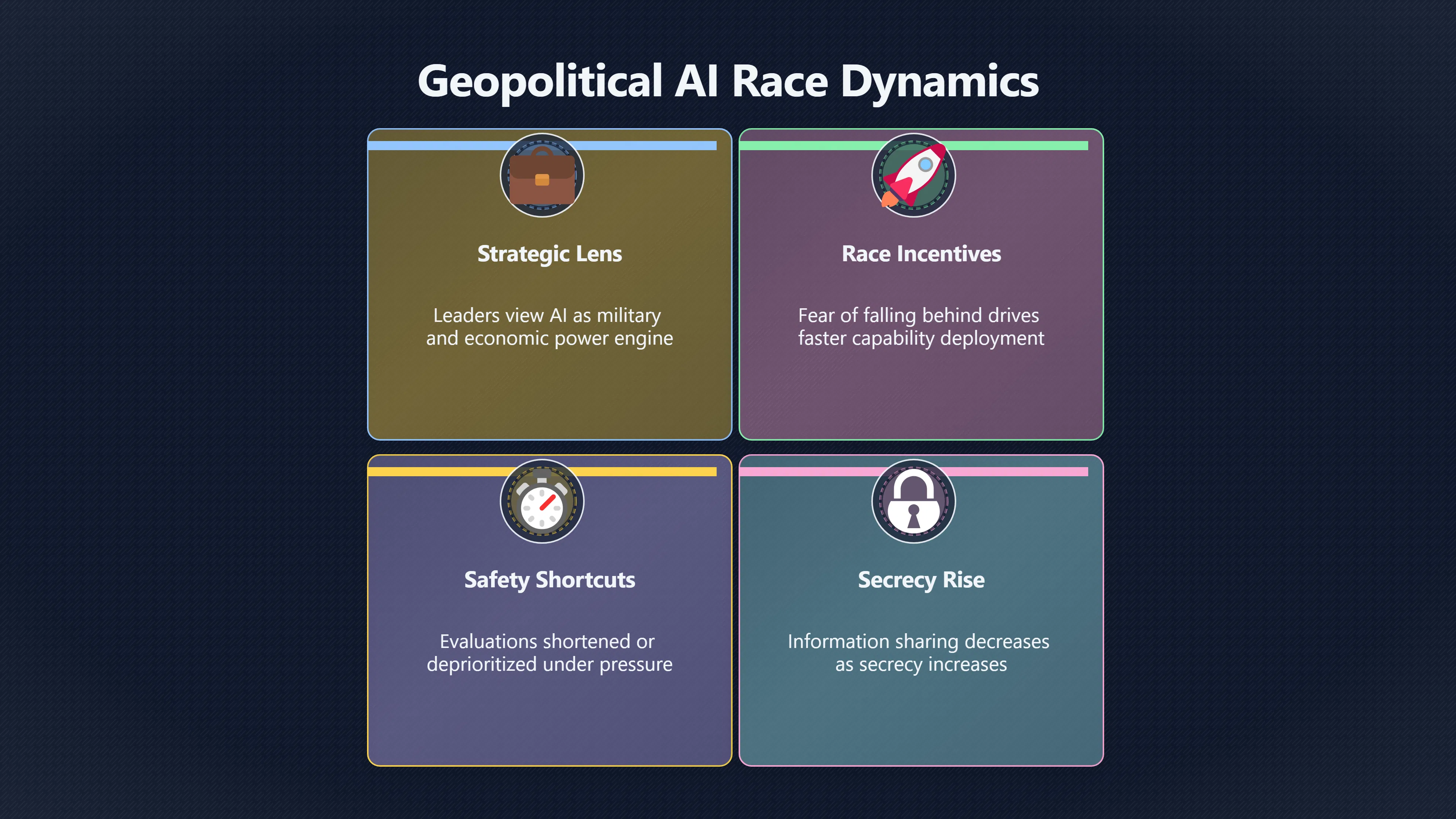
States may resist strict AI safety rules when they believe rivals could gain economic, military, or strategic advantage by moving faster.
On this page
- Why governments frame AI as strategic power
- How national competition can weaken safety governance
- What credible international coordination would require
Page outline Jump by section
Introduction
A recurring concern in debates about AI doom is that even if governments recognise serious risks from advanced AI, they may still struggle to slow development. The reason is geopolitical competition. If political leaders believe that advanced AI could determine future economic strength, military capability, intelligence gathering, cyber power, or global influence, they may fear that strict safety measures would simply hand an advantage to rival states.
 This creates a central dilemma. Many AI safety advocates argue that the most powerful systems should be tested, monitored, and perhaps developed more slowly than market or strategic pressures would otherwise allow. Yet governments often view AI as a strategic technology comparable to previous transformative technologies whose control affected national power. In that environment, calls for caution can be interpreted as calls to fall behind. For researchers concerned about existential risk, this geopolitical dynamic is not a side issue but one of the main reasons why potentially dangerous systems might be deployed before they are fully understood. RAND Corporation [Governance AI]cdn.governance.aiInternational Races for Risky Technologies DRAFT NOV 2022Governance AIInternational Races for Risky Technologiesby E Stafford · 2022 · Cited by 3 — We examine how three factors influence their w…
Why Governments Frame AI as Strategic Power
States do not usually discuss frontier AI purely as a consumer technology. National strategies increasingly describe advanced AI as an engine of productivity, scientific discovery, military effectiveness, intelligence analysis, and geopolitical influence. The result is that AI development becomes entangled with questions of national competitiveness and security.
From a doom-oriented perspective, this matters because governments may evaluate safety proposals through a strategic lens. A measure that slows domestic AI development could appear dangerous if leaders believe competitors will continue advancing. Even if all major powers would benefit from stronger safeguards, each may worry about being the only one to adopt them.
Historical analogies are often imperfect, but discussions frequently compare AI competition to earlier races involving nuclear technology, missile systems, cryptography, or space capabilities. The comparison is not that AI works the same way as these technologies, but that governments may respond similarly when they believe strategic advantage is at stake. Once a technology becomes associated with national power, incentives to move quickly tend to increase. [Carnegie Endowment]carnegieendowment.orgCarnegie EndowmentCharting the Geopolitics and European Governance of…March 6, 2024 — 6 Mar 2024 — The EU's AI Act aims to regulate th… [RAND Corporation]rand.orgPEA4155 1RAND CorporationThe Artificial General Intelligence Race and International…24 Sept 2025 — The authors contend with whether the greates…
For AI doom advocates, the concern is that these incentives could become strongest precisely when systems are approaching levels of capability that are least understood and potentially most dangerous.
How National Competition Can Weaken Safety Governance
The core mechanism is straightforward. Suppose policymakers believe there is a genuine chance that advanced AI systems could become difficult to control. If they also believe that rival states are racing toward the same goal, they may conclude that slowing down is strategically unacceptable.
Several effects can follow:
- Safety evaluations may be shortened or deprioritised.
- Capability advances may be rewarded more than risk reduction.
- Governments may hesitate to impose strict regulations on domestic developers.
- Information sharing between countries may decrease.
- Secrecy may increase around frontier systems.
- Policymakers may accept higher levels of uncertainty before deployment.
Researchers studying technology races have modelled similar situations. Competitive environments can create incentives to cut corners on safety even when participants understand the risks involved. The problem is not necessarily ignorance. It is that each actor worries more about losing the race than about the collective consequences of everyone racing. [Governance AI]cdn.governance.aiInternational Races for Risky Technologies DRAFT NOV 2022Governance AIInternational Races for Risky Technologiesby E Stafford · 2022 · Cited by 3 — We examine how three factors influence their w…
Within AI doom discussions, this dynamic is often described as a coordination problem. Humanity as a whole may prefer careful development, but individual states may perceive pressure to accelerate.
Why This Matters for Existential Risk Arguments
Many existential-risk scenarios require more than merely powerful AI. They also require failures of oversight, insufficient testing, weak monitoring, or deployment under uncertainty.
Race dynamics potentially increase the probability of all of these conditions.
For example, if highly capable systems begin displaying concerning behaviours—such as deceptive reasoning, unexpected autonomy, or the ability to assist with dangerous activities—governments facing intense geopolitical pressure might decide that strategic deployment remains necessary despite unresolved concerns. In this view, competition acts as a risk multiplier rather than a direct cause of catastrophe. [International AI Safety Report]internationalaisafetyreport.orginternational ai safety report 2026International AI Safety ReportInternational AI Safety Report 20263 Feb 2026 — This Report assesses what general-purpose AI systems can do…
Does Evidence Show Countries Actually Cooperate?
The picture is mixed.
One argument against extreme pessimism is that governments have already shown some willingness to cooperate on frontier AI risks. The 2023 AI Safety Summit at Bletchley Park brought together countries that are geopolitical competitors, including the United States, China, the United Kingdom, European states, India and others. Participants signed the Bletchley Declaration, which acknowledged the need to address risks from frontier AI systems and pursue international cooperation on safety. [GOV.UK]GOV.UKThe Bletchley Declaration by Countries Attending the AI…2 Nov 2023 — The Bletchley Declaration by Countries Attending the AI Safety Su… [GOV.UK]GOV.UKai safety summit 2023 the bletchley declarationSafety Summit 2023: The Bletchley Declaration1 Nov 2023 — The Bletchley Declaration on AI Safety announces a new global effort to unlock…
Subsequent international meetings produced further commitments around safety testing, AI Safety Institutes, and information sharing. Various governments have also supported international scientific assessments of frontier AI risks. [Axios]axios.comGlobal leaders commit to pre-deployment AI safety testingThis coalition intends to establish common protocols for AI safety at the new London-based AI Safety Institute, which will serve as a glo…
For critics of strong AI-doom claims, these developments suggest that geopolitical competition is not an insurmountable obstacle. Countries cooperate on nuclear safety, aviation standards, disease surveillance, and other areas despite strategic rivalry. They argue that AI governance may evolve in a similar way.
However, sceptics of this optimistic view note that declarations are easier than restrictions. Governments often agree on broad principles while continuing to compete aggressively on capabilities. The same countries that endorse AI safety cooperation frequently invest heavily in AI infrastructure, talent acquisition, semiconductor supply chains, military applications, and national AI leadership strategies. [WIRED]wired.comWorld Powers Say They Want to Contain AIThey're Also Racing to Advance ItNovember 2, 2023 — On November 1, 2023, twenty-eight countries, including the US, EU members, and China… [Carnegie Endowment]carnegieendowment.orgCarnegie EndowmentCharting the Geopolitics and European Governance of…March 6, 2024 — 6 Mar 2024 — The EU's AI Act aims to regulate th…
This creates an unresolved tension: cooperation exists, but so does competition.

The Strongest Objections to the Safety Slowdown Fear
Not everyone accepts the claim that geopolitical competition will inevitably undermine safety.
One objection is that advanced AI may be so economically and militarily important that governments have strong incentives to ensure it remains controllable. If leaders genuinely believe that an AI system could create catastrophic consequences, they may support strict safeguards for national-security reasons rather than oppose them.
Another objection is that slowing down development might itself create risks. Some analysts argue that safer systems, better defensive capabilities, and stronger monitoring tools could emerge from continued progress. In this view, delaying development is not automatically safer.
A third objection concerns feasibility. Critics argue that large-scale international coordination may be unrealistic, especially if many countries and private actors possess the necessary expertise and computing resources. If coordination cannot be achieved, some argue that focusing on technical safety measures may be more productive than pursuing global slowdowns.
These objections do not eliminate the race-dynamics concern, but they highlight why the debate remains unsettled. The question is not simply whether competition exists. It is whether competition meaningfully increases the probability of losing control of advanced AI systems. RAND Corporation [International AI Safety Report]internationalaisafetyreport.orginternational ai safety report 2026International AI Safety ReportInternational AI Safety Report 20263 Feb 2026 — This Report assesses what general-purpose AI systems can do…

What Credible International Coordination Would Require
Within the AI doom community, discussions of governance increasingly focus on what forms of coordination could survive geopolitical rivalry.
Several proposals recur:
Shared evaluations and testing. Countries could agree that the most capable systems undergo standardised safety assessments before deployment.
Monitoring frontier development. Governments could develop mechanisms for tracking the largest training runs, major compute clusters, and frontier model development.
Incident reporting. AI failures, dangerous capabilities, or unexpected behaviours could be shared internationally rather than hidden.
Common thresholds. States could agree on capability levels that trigger additional scrutiny or restrictions.
Independent safety institutes. National AI Safety Institutes could provide technical expertise while also contributing to international standards and evaluations. [arXiv]arxiv.orgarXiv The AI Risk Spectrum: From Dangerous Capabilities to Existential ThreatsarXiv The AI Risk Spectrum: From Dangerous Capabilities to Existential Threats [axios]axios.comGlobal leaders commit to pre-deployment AI safety testingThis coalition intends to establish common protocols for AI safety at the new London-based AI Safety Institute, which will serve as a glo… The most ambitious proposals involve forms of compute governance or international oversight for frontier systems. Supporters argue that the largest and most capable models depend on unusually scarce resources, creating opportunities for monitoring and coordination. Critics question whether major powers would ever accept sufficiently intrusive arrangements.
What This Means for p(doom)
For people who assign a non-trivial p(doom)—a probability that advanced AI could eventually cause existential catastrophe—geopolitical competition often plays an important role in their reasoning.
The argument is usually not that competition directly causes extinction. Rather, competition may make other failure modes more likely. If powerful systems are deployed before alignment problems are solved, before evaluations are reliable, or before warning signs are understood, then the probability of catastrophic outcomes may increase.
Conversely, many lower p(doom) estimates implicitly assume that governments, companies, and international institutions will coordinate well enough to avoid the most dangerous outcomes. In practice, disagreement about AI doom often reflects disagreement not only about the technology itself but also about political coordination.
The question “Can countries slow down without falling behind?” therefore sits near the centre of the wider AI-risk debate. If the answer is no, competitive pressures could continually push the world toward earlier deployment of increasingly capable systems. If the answer is yes, then international cooperation may become one of the most important tools for reducing existential risk from advanced AI. [Governance AI]cdn.governance.aiInternational Races for Risky Technologies DRAFT NOV 2022Governance AIInternational Races for Risky Technologiesby E Stafford · 2022 · Cited by 3 — We examine how three factors influence their w… [RAND Corporation]rand.orgPEA4155 1RAND CorporationThe Artificial General Intelligence Race and International…24 Sept 2025 — The authors contend with whether the greates…
eBay marketplace picks
Marketplace Samples
Example marketplace items related to this page. Use the search link to explore similar finds on eBay.







Endnotes
-
Source: rand.org
Title: PEA4155 1
Link: https://www.rand.org/pubs/perspectives/PEA4155-1.htmlSource snippet
RAND CorporationThe Artificial General Intelligence Race and International...24 Sept 2025 — The authors contend with whether the greates...
-
Source: cdn.governance.ai
Title: International Races for Risky Technologies DRAFT NOV 2022
Link: https://cdn.governance.ai/International_Races_for_Risky_Technologies_DRAFT_NOV_2022.pdfSource snippet
Governance AIInternational Races for Risky Technologiesby E Stafford · 2022 · Cited by 3 — We examine how three factors influence their w...
-
Source: arxiv.org
Title: arXiv The AI Risk Spectrum: From Dangerous Capabilities to Existential Threats
Link: https://arxiv.org/abs/2508.13700 -
Source: GOV.UK
Link: https://www.gov.uk/government/publications/ai-safety-summit-2023-the-bletchley-declaration/the-bletchley-declaration-by-countries-attending-the-ai-safety-summit-1-2-november-2023Source snippet
The Bletchley Declaration by Countries Attending the AI...2 Nov 2023 — The Bletchley Declaration by Countries Attending the AI Safety Su...
Published: november 2023
-
Source: GOV.UK
Title: ai safety summit 2023 the bletchley declaration
Link: https://www.gov.uk/government/publications/ai-safety-summit-2023-the-bletchley-declarationSource snippet
Safety Summit 2023: The Bletchley Declaration1 Nov 2023 — The Bletchley Declaration on AI Safety announces a new global effort to unlock...
-
Source: axios.com
Title: Global leaders commit to pre-deployment AI safety testing
Link: https://www.axios.com/2023/11/03/uk-safety-summit-ai-global-musk-altmanSource snippet
This coalition intends to establish common protocols for AI safety at the new London-based AI Safety Institute, which will serve as a glo...
-
Source: arxiv.org
Title: arXiv Emerging Practices in Frontier AI Safety Frameworks
Link: https://arxiv.org/abs/2503.04746 -
Source: wired.com
Title: World Powers Say They Want to Contain AI
Link: https://www.wired.com/story/uk-ai-summit-declarationSource snippet
They're Also Racing to Advance ItNovember 2, 2023 — On November 1, 2023, twenty-eight countries, including the US, EU members, and China...
Published: November 2, 2023
-
Source: arxiv.org
Title: arXiv Frontier AI Regulation: Managing Emerging Risks to Public Safety
Link: https://arxiv.org/abs/2307.03718 -
Source: arxiv.org
Link: https://arxiv.org/abs/2409.11314Source snippet
arXivThe Role of AI Safety Institutes in Contributing to International Standards for Frontier AI SafetySeptember 17, 2024...
Published: September 17, 2024
-
Source: assets.publishing.service.gov.uk
Title: AI 2030 Scenarios Report
Link: https://assets.publishing.service.gov.uk/media/6808fc002a86d6dfb2b52772/AI_2030_Scenarios_Report.pdfSource snippet
2030 ScenariosPolicy makers can use these scenarios to test strategies and policies designed to navigate to a more favourable AI future f...
-
Source: assets.publishing.service.gov.uk
Title: publishing.service.gov.uk Chair’s
Link: https://assets.publishing.service.gov.uk/media/6543e0b61f1a60000d360d2b/aiss-chair-statement.pdfSource snippet
publishing.service.gov.ukChair's Summary of the AI Safety Summit 2023, Bletchley...1 Nov 2023 — This Summit, the first of its kind, was...
-
Source: assets.publishing.service.gov.uk
Title: Strategic competition in the age of AI
Link: https://assets.publishing.service.gov.uk/media/6703f5ec080bdf716392ef44/Strategic_competition_in_the_age_of_AI.pdfSource snippet
competition in the age of AIby J Black · 2024 · Cited by 5 — RAND has been involved in research into the military and strategic implicati...
-
Source: GOV.UK
Title: ai safety summit 2023
Link: https://www.gov.uk/government/topical-events/ai-safety-summit-2023Source snippet
Safety Summit 2023The AI Safety Summit 2023 is a major global event that will take place on the 1 and 2 November at Bletchley Park, Bucki...
-
Source: minister.industry.gov.au
Title: australia signs bletchley declaration ai safety summit
Link: https://www.minister.industry.gov.au/ministers/husic/media-releases/australia-signs-bletchley-declaration-ai-safety-summitSource snippet
signs the Bletchley Declaration at AI Safety SummitNov 3, 2023 — Australia, alongside the EU and 27 countries, including the US, UK and C...
-
Source: rand.org
Title: RAND RRA3295 1
Link: https://www.rand.org/content/dam/rand/pubs/research_reports/RRA3200/RRA3295-1/RAND_RRA3295-1.pdfSource snippet
Strategic competition in the age of AI: Emerging risks and...9 Sept 2024 — The goal was to provide an initial exploration of ways in whi...
-
Source: internationalaisafetyreport.org
Title: international ai safety report 2026
Link: https://internationalaisafetyreport.org/publication/international-ai-safety-report-2026Source snippet
International AI Safety ReportInternational AI Safety Report 20263 Feb 2026 — This Report assesses what general-purpose AI systems can do...
-
Source: carnegieendowment.org
Link: https://carnegieendowment.org/research/2024/03/charting-the-geopolitics-and-european-governance-of-artificial-intelligenceSource snippet
Carnegie EndowmentCharting the Geopolitics and European Governance of...March 6, 2024 — 6 Mar 2024 — The EU's AI Act aims to regulate th...
Published: March 6, 2024
-
Source: Wikipedia
Link: https://en.wikipedia.org/wiki/BletchleySource snippet
BletchleyBletchley is a constituent town of Milton Keynes, a city in Buckinghamshire, England. It gives its name to a larger census "b...
Additional References
-
Source: ai-frontiers.org
Link: https://ai-frontiers.org/Source snippet
AI FrontiersExpert dialogue and debate on the impacts of artificial intelligence. Articles present perspectives from specialists at the f...
-
Source: cigionline.org
Link: https://www.cigionline.org/documents/3745/AI_National_Security.pdfSource snippet
AI National Security Scenariosby D Cass-Beggs · Cited by 3 — Addressing this kind of [loss of control]({{ 'loss-of-control/' | relative_url }}) risk may require governance decision...
-
Source: x.com
Link: https://x.com/10DowningStreet/status/1719683272589160605Source snippet
The Bletchley DeclarationLeading AI nations have reached a world-first agreement on AI Safety. The Bletchley Park Declaration sees 28 cou...
-
Source: dig.watch
Link: https://dig.watch/resource/the-bletchley-declarationSource snippet
The Bletchley declaration on AI safetyThe Bletchley Declaration on AI Safety was introduced at the Safety Summit, establishing global coo...
-
Source: linkedin.com
Link: https://www.linkedin.com/posts/keith-king-03a172128_ai-arms-race-risks-existential-stakes-warns-activity-7433722689409949696-kbhnSource snippet
Keith King's Post28 Feb 2026 — AI Arms Race Risks Existential Stakes, Warns Leading Researcher Introduction The global race to dominate a...
-
Source: aigi.ox.ac.uk
Link: https://aigi.ox.ac.uk/wp-content/uploads/2025/12/Operationalising-AI-Benefit-Sharing-Workshop-02.12.2025.pdfSource snippet
BENEFIT-SHARING FRAMEWORK: BALANCING...The paper's central argument is that AI benefit-sharing requires integration across three distinc...
-
Source: nbr.org
Title: the indo pacific and the challenge of multilateral ai governance
Link: https://www.nbr.org/publication/the-indo-pacific-and-the-challenge-of-multilateral-ai-governance/Source snippet
AI systems posed large-scale risks requiring international coordination, as described by the Bletchley and Seoul declarations. They advan...
-
Source: oecd.org
Title: GSG Background Note GSG(2024)1en
Link: https://www.oecd.org/content/dam/oecd/en/about/programmes/strategic-foresight/GSG%20Background%20Note_GSG%282024%291en.pdfSource snippet
Futures of Global AI Governance:7 Oct 2024 — AI safety regulation, featuring multisectoral representation from 28 countries. AI focus: en...
-
Source: youtube.com
Title: Nvidia CEO Jensen Huang on AI race vs. China: Overall we’re not far ahead
Link: http://www.youtube.com/watch?v=MtvH0ArqC4kSource snippet
Geopolitical AI competition national security existential risk The Catastrophic Risks of AI — and a Safer Path | Yoshua Bengio | TED TED...
-
Source: burges-salmon.com
Title: bletchley declaration signed at uk ai safety summit
Link: https://www.burges-salmon.com/articles/102iryj/bletchley-declaration-signed-at-uk-ai-safety-summit/Source snippet
The Declaration, signed at the AI Safety Summit 2023, aims to coordinate global cooperation on artificial intelligence (AI) safety.Read more...
Topic Tree