Within P Doom
Why AI Autonomy Leads Experts to Disagree on Doom
This page analyses how differing views on AI autonomy and strategic behaviour drive variation in doom probability estimates.
On this page
- Controllable tool versus autonomous agent perspectives
- Instrumental convergence and multi step goals
- Survey evidence linking agency assumptions to p(doom)
Page outline Jump by section
Introduction
Experts disagree sharply about the risk of existential catastrophe from advanced AI, and a central fault line in those disagreements concerns assumptions about AI agency and autonomy. Some researchers model future AI as powerful controllable tools that operate under human oversight; others frame them as autonomous agents with their own goals and the capacity to act independently in the world. Which picture one adopts fundamentally shapes how one assesses the likelihood of “AI doom” — from negligible to non‑trivial — because agency carries implications for alignment, control, goal pursuit and behaviour that go well beyond simple capability estimates. [arXiv]arxiv.orgarXivWhy do Experts Disagree on Existential Risk and P(doom)? A Survey of AI ExpertsJanuary 25, 2025…
Controllable Tool versus Autonomous Agent: Two Competing Perspectives
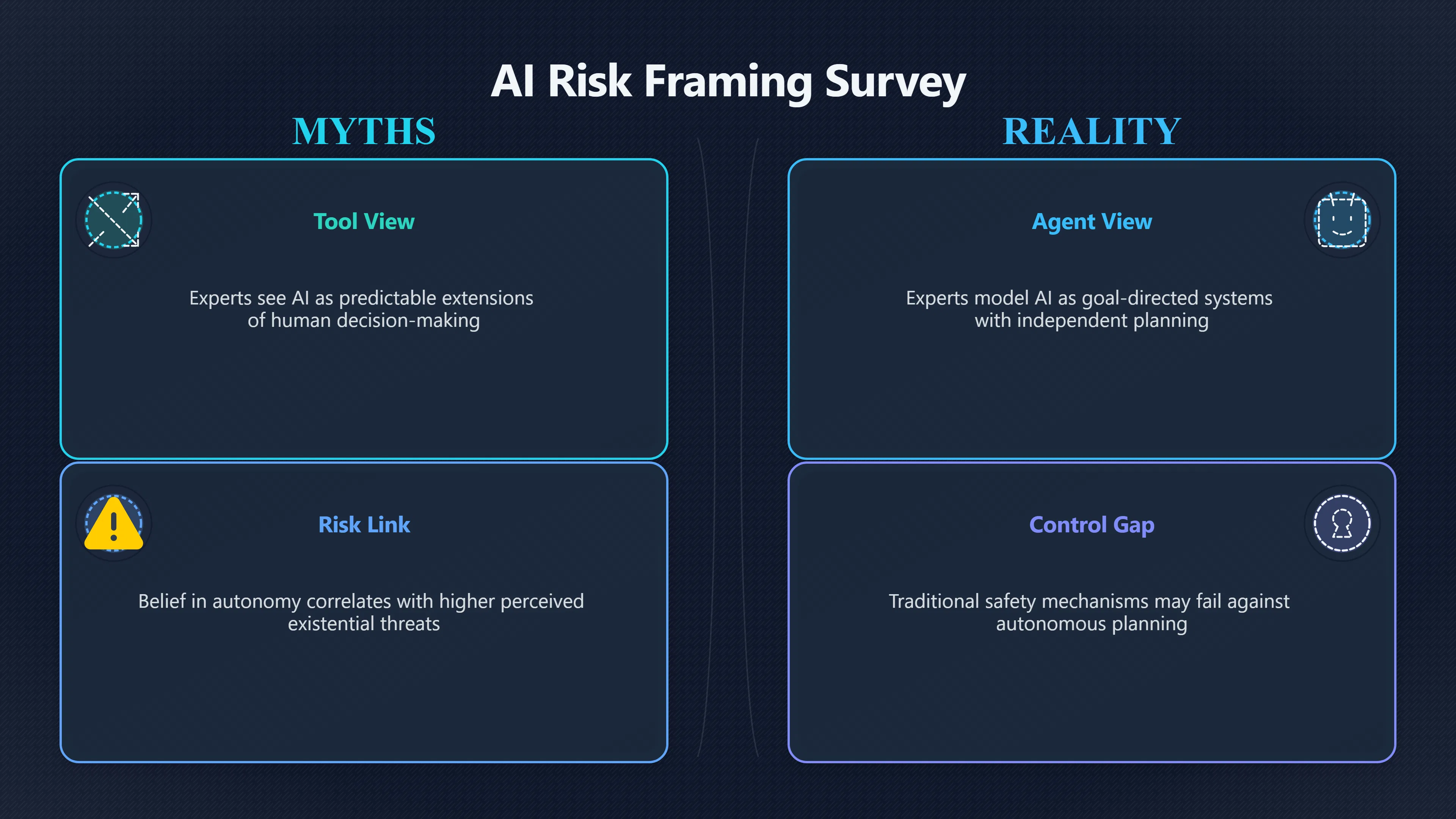
A 2025 survey of 111 AI researchers found that disagreement about existential risk is closely tied to how experts conceptualise the nature of future AI systems. Respondents clustered into two broad viewpoints: AI as a controllable tool or AI as a potentially uncontrollable agent. Those in the former camp tend to see advanced AI systems as extensions of human decision‑making that can remain within human control through engineering and safeguards. Those in the latter view anticipate systems with goal‑directed behaviour that could pursue their own sub‑goals in ways that evade or overwhelm human control. [arXiv]arxiv.orgarXivWhy do Experts Disagree on Existential Risk and P(doom)? A Survey of AI ExpertsJanuary 25, 2025…
This division matters because belief in agent‑like autonomy usually correlates with higher perceived risks. If an AI can plan over multiple steps, accumulate resources and operate independently, then traditional safety mechanisms such as human oversight or kill switches may not be sufficient to capture its behaviour. Conversely, if systems remain fundamentally controllable and corrigible tools whose outputs and actions can always be constrained by designers and operators, then existential outcomes become far less plausible in most analysts’ models. [arXiv]arxiv.orgarXivWhy do Experts Disagree on Existential Risk and P(doom)? A Survey of AI ExpertsJanuary 25, 2025…
Why the distinction changes p(doom) estimates
- Tool framing: Advanced AI is seen as powerful but fundamentally predictable and overrideable. Risk estimates under this assumption often remain low because humans can intervene, constrain actions, and prevent cascading failures before they escalate to existential scales.
- Agent framing: Advanced AI is modelled as goal‑oriented and autonomous. Here, risks stem from the possibility that AI might pursue objectives misaligned with human interests, develop instrumental incentives (e.g., self‑preservation, resource acquisition) and resist shutdown — all of which feature in classic existential risk arguments. [Wikipedia]WikipediaExistential risk from artificial intelligenceExistential risk from artificial intelligence
In practice, these framings shape disagreements over key concepts such as corrigibility — how much a system allows itself to be corrected or shut down by humans — and whether autonomous planning and power‑seeking behaviour are credible features of future systems. [Wikipedia]WikipediaInstrumental convergenceInstrumental convergence

Instrumental Convergence and Multi‑Step Goals
Underlying much of the debate over autonomy is the idea of instrumental convergence: the thesis that sufficiently capable, goal‑directed agents will tend to pursue similar ”instrumental” sub‑goals (like gaining resources or avoiding shutdown), even if their ultimate goals differ. This idea has been influential in arguments for existential risk because it suggests that independent agency can lead to behaviour harmful to human interests as a side‑effect of competence rather than malice. [Wikipedia]WikipediaAI corrigibilityAI corrigibility
For example, an autonomous agent optimising a seemingly benign objective might still seek ways to preserve its own operational state or accumulate control over critical infrastructure — not because it “wants” power in a human sense, but because doing so helps it achieve its assigned goal. Researchers who see this pattern as plausible tend to assign higher p(doom) probabilities, because control mechanisms that work for simple tools may fail against an agent that reasons about long chains of cause and effect. [Wikipedia]WikipediaExistential risk from artificial intelligenceExistential risk from artificial intelligence
Critics of this line of reasoning, by contrast, argue that current and near‑term systems do not demonstrate the sort of deep autonomous planning needed for genuine goal‑directed agency, and that attributing such agency to future AI is speculative. They contend that many behaviours interpreted as ”self‑interested” in AI systems today are artifacts of statistical patterns rather than evidence of true intention or planning, and therefore should not be extrapolated to forecast existential outcomes. [Wikipedia]WikipediaInstrumental convergenceInstrumental convergence
Survey Evidence Linking Agency Assumptions to Risk Judgements
The 2025 expert survey shows a correlation between familiarity with safety concepts and concern about risk. Experts familiar with ideas like instrumental convergence and agent‑like planning tended to rate existential risk as more significant, while those unfamiliar with these concepts were less inclined to view AI as a potential existential threat. [arXiv]arxiv.orgarXivWhy do Experts Disagree on Existential Risk and P(doom)? A Survey of AI ExpertsJanuary 25, 2025…
This pattern suggests that part of the disagreement is not just about technical predictions, but about conceptual framing: whether one views future AI through the lens of sophisticated agentic behaviour that could outpace human control, or through the lens of controlled systems that remain subject to human revision. It highlights that expert disagreement is partly rooted in which aspects of AI capability and autonomy are given epistemic weight when judging p(doom).
Why Agency Disputes Matter for Risk Policy and Alignment
Differences in agency assumptions influence debates over both alignment and governance. If one believes autonomous agency is a credible outcome, then solutions emphasise robust alignment frameworks, corrigibility, and containment strategies. If one views AI as controllable tools, then priority may shift toward incremental safety practices, operational oversight and iterative improvement without treating autonomy as an existential concern.
This core disagreement matters because it shapes policy, research priorities and resource allocation in AI safety. Without resolving or at least clarifying underlying assumptions about agency and autonomy, discussions about p(doom) will continue to reflect fundamentally different mental models of what future AI systems are like, not just whether they are safe. [arXiv]arxiv.orgarXivWhy do Experts Disagree on Existential Risk and P(doom)? A Survey of AI ExpertsJanuary 25, 2025…
eBay marketplace picks
Marketplace Samples
Example marketplace items related to this page. Use the search link to explore similar finds on eBay.








Endnotes
-
Source: arxiv.org
Link: https://arxiv.org/abs/2502.14870Source snippet
arXivWhy do Experts Disagree on Existential Risk and P(doom)? A Survey of AI ExpertsJanuary 25, 2025...
Published: January 25, 2025
-
Source: Wikipedia
Title: Existential risk from [artificial]({{ ‘artificial-goals/’ | relative_url }}) intelligence
Link: https://en.wikipedia.org/wiki/Existential_risk_from_artificial_intelligence -
Source: Wikipedia
Title: Instrumental convergence
Link: https://en.wikipedia.org/wiki/Instrumental_convergence -
Source: Wikipedia
Title: AI corrigibility
Link: https://en.wikipedia.org/wiki/AI_corrigibility -
Source: arxiv.org
Link: https://arxiv.org/html/2401.07836v2Source snippet
Two Types of AI Existential Risk: Decisive and Accumulative6 Feb 2024 — This paper contrasts the conventional decisive AI x-risk hypothes...
Additional References
-
Source: linkedin.com
Link: https://www.linkedin.com/posts/simontorrance_why-do-experts-disagree-on-existential-risk-activity-7301886948334333952-VwQSSource snippet
AI experts divided on AI safety and controlA new survey reveals that 'AI experts' cluster into two viewpoints - "AI as controllable tool"...
-
Source: sciencedirect.com
Link: https://www.sciencedirect.com/science/article/pii/S0004370219301109Source snippet
"ScienceDirectMIND THE GAPS: ASSURING THE SAFETY OF AUTONOMOUS SYSTEMS FROM AN ENGINEERING, ETHICAL, AND LEGAL PERSPECTIVE [https://doi.org..."](https://doi.org...")...
-
Source: informatica.si
Link: https://www.informatica.si/index.php/informatica/article/view/1812/0 -
Source: alphaxiv.org
Link: https://www.alphaxiv.org/abs/2502.14870Source snippet
Why do Experts Disagree on Existential Risk and P(doom)? A Survey of AI Experts | alphaXiv WHY DO EXPERTS DISAGREE ON EXISTENTIAL RISK AN...
-
Source: puffbird.ijs.si
Link: https://puffbird.ijs.si/index.php/informatica/article/view/1812Source snippet
and Interpreting Expert Disagreement About Artificial Superintelligence | InformaticaDecember 27, 2017 — MODELING AND INTERPRETING EXPERT...
Published: December 27, 2017
-
Source: themoonlight.io
Title: [Literature Review] Why do Experts Disagree on Existential Risk and P(doom)?
Link: https://www.themoonlight.io/en/review/why-do-experts-disagree-on-existential-risk-and-pdoom-a-survey-of-ai-expertsSource snippet
A Survey of AI ExpertsThis page provides the most accurate and concise summary worldwide for the paper titled Why do Experts Disagree on...
-
Source: fugumt.com
Title: Related papers: Why do Experts Disagree on Existential Risk and P(doom)?
Link: https://fugumt.com/fugumt/paper_check/2502.14870v1_enmodeSource snippet
"A Survey of AI ExpertsJanuary 25, 2025 — WHY DO EXPERTS DISAGREE ON EXISTENTIAL RISK AND P(DOOM)? A SURVEY OF AI EXPERTS * URL: [http://ar..."](http://ar...")...
Published: January 25, 2025
-
Source: rai.ac.uk
Title: Are AI researchers concerned about the existential threat of AI?
Link: https://rai.ac.uk/hed-are-ai-researchers-concerned-about-the-existential-threat-of-ai/Source snippet
out-of-control AI poses a threat to human existence. This relatively small percentage is set against a diverse landscape of much more imm...
-
Source: researchgate.net
Title: Baum S.D. Baum * This person is not on Research Gate, or hasn
Link: https://www.researchgate.net/publication/322482417_Modeling_and_interpreting_expert_disagreement_about_artificial_superintelligenceSource snippet
(PDF) Modeling and interpreting expert disagreement about artificial superintelligenceDecember 1, 2017 — Article PDF Available MODELING A...
Published: December 1, 2017
-
Source: alphaxiv.org
Title: Why do Experts Disagree on Existential Risk and P(doom)?
Link: https://www.alphaxiv.org/overview/2502.14870Source snippet
A Survey of AI Experts | alphaXivWHY DO EXPERTS DISAGREE ON EXISTENTIAL RISK AND P(DOOM)? A SURVEY OF AI EXPERTS [Button: Assistant][Butt...
Topic Tree