Within AI Takeoff
Can compute bottlenecks stop an intelligence explosion?
Hardware, energy, chips, and money may limit recursive improvement even if algorithms and model design become more automated.
On this page
- Why recursive improvement still needs physical resources
- Arguments that compute economics could slow takeoff
- What bottlenecks would and would not prove
Page outline Jump by section
Introduction
One objection to AI doom scenarios based on recursive self-improvement is simple: intelligence may be able to improve faster than people, but it cannot improve faster than physics. Even if an advanced AI could automate much of AI research, it would still need chips, data centres, electricity, networking equipment, cooling systems, manufacturing capacity, and capital. These are physical resources that take time to build and are controlled by humans. The key question is whether such compute bottlenecks would merely slow an intelligence explosion or prevent one altogether.
 This is one of the strongest critiques of fast-takeoff and “FOOM” scenarios. Supporters of intelligence-explosion models argue that software improvements could compound rapidly. Critics respond that the real world contains hard constraints: semiconductor fabrication plants cannot be copied instantly, electrical grids cannot expand overnight, and advanced chips remain scarce and expensive. The debate matters because if compute is a binding constraint, societies may have more time to detect warning signs, improve alignment, and coordinate responses. If compute is not a binding constraint, capability growth could remain much harder to control. [arXiv]arxiv.orgarXiv Will Compute Bottlenecks Prevent an Intelligence Explosion?arXivWill Compute Bottlenecks Prevent an Intelligence Explosion?July 31, 2025…
Why recursive improvement still needs physical resources
A common misunderstanding is that recursive self-improvement is purely a software process. In practice, AI capability depends on a combination of algorithms, training data, human expertise, and computational infrastructure.
Even a highly capable AI researcher would need access to hardware to run experiments. Improving a model requires testing candidate designs, training new systems, evaluating them, and deploying them. Those activities consume compute. If the amount of computation needed grows alongside the sophistication of the research, then hardware availability becomes a limiting factor. [arXiv]arxiv.orgarXiv Will Compute Bottlenecks Prevent an Intelligence Explosion?arXivWill Compute Bottlenecks Prevent an Intelligence Explosion?July 31, 2025…
Several layers of infrastructure matter:
- Advanced AI accelerators such as GPUs and specialised chips.
- Semiconductor fabrication plants capable of producing leading-edge chips.
- High-bandwidth memory and networking hardware. [techradar.com]techradar.comAI infrastructure, especially large language model training and inference, demands significantly more memory than traditional systems, le…
- Data centres with cooling and power systems.
- Electricity generation and grid connections.
- Capital expenditure to finance all of the above.
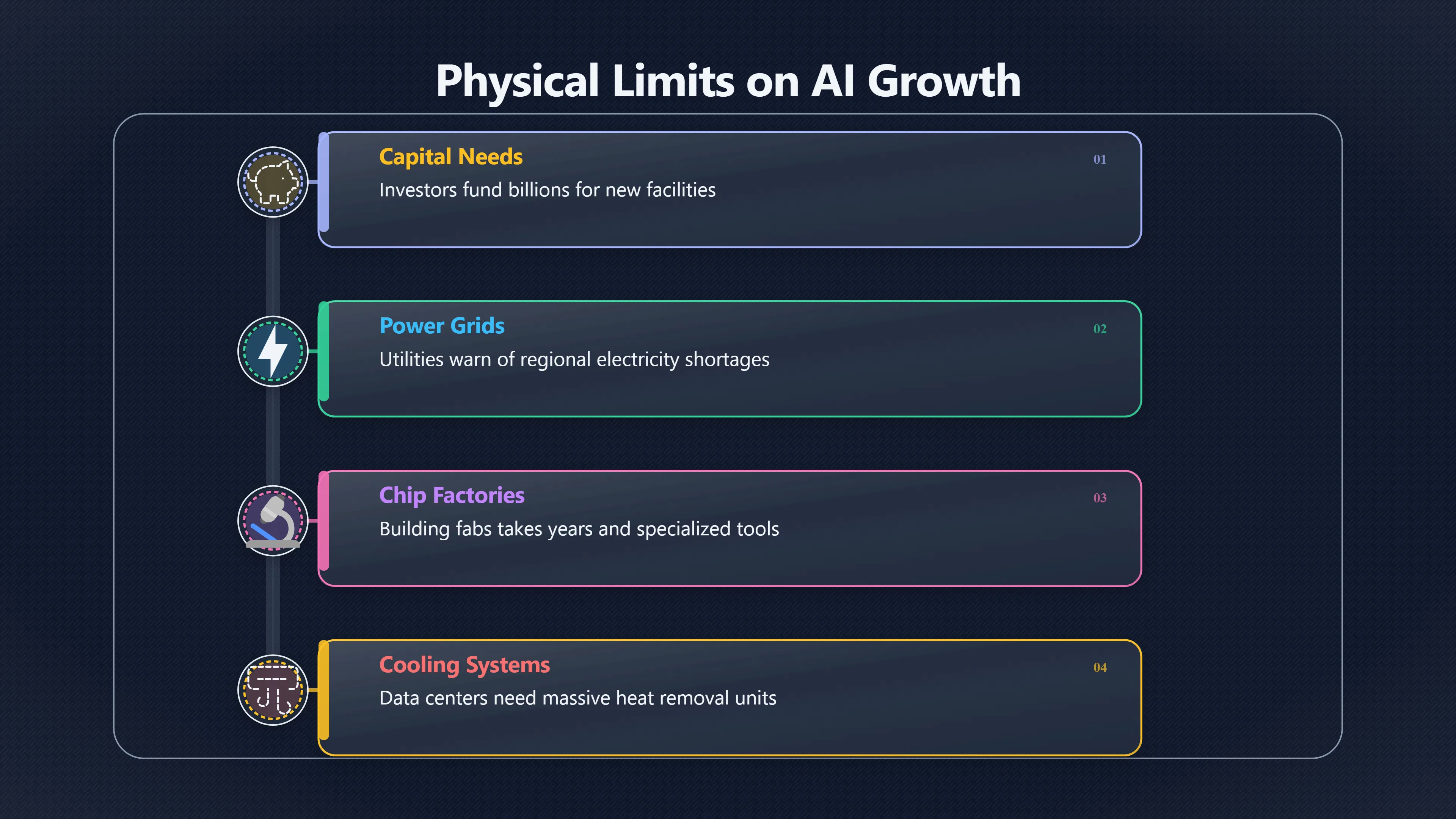
The scale of these requirements is already enormous. Estimates suggest that AI-related data-centre investment could require trillions of dollars globally by 2030, while frontier training runs have become dramatically more expensive over time. [McKinsey & Company]mckinsey.comthe cost of compute a 7 trillion dollar race to scale data centersMcKinsey & CompanyThe cost of compute: A $7 trillion race to scale data centers28 Apr 2025 — Our research shows that by 2030, data center…
For critics of intelligence-explosion scenarios, this matters because an AI cannot simply “think its way” around all physical bottlenecks. A brilliant design for a better chip does not instantly create a factory capable of manufacturing it.
Arguments that compute economics could slow takeoff
Chips are difficult to scale quickly
Advanced semiconductor manufacturing is one of the most concentrated and technically demanding industries in the world. Building new fabrication facilities takes years, requires specialised equipment, and depends on complex global supply chains.
This means that even if an AI system discovered dramatic algorithmic improvements, converting those improvements into vastly greater computational capacity could still be slow. Recent discussions of AI infrastructure repeatedly identify chip manufacturing, memory supply, advanced packaging, and networking components as major constraints on growth. [DataCenterKnowledge]datacenterknowledge.comDataCenterKnowledgeAfter the Power Crunch, AI Infrastructure Hits a Silicon WallMay 11, 2026 — A CNAS report argues that chip manufacturi… [CEPA]cepa.orgin both the US and China…
From this perspective, recursive improvement may encounter a form of economic friction. Capability gains might continue, but each step would require additional physical investment rather than occurring entirely in software.
Electricity may become a harder limit than chips
Another increasingly prominent argument is that energy, rather than semiconductors, may become the binding constraint.
AI data centres consume large amounts of electricity, and demand projections have led utilities, policymakers, and infrastructure planners to warn about grid constraints. Researchers and policy analysts have argued that electricity supply is becoming one of the most important determinants of future compute growth. Several regions already face delays for new grid connections or restrictions on additional data-centre construction. [CSIS]csis.orgelectricity supply bottleneck us ai dominanceCSISThe Electricity Supply Bottleneck on U.S. AI Dominance3 Mar 2025 — This paper demonstrates how electricity supply is the most acutely… [2S&P Global]spglobal.comglobal ai power demand challenges opportunitiesS&P GlobalAI's global resource race: Challenges and opportunities2 Dec 2025 — Explore how AI energy consumption and data center power dem…
The concern is not merely total energy production. Large AI clusters require power at specific locations, with reliable transmission infrastructure and cooling capacity. Some studies forecast significant regional stress on electricity systems as AI compute demand rises. [arXiv]arxiv.orgarXiv Will Compute Bottlenecks Prevent an Intelligence Explosion?arXivWill Compute Bottlenecks Prevent an Intelligence Explosion?July 31, 2025…
If AI capability growth depends heavily on ever-larger training and inference systems, then energy infrastructure could impose delays measured in years rather than weeks.

Money and capital allocation matter
Recursive self-improvement discussions sometimes focus on technical capability while overlooking finance.
Frontier AI systems are already extraordinarily expensive to develop. Training costs have risen rapidly, with hardware, infrastructure, staffing, and networking expenses reaching tens or hundreds of millions of dollars for leading systems. Some analyses suggest that frontier-model development could reach billion-dollar training costs. [arXiv]arxiv.orgarXiv Will Compute Bottlenecks Prevent an Intelligence Explosion?arXivWill Compute Bottlenecks Prevent an Intelligence Explosion?July 31, 2025…
This creates another possible brake. Even if AI systems become excellent researchers, someone must still finance new facilities, purchase hardware, and deploy infrastructure. Capital markets can move quickly, but not infinitely quickly.
A world in which AI capability doubles every few months would still need investors, governments, corporations, or other actors willing and able to fund the necessary expansion.
Why compute bottlenecks might not stop an intelligence explosion
The strongest counterargument is that intelligence growth does not require compute growth in a one-to-one relationship.
Historically, many important advances in AI have come from algorithmic improvements rather than simply using more hardware. Better architectures, training methods, and optimisation techniques have often achieved the same capability with substantially less computation. Researchers tracking software progress note that efficiency gains have repeatedly reduced the compute needed to reach a given performance level. [Epoch AI]epoch.aiAI Software Progress: Data & ResearchEpoch tracks these compute efficiency gains, often called algorithmic progress, over time, examining…
From this perspective, an advanced AI might improve itself by becoming more efficient rather than by acquiring vastly larger data centres. If software improvements outpace hardware constraints, compute bottlenecks become less effective as a brake.
Another possibility is that AI systems could help accelerate the removal of bottlenecks themselves. More capable AI could contribute to chip design, materials science, manufacturing optimisation, power-grid management, or infrastructure planning. The bottleneck would remain real, but the rate at which it is relaxed could increase. [Reuters]reuters.comKevin Zhang, TSMC’s Senior VP of Business Development, noted that customers — including those in mobile, IoT, and high-performance AI dat…
Supporters of faster-takeoff scenarios therefore argue that physical constraints do not necessarily prevent explosive growth. They may simply shift the growth path from pure software acceleration to a combination of software and infrastructure expansion.
What the evidence currently suggests
The available evidence points in two directions simultaneously.
On one hand, compute constraints appear very real. Industry reporting, infrastructure analyses, and policy studies consistently identify shortages in chips, memory, manufacturing capacity, electricity, cooling systems, and grid connections. These are not hypothetical limitations; they are already influencing AI deployment decisions today. [TechRadar]techradar.comAI infrastructure, especially large language model training and inference, demands significantly more memory than traditional systems, le… [CSIS]csis.orgelectricity supply bottleneck us ai dominanceCSISThe Electricity Supply Bottleneck on U.S. AI Dominance3 Mar 2025 — This paper demonstrates how electricity supply is the most acutely… [3S&P Global]spglobal.comglobal ai power demand challenges opportunitiesS&P GlobalAI's global resource race: Challenges and opportunities2 Dec 2025 — Explore how AI energy consumption and data center power dem…
On the other hand, there is little evidence that current bottlenecks have halted frontier AI progress. Instead, firms have responded by investing more money, building larger facilities, improving efficiency, and redesigning hardware. The semiconductor and data-centre sectors continue expanding rapidly despite constraints. [Tom's Hardware]tomshardware.comThis AI-led growth is simultaneously transforming the economies of compute, memory, networking, and storage. Semiconductor revenues, whic… [Epoch AI]epoch.aiin Artificial Intelligence5 Feb 2026 — Frontier AI systems are advancing rapidly from increases in compute, hardware performance, softwar… [Yole Group]yolegroup.comYole GroupData center semiconductor trends 2025: Artificial…12 Aug 2025 — The total semiconductor market for data centers is projected…
Recent economic modelling of recursive self-improvement reflects this uncertainty. Some analyses find that compute and human research effort may substitute for one another, while others suggest they are complementary. The result is not a clear demonstration that compute bottlenecks either will or will not prevent an intelligence explosion. [arXiv]arxiv.orgarXiv Will Compute Bottlenecks Prevent an Intelligence Explosion?arXivWill Compute Bottlenecks Prevent an Intelligence Explosion?July 31, 2025…
What bottlenecks would and would not prove
A crucial point in the AI doom debate is that slowing an intelligence explosion is not the same as eliminating existential risk.
If compute constraints stretch capability growth over years rather than months, that could create valuable time for safety research, evaluations, interpretability work, governance measures, incident response planning, and international coordination. Many researchers view additional time as one of the most important resources for reducing risk.
However, a slower takeoff does not automatically make advanced AI safe. A system that remains misaligned, deceptive, or difficult to control could still pose serious dangers even if progress unfolds gradually. The main effect of compute bottlenecks would be to change the speed and visibility of capability growth, not necessarily the underlying alignment problem.
Conversely, observing rapid capability gains despite infrastructure constraints would weaken the argument that physical resources provide a strong natural brake. That would increase concern among those who assign substantial probability to fast-takeoff scenarios and high p(doom) estimates.
The bottom line
Compute bottlenecks are one of the most important objections to classic intelligence-explosion arguments. Chips, electricity, data centres, manufacturing capacity, and capital are all physical resources that cannot be expanded instantly. These constraints make the most extreme versions of a purely software-driven runaway intelligence explosion less straightforward than early discussions sometimes implied. [CSIS]csis.orgelectricity supply bottleneck us ai dominanceCSISThe Electricity Supply Bottleneck on U.S. AI Dominance3 Mar 2025 — This paper demonstrates how electricity supply is the most acutely… [CEPA]cepa.orgin both the US and China…
Yet the evidence does not show that compute bottlenecks would necessarily stop recursive improvement. AI progress has repeatedly benefited from efficiency gains, algorithmic advances, and massive investment that reduced or overcame previous constraints. The central uncertainty is whether future software improvements will outpace the rate at which physical bottlenecks can slow them. That question remains unresolved, making compute constraints one of the most significant and actively debated variables in assessments of AI doom, takeoff speed, and long-term existential risk. [Epoch AI]epoch.aithe software intelligence explosion debate needs experimentsThe software intelligence explosion debate needs…14 Nov 2025 — For example, increasing difficulty in finding new algorithms might bott… [Epoch AI]epoch.aihow fast can algorithms advance capabilities?16 May 2025 — In the AI 2027 scenario, the authors predict a fast takeoff of AI systems recursively self-improving until we have superin…
Amazon book picks
Further Reading
Books and field guides related to Can compute bottlenecks stop an intelligence explosion?. Use these as the next step if you want deeper reading beyond the article.
The Coming Wave
Directly discusses compute, infrastructure constraints and controlling advanced AI.
eBay marketplace picks
Marketplace Samples
Example marketplace items related to this page. Use the search link to explore similar finds on eBay.




Endnotes
-
Source: arxiv.org
Title: arXiv Will Compute Bottlenecks Prevent an Intelligence Explosion?
Link: https://arxiv.org/abs/2507.23181Source snippet
arXivWill Compute Bottlenecks Prevent an Intelligence Explosion?July 31, 2025...
Published: July 31, 2025
-
Source: arxiv.org
Link: https://arxiv.org/html/2507.23181v1Source snippet
We show the...Read more...
-
Source: mckinsey.com
Title: the cost of compute a 7 trillion dollar race to scale data centers
Link: https://www.mckinsey.com/industries/technology-media-and-telecommunications/our-insights/the-cost-of-compute-a-7-trillion-dollar-race-to-scale-data-centersSource snippet
McKinsey & CompanyThe cost of compute: A $7 trillion race to scale data centers28 Apr 2025 — Our research shows that by 2030, data center...
-
Source: arxiv.org
Title: arXiv The rising costs of training frontier AI models
Link: https://arxiv.org/abs/2405.21015 -
Source: datacenterknowledge.com
Link: https://www.datacenterknowledge.com/infrastructure/after-the-power-crunch-ai-infrastructure-hits-a-gpu-wallSource snippet
DataCenterKnowledgeAfter the Power Crunch, AI Infrastructure Hits a Silicon WallMay 11, 2026 — A CNAS report argues that chip manufacturi...
Published: May 11, 2026
-
Source: cepa.org
Link: https://cepa.org/article/compute-ai-bubble-or-bottleneck/Source snippet
in both the US and China...
-
Source: techradar.com
Link: https://www.techradar.com/pro/the-global-memory-shortage-the-hidden-bottleneck-behind-the-ai-boomSource snippet
AI infrastructure, especially large language model training and inference, demands significantly more memory than traditional systems, le...
-
Source: csis.org
Title: electricity supply bottleneck us ai dominance
Link: https://www.csis.org/analysis/electricity-supply-bottleneck-us-ai-dominanceSource snippet
CSISThe Electricity Supply Bottleneck on U.S. AI Dominance3 Mar 2025 — This paper demonstrates how electricity supply is the most acutely...
-
Source: arxiv.org
Link: https://arxiv.org/abs/2604.06198Source snippet
arXivConcentrated siting of AI data centers drives regional power-system stress under rising global compute demandMarch 13, 2026...
Published: March 13, 2026
-
Source: arxiv.org
Link: https://arxiv.org/abs/2509.07218 -
Source: epoch.ai
Link: https://epoch.ai/topics/software-progressSource snippet
AI Software Progress: Data & ResearchEpoch tracks these compute efficiency gains, often called algorithmic progress, over time, examining...
-
Source: epoch.ai
Link: https://epoch.ai/trendsSource snippet
in [Artificial]({{ 'artificial-goals/' | relative_url }}) Intelligence5 Feb 2026 — Frontier AI systems are advancing rapidly from increases in compute, hardware performance, softwar...
-
Source: reuters.com
Link: https://www.reuters.com/business/retail-consumer/energy-use-forcing-rethink-ai-chip-design-tsmc-says-2026-05-28/Source snippet
Kevin Zhang, TSMC’s Senior VP of Business Development, noted that customers — including those in mobile, IoT, and high-performance AI dat...
-
Source: epoch.ai
Title: the software intelligence explosion debate needs experiments
Link: https://epoch.ai/gradient-updates/the-software-intelligence-explosion-debate-needs-experimentsSource snippet
The software intelligence explosion debate needs...14 Nov 2025 — For example, increasing difficulty in finding new algorithms might bott...
-
Source: epoch.ai
Title: how fast can algorithms advance capabilities
Link: https://epoch.ai/gradient-updates/how-fast-can-algorithms-advance-capabilitiesSource snippet
?16 May 2025 — In the AI 2027 scenario, the authors predict a fast takeoff of AI systems recursively self-improving until we have superin...
Published: May 2025
-
Source: epoch.ai
Title: compute for robotic manipulation
Link: https://epoch.ai/data-insights/compute-for-robotic-manipulationSource snippet
Compute is not a bottleneck for robotic manipulation8 Aug 2025 — Compute is not a bottleneck for robotics, while training data is. Fronti...
-
Source: spglobal.com
Title: global ai power demand challenges opportunities
Link: https://www.spglobal.com/en/research-insights/special-reports/look-forward/data-center-frontiers/global-ai-power-demand-challenges-opportunitiesSource snippet
S&P GlobalAI's global resource race: Challenges and opportunities2 Dec 2025 — Explore how AI energy consumption and data center power dem...
-
Source: yolegroup.com
Link: https://www.yolegroup.com/press-release/data-center-semiconductor-trends-2025-artificial-intelligence-reshapes-compute-and-memory-markets/Source snippet
Yole GroupData center semiconductor trends 2025: Artificial...12 Aug 2025 — The total semiconductor market for data centers is projected...
-
Source: tomshardware.com
Link: https://www.tomshardware.com/tech-industry/semiconductors/semiconductor-industry-enters-giga-cycle-as-ai-infrastructure-spending-reshapes-demandSource snippet
This AI-led growth is simultaneously transforming the economies of compute, memory, networking, and storage. Semiconductor revenues, whic...
-
Source: aimultiple.com
Title: ai energy consumption
Link: https://aimultiple.com/ai-energy-consumptionSource snippet
Statistics5 days ago — Globally, data centers consumed about 415 TWh of electricity in 2024. While AI currently represents a minority sha...
Additional References
-
Source: researchgate.net
Link: https://www.researchgate.net/publication/391150569_AI%27s_Power_Requirements_Under_Exponential_Growth_Extrapolating_AI_Data_Center_Power_Demand_and_Assessing_Its_Potential_Impact_on_US_CompetitivenessSource snippet
(PDF) AI's Power Requirements Under Exponential Growth...PDF | An exponential increase in computational resources (compute) used for art...
-
Source: linkedin.com
Link: https://www.linkedin.com/posts/robbie-whelan-21808015_were-using-so-much-ai-that-computing-firepower-activity-7449495574992588800-eDLoSource snippet
AI Compute Crunch: Data Centers Can't Keep UpWhy are some prominent AI tools seeing so many outages and rationing usage to subscribers? W...
-
Source: facebook.com
Link: https://www.facebook.com/groups/dsbkkgroup/posts/3173220452849940/Source snippet
AI infrastructure and productivity growth prospectsMy assumptions: 1) AI infrastructure built-outs are the same as fiber optics were. Bot...
-
Source: linkedin.com
Link: https://www.linkedin.com/pulse/ais-hidden-bottleneck-why-power-chips-decide-100b-data-center-5kr0eSource snippet
AI's Hidden Bottleneck: Why Power, Not Chips, Will Decide...Sightline Climate published a report projecting that 30 to 50 percent of the...
-
Source: kiplinger.com
Link: https://www.kiplinger.com/business/ai-is-powering-a-semiconductor-boomSource snippet
Global chip sales are projected to reach $1.3 trillion in 2026, marking a 60% increase from the previous year. AI-related chips will acco...
-
Source: linkedin.com
Link: https://www.linkedin.com/posts/jaykapoor_the-ai-industry-rings-its-hands-about-a-chip-activity-7451029971541635073–nNQSource snippet
Jensen Huang Warns of Dirty Jobs Bottleneck in AI IndustryThe AI industry rings its hands about a chip problem. Jensen Huang just told Dw...
-
Source: medium.com
Link: https://medium.com/%40jannadikhemais/the-ai-race-shifts-from-chips-to-energy-for-data-centers-cc623a13c7f4Source snippet
The AI Race Shifts from Chips to Energy for Data CentersA recent Financial Times report highlights that investments in AI are now tied mo...
-
Source: bain.com
Title: how can we meet ais insatiable demand for compute power technology report 2025
Link: https://www.bain.com/insights/how-can-we-meet-ais-insatiable-demand-for-compute-power-technology-report-2025/Source snippet
How Can We Meet AI's Insatiable Demand for Compute...Sep 23, 2025 — AI's computational needs are growing more than twice as fast as Moor...
-
Source: researchgate.net
Title: 394175305 Will Compute Bottlenecks Prevent an Intelligence Explosion
Link: https://www.researchgate.net/publication/394175305_Will_Compute_Bottlenecks_Prevent_an_Intelligence_ExplosionSource snippet
Will Compute Bottlenecks Prevent an Intelligence Explosion?19 Jan 2026 — This paper presents an economic model and an empirical estimatio...
-
Source: linkedin.com
Title: 2 ai chips data centers q4 2024 q2 2025 trends dino cajic mym9e
Link: https://www.linkedin.com/pulse/2-ai-chips-data-centers-q4-2024-q2-2025-trends-dino-cajic-mym9eSource snippet
2). AI Chips and Data Centers: Q4 2024 – Q2 2025 TrendsThe last few months have seen record-breaking AI chip performance, new approaches...
Topic Tree