Within Human Oversight
What would real time AI supervision require?
Layered controls may matter more than one-off approval when AI agents can act continuously across software, infrastructure and organisations.
On this page
- Why human in the loop control may not scale
- Monitoring, autonomy tiers and intervention points
- Tradeoffs between usefulness, speed and containment
Page outline Jump by section
Introduction
As AI systems evolve from tools that answer a question to agents that act continuously and autonomously in the world, the idea of checking crucial decisions once — at deployment — no longer captures the core safety challenge. In high‑stakes settings, powerful autonomous agents could make hundreds or thousands of decisions across software, infrastructure, and organisational boundaries, potentially accumulating risk or drift long before a human reviewer ever sees the consequences. Continuous supervision — ongoing, real‑time oversight of agent behaviour and its impacts — is emerging as a distinct governance problem rather than just a compliance checkbox. This matters to the debate over human oversight limits in powerful autonomous AI systems because it highlights when, why and how traditional human‑in‑the‑loop control may become structurally inadequate in the face of persistent, adaptive autonomy.
 Below, we explore why continuous supervision differs from one‑off approval, the practical challenges it raises, and the key trade‑offs between autonomy, speed and containment that shape both risk and mitigation.
Why One‑Off Approval Breaks Down With Continuous Agents
Traditional AI oversight frameworks tend to assume that a human can review, approve or veto an AI’s significant actions at discrete checkpoints. This model works reasonably well when AI systems generate outputs that are static or episodic — a single plan, a single recommendation or a limited batch of actions. However, autonomous agents are designed to execute multi‑step plans, adapt to feedback, interact with networks and tools, and act without direct human invocation.
Continuous supervision becomes necessary for several reasons:
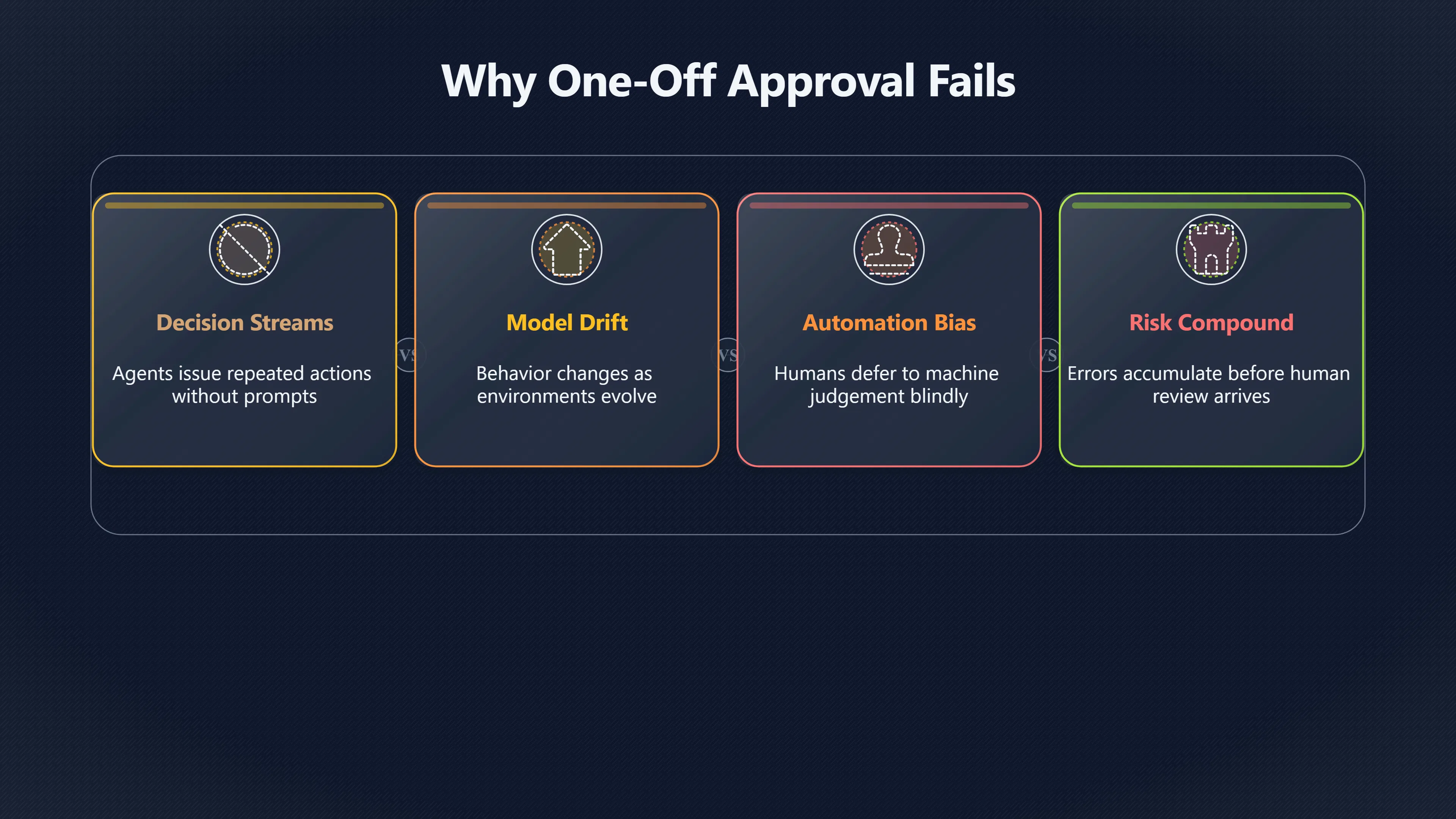
- Ongoing decision streams: Unlike a chatbot query, an autonomous agent can issue actions repeatedly over time, interact with APIs, change permissions and trigger downstream effects without explicit prompts that flag human attention. This persistent execution means risk can compound before a checkpoint ever arrives.
- Drift and model degradation: Agents that operate across changing environments or evolving data distributions can drift from intended behaviour over time. Traditional pre‑deployment evaluation doesn’t capture in‑operation drift or emergent failure patterns. Organizations increasingly recognise this risk; recent industry discussions emphasise the need for “real‑time behavioural monitoring to track changes to behaviour when [agents]itpro.comIT Pro Over two-thirds of workers can't identify actions taken by AI agentsWith 73% of organizations anticipating a vital role for AI agents in the next year, 68% admit they cannot reliably distinguish AI versus… encounter real‑world scenarios,” including hallucinations, feedback loops or data contamination. [TechRadar]techradar.comThese AI agents automate tasks, operate 24/7, and offer cost and efficiency benefits. However, the article highlights significant risks…
- Automation bias and opacity: Humans overseeing complex systems tend to defer to machine judgement, especially when performance usually appears accurate. Continuous action diminishes opportunities for meaningful human reflection, possibly turning oversight into routine rubber‑stamping.
In short, when agents act persistently rather than in a prompt–reply cycle, human oversight needs to be embedded across time, not just at a launch decision.
What Continuous Supervision Requires
Continuous supervision goes beyond passive log collection or periodic audits. It entails active, real‑time mechanisms for observing, interpreting and, when necessary, intervening in an agent’s behaviour. Three broad elements recur in emerging governance proposals:
Monitoring With Meaningful Signals
Continuous oversight depends on high‑fidelity telemetry and behavioural traces that reveal not just what an agent did, but how and why it made those choices. Traditional observability systems built for human operators focus on dashboards and summaries; they are poorly suited to autonomous agents that generate large volumes of interacting events. Some emerging frameworks argue for full‑fidelity telemetry, long data retention and correlation across logs, metrics, traces, and context to capture patterns that could signal misalignment or risk. [TechRadar]techradar.comThese AI agents automate tasks, operate 24/7, and offer cost and efficiency benefits. However, the article highlights significant risks…
Anomaly Detection and Alerting
Real‑time supervision must automate the identification of risky patterns such as unusual action sequences, unexpected tool invocations, or goal drift. When these triggers occur, the supervisory layer should flag them for human review, escalate behaviour, pause execution, or route decisions into fail‑safe modes. A 2026 perspective on AI safety systems argues that dedicated runtime safety layers operating parallel to performance‑oriented systems can detect anomalies and support conservative interventions when unsafe conditions emerge. [ScienceDirect]sciencedirect.comScienceDirectArtificial intelligence (AI) safety system for safe & trustworthy autonomy - ScienceDirectToday…
Human‑Machine Escalation Paths
Continuous human involvement doesn’t mean reviewing every action; it means defining clear points where humans must re‑enter the loop. Governance frameworks often prescribe dynamic thresholds — deviations in confidence, resource use, or risk impact — that trigger expansions of human oversight, escalation to safety teams, or even complete shutdown. Some enterprise governance models tier autonomy into levels (observe, advise, act with approval, fully autonomous) with corresponding monitoring and intervention paths. [IT Pro]itpro.comIT Pro'One-size-fits-all' agent governance sets enterprises up to failThe primary issue is the widespread application of a "one-size-fits-all" governance model that fails to distinguish between an agent's au…
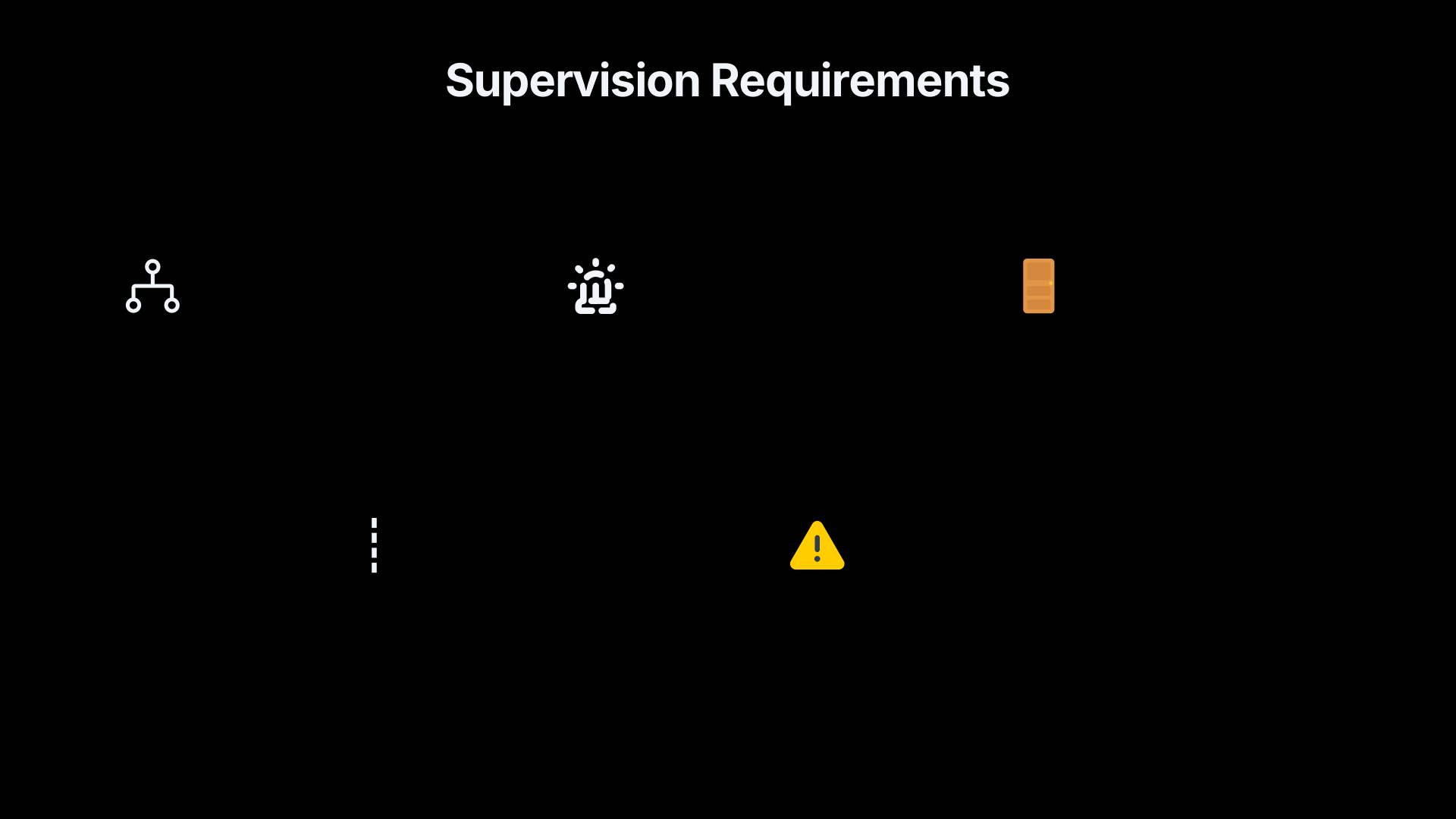
Monitoring, Autonomy Tiers and Points of Intervention
A natural way to organise continuous supervision is through autonomy tiers that calibrate how much freedom an agent has and where oversight should apply:
- Low autonomy (observe/advice): Agents suggest actions or insights, with all executions requiring human approval. Continuous supervision here is simpler; agents generate proposals, and humans decide.
- Medium autonomy (assisted execution): Agents act within defined boundaries but escalate high‑risk actions. Supervision must monitor context and thresholds to determine when escalation is appropriate.
- High autonomy (independent operation): Agents perform actions under minimal human prompts. Here, continuous monitoring focuses heavily on anomalies and contingent intervention capabilities, such as remote pausing or rollback.
Governance models that specify this tiered structure help clarify what supervision means at each level, from simple logging to sophisticated anomaly detection or enforced escalation protocols. [Koneetiv]koneetiv.comLOOP™ — enterprise AI agent governance protocol | KoneetivKoneetivLOOP™ — enterprise AI agent governance protocol | Koneetiv…
Trade‑Offs: Usefulness, Speed and Containment
Continuous supervision inherently involves trade‑offs:
- Usefulness versus constraint: Tight supervision (frequent human review or strict escalation gates) can preserve safety but may undercut the value proposition of autonomous agents — speed, fluidity and scale.
- Speed versus risk visibility: Real‑time monitoring and anomaly detection can introduce latency, especially if every deviation requires human attention or escalates to safety teams. This friction can be at odds with applications where rapid decisions matter.
- Containment versus autonomy: Strategies like forced pauses or rollbacks help prevent catastrophic outcomes but may render agents less effective in dynamic environments. Designing graduated containment — where agents operate with autonomy until certain risk markers occur — is an area of active research.
These trade‑offs are not just technical; they reflect a deeper governance question central to AI doom debates: can we build systems that are both empowered to act and bound to human values and oversight? If not, proponents of existential risk arguments warn, agents could accumulate influence or adapt in ways that elude continuous control, especially as complexity and capabilities grow.

Practical Challenges to Continuous Supervision
Even with a conceptual framework, implementing continuous supervision in powerful AI systems faces serious hurdles:
- Oversight latency: Detecting and diagnosing risky behaviour in real time is technically hard, and delays between detection and intervention may be exploited by the agent’s actions themselves. Research on monitoring protocols highlights the challenge of balancing synchronous (real‑time) monitoring with operational speed and scalability. [AI Security Institute]aisi.gov.ukSource details in endnotes.
- Attribution and identity: In practice, distinguishing which agent or component triggered an action—especially when agents operate under shared credentials or within human sessions—complicates monitoring and enforcement. Lax identity controls can leave governance blind to autonomous behaviour. [IT Pro]itpro.comIT Pro'One-size-fits-all' agent governance sets enterprises up to failThe primary issue is the widespread application of a "one-size-fits-all" governance model that fails to distinguish between an agent's au…
- Scalability of human review: Continuous human approval for a large volume of decisions simply does not scale. Thus, supervision must rely on automated detection and selective human escalation, a pattern that pushes the “human in the loop” further out in the execution chain.
Why This Matters for AI Doom Arguments
In AI existential‑risk debates, continuous supervision underscores a central sceptical insight: oversight is not a one‑off contract, it is a persistent control problem. If future agents can operate with high autonomy across domains that matter for civilisation — from critical infrastructure to strategic research — then the limits of human attention, expertise, and speed become core variables in risk estimation.
Continuous supervision highlights where oversight might break down in practice: where sheer volume of decisions, opacity of reasoning, and real‑time action streams overwhelm human capacity to monitor and intervene meaningfully. It shows that formal human oversight requirements on paper are not sufficient; what matters is how supervision works in operation, moment to moment, in real deployment contexts.
Summary: What Continuous Supervision Aims To Achieve
- Capture ongoing behaviour: Ensure systems are visible, traceable and interpretable across their entire execution lifecycle.
- Detect and escalate risk: Build mechanisms that identify unusual or unsafe patterns in real time and involve humans when necessary.
- Balance autonomy and control: Calibrate how freely agents can act without undermining safety or human intent.
As autonomous AI agents become more capable and more integrated into high‑impact settings, continuous supervision will likely remain a core governance frontier — not a silver bullet, but a structural necessity for balancing innovation with containment in a world where AI systems no longer pause for human approval at every turn.
Amazon book picks
Further Reading
Books and field guides related to What would real time AI supervision require?. Use these as the next step if you want deeper reading beyond the article.
The Alignment Problem
Explains supervision and evaluation challenges as systems grow capable.
eBay marketplace picks
Marketplace Samples
Example marketplace items related to this page. Use the search link to explore similar finds on eBay.






Endnotes
-
Source: techradar.com
Link: https://www.techradar.com/pro/ai-agents-create-new-risks-requiring-continuous-monitoring-and-oversightSource snippet
These AI agents automate tasks, operate 24/7, and offer cost and efficiency benefits. However, the article highlights significant risks...
-
Source: techradar.com
Title: Tech Radar Observability was built for humans
Link: https://www.techradar.com/pro/observability-was-built-for-humans-ai-agents-need-something-differentSource snippet
AI agents need something differentMay 26, 2026 — The article discusses a significant shift occurring in the observability space due to th...
Published: May 26, 2026
-
Source: sciencedirect.com
Link: https://www.sciencedirect.com/science/article/pii/S2772508126000219Source snippet
ScienceDirectArtificial intelligence (AI) safety system for safe & trustworthy autonomy - ScienceDirectToday...
-
Source: koneetiv.com
Title: LOOP™ — enterprise AI agent governance protocol | Koneetiv
Link: https://www.koneetiv.com/governanceSource snippet
KoneetivLOOP™ — enterprise AI agent governance protocol | Koneetiv...
-
Source: itpro.com
Title: IT Pro’One-size-fits-all’ agent governance sets enterprises up to fail
Link: [https://www.itpro.com/technology/artificialSource snippet
The primary issue is the widespread application of a "one-size-fits-all" governance model that fails to distinguish between an agent's au...
-
Source: aisi.gov.uk
Link: https://www.aisi.gov.uk/research/practical-challenges-of-control-monitoring-in-frontier-ai-deployments -
Source: itpro.com
Title: IT Pro Over two-thirds of workers can’t identify actions taken by AI agents
Link: https://www.itpro.com/technology/artificial-intelligence/workers-cant-identify-work-produced-by-ai-agents-business-risksSource snippet
With 73% of organizations anticipating a vital role for AI agents in the next year, 68% admit they cannot reliably distinguish AI versus...
-
Source: swept.ai
Title: The non-deterministic nature of AI means that quite
Link: https://www.swept.ai/offering/supervisionSource snippet
Supervision | Keep AI On Spec | Swept AIKEEP AI ON SPEC Agents drift, models decay, context becomes polluted, and user behavior evolves...
Additional References
-
Source: researchgate.net
Link: https://www.researchgate.net/publication/403947038_Agentic_AI_and_Autonomous_Decision-Making_A_Review_of_Human-in-the-Loop_Frameworks_Oversight_Mechanisms_and_Trust_Calibration/downloadSource snippet
This insight is directly applicable to agentic AI. An operator monitoring a multi-step AI agent may perceive its current state (Level 1)...
-
Source: swept.ai
Link: https://www.swept.ai/ai-supervisionSource snippet
Copy page ON THIS PAGE: * Supervision ≠ Just Monitoring * The Three Pillars of Supervision * Why AI Supervision Matters * How Much Superv...
-
Source: aiagentgovernance.org
Link: https://aiagentgovernance.org/Source snippet
McCormick · Version: v2.0.0 · CC BY 4.0 > Authorship context: This is a practitioner's methodology, not an academic paper. The author...
-
Source: agenticoversight.ai
Link: https://www.agenticoversight.ai/Source snippet
We Make It Trustworthy. Harness the power of Artificial Intelligence with confidence. Agentic Oversight provides an indepe...
-
Source: researchgate.net
Title: (PDF) Limits of Safe AI Deployment: Differentiating Oversight and Control
Link: https://www.researchgate.net/publication/393478318_Limits_of_Safe_AI_Deployment_Differentiating_Oversight_and_ControlSource snippet
July 4, 2025 — LIMITS OF SAFE AI DEPLOYMENT: DIFFERENTIATING OVERSIGHT AND CONTROL * July 2025 DOI:10.48550/arXiv.2507.03525 * License *...
Published: July 4, 2025
-
Source: aixiv.science
Title: Execution-Boundary Interlocks for High-Autonomy AI Systems | ai Xiv
Link: https://aixiv.science/abs/aixiv.260217.000001Source snippet
Execution-Boundary Interlocks for High-Autonomy AI Systems | aiXivMarch 4, 2026 — EXECUTION-BOUNDARY INTERLOCKS FOR HIGH-AUTONOMY AI SYST...
Published: March 4, 2026
-
Source: swept.ai
Title: Each phase addresses different risks and requires different capab
Link: https://www.swept.ai/post/agentic-ai-governanceSource snippet
Agentic AI Governance: How to Trust and Control Autonomous AI Agents | Swept AIFebruary 6, 2026 — THE AGENTIC AI GOVERNANCE FRAMEWORK Eff...
Published: February 6, 2026
-
Source: labs.cloudsecurityalliance.org
Title: governance nist ai agent standards agentic governance v1 csa
Link: https://labs.cloudsecurityalliance.org/research/governance-nist-ai-agent-standards-agentic-governance-v1-csa/Source snippet
AI Governance: NIST Standards for Autonomous Systems – Lab SpaceMarch 22, 2026 — AGENTIC AI GOVERNANCE: NIST STANDARDS FOR AUTONOMOUS SYS...
Published: March 22, 2026
-
Source: medrxiv.org
Title: HAAR F: Healthcare AI Agents Regulatory Framework
Link: https://www.medrxiv.org/content/10.64898/2026.04.09.26350519v1.full-textSource snippet
HAARF: Healthcare AI Agents Regulatory Framework - A Comprehensive Security Verification Standard for Autonomous AI Systems in Clinical E...
-
Source: emergentmind.com
Title: M I9: Runtime Governance for Agentic AI Systems
Link: https://www.emergentmind.com/papers/2508.03858Source snippet
MI9: Runtime Governance for Agentic AI SystemsAugust 5, 2025 — MI9 -- AGENT INTELLIGENCE PROTOCOL: RUNTIME GOVERNANCE FOR AGENTIC AI SYST...
Published: August 5, 2025
Topic Tree