Within Cloud Oversight
Can clouds really spot frontier AI training?
Large AI training runs can leave compute-use patterns that cloud providers may detect without reading a model's private contents.
On this page
- What large training runs look like from the cloud
- Why metadata may be enough for threshold reporting
- Where detection becomes uncertain or misleading
Page outline Jump by section
Introduction
One reason cloud-provider monitoring appears so often in discussions of AI doom and existential risk is that the largest AI training runs are unusually difficult to hide. Training a frontier model typically requires vast numbers of specialised AI chips working together for weeks or months, creating distinctive patterns of compute use, networking activity, power consumption, storage access, and spending. Supporters of compute governance argue that cloud providers may be able to identify such projects without inspecting a model’s weights, training data, or internal design. Instead, they would monitor operational metadata: the digital equivalent of noticing that a factory is consuming enormous amounts of electricity and raw materials, without knowing exactly what product is being made inside. [robots.ox.ac.uk]robots.ox.ac.ukHeim et al. 2024 Governing Through the Cloud The Intermediary RoleTHE INTERMEDIARY ROLE OF COMPUTE PROVIDERS…26 Mar 2024 — They store and process valuable technical data during large AI deployments an…
 For people concerned about loss of control from advanced AI, the appeal is straightforward. If frontier training runs leave detectable traces before deployment, regulators and cloud providers may gain an opportunity to investigate, verify compliance, or trigger safety reviews before a potentially dangerous system is released. The key question is whether those traces are reliable enough to detect genuinely frontier-scale development while avoiding false alarms and easy evasion.
What large training runs look like from the cloud
Cloud providers already collect extensive operational information for billing, capacity planning, security monitoring, and system maintenance. Researchers examining cloud-based AI governance note that providers routinely observe many characteristics of large-scale workloads even when they do not inspect the contents of the computation itself. [robots.ox.ac.uk]robots.ox.ac.ukHeim et al. 2024 Governing Through the Cloud The Intermediary RoleTHE INTERMEDIARY ROLE OF COMPUTE PROVIDERS…26 Mar 2024 — They store and process valuable technical data during large AI deployments an…
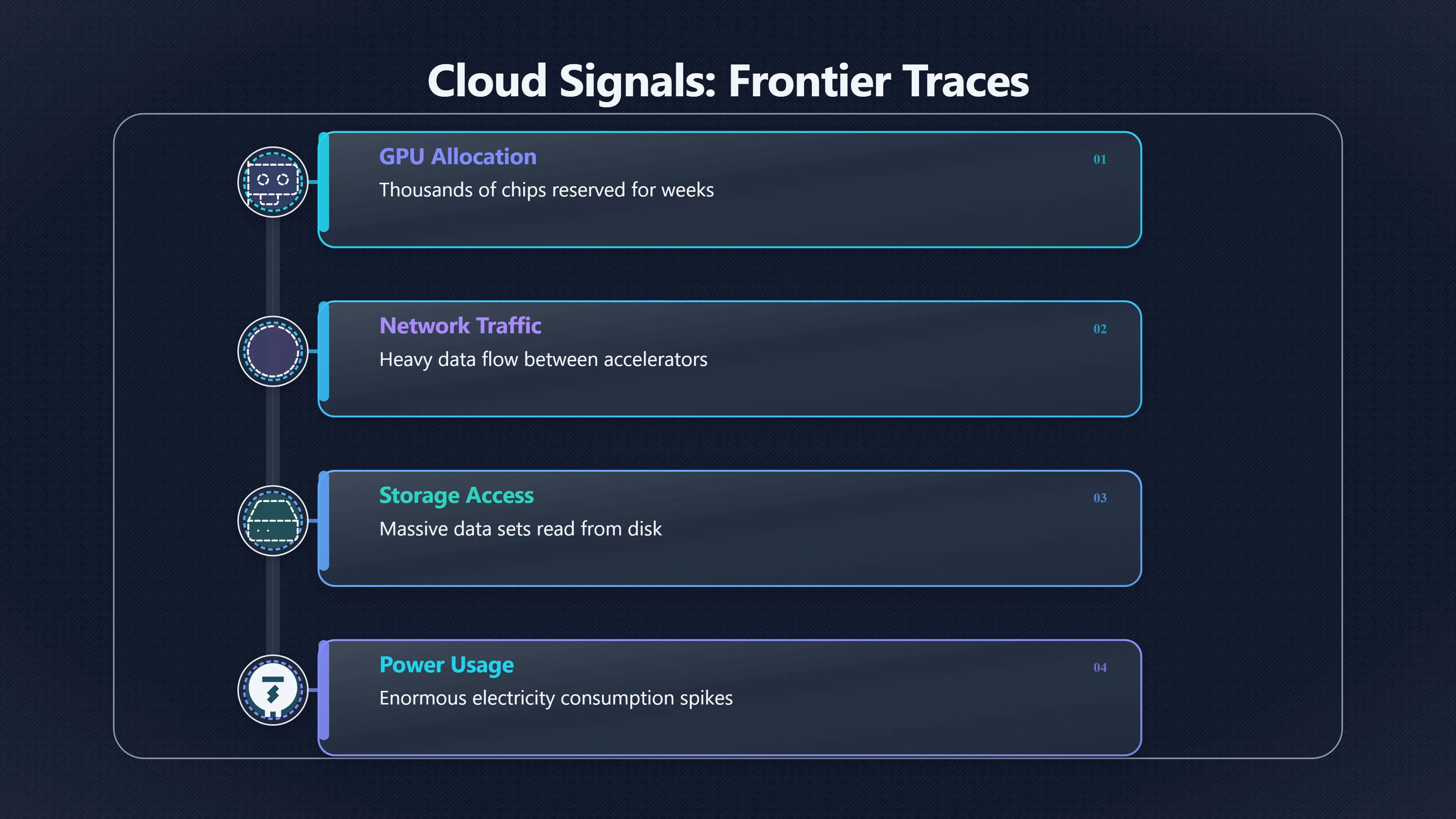
A frontier training run often stands out through several signals occurring simultaneously:
- Allocation of thousands or tens of thousands of high-end AI accelerators.
- Sustained use of those accelerators for long periods rather than short bursts.
- Heavy communication between GPUs across high-speed networking infrastructure.
- Large-scale storage access for training datasets and checkpoints.
- Compute expenditure reaching millions of pounds or dollars.
- Reserved capacity booked well in advance due to the rarity of the required hardware. [robots.ox.ac.uk]robots.ox.ac.ukHeim et al. 2024 Governing Through the Cloud The Intermediary RoleTHE INTERMEDIARY ROLE OF COMPUTE PROVIDERS…26 Mar 2024 — They store and process valuable technical data during large AI deployments an…
The important point is that cloud providers do not need to know what model is being trained in order to observe these patterns. A customer renting a handful of GPUs for research looks very different from a customer continuously operating a giant cluster intended to push the state of the art.
This distinction is one reason compute governance proposals focus on training rather than deployment. A deployed model may serve millions of users using distributed infrastructure, but training a new frontier model often requires unusually concentrated resources. Researchers have repeatedly identified this concentration as one of the few practical monitoring points available in the AI ecosystem. [robots.ox.ac.uk]robots.ox.ac.ukHeim et al. 2024 Governing Through the Cloud The Intermediary RoleTHE INTERMEDIARY ROLE OF COMPUTE PROVIDERS…26 Mar 2024 — They store and process valuable technical data during large AI deployments an… [AI Security]aisecurityandsafety.orgcompute governanceAI Security & Safety DirectoryControlling AI Through Hardware & Compute Access (2026)3 Apr 2026 — Compute governance is an emerging polic… & Safety Directory
Why metadata may be enough for threshold reporting
Many proposals do not require cloud providers to judge whether a model is safe, dangerous, aligned, or misaligned. Instead, they would report training runs that cross predefined thresholds.
The logic resembles financial reporting rules. Banks do not need to know why every large transaction occurs; they simply report transactions above specified thresholds. Similarly, a cloud provider might report when a customer exceeds a certain amount of training compute, uses an unusually large cluster, or consumes resources associated with frontier development. [ai-safety-atlas.com]ai-safety-atlas.comCompute GovernanceChapter 4The U.S. Executive Order on AI requires companies to notify the government about training runs exceeding 1 0 2 6 operations - a…
Several governance proposals and regulatory discussions have centred on compute thresholds for exactly this reason. The threshold serves as a practical proxy for capability development. Although compute alone does not determine how powerful a model will become, the largest frontier systems currently require extraordinary amounts of computation, making compute usage a measurable signal that regulators can observe. [ai-safety-atlas.com]ai-safety-atlas.comCompute GovernanceChapter 4The U.S. Executive Order on AI requires companies to notify the government about training runs exceeding 1 0 2 6 operations - a…
From a monitoring perspective, metadata can provide information such as:
Observable metadataWhat it may indicateNumber of GPUs reservedScale of training effortDuration of continuous usageWhether the activity resembles training rather than experimentationNetwork traffic between acceleratorsLarge distributed training clustersCompute expenditureApproximate project scaleCustomer identity and ownershipWho is operating the projectGeographic location of resourcesJurisdiction and compliance requirements
Supporters argue that this approach is less intrusive than inspecting models directly. The provider monitors infrastructure usage rather than intellectual property, training data, or model architecture. That distinction is often presented as a way to balance oversight with commercial confidentiality. [robots.ox.ac.uk]robots.ox.ac.ukHeim et al. 2024 Governing Through the Cloud The Intermediary RoleTHE INTERMEDIARY ROLE OF COMPUTE PROVIDERS…26 Mar 2024 — They store and process valuable technical data during large AI deployments an…
Why frontier training may be easier to spot than many people assume
A common misconception is that cloud monitoring would require providers to identify a particular model such as GPT-4, Gemini, or a future successor. In reality, many proposals rely on detecting unusually large projects rather than identifying specific models.
This matters because frontier training runs are expensive and increasingly concentrated. Analyses of training costs suggest that leading models require enormous investments in hardware, networking, engineering, and compute resources. If training costs continue to rise, only a relatively small number of organisations may be capable of conducting the largest runs. [arXiv]arxiv.orgarXiv The rising costs of training frontier AI modelsarXiv The rising costs of training frontier AI models
For AI doom advocates, this concentration creates a potential warning system. If only a handful of organisations can realistically conduct frontier training, and if those projects require unusually large compute clusters, then cloud providers may have visibility into a significant fraction of the most advanced development efforts before deployment occurs. The monitoring does not need to be perfect to create additional oversight opportunities.
Where detection becomes uncertain or misleading
The strongest objection is that large compute usage is only a proxy for capability.
A massive training run might produce a breakthrough model, but it might also produce a disappointing one. Conversely, an unexpected algorithmic advance could generate substantial capability gains using less compute than regulators anticipated. Compute thresholds therefore risk both false positives and false negatives. [AI Security & Safety Directory]aisecurityandsafety.orgcompute governanceAI Security & Safety DirectoryControlling AI Through Hardware & Compute Access (2026)3 Apr 2026 — Compute governance is an emerging polic…
Another challenge is distinguishing training from other activities. Large clusters may be used for scientific computing, simulation, inference serving, or other machine-learning workloads. Operational metadata can indicate scale, but it may not reveal the exact purpose of the computation. Cloud providers would therefore face difficult classification problems if monitoring regimes became more sophisticated than simple threshold reporting. [robots.ox.ac.uk]robots.ox.ac.ukHeim et al. 2024 Governing Through the Cloud The Intermediary RoleTHE INTERMEDIARY ROLE OF COMPUTE PROVIDERS…26 Mar 2024 — They store and process valuable technical data during large AI deployments an…
There is also the risk of deliberate concealment. A developer seeking to avoid scrutiny might attempt to divide a large training run into smaller pieces, spread activity across providers, or use privately owned hardware rather than public clouds. Recent research on distributed training and compute governance examines whether frontier-scale training could eventually be fragmented across multiple systems in ways that reduce visibility. While such approaches face substantial technical and economic challenges, they represent a genuine concern for governance proposals that assume frontier training remains highly concentrated. [arXiv]arxiv.orgarXiv The rising costs of training frontier AI modelsarXiv The rising costs of training frontier AI models
Could providers monitor chips directly?
Some researchers have explored more sophisticated telemetry systems that would collect information from AI accelerators themselves rather than relying solely on cloud-level metadata. These proposals investigate whether timing, memory usage, or other hardware-level signals could provide stronger evidence that large-scale training is occurring. [arXiv]arxiv.orgarXiv The rising costs of training frontier AI modelsarXiv The rising costs of training frontier AI models
The attraction is obvious: if governance mechanisms could observe compute activity closer to the hardware, it might become harder to disguise frontier training runs. However, such approaches remain largely research proposals rather than widely deployed systems. They also raise questions about privacy, trust, hardware modification, international coordination, and technical feasibility. [arXiv]arxiv.orgarXiv The rising costs of training frontier AI modelsarXiv The rising costs of training frontier AI models
For now, most practical cloud-monitoring proposals focus on operational metadata because providers already collect much of that information as part of normal infrastructure management.
What this means for AI doom debates
Within existential-risk discussions, cloud monitoring is usually presented as an early-warning mechanism rather than a complete solution. Even proponents generally acknowledge that spotting a frontier training run does not reveal whether a model is aligned, deceptive, controllable, or dangerous. It merely provides visibility that might otherwise be absent. [robots.ox.ac.uk]robots.ox.ac.ukHeim et al. 2024 Governing Through the Cloud The Intermediary RoleTHE INTERMEDIARY ROLE OF COMPUTE PROVIDERS…26 Mar 2024 — They store and process valuable technical data during large AI deployments an…
The strongest argument in favour of cloud monitoring is that frontier AI development currently depends on unusually large and expensive computing infrastructure. If that remains true, cloud providers may be one of the few actors capable of noticing when development crosses into frontier territory. The strongest objection is that future advances could reduce the amount of compute needed, distribute training across many systems, or otherwise weaken the connection between observable infrastructure use and genuinely dangerous capability development. [arXiv]arxiv.orgarXiv The rising costs of training frontier AI modelsarXiv The rising costs of training frontier AI models [AAAI]ojs.aaai.orgAAAI PublicationsDetecting Compute Structuring in AI Governance Is Likely…by E Seferis · 2026 — A1: There are only a few cloud provide…
As a result, the debate is less about whether large training runs leave traces—they almost certainly do—and more about whether those traces will remain a reliable warning signal as AI technology continues to advance.

Amazon book picks
Further Reading
Books and field guides related to Can clouds really spot frontier AI training?. Use these as the next step if you want deeper reading beyond the article.
The Oxford Handbook of AI Governance
Addresses oversight frameworks relevant to training-run reporting.
The Coming Wave
Focuses on identifying and containing frontier technological development.
eBay marketplace picks
Marketplace Samples
Example marketplace items related to this page. Use the search link to explore similar finds on eBay.








Endnotes
-
Source: robots.ox.ac.uk
Title: Heim et al. 2024 Governing Through the Cloud The Intermediary Role
Link: https://www.robots.ox.ac.uk/~mosb/public/pdf/3343/Heim%20et%20al.%20-%202024%20-%20Governing%20Through%20the%20Cloud%20The%20Intermediary%20Role.pdfSource snippet
THE INTERMEDIARY ROLE OF COMPUTE PROVIDERS...26 Mar 2024 — They store and process valuable technical data during large AI deployments an...
-
Source: ai-safety-atlas.com
Title: Compute Governance
Link: https://ai-safety-atlas.com/chapters/v1/governance/compute-governanceSource snippet
Chapter 4The U.S. Executive Order on AI requires companies to notify the government about training runs exceeding 1 0 2 6 operations - a...
-
Source: arxiv.org
Title: arXiv The rising costs of training frontier AI models
Link: https://arxiv.org/abs/2405.21015 -
Source: arxiv.org
Title: arXiv Does Distributed Training Undermine Compute Governance?
Link: https://arxiv.org/abs/2605.29359Source snippet
arXivDoes Distributed Training Undermine Compute Governance?May 28, 2026...
Published: May 28, 2026
-
Source: ojs.aaai.org
Link: https://ojs.aaai.org/index.php/AAAI/article/view/41127/45088Source snippet
AAAI PublicationsDetecting Compute Structuring in AI Governance Is Likely...by E Seferis · 2026 — A1: There are only a few [cloud provide]({{ 'cloud-oversight/' | relative_url }})...
-
Source: arxiv.org
Title: arXiv Timing and Memory Telemetry on GPUs for AI Governance
Link: https://arxiv.org/abs/2602.09369Source snippet
arXivTiming and Memory Telemetry on GPUs for AI GovernanceFebruary 10, 2026...
Published: February 10, 2026
-
Source: arxiv.org
Link: https://arxiv.org/pdf/2412.03824Source snippet
Towards Data Governance of Frontier AI Modelsby J Hausenloy · 2024 · Cited by 5 — As a key input to the pre-training and fine- tuning of...
-
Source: aisecurityandsafety.org
Title: compute governance
Link: https://aisecurityandsafety.org/en/guides/compute-governance/Source snippet
AI Security & Safety DirectoryControlling AI Through Hardware & Compute Access (2026)3 Apr 2026 — Compute governance is an emerging polic...
Additional References
-
Source: frontier-economics.com
Link: https://www.frontier-economics.com/uk/en/news-and-insights/articles/article-i21406-ai-beyond-the-cloud-navigating-competition-innovation-and-regulation/Source snippet
AI beyond the cloud: navigating competition, innovation...However, cloud services will remain crucial for training new models, running l...
-
Source: ifs.org.uk
Link: https://ifs.org.uk/Source snippet
IFS | Institute for Fiscal StudiesIFS is the UK's leading [independent]({{ 'red-teaming/' | relative_url }}) economics research institute. We analyse and inform economic and po...
-
Source: history.ac.uk
Link: https://www.history.ac.uk/Source snippet
Institute of Historical ResearchThe IHR is the UK's national centre for history. Dedicated to supporting historians of all kinds. Find ou...
-
Source: flyfrontier.com
Link: https://www.flyfrontier.com/Source snippet
Frontier Airlines: Low Fares Done RightAs Home of Low Fares Done Right, find great deals and cheap flights to destinations all over North...
-
Source: medium.com
Link: https://medium.com/%40adnanmasood/the-ai-governance-frontier-series-part-4-google-clouds-approach-to-safe-and-responsible-ai-fe4644415e44Source snippet
le AI by embedding fairness, transparency, safety, and accountability into...Read more...
-
Source: iod.com
Title: Institute of Directors | Business Networking, Events
Link: https://www.iod.com/Source snippet
LondonThe IoD is a thriving membership community for directors in the UK and beyond, where you can connect with other leaders, develop yo...
-
Source: aisafetybook.com
Link: https://www.aisafetybook.com/textbook/compute-governanceSource snippet
8.7: Compute Governance | AI Safety...A common shorthand for computational resources or computing power used for AI is compute...
-
Source: ics.sas.ac.uk
Title: sas.ac.uk Institute of Classical Studies
Link: https://ics.sas.ac.uk/Source snippet
of Classical Studies - LondonThe national centre for the promotion and facilitation of research in Classics and related disciplines throu...
-
Source: Wikipedia
Title: Category:Research institutes in London
Link: https://en.wikipedia.org/wiki/Category%3AResearch_institutes_in_LondonSource snippet
Category:Research institutes in LondonI · Institute for Community Studies · Institute for Fiscal Studies · Institute of Cancer Researc...
-
Source: GOV.UK
Link: https://www.gov.uk/government/publications/frontier-ai-capabilities-and-risks-discussion-paper/future-risks-of-frontier-ai-annex-aSource snippet
risks of frontier AI (Annex A)28 Apr 2025 — The risks posed by future Frontier AI will include the risks we see today, but with potential...
Topic Tree