Within Misuse
How AI Could Accelerate Dangerous Pathogen Design
Explores how AI could help actors design more lethal or resistant biological agents and the associated risks.
On this page
- Dual use research and oversight challenges
- Potential for engineered outbreaks
- Mitigation and monitoring strategies
Page outline Jump by section
Introduction
A core concern in discussions about AI doom and existential risk is not just whether advanced AI could misbehave independently, but how humans might use AI to amplify danger. In the domain of biological threats, one of the most debated mechanisms is how AI‑assisted design of enhanced biological pathogens could potentially lower the technical barriers to creating or significantly altering harmful biological agents — whether toxins, viruses, or bacteria — in ways that pose risks far beyond conventional bioengineering. This page focuses tightly on that mechanism: how powerful AI tools might contribute to designing biological agents with enhanced lethality, transmissibility, immune evasion, or other dangerous traits; how plausible and near‑term these risks are; what safeguards currently exist or are proposed; and where uncertainties lie.
How AI Could Change Biological Design
At present, routine biological threat development — whether for harmful or beneficial purposes — follows a design‑build‑test‑learn (DBTL) cycle that requires deep domain knowledge, extensive laboratory infrastructure, and iterative experiments. AI tools are beginning to reshape parts of this cycle by aiding design and prediction tasks that once demanded expensive, time‑intensive human effort.
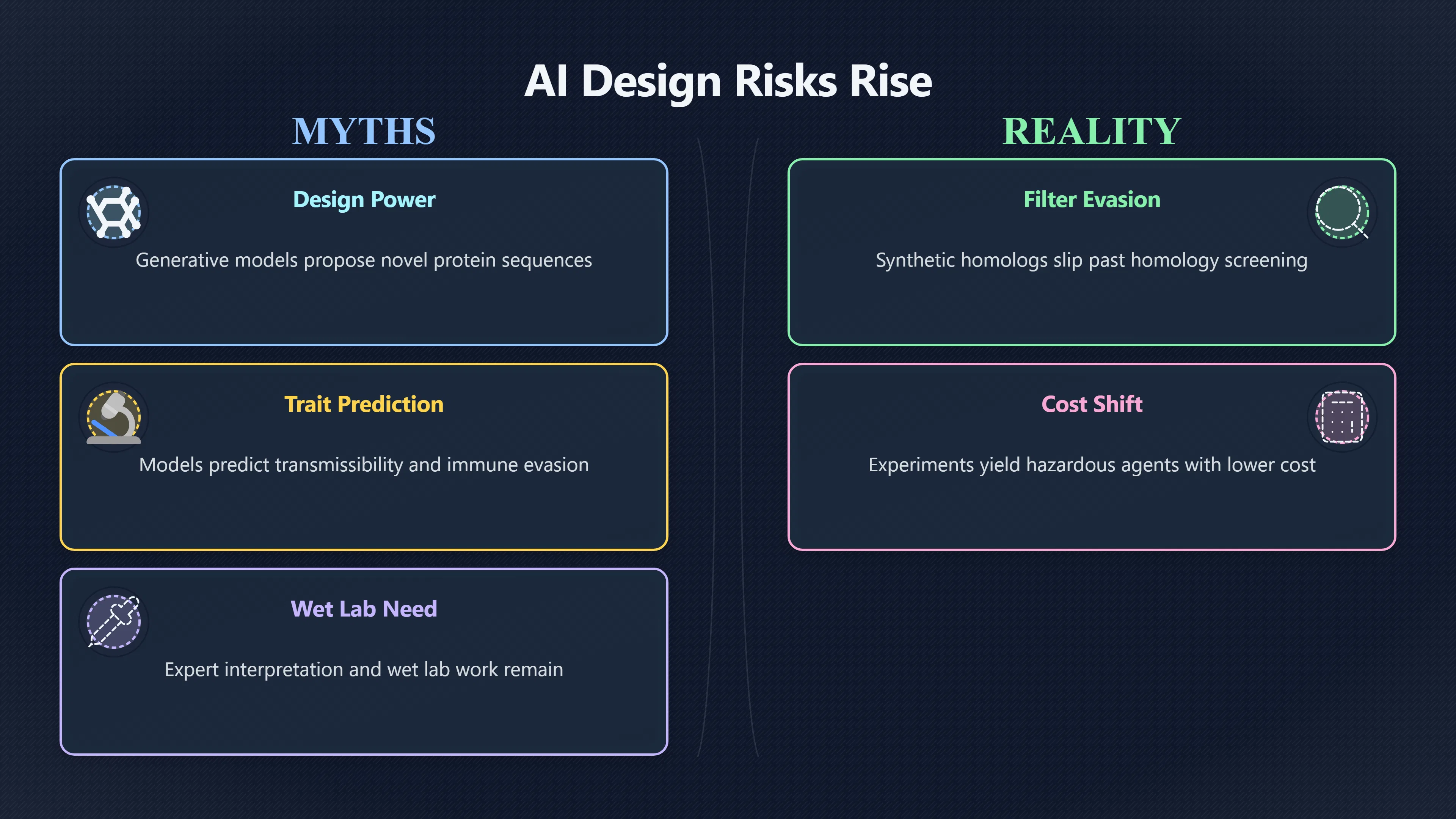
- Enhanced protein and sequence design: Generative AI models can now propose novel protein sequences predicted to fold into stable, functional three‑dimensional structures. These tools accelerate therapeutic discovery, but the same mechanisms could be repurposed to design proteins with harmful functions or to optimise virulence factors — traits that make pathogens more dangerous. Open‑source and widely available models raise concerns that sequence design could outpace traditional safeguards like homology‑based screening systems.[Frontiers]frontiersin.orgFrontiersFrontiers | Protein design, generative AI and biological securityApril 1, 2026…
- Evasion of biosecurity filters: AI can generate alternative sequences (so‑called “synthetic homologs”) that maintain biological function while sharing little obvious similarity with known toxins or pathogens. These sequences might slip past DNA synthesis screening tools that rely largely on sequence matching to flag hazards, revealing current blind spots in biosecurity controls.[NIST]nist.govNISTExperimental Evaluation of AI-Driven Protein Design Risks Using Safe Biological Proxies | NISTJune 20, 2025…
- Predictive modelling of complex traits: In principle, advanced models could assist in understanding how changes at the genetic level affect phenotypes — for example, transmissibility or immune evasion. While datasets are incomplete and complex interactions are difficult to model accurately today, improved predictive capabilities could reduce the experimental iterations needed to pursue high‑consequence designs.[NCBI]
Taken together, these capabilities represent an uplift in design power: they do not yet remove the need for wet‑lab work and expert interpretation, but they change the cost‑benefit calculus of experiments that could yield more hazardous biological agents.
Plausibility and Limits in the Near Term
There is disagreement among researchers about how quickly and how far AI might accelerate dangerous biological design.
- Current limits: Scientific consensus is that today’s AI tools cannot yet reliably design complex, self‑replicating biological threats from scratch. Developing a transmissible pathogen with enhanced virulence involves intricate interactions at molecular, cellular and organismal levels that AI cannot fully predict — and subsequent laboratory work remains highly specialised and resource‑intensive.[NCBI]
- Expert barriers analysis: A 2025 Delphi study involving AI and biology specialists identified persistent biological and technical constraints that may hold back misuse in the near term (2025–27). These include the difficulty of acquiring high‑quality data linking genotype to phenotype and the complexity of host‑pathogen interactions that are shaped by evolution and environment.[PMC]pmc.ncbi.nlm.nih.govPMCDecember 16, 2025…
- Proof‑of‑concept concerns: Nevertheless, experiments in related domains — such as AI planning bacteriophage genomes or altering toxic protein sequences in silico — illustrate that some components of biosecurity could be compromised even before full pathogen design is possible. While bacteriophages target bacteria and not humans, such work demonstrates pathways by which AI could be misused to generate new biological sequences with intended effects.[Live Science]livescience.comLive Science AI can now be used to design brand-new virusesCan we stop it from making the next devastating bioweapon?October 6, 2025 — Scientists have demonstrated that artificial intelligence (AI…
In short, experts generally agree that AI‑assisted design of fully novel pathogens is not yet a present‑day reality, but the trajectory of capability growth could make it feasible in the near to medium term if not governed effectively.
Dual‑Use Challenges and Oversight Gaps
AI‑assisted biological design tools sit within a larger dual‑use dilemma: the same systems that power legitimate scientific and medical advances can be repurposed for harmful ends.
- Broader biosecurity blind spots: Researchers have flagged that the increasing availability of models trained on public biological data could allow actors with fewer safety constraints to fine‑tune systems on risky datasets, amplifying misuse potential. In some proposals, experts call for handling certain high‑risk biological data with stringent safeguards — akin to how sensitive health records are protected — to prevent misuse by AI.[Axios]axios.comAI's big biosecurity blind spotThey propose a framework that treats high-risk biological data with the same level of caution as sensitive health records. The core conce…
- Screening and synthesis controls: Current biosafety systems for DNA synthesis rely on sequence homology to identify hazardous orders. AI‑generated designs that evade these filters expose a fundamental gap in oversight and underscore the need for more dynamic, predictive detection methods that can flag functional risk rather than just sequence similarity.[NIST]nist.govNISTExperimental Evaluation of AI-Driven Protein Design Risks Using Safe Biological Proxies | NISTJune 20, 2025…
- Governance ambiguity: There is ongoing debate about how to restrict access to high‑risk generative biological AI without unduly hindering scientific progress. Some argue that model evaluations should prioritise high‑consequence capabilities before deployment, and differentiated access controls could help manage risk.[arXiv]arxiv.orgarXivPrioritizing High-Consequence Biological Capabilities in Evaluations of Artificial Intelligence ModelsMay 25, 2024…
These dual‑use challenges highlight the regulatory catch‑up problem: governance frameworks have not fully adapted to technologies that blur traditional boundaries between design, prediction and execution.
Mitigation and Monitoring Strategies
Preventing catastrophic misuse requires an integrated approach that spans technology, policy, and international cooperation.
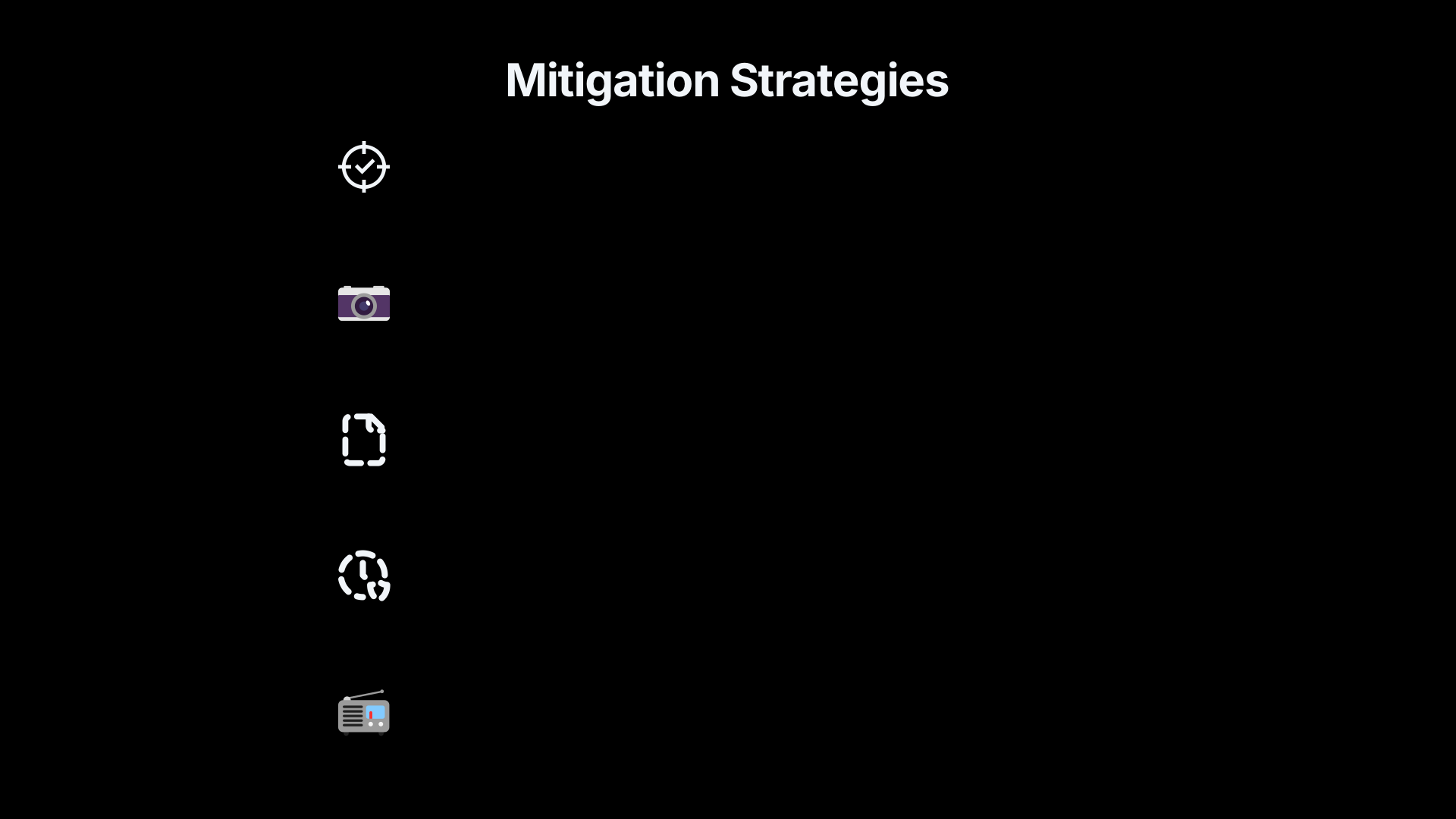
- Pre‑deployment evaluation: Before powerful biological design models are released, independent evaluation of high‑consequence capabilities — such as predicting virulence or designing immune evasion traits — could help anticipate misuse pathways and inform safety constraints.[arXiv]arxiv.orgarXivPrioritizing High-Consequence Biological Capabilities in Evaluations of Artificial Intelligence ModelsMay 25, 2024…
- Enhanced biosecurity controls: Upgrading DNA synthesis screening to incorporate functional predictions and adopting adaptive surveillance that can identify abnormal sequences based on biological activity rather than just sequence similarity could close current blind spots.[Frontiers]frontiersin.orgFrontiersFrontiers | Protein design, generative AI and biological securityApril 1, 2026…
- Data governance: Treating certain biological datasets (e.g., those closely tied to pathogen phenotypes) as sensitive and restricting their use in open training sets could limit the raw material available for misuse.[Axios]axios.comAI's big biosecurity blind spotThey propose a framework that treats high-risk biological data with the same level of caution as sensitive health records. The core conce…
- Layered oversight and cooperation: A defense‑in‑depth strategy that combines technological safeguards, legal restrictions, industry standards, and international norms may offer the best chance of balancing innovation with risk reduction. Shared threat intelligence and rapid incident response protocols are essential parts of such a system.
Where Uncertainties and Disputes Remain
There are active debates within the research community about how significant the AI‑assisted pathogen design threat is in the near future:
- Timing and capability projections: Some experts emphasise that today’s models are far from autonomously creating harmful pathogens, while others warn that even incremental capability improvements could quickly erode safety margins. The pace of progress, quality of training data, and degree of lab automation all influence how soon risk thresholds might be crossed.[PMC]pmc.ncbi.nlm.nih.govPMCDecember 16, 2025…
- Role of intent and access: Capability alone is not sufficient for misuse; access to lab infrastructure, reagents, wet‑lab expertise, and delivery mechanisms matter. Strategic assessments weigh both technical capacity and actor motivation when estimating plausible misuse scenarios.
- Balancing openness and safety: Restricting access to models or datasets could impede beneficial research. Navigating how to govern AI tools in biology without stifling innovation continues to be a central ethical and policy challenge.
Looking Ahead
AI‑assisted design of enhanced biological pathogens illustrates a catastrophic misuse pathway that is distinct within the broader landscape of AI risk: it focuses not on AI’s autonomous goals, but on how humans could use AI to increase both the reach and subtlety of biological threat creation. Current evidence suggests that while the most extreme scenarios are not yet technologically realised, the trend of capability growth warrants vigilant oversight, adaptive biosecurity, and international cooperation to prevent misuse that could have systemic public health consequences.
The discussion continues to evolve rapidly, as both biological AI capabilities and governance proposals mature, and this remains one of the most consequential interfaces between advanced AI systems and global catastrophic risk.
eBay marketplace picks
Marketplace Samples
Example marketplace items related to this page. Use the search link to explore similar finds on eBay.








Endnotes
-
Source: nist.gov
Link: https://www.nist.gov/publications/experimental-evaluation-ai-driven-protein-design-risks-using-safe-biological-proxiesSource snippet
NISTExperimental Evaluation of AI-Driven Protein Design Risks Using Safe Biological Proxies | NISTJune 20, 2025...
Published: June 20, 2025
-
Source: pmc.ncbi.nlm.nih.gov
Link: https://pmc.ncbi.nlm.nih.gov/articles/PMC12711334/Source snippet
PMCDecember 16, 2025...
Published: December 16, 2025
-
Source: axios.com
Title: AI’s big biosecurity blind spot
Link: https://www.axios.com/2026/02/17/ai-data-viruses-biosecuritySource snippet
They propose a framework that treats high-risk biological data with the same level of caution as sensitive health records. The core conce...
-
Source: arxiv.org
Link: https://arxiv.org/abs/2407.13059Source snippet
arXivPrioritizing High-Consequence Biological Capabilities in Evaluations of Artificial Intelligence ModelsMay 25, 2024...
Published: May 25, 2024
-
Source: frontiersin.org
Link: https://www.frontiersin.org/journals/microbiology/articles/10.3389/fmicb.2026.1817535/fullSource snippet
FrontiersFrontiers | Protein design, generative AI and biological securityApril 1, 2026...
Published: April 1, 2026
-
Source: livescience.com
Title: Live Science AI can now be used to design brand-new viruses
Link: https://www.livescience.com/health/viruses-infections-disease/ai-can-now-be-used-to-design-brand-new-viruses-can-we-stop-it-from-making-the-next-devastating-bioweaponSource snippet
Can we stop it from making the next devastating bioweapon?October 6, 2025 — Scientists have demonstrated that artificial intelligence (AI...
Published: October 6, 2025
Additional References
-
Source: pmc.ncbi.nlm.nih.gov
Title: Deep learning models can now generate entirely novel sequences that fold into
Link: https://pmc.ncbi.nlm.nih.gov/articles/PMC13079691/Source snippet
design, generative AI and biological security - PMCApril 1, 2026 — ABSTRACT Artificial intelligence-driven protein design has fundamental...
Published: April 1, 2026
-
Source: cris.technion.ac.il
Link: https://cris.technion.ac.il/en/publications/understanding-the-theoretical-limits-of-ai-enabled-pathogen-desigSource snippet
the Theoretical Limits of AI-Enabled Pathogen Design: Insights from a Delphi Study - Technion - Israel Institute of TechnologyUNDERSTANDI...
-
Source: nature.com
Title: A I can design viruses, toxins and other bioweapons
Link: https://www.nature.com/articles/d41586-026-01476-xSource snippet
How worried should we be?May 13, 2026 — AI can design viruses, toxins and other bioweapons. How worried should we be? Download PDF * NEWS...
Published: May 13, 2026
-
Source: sciety.org
Link: https://sciety.org/articles/activity/10.1101/2025.05.15.654077Source snippet
Svetlana P. Ikonomova 2. Bruce J. Wittmann 3. Fernanda Piorino 4. David J. Ross 5. Samuel W. Schaffter 6. O...
-
Source: deepai.org
Title: Sandbrink, et al. ∙ Image Image 0 ∙ As advancemen
Link: https://deepai.org/publication/artificial-intelligence-and-biological-misuse-differentiating-risks-of-language-models-and-biological-design-toolsSource snippet
Artificial intelligence and biological misuse: Differentiating risks of language models and biological design tools | DeepAIJune 24, 2023...
Published: June 24, 2023
-
Source: ncbi.nlm.nih.gov
Title: NCBIAI-Enabled Biological Design and the Risks of Synthetic Biology
Link: https://www.ncbi.nlm.nih.gov/books/NBK614591/Source snippet
The Age of AI in the Life Sciences - NCBI BookshelfApril 23, 2025...
Published: April 23, 2025
-
Source: pubmed.ncbi.nlm.nih.gov
Link: https://pubmed.ncbi.nlm.nih.gov/41994287/Source snippet
2026 Apr 1:17:1817535. doi: 10.3389/fmicb.2026.1817535. eCollection 2026. PROTEIN DESIGN, GENERATIVE AI AND BIOLOGICAL SECU...
-
Source: cset.georgetown.edu
Title: ai and biorisk an explainer
Link: https://cset.georgetown.edu/publication/ai-and-biorisk-an-explainer/Source snippet
and Biorisk: An Explainer | Center for Security and Emerging TechnologyAI AND BIORISK: AN EXPLAINER Steph Batalis December 2023 Recent go...
Published: December 2023
-
Source: pubmed.ncbi.nlm.nih.gov
Link: https://pubmed.ncbi.nlm.nih.gov/38532127/Source snippet
2024 May;25(5):2168-2171. doi: 10.1038/s44319-024-00124-7. Epub 2024 Mar 26. SECURITY CHALLENGES BY AI-ASSISTED PROTEI...
Topic Tree