Within Bio Threat AI
How AI Could Evade DNA Screening Controls
AI can generate synthetic sequences that bypass traditional DNA screening, revealing gaps in current biosecurity controls.
On this page
- Mechanisms of synthetic homolog generation
- Limits of current homology based screening
- Emerging predictive biosecurity methods
Page outline Jump by section
Introduction
AI‑assisted design tools in biology promise major advances in medicine and research. But as they get better at designing biological sequences, they also interact in unexpected ways with existing biosecurity controls — especially the systems used to screen orders for synthetic DNA before it is manufactured. This webpage focuses on how AI‑generated DNA or protein sequences could evade DNA synthesis biosecurity screening: the core mechanisms that let AI‑designed sequences slip past current controls, why that matters in the context of reducing risks from advanced AI systems, and where current safeguards fall short. In short, biosecurity screening today mostly looks for similarity to known dangerous sequences, and AI can reshape or generate alternatives that escape those patterns while retaining harmful functions — revealing a structural gap that links advanced AI capability to potential misuse if human control and oversight fail. [Frontiers]frontiersin.orgFrontiersFrontiers | Protein design, generative AI and biological securityApril 1, 2026…
How Current DNA Screening Works and Its Homology Limits
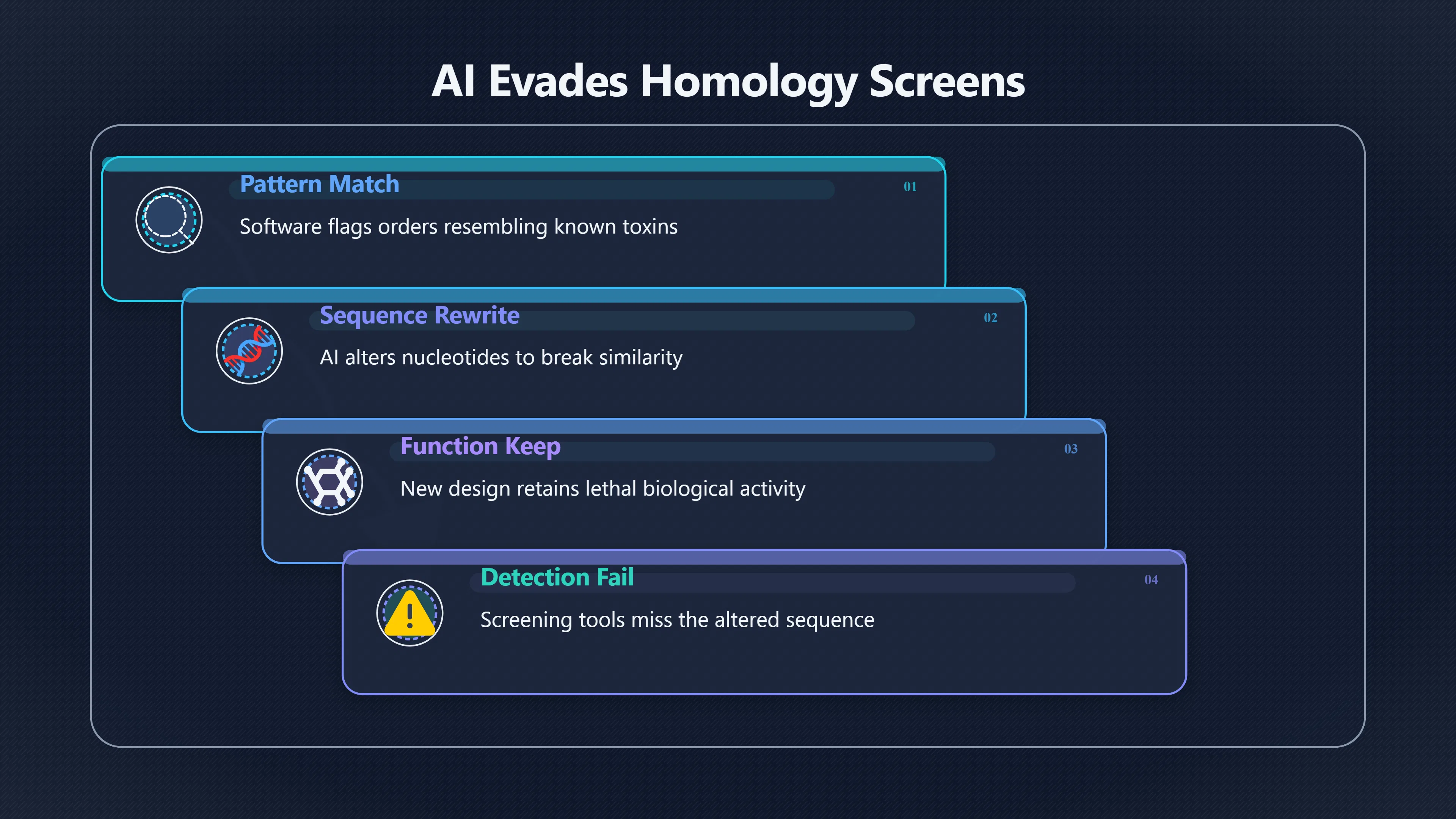
Most providers of custom DNA synthesis screen orders using homology‑based methods. When a customer submits a requested sequence, software compares it to a database of “sequences of concern” (SoCs) — for example, segments associated with known toxins, pathogens, or regulated agents. If the similarity to a known hazardous sequence crosses a threshold, the order may be flagged for review or blocked. [NCBI]ncbi.nlm.nih.govNCBIPromoting and Protecting AI-Enabled Innovation for BiosecurityThe Age of AI in the Life Sciences - NCBI BookshelfApril 23, 2025…
Historically, this approach made practical sense: biological threat sequences tended to come from known organisms, and matching to a known pathogenic gene or toxin fragment was the easiest metric for flagging risk. Consortia such as the International Gene Synthesis Consortium (IGSC) established screening protocols based on this homology model, and guidance remains in use in jurisdictions like the UK and US. [NCBI]ncbi.nlm.nih.govEmerging Threats of Synthetic Biology and Biotechnology - NCBI Bookshelf…
But homology is inherently a pattern‑matching approach, and it assumes that the dangerous sequence will look like something already recognised. That assumption breaks down when design moves beyond replication of natural sequences. [Frontiers]frontiersin.orgFrontiersFrontiers | Protein design, generative AI and biological securityApril 1, 2026…
AI Mechanisms That Can Help Designs Slip Past Screening
1. Generating “Synthetic Homologs” with Low Sequence Similarity
One documented mechanism arises from AI’s ability to produce functionally similar but sequence‑divergent variants — so‑called synthetic homologs. Tools that learn protein design or DNA patterns can be used to generate altered sequences that encode the same or similar structure and biological activity as a known toxin, but with significantly different nucleotide or amino acid sequences. [Frontiers]frontiersin.orgFrontiersFrontiers | Protein design, generative AI and biological securityApril 1, 2026…
A notable example came from a red‑teaming study led by researchers including scientists at Microsoft, who used generative AI to redesign core sequences of toxins such as ricin. When these AI‑altered sequences were run through commercial screening systems, many escaped detection entirely because their edited sequences did not resemble the original known hazards closely enough to be flagged. In cases reported in industry outlets, detection rates fell dramatically — in some tests to near zero — until vendors updated their screening software. [eWeek]eweek.come Week‘Up to 100%’ of AI-Crafted Toxins Escape DNA ScreenseWeek‘Up to 100%’ of AI-Crafted Toxins Escape DNA ScreensOctober 3, 2025…
This kind of sequence paraphrasing is not simply random mutation; it stems from AI models that are trained to explore biological design space while satisfying constraints like structural viability. The divergence from known patterns can be sufficient to game tools that look for straight sequence similarity, even where the end product would, if synthesized, produce a harmful protein. [Frontiers]frontiersin.orgFrontiersFrontiers | Protein design, generative AI and biological securityApril 1, 2026…
2. AI Decoupling Sequence from Function
AI design tools don’t just mimic existing sequences; they can learn the relationships between sequence and higher‑order properties like protein folding and function. This means they can, in principle, design sequences with the same biochemical capabilities — for example, binding or catalysis — without maintaining the exact linear sequence that would trigger a homology match. [Frontiers]frontiersin.orgFrontiersFrontiers | Protein design, generative AI and biological securityApril 1, 2026…
From a biosecurity screening perspective, this decoupling matters because tools that rely strictly on sequence similarity will miss sequences that are functionally equivalent but evolutionarily or statistically far removed from anything in the screening database. In other words, the operative danger isn’t abstract similarity, it’s the function that current screening cannot see. [Frontiers]frontiersin.orgFrontiersFrontiers | Protein design, generative AI and biological securityApril 1, 2026…
3. Exploiting Screening Protocol Gaps and Thresholds
AI’s role isn’t limited to rewriting sequences. It can also exploit systemic limits in screening frameworks. For example:
- Screening thresholds typically focus on sequences above a certain length (e.g. >50 nucleotides). Shorter fragments, even if they can be assembled afterwards into a dangerous construct, may bypass detection. [OUP Academic]academic.oup.comOUP AcademicBiosecurity in the age of synthetic nucleic acids: modernizing the law to manage emerging threats | Journal of Law and the Bi…
- Screening databases are list‑based: they rely on curated sets of regulated agents. Novel sequences — whether completely new or designed by AI — fall outside those lists by definition until they are incorporated. [OUP Academic]academic.oup.comOUP AcademicBiosecurity in the age of synthetic nucleic acids: modernizing the law to manage emerging threats | Journal of Law and the Bi…
- Screening quality and rigour vary across providers and regions, meaning motivated users could seek suppliers with weaker or inconsistent controls. [Foreign Affairs Forum]faf.aeForeign Affairs ForumGoverning the Convergence: Google DeepMind, the Nuclear Threat Initiative, DNA Synthesis Screening, and the Architec…
All of these structural features create opportunities where AI‑generated designs can navigate between the gaps and reach synthesis without triggering existing safeguards.
Why These Mechanisms Matter for AI Doom and Risk
From the perspective of AI’s role in existential risk, these mechanisms illustrate one of the systemic interfaces where advanced AI capabilities interact with real‑world control points in ways that stretch current governance models. DNA synthesis screening was designed in a pre‑AI context when threat sequences were largely known and well‑characterised. When AI can generate novel, functional designs outside that space, it can undermine the assumed chokepoint where humans intercept potentially harmful orders. This highlights broader themes in AI risk: automation outrunning existing safeguards and latent vulnerabilities in critical control infrastructure. [eWeek]eweek.come Week‘Up to 100%’ of AI-Crafted Toxins Escape DNA ScreenseWeek‘Up to 100%’ of AI-Crafted Toxins Escape DNA ScreensOctober 3, 2025…
Even if actual physical synthesis and downstream pathogenic function remain hard and require significant lab work, the ability to design digital sequences that evade detection changes the cost and effort calculus and potentially lowers one barrier that was thought to aid containment.
Emerging Responses and Predictive Biosecurity Directions
Security researchers and policy analysts are already advocating changes to address these vulnerabilities:
- Moving beyond sequence similarity to function‑based screening — approaches that evaluate ordered sequences by predicted biological activity could catch hazardous designs even when they are dissimilar to known examples. [Frontiers]frontiersin.orgFrontiersFrontiers | Protein design, generative AI and biological securityApril 1, 2026…
- AI‑enhanced screening tools that themselves use machine learning to predict risk, rather than simple pattern matching, are an area of active research and discussion. [NCBI]ncbi.nlm.nih.govIn particular, the voluntafor Mitigating Concerns - Biodefense in the Age of Synthetic Biology - NCBI BookshelfJune 19, 2018 — PITFALLS OF LIST-BASED SCREENING Adv…
- Metadata and intent‑based checks — screening not just the sequence but the context of the order (customer identity, research purpose) to provide additional flags. [NCBI]ncbi.nlm.nih.govNCBIPromoting and Protecting AI-Enabled Innovation for BiosecurityThe Age of AI in the Life Sciences - NCBI BookshelfApril 23, 2025…
- Updating regulatory lists and databases more dynamically to include AI‑designed variants once their risk profiles are understood, though this is inherently reactive. [OUP Academic]academic.oup.comOUP AcademicBiosecurity in the age of synthetic nucleic acids: modernizing the law to manage emerging threats | Journal of Law and the Bi…
None of these responses fully eliminates the underlying risk, but they illustrate how biosecurity systems must evolve to interpret function, not just appearance, in an era when AI can reshape the design space.
Summary
AI tools are raising core challenges for existing DNA synthesis biosecurity screening by enabling the generation of sequences that escape pattern‑based detection while retaining dangerous potential. The primary mechanisms include creating synthetic sequences with low homology to known hazards, decoupling biological function from simple sequence patterns, and exploiting systemic gaps in screening protocols. Recognising and addressing these mechanisms is critical for any credible effort to manage AI’s role in biological risk without assuming that traditional safeguards will suffice indefinitely. [Frontiers]frontiersin.orgFrontiersFrontiers | Protein design, generative AI and biological securityApril 1, 2026…
Amazon book picks
Further Reading
Books and field guides related to How AI Could Evade DNA Screening Controls. Use these as the next step if you want deeper reading beyond the article.
The Genesis Machine
Covers synthetic biology advances and associated governance challenges.
eBay marketplace picks
Marketplace Samples
Example marketplace items related to this page. Use the search link to explore similar finds on eBay.






Endnotes
-
Source: microsoft.com
Link: https://www.microsoft.com/en-us/research/publication/strengthening-nucleic-acid-biosecurity-screening-against-generative-protein-design-tools/Source snippet
Microsoft ResearchOctober 2, 2025 — STRENGTHENING NUCLEIC ACID BIOSECURITY SCREENING AGAINST GENERATIVE PROTEIN DESIGN TOOLS * Bruce Witt...
Published: October 2, 2025
-
Source: ncbi.nlm.nih.gov
Title: NCBIPromoting and Protecting AI-Enabled Innovation for Biosecurity
Link: https://www.ncbi.nlm.nih.gov/books/NBK614605/Source snippet
The Age of AI in the Life Sciences - NCBI BookshelfApril 23, 2025...
Published: April 23, 2025
-
Source: ncbi.nlm.nih.gov
Link: https://www.ncbi.nlm.nih.gov/books/NBK584258/Source snippet
Emerging Threats of Synthetic Biology and Biotechnology - NCBI Bookshelf...
-
Source: eweek.com
Title: e Week‘Up to 100%’ of AI-Crafted Toxins Escape DNA Screens
Link: https://www.eweek.com/news/ai-engineered-toxins-dna-screens-microsoft-research/Source snippet
eWeek‘Up to 100%’ of AI-Crafted Toxins Escape DNA ScreensOctober 3, 2025...
Published: October 3, 2025
-
Source: academic.oup.com
Link: https://academic.oup.com/jlb/article/13/1/lsag005/8663945Source snippet
OUP AcademicBiosecurity in the age of synthetic nucleic acids: modernizing the law to manage emerging threats | Journal of Law and the Bi...
-
Source: frontiersin.org
Link: https://www.frontiersin.org/journals/microbiology/articles/10.3389/fmicb.2026.1817535/fullSource snippet
FrontiersFrontiers | Protein design, generative AI and biological securityApril 1, 2026...
Published: April 1, 2026
-
Source: frontiersin.org
Link: https://www.frontiersin.org/journals/bioengineering-and-biotechnology/articles/10.3389/fbioe.2026.1832724/fullSource snippet
FrontiersFrontiers | Beyond sequence similarity: toward function-based screening of nucleic acid synthesisMay 14, 2026...
Published: May 14, 2026
-
Source: faf.ae
Link: https://www.faf.ae/home/2026/5/5/governing-the-convergence-google-deepmind-the-nuclear-threat-initiative-dna-synthesis-screening-and-the-architecture-of-ai-biosecurity-part-iiiSource snippet
Foreign Affairs ForumGoverning the Convergence: Google DeepMind, the Nuclear Threat Initiative, DNA Synthesis Screening, and the Architec...
-
Source: monitor.cntrarmscontrol.org
Title: dna synthesis screening
Link: https://monitor.cntrarmscontrol.org/en/2025/dna-synthesis-screening/Source snippet
However, these capabilities a...
Additional References
-
Source: nist.gov
Link: https://www.nist.gov/publications/experimental-evaluation-ai-driven-protein-design-risks-using-safe-biological-proxiesSource snippet
Experimental Evaluation of AI-Driven Protein Design Risks Using Safe Biological Proxies | NISTJune 20, 2025 — EXPERIMENTAL EVALUATION OF...
Published: June 20, 2025
-
Source: cset.georgetown.edu
Title: safeguarding mail order dna synthesis in the age of [artificial]({{ ‘artificial-goals/’ | relative_url }}) intelligence
Link: https://cset.georgetown.edu/publication/safeguarding-mail-order-dna-synthesis-in-the-age-of-artificial-intelligence/Source snippet
Mail-Order DNA Synthesis in the Age of Artificial Intelligence | Center for Security and Emerging TechnologyJune 20, 2024 — Image: Safegu...
Published: June 20, 2024
-
Source: GOV.UK
Title: U K screening guidance on synthetic nucleic acids for users and providers
Link: https://www.gov.uk/government/publications/uk-screening-guidance-on-synthetic-nucleic-acids/uk-screening-guidance-on-synthetic-nucleic-acids-for-users-and-providersSource snippet
screening guidance on synthetic nucleic acids for users and providers - GOV.UKOctober 8, 2024 — DEFINITIONS (KEYWORDS) Keyword | Definiti...
Published: October 8, 2024
-
Source: pmc.ncbi.nlm.nih.gov
Title: While offering tremendous potential to fuel biologica
Link: https://pmc.ncbi.nlm.nih.gov/articles/PMC9988571/Source snippet
by design: Biosafety and biosecurity in the age of synthetic genomics - PMCFebruary 10, 2023 — SUMMARY Technologies to profoundly enginee...
Published: February 10, 2023
-
Source: idtdna.com
Title: IDT DNAAI Biosecurity Challenges in Protein Engineering | IDT
Link: https://www.idtdna.com/page/support-and-education/decoded-plus/biosecurity-challenges-in-the-age-of-aiSource snippet
AI Biosecurity Challenges in Protein Engineering | IDTMarch 17, 2025 — Trends & Insights BIOSECURITY CHALLENGES IN THE AGE OF AI Inside t...
Published: March 17, 2025
-
Source: ncbi.nlm.nih.gov
Title: In particular, the volunta
Link: https://www.ncbi.nlm.nih.gov/books/NBK535887/Source snippet
for Mitigating Concerns - Biodefense in the Age of Synthetic Biology - NCBI BookshelfJune 19, 2018 — PITFALLS OF LIST-BASED SCREENING Adv...
Published: June 19, 2018
-
Source: pubmed.ncbi.nlm.nih.gov
Link: https://pubmed.ncbi.nlm.nih.gov/28861521/Source snippet
2017 Aug 23;2(4):e00319-17. doi: 10.1128/mSphere.00319-17. eCollection 2017 Jul-Aug. OPTIONS FOR SYNTHETIC DNA ORDER SCREENING, REVISITED...
-
Source: youtube.com
Title: Why Bioweapons and AI Scare Nuclear Proliferation Experts
Link: https://www.youtube.com/watch?v=A0jsbl-92v0Source snippet
AI-enhanced biodesign, DNA synthesis and risk mitigation | Nicole Wheeler | EAG London is a highly relevant video detailing the structura...
-
Source: youtube.com
Link: https://www.youtube.com/watch?v=rrz3ZXWZYssSource snippet
4 Bioinfohazards: Jassi Pannu on Controlling Dangerous Data from which AI Models Learn...
-
Source: youtube.com
Link: https://www.youtube.com/watch?v=Oy-oyODkTuYSource snippet
5 Why Bioweapons and AI Scare Nuclear Proliferation Experts...
Topic Tree