Within Over delegation
When Advice Becomes the Decision
AI systems can gain real authority when their recommendations quietly harden into routine decisions no one actively rechecks.
On this page
- How advisory systems become de facto decision makers
- Why defaults, speed and workload weaken human review
- Warning signs that oversight has become ceremonial
Page outline Jump by section
Introduction
One of the subtler pathways to loss of meaningful human control is when AI advice quietly becomes the default decision — that is, when recommendations from an AI system are accepted so habitually that they effectively are the decision, even if a human formally approves them. In debates about existential risk from advanced AI, this mechanism matters because it can erode human judgement, oversight and agency long before systems reach any dramatic form of autonomy. Instead of a system “running amok,” authority shifts through routine practice: humans come to trust, automate or default to AI suggestions in ways that weaken their ability — and incentive — to review, override, or contest those outputs. Over time, this dynamic can concentrate decision‑making power in opaque processes that no one thoroughly understands or governs.

How Advisory Systems Become De Facto Decision‑Makers
The phenomenon where AI advice hardens into the decision itself isn’t simply about delegation by fiat. It plays out through automation bias — a well‑documented cognitive tendency for humans to favour automated recommendations over their own judgements, and to lean on them even when the advice is incorrect or misaligned with context. Research in human‑machine interaction shows that when people receive advice labelled as coming from an AI, they are significantly more likely to follow it, even against contradictory evidence and to their own detriment. This overreliance arises from trust, perceived competence of the system, and cognitive ease, not from malicious intent or clear delegation of authority. [ScienceDirect]sciencedirect.comScienceDirectTrust and reliance on AI — An experimental study on the extent and costs of overreliance on AI - ScienceDirectNovember 1, 2024…
Studies across psychology and organisational behaviour identify two related biases that underpin this shift:
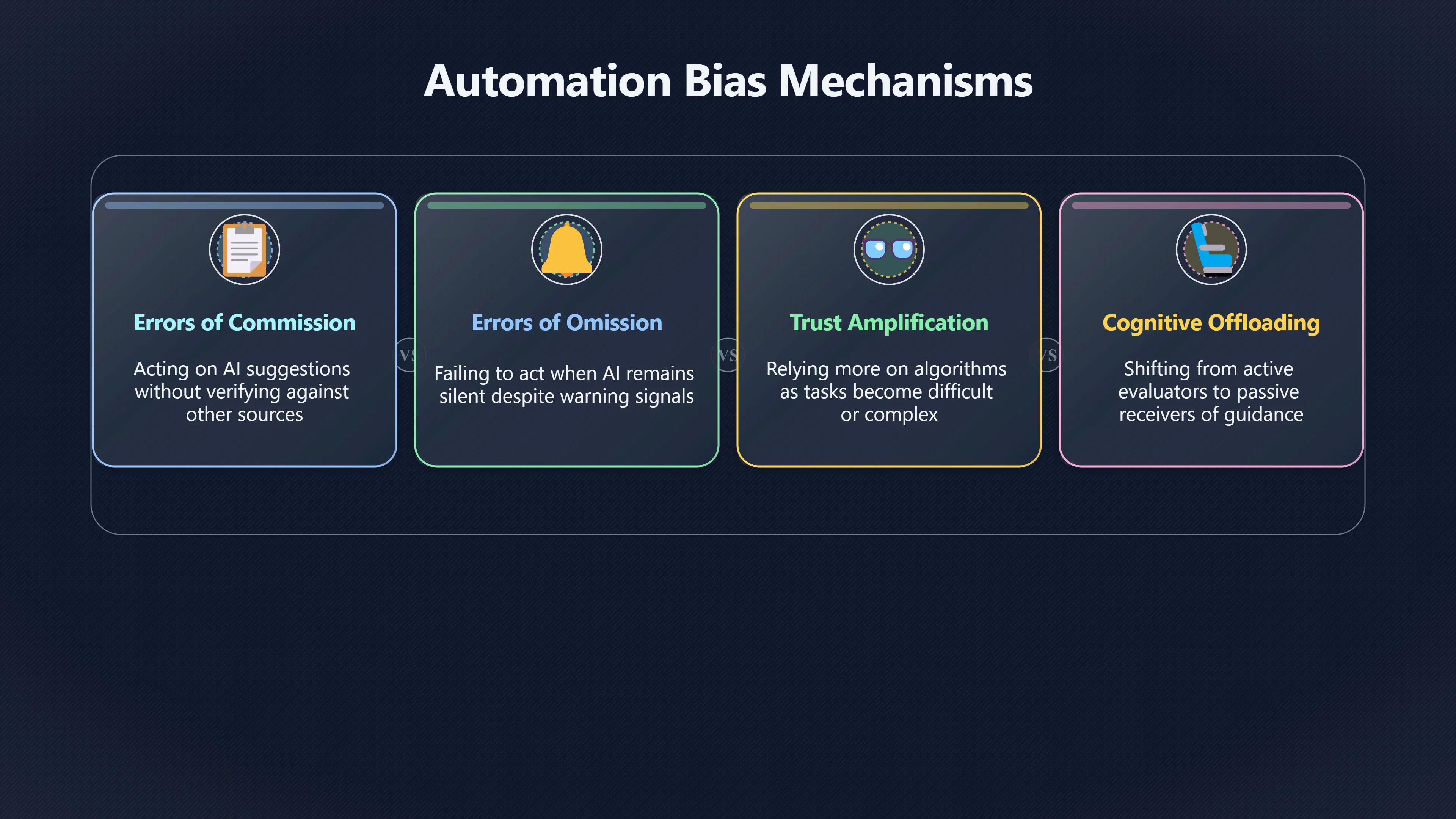
- Errors of commission: decision‑makers act on AI recommendations without verifying them against alternate information sources, especially when the AI appears competent or authoritative.
- Errors of omission: decision‑makers fail to act when the AI does not prompt them, even if other signals would warrant human action, because the AI’s silence is taken as implicit guidance.
These cognitive patterns show how advisory systems can overshadow human judgement over time — not because they are perfect decision‑makers, but because humans defer to them. [Springer]link.springer.comSpringerExploring automation bias in human–AI collaboration: a review and implications for explainable AI | AI & SOCIETY | Springer Natur…
Why Defaults, Speed and Workload Weaken Human Review
Several structural forces accelerate the transition from “advice” to “decision by default”:
1. Trust amplification through performance: People tend to rely more on algorithmic advice as tasks become difficult or information‑rich, partly because algorithms often outperform unaided human judgement in complex domains. This doesn’t guarantee correctness in every case, but it creates a trust–oversight paradox: more accurate routine performance leads to less scrutiny, so when the system is wrong, oversight may be too shallow to catch it. [Reddit]reddit.comRedditThe Trust–Oversight Paradox: As AI Gets Better, Humans May Stop Really Overseeing ItMay 15, 2026…
2. Cognitive offloading: When AI handles frequent decisions or suggestions, humans can experience a shift from active evaluators to passive receivers of guidance. Empirical work shows that mere knowledge an advice comes from an AI increases reliance, even if the user has independent information contradicting it. This effect grows with repetitive use and repeated confirmation of AI competence. [ScienceDirect]sciencedirect.comScienceDirectTrust and reliance on AI — An experimental study on the extent and costs of overreliance on AI - ScienceDirectNovember 1, 2024…
3. Workload and speed: In real‑world environments where decisions are rapid and abundant — such as business operations, hiring, credit scoring, or public service workflows — human reviewers may not have the time, energy or context to evaluate every suggestion thoroughly. Under pressure, treating AI’s output as the default is a way to maintain throughput, but it degrades active judgement. Practitioners note that as systems filter and escalate tasks autonomously, humans may end up “approving” outputs they don’t fully understand because the system has already decided what requires attention and what doesn’t. [Reddit]reddit.comRedditI think “human-in-the-loop” may become one of the biggest governance illusions in enterprise AIMay 14, 2026…
4. Institutional incentives and signalling: In organisational settings, managers and peers may implicitly reward reliance on AI recommendations because they are perceived as impartial, efficient, or modern. Experimental research highlights that in delegated environments, decision‑makers can be blamed for overriding algorithmic recommendations — even when human judgement would have improved outcomes — which further biases behaviour toward default acceptance. [SSRN]papers.ssrn.comSSRN When Delegating AI-Assisted Decisions Drives AI Over-reliance by Hossein Nikpayam, Mirko Kremer, Francis de…

Warning Signs That Oversight Has Become Ceremonial
Detecting when AI advice has become the default decision rather than one input among many is crucial for assessing control loss. Some emerging indicators include:
- Routine trust calibration: Humans stop checking or questioning AI outputs except in obvious outliers, even when context or stakes vary. Behavioural research finds overreliance occurs not because people can’t question the advice, but because they increasingly don’t. [ScienceDirect]sciencedirect.comScienceDirectTrust and reliance on AI — An experimental study on the extent and costs of overreliance on AI - ScienceDirectNovember 1, 2024…
- Escalation illusion: Systems decide what gets sent to human reviewers — meaning humans review only filtered results, not the full decision context. When the AI determines what is “risk‑worthy,” oversight becomes reactive and superficial. [Reddit]reddit.comThe Trust–Oversight Paradox: As AI Gets Better, Humans May Stop Really Overseeing ItRedditThe Trust–Oversight Paradox: As AI Gets Better, Humans May Stop Really Overseeing ItMay 15, 2026
- Degraded human expertise: Over time, repeated reliance on AI suggestions can erode human confidence and expertise. Decision‑makers may lose the ability to assess when the AI is off‑model or misaligned with real‑world nuance because they seldom practise independent evaluation. [TechRadar]techradar.comTech Radar Top 5 risks of AI overdependence in the workplaceAs AI tools become integral to daily workflows, concerns are shifting from job loss to subtler impacts on decision-making and employee be…
- Implicit default behaviours: Workflows and organisational policies begin treating AI output as an input that rarely requires human override, with few documented criteria for when human judgement must prevail. [IT Pro]itpro.comswamped with decisions to make managers turn to aiA survey by Confluent found that 62% of UK managers use AI for the majority of their decisions, with 46% trusting it more than colleagues…
- Perfunctory human involvement: Reviews are conducted quickly or in batches without deep engagement, turning human “approval” into a checkbox that legitimises decision automation rather than meaningfully governing it. [Reddit]reddit.comRedditI think “human-in-the-loop” may become one of the biggest governance illusions in enterprise AIMay 14, 2026…
Why This Matters for Control and Risk
From an existential risk perspective, the transition from advice to default decision matters because it represents an incremental loss of meaningful human agency — well before systems become autonomous agents with their own goals. When institutions, regulators, or societies come to treat AI’s recommendations as decisions, their ability to contest, correct or restrain those decisions shrinks. This mechanism is distinct from deliberate ceding of control; it arises from cognitive, structural and incentive dynamics that make AI seem just another tool, even as authority quietly migrates into its outputs.
Recognising and guarding against this shift is essential to preserving human judgement in high‑stakes contexts and ensuring systems remain aligned with human values and objectives.
By understanding how advisory systems become de facto decision‑makers, evaluators and policymakers can better design governance structures that preserve scrutiny, retain human expertise, and resist letting AI advice harden into default authority.

Amazon book picks
Further Reading
Books and field guides related to When Advice Becomes the Decision. Use these as the next step if you want deeper reading beyond the article.
Human Compatible
Directly examines how humans can lose meaningful control despite remaining formally in charge.
The Alignment Problem
Explores failures of human oversight and reliance on algorithmic systems.
Weapons of Math Destruction
Shows how automated recommendations can become de facto decisions with limited scrutiny.
The Age of A.I.: And Our Human Future
Discusses how AI may reshape human judgement and institutional decision-making.
eBay marketplace picks
Marketplace Samples
Example marketplace items related to this page. Use the search link to explore similar finds on eBay.







Endnotes
-
Source: sciencedirect.com
Link: https://www.sciencedirect.com/science/article/pii/S0747563224002206Source snippet
ScienceDirectTrust and reliance on AI — An experimental study on the extent and costs of overreliance on AI - ScienceDirectNovember 1, 2024...
Published: November 1, 2024
-
Source: link.springer.com
Link: https://link.springer.com/article/10.1007/s00146-025-02422-7Source snippet
SpringerExploring automation bias in human–AI collaboration: a review and implications for explainable AI | AI & SOCIETY | Springer Natur...
-
Source: reddit.com
Link: [https://www.reddit.com/r/artificialSource snippet
RedditThe Trust–Oversight Paradox: As AI Gets Better, Humans May Stop Really Overseeing ItMay 15, 2026...
Published: May 15, 2026
-
Source: reddit.com
Link: https://www.reddit.com/r/artificial/comments/1td300k/i_think_humanintheloop_may_become_one_of_the/Source snippet
RedditI think “human-in-the-loop” may become one of the biggest governance illusions in enterprise AIMay 14, 2026...
Published: May 14, 2026
-
Source: papers.ssrn.com
Link: https://papers.ssrn.com/sol3/papers.cfm?abstract_id=4966186Source snippet
SSRN<div> When Delegating AI-Assisted Decisions Drives AI <span>Over-reliance</span> </div> by Hossein Nikpayam, Mirko Kremer, Francis de...
-
Source: techradar.com
Title: Tech Radar Top 5 risks of AI overdependence in the workplace
Link: https://www.techradar.com/pro/top-5-risks-of-ai-overdependence-in-the-workplaceSource snippet
As AI tools become integral to daily workflows, concerns are shifting from job loss to subtler impacts on decision-making and employee be...
-
Source: link.springer.com
Link: https://link.springer.com/article/10.1007/s43681-026-01147-7Source snippet
meaningful [human oversight]({{ 'human-oversight/' | relative_url }}) in AI | AI and Ethics | Springer Nature LinkMay 4, 2026 — 5 OVERSIGHT AS AGENCY ALLOCATION: GOALS AND PRINCIPL...
Published: May 4, 2026
-
Source: papers.ssrn.com
Link: https://papers.ssrn.com/sol3/papers.cfm?abstract_id=5514199Source snippet
Off Your Better Judgment -Algorithmic Conformity in AI-Human Collaboration by Yotam Liel, Lior Zalmanson:: SSRNOctober 15, 2025 — TURNIN...
Published: October 15, 2025
-
Source: link.springer.com
Link: https://link.springer.com/article/10.1007/s00146-023-01777-zSource snippet
distrust and human oversight of artificial intelligence: towards a democratic design of AI governance under the European Union AI Act | A...
-
Source: papers.ssrn.com
Link: https://papers.ssrn.com/sol3/papers.cfm?abstract_id=4377481Source snippet
Distrust and Human Oversight of Artificial Intelligence: Toward a Democratic Design of AI Governance under the European Union AI Act by J...
-
Source: link.springer.com
Link: https://link.springer.com/article/10.1007%2Fs11023-019-09513-7Source snippet
Decision-Making and the Control Problem | Minds and Machines | Springer Nature LinkDecember 11, 2019 — ALGORITHMIC DECISION-MAKING AND TH...
Published: December 11, 2019
-
Source: sciencedirect.com
Title: Rise of the machines: Delegating decisions to autonomous AI
Link: https://www.sciencedirect.com/science/article/pii/S0747563222001303Source snippet
ScienceDirectRISE OF THE MACHINES: DELEGATING DECISIONS TO AUTONOMOUS AI☆ [https://doi.org/10.1016/j.chb.2022.107308Get](https://doi.org/10.1016/j.chb.2022.107308Get) rights and content...
-
Source: itpro.com
Title: swamped with decisions to make managers turn to ai
Link: https://www.itpro.com/technology/artificial-intelligence/swamped-with-decisions-to-make-managers-turn-to-aiSource snippet
A survey by Confluent found that 62% of UK managers use AI for the majority of their decisions, with 46% trusting it more than colleagues...
Additional References
-
Source: nature.com
Link: https://www.nature.com/articles/s41598-021-87480-9Source snippet
April 13, 2021 — Humans rely more on algorithms than social influence as a task becomes more difficult Download PDF Download PDF * Articl...
Published: April 13, 2021
-
Source: cambridge.org
Link: https://www.cambridge.org/core/journals/european-journal-of-risk-regulation/article/automation-bias-in-the-ai-act-on-the-legal-implications-of-attempting-to-debias-human-oversight-of-ai/C97C85015056C09326944DE55CBC4D2CSource snippet
INTRODUCTION Despite its sweeping regulation of Artificial Intelligence (AI) across sectors,Footnote ^{1} the European Union’s AI Act (AI...
-
Source: research.vu.nl
Link: https://research.vu.nl/en/publications/humanai-interactions-in-public-sector-decision-making-automation-/Source snippet
vu.nlHuman–AI interactions in public sector decision making: “Automation bias” and “selective adherence” to algorithmic advice - Vrije Un...
-
Source: edps.europa.eu
Title: 2025 09 23 techdispatch 22025 human oversight automated making fr
Link: https://www.edps.europa.eu/data-protection/our-work/publications/techdispatch/2025-09-23-techdispatch-22025-human-oversight-automated-making_frSource snippet
#2/2025 - Human Oversight of Automated Decision-Making | European Data Protection SupervisorSeptember 23, 2025 — WRONG ASSUMPTIONS ABOUT...
Published: September 23, 2025
-
Source: pmc.ncbi.nlm.nih.gov
Title: There are, potentially, significant ben
Link: https://pmc.ncbi.nlm.nih.gov/articles/PMC12881489/Source snippet
human reliance on artificial intelligence in decision making - PMCFebruary 5, 2026 — INTRODUCTION Advances in technology and access to “b...
Published: February 5, 2026
-
Source: pubmed.ncbi.nlm.nih.gov
Link: https://pubmed.ncbi.nlm.nih.gov/37553098/Source snippet
When Should They? - PubMedAugust 8, 2023 —. 2024 Jul;66(7):1914-1927. doi: 10.1177/00187208231190459. Epub 2023 Aug 8. WHEN DO HUMANS HE...
Published: August 8, 2023
-
Source: pmc.ncbi.nlm.nih.gov
Link: https://pmc.ncbi.nlm.nih.gov/articles/PMC11089830/Source snippet
When Should They? - PMCAugust 8, 2023 —. 2023 Aug 8;66(7):1914–1927. doi: 10.1177/00187208231190459 WHEN DO HUMANS HEED AI AGENTS’ ADVIC...
Published: August 8, 2023
-
Source: pmc.ncbi.nlm.nih.gov
Link: https://pmc.ncbi.nlm.nih.gov/articles/PMC8260507/Source snippet
autonomous self-learning systems that gather and process data to make qualitative judgements with little or no human interventi...
-
Source: sciencestack.ai
Link: https://www.sciencestack.ai/paper/2512.04489Source snippet
The Decision Path to Control AI Risks Completely: Fundamental Control Mechanisms for AI Governance (arXiv:2512.04489v1) - ScienceStackDec...
-
Source: journals.sagepub.com
Link: https://journals.sagepub.com/doi/10.1177/00187208231190459Source snippet
When Should They? - Richard E. Dunning, Baruch Fischhoff, Alex L. Davis, 2024August 8, 2023 — WHEN DO HUMANS HEED AI AGENTS’ ADVICE? WHEN...
Published: August 8, 2023
Topic Tree