Within Weak evidence
What AlphaZero and AutoML Reveal About Limits of AI Self Improvement
Self-play and AutoML offer modest evidence that AI can improve components of itself but fall short of demonstrating open-ended recursion or cross-domain
On this page
- Case studies of AlphaZero and AutoML progress
- Observed performance improvements versus human dependence
- Implications for intelligence explosion and p(doom) debates
Page outline Jump by section
Introduction
In debates about AI doom and whether future systems could spiral into runaway improvement outside human control, analysts often look for concrete evidence that machines can improve themselves. Two well‑known examples from current AI — DeepMind’s AlphaZero in game playing and automated machine learning (AutoML) systems — are frequently cited. They do show machines learning without direct human examples and automating parts of the model‑building process, but when examined closely, these examples highlight clear limits to autonomous, open‑ended recursive self‑improvement — the sort of feedback loop at the heart of intelligence‑explosion arguments.[AI Wiki]AI WikiAI Wiki - Artificial Intelligence WikiCURRENT STATE AND FUTURE TRAJECTORIES As of 2024-2025, recursive self-improvement has transitioned
 This article looks at what AlphaZero and AutoML really demonstrate, where they fall short of recursive AI improvement in the strong sense relevant for existential risk, and what that suggests for how we should interpret “machines improving machines” in the AI‑doom context.
AlphaZero: Self-Play Within Fixed Constraints
DeepMind’s AlphaZero learned to play chess, Go and shogi at superhuman levels by self‑play — repeatedly playing games against itself from the rules alone. It required no human game databases and discovered strong strategies by reinforcement learning driven by Monte Carlo tree search. That is often described as self‑improvement because the system generated its own training data and improved performance without human examples.[AI Wiki]AI WikiAI Wiki - Artificial Intelligence WikiCURRENT STATE AND FUTURE TRAJECTORIES As of 2024-2025, recursive self-improvement has transitioned
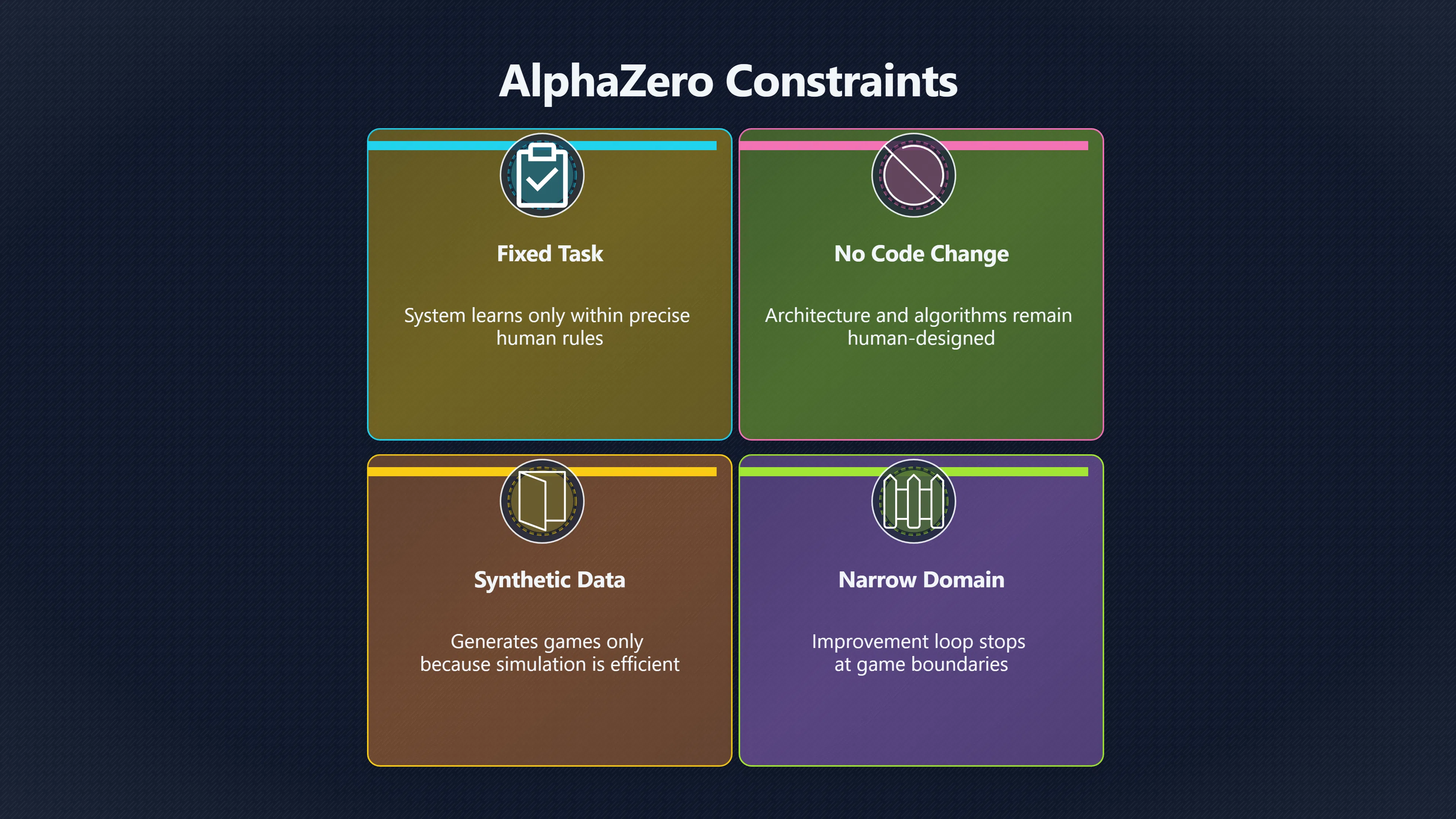
However, this improvement loop is highly constrained:
- Predefined task and environment: AlphaZero only learns within a fixed game with precise rules specified by humans; it doesn’t create or choose new tasks on its own.[Informatica]
- No autonomous change of objectives or code: It cannot alter its own architecture, learning algorithm, or optimisation strategy; all aspects of its learning pipeline are human‑designed and fixed.[AI Wiki]AI WikiAI Wiki - Artificial Intelligence WikiCURRENT STATE AND FUTURE TRAJECTORIES As of 2024-2025, recursive self-improvement has transitioned
- Data generation is specialised: The system generates synthetic games only because the game environment permits massive simulated play. Most real‑world domains lack such efficient, fully simulable environments.[Informatica]
So while AlphaZero demonstrates a powerful positive feedback loop in a narrow domain, it does not exhibit the open‑ended, goal‑setting, self‑modifying loop that would be required for recursive self‑improvement of the sort implicated in intelligence‑explosion scenarios.
AutoML: Automating Machine Learning, Not Agency
Automated machine learning (AutoML) and neural architecture search (NAS) systems push automation deeper into AI development. They help choose model architectures, tune hyperparameters, and, in some cases, even rediscover basic algorithmic components with minimal human intervention — as in Google’s AutoML‑Zero experiments.[AI Wiki]AI WikiAI Wiki - Artificial Intelligence WikiCURRENT STATE AND FUTURE TRAJECTORIES As of 2024-2025, recursive self-improvement has transitioned
These developments illustrate that parts of the model design and optimisation process can be outsourced to algorithms:
- AutoML systems can outperform some human‑designed architectures on benchmarks.[AI Wiki]AI WikiAI Wiki - Artificial Intelligence WikiCURRENT STATE AND FUTURE TRAJECTORIES As of 2024-2025, recursive self-improvement has transitioned
- They reduce the need for human expert time in negotiating between models and settings.[AI Wiki]AI WikiAI Wiki - Artificial Intelligence WikiCURRENT STATE AND FUTURE TRAJECTORIES As of 2024-2025, recursive self-improvement has transitioned
Yet, crucially:
- Framework and goals still human‑defined: AutoML operates within human‑specified search spaces, evaluation metrics, and performance targets. It does not choose or redefine what “better” means in a broader sense.[IEEE Spectrum]spectrum.ieee.orgSpectrum Recursive Self-Improvement Edges Closer In AI LabsIEEE SpectrumRecursive Self-Improvement Edges Closer In AI Labs - IEEE SpectrumMay 7, 2026…
- No intrinsic drive to open‑ended improvement: The process optimises within given bounds; without new tasks or evaluation criteria, the system does not continue improving itself in increasingly novel or broader ways.[Ithy]ithy.comai self improvement limitations explained la6n25p1Why AI Can't Self-Improve Yet: A Technical Deep DiveJanuary 1, 2025…
Thus, AutoML shows automation of components of the ML lifecycle, but not autonomous recursive improvement that expands capability beyond originally defined objectives.
Why These Examples Are Weak Evidence for Strong Recursion
For AI disaster scenarios predicated on a self‑sustaining intelligence explosion, the key question is whether an AI can autonomously set its own goals, redesign its own mechanisms, acquire resources, and embark on a positive feedback loop that accelerates without bound. AlphaZero and AutoML do not exhibit this:
- They remain tethered to external grounding and human specification at every stage. Systems improvise performance in a fixed domain with a predefined criterion for success; they do not choose domains, objectives, or evaluation metrics.[IEEE Spectrum]spectrum.ieee.orgSpectrum Recursive Self-Improvement Edges Closer In AI LabsIEEE SpectrumRecursive Self-Improvement Edges Closer In AI Labs - IEEE SpectrumMay 7, 2026…
- They depend on external evaluation and embedding (e.g. human‑designed reward functions, simulators, benchmarks) that anchor their improvement to human values and constraints.[AI Wiki]AI WikiAI Wiki - Artificial Intelligence WikiCURRENT STATE AND FUTURE TRAJECTORIES As of 2024-2025, recursive self-improvement has transitioned
- They do not demonstrate the ability to rewrite their own core designs or extend themselves into new arenas without human input.[Ithy]ithy.comai self improvement limitations explained la6n25p1Why AI Can't Self-Improve Yet: A Technical Deep DiveJanuary 1, 2025…
Recent theoretical work also emphasises limits when systems try to rely purely on self‑generated data without grounding in external signals: without anchored feedback, model distributions can degenerate in quality over repeated self‑training, revealing a fundamental boundary to closed‑loop self‑improvement in current paradigms.[arXiv]arxiv.orgarXivOn the Limits of Self-Improving in LLMs and Why AGI, ASI and the Singularity Are Not Near Without Symbolic Model SynthesisJanuary 5…
Implications for Intelligence Explosion and p(doom) Debates
In the context of AI existential risk, AlphaZero and AutoML are often invoked to suggest that AI could soon bootstrap its way to superintelligence. They do show plausible feedback loops — machines generating data for their own training and automating design tasks — but these loops are domain‑limited, human‑anchored, and not self‑directed. As such, they are weak evidence for scenarios where an AI enters an unbounded, autonomous improvement spiral.
This doesn’t mean such a spiral is impossible in principle, but it does mean that current real‑world systems fall far short of the kind of recursive self‑improvement that would justify strong confidence in rapid intelligence explosions. In risk assessments framed around p(doom) or existential outcomes, the evidence from AlphaZero and AutoML suggests we should be cautious about extrapolating narrow optimisation loops into unfettered, autonomous capability growth.[AISafety]aisafety.infoIs recursive self-improvement possible?AISafetyIs recursive self-improvement possible?…
What these examples do show is that AI can increasingly assist in its own development and optimise components of its architecture, which raises practical governance and safety questions — but the leap to genuine recursive self‑improvement remains unsubstantiated by current empirical examples.

Summary
- AlphaZero’s self‑play demonstrates machine improvement within tightly constrained game domains but doesn’t entail open‑ended, self‑directed learning beyond those constraints.[AI Wiki]AI WikiAI Wiki - Artificial Intelligence WikiCURRENT STATE AND FUTURE TRAJECTORIES As of 2024-2025, recursive self-improvement has transitioned
- AutoML systems automate search and design processes but still require human‑set goals and frameworks.[MDPI]mdpi.comAn Empirical Review of Automated Machine LearningMDPIAn Empirical Review of Automated Machine LearningJanuary 13, 2021…
- The loophole from narrow optimisation to fully recursive self‑improvement — the engine of many AI‑doom scenarios — is not bridged by these examples.[IEEE Spectrum]spectrum.ieee.orgSpectrum Recursive Self-Improvement Edges Closer In AI LabsIEEE SpectrumRecursive Self-Improvement Edges Closer In AI Labs - IEEE SpectrumMay 7, 2026…
- Evidence to date suggests machines can help build better machines in bounded ways, but they do not yet display the autonomous, unbounded feedback loops associated with intelligence explosion.[AISafety]aisafety.infoIs recursive self-improvement possible?AISafetyIs recursive self-improvement possible?…
In short, AlphaZero and AutoML offer important insights into self‑improvement dynamics, but they remain weak evidence for the kind of recursive AI limits that would drive runaway capability growth without human oversight — a core concern in existential risk discussions.
Amazon book picks
Further Reading
Books and field guides related to What AlphaZero and AutoML Reveal About Limits of AI Self Improvement. Use these as the next step if you want deeper reading beyond the article.
Human Compatible
Directly addresses advanced AI systems, control problems, and limits of current AI approaches.
Life 3.0
Examines intelligence explosion scenarios and the evidence for and against transformative AI trajectories.
Artificial Intelligence
Rating: 4.5/5 from 10 Google Books ratings
Provides technical grounding for self-play, AutoML and AI capabilities.
Superintelligence
Directly analyzes recursive self-improvement and superintelligence arguments.
eBay marketplace picks
Marketplace Samples
Example marketplace items related to this page. Use the search link to explore similar finds on eBay.




Endnotes
-
Source: informatica.si
Title: Alpha Zero – What’s Missing? | Informatica
Link: https://www.informatica.si/index.php/informatica/article/view/2226Source snippet
InformaticaAlphaZero – What’s Missing? | InformaticaMarch 26, 2018...
Published: March 26, 2018
-
Source: spectrum.ieee.org
Title: Spectrum Recursive Self-Improvement Edges Closer In AI Labs
Link: https://spectrum.ieee.org/recursive-self-improvementSource snippet
IEEE SpectrumRecursive Self-Improvement Edges Closer In AI Labs - IEEE SpectrumMay 7, 2026...
Published: May 7, 2026
-
Source: ithy.com
Title: ai self improvement limitations explained la6n25p1
Link: https://ithy.com/article/ai-self-improvement-limitations-explained-la6n25p1Source snippet
Why AI Can't Self-Improve Yet: A Technical Deep DiveJanuary 1, 2025...
Published: January 1, 2025
-
Source: arxiv.org
Link: https://arxiv.org/abs/2601.05280Source snippet
arXivOn the Limits of Self-Improving in LLMs and Why AGI, ASI and the Singularity Are Not Near Without Symbolic Model SynthesisJanuary 5...
-
Source: aisafety.info
Title: Is recursive self-improvement possible?
Link: https://aisafety.info/questions/8AEL/Is-recursive-self-improvement-possibleSource snippet
AISafetyIs recursive self-improvement possible?...
-
Source: mdpi.com
Title: An Empirical Review of Automated Machine Learning
Link: https://www.mdpi.com/2073-431X/10/1/11Source snippet
MDPIAn Empirical Review of Automated Machine LearningJanuary 13, 2021...
Published: January 13, 2021
-
Source: informatica.si
Title: Alpha Zero – What’s Missing?
Link: https://www.informatica.si/index.php/informatica/article/view/2226%3E/0Source snippet
| Bratko | InformaticaAbout The Author Ivan Bratko University of Ljubljana, Faculty of Computer and Information Science Slovenia Support...
-
Source: aiwiki.ai
Title: AI Wiki Recursive self-improvement
Link: https://www.aiwiki.ai/wiki/Recursive_self-improvementSource snippet
AI WikiRecursive self-improvement - AI Wiki - [Artificial]({{ 'artificial-goals/' | relative_url }}) Intelligence Wiki...
-
Source: papers.cool
Link: https://papers.cool/arxiv/2601.05280Source snippet
Immersive Paper DiscoveryJanuary 5, 2026 — #1 ON THE LIMITS OF SELF-IMPROVING IN LLMS AND WHY AGI, ASI AND THE SINGULARITY ARE NOT NEAR W...
Published: January 5, 2026
-
Source: s-rsa.com
Link: https://s-rsa.com/index.php/agi/article/view/17159Source snippet
On the Limits of Self-Improving in LLMs and Why AGI, ASI and the Singularity Are Not Near Without Symbolic Model Synthesis | SuperIntelli...
-
Source: researchtrend.ai
Link: https://researchtrend.ai/papers/2601.05280 -
Source: alphaxiv.org
Link: https://www.alphaxiv.org/audio/2601.05280v2Source snippet
On the Limits of Self-Improving in Large Language Models: The Singularity Is Not Near Without Symbolic Model Synthesis | alphaXivON THE L...
-
Source: researchgate.net
Link: https://www.researchgate.net/publication/368829510_Targeted_Search_Control_in_AlphaZero_for_Effective_Policy_ImprovementSource snippet
(PDF) Targeted Search Control in AlphaZero for Effective Policy ImprovementPreprint PDF Available TARGETED SEARCH CONTROL IN ALPHAZERO FO...
-
Source: milvus.io
Link: https://milvus.io/ai-quick-reference/can-ai-reasoning-models-selfimproveSource snippet
Copy page CAN AI REASONING MODELS SELF-IMPROVE? AI reasoning models can achieve limited forms of self-improvement under specific condi...
-
Source: papers.cool
Title: Self-Improving AI Agents through Self-Play | Cool Papers
Link: https://papers.cool/arxiv/2512.02731Source snippet
Immersive Paper DiscoveryDecember 2, 2025 — 2512.02731 Total: 1 #1 SELF-IMPROVING AI AGENTS THROUGH SELF-PLAY [PDF^{3}] [COPY] [KIMI^{8}]...
Published: December 2, 2025
-
Source: gpuinsights.net
Title: Recursive Self-Improvement GPU Limits — Next-Gen Design
Link: https://gpuinsights.net/recursive-self-improvement-gpu-limits-2026/Source snippet
May 27, 2026 — THEORETICAL LIMITS OF RECURSIVE SELF-IMPROVEMENT: IMPLICATIONS FOR NEXT-GEN GPU DESIGN May 27, 2026 by Iovanny Olguín Ávil...
Published: May 27, 2026
-
Source: youtube.com
Link: https://www.youtube.com/watch?v=MrJVgw8dBhwSource snippet
Understanding Recursive Self-Improvement, Risks & Rewards - The AI Show w/ Paul Roetzer & Mike Kaput...
-
Source: youtube.com
Title: Understanding Recursive Self-Improvement, Risks & Rewards
Link: https://www.youtube.com/watch?v=nJnc_1dHHMISource snippet
Self-Taught Optimizer (STOP): Recursively Self-Improving Code Generation...
Topic Tree