Within Bio Threat AI
AI in Predicting Dangerous Pathogen Traits
Advanced AI may model how genetic changes affect traits like transmissibility, potentially accelerating high-consequence pathogen design.
On this page
- Predictive modeling techniques
- Case studies of trait simulation
- Limitations and uncertainty in predictions
Page outline Jump by section
Introduction
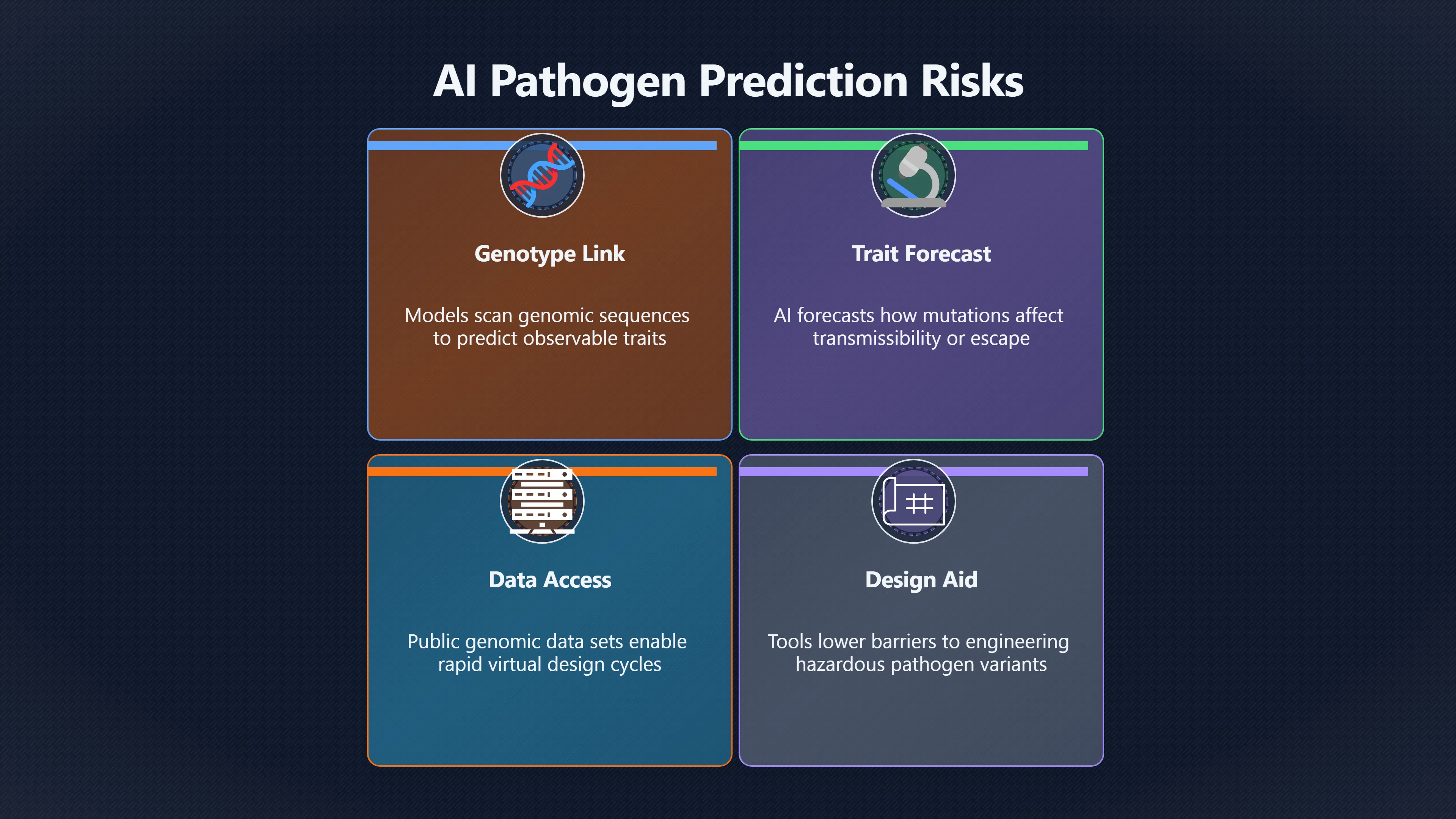
Artificial intelligence’s growing ability to analyse and model biological systems has sparked serious debate about whether it could assist not just in beneficial scientific work but also in predicting and potentially enhancing dangerous traits in pathogens — such as transmissibility, immune evasion, or host range. In discussions about AI‑assisted design of enhanced biological pathogens within the broader context of AI doom and existential risk from advanced AI systems, one specific mechanism of concern is AI‑enhanced pathogen trait prediction. This is where AI models could help forecast how specific genetic changes might affect pathogen behaviour, potentially steering biological design toward more hazardous variants with far less human expertise or experimentation than classical approaches once required. The risks here are subtle: not immediate autonomous bioweapons creation by AI, but the lowering of technical barriers and acceleration of iterative design cycles that can make high‑consequence pathogen evolution easier to explore virtually.
 Importantly, such capabilities are not yet close to reliably engineering pandemics on their own. Major scientific and data limitations remain, but the trend toward more powerful predictive models and larger biological datasets is driving debate and concern among biosecurity experts, especially about misuse, oversight gaps, and governance frameworks. [euronews]euronews.comeuronewsExperts warn open access bio-data could help AI design dangerous pathogens | EuronewsFebruary 18, 2026…
How Predictive Models Work and Why They Matter
At a basic level, what makes pathogen trait prediction with AI notable — and potentially risky — is its attempt to link genotype (the sequence of genetic material) with phenotype (observable characteristics such as transmissibility or immune escape). Machine learning and deep learning models can scan vast amounts of genomic and epidemiological data to recognise patterns that might be invisible to human experts. In recent years, these approaches have been applied to forecasting viral evolution, identifying variants with certain properties, and even anticipating how a virus might adapt under immune pressure. [PubMed]pubmed.ncbi.nlm.nih.govPubMedPredicting pathogen evolution and immune evasion in the age of artificial intelligence - PubMedMarch 28, 2025…
Such models may use techniques ranging from language‑model architectures (originally developed for text) to specialised neural networks that integrate genomic, epidemiological, ecological, and immunological data. When accurate, predictive insights can aid public health preparedness — for example, suggesting which mutations in SARS‑CoV‑2 might reduce vaccine effectiveness. However, those same capabilities, in a dual‑use context, could be repurposed to explore which alterations would most increase danger if introduced intentionally. [PubMed]pubmed.ncbi.nlm.nih.govPubMedPredicting pathogen evolution and immune evasion in the age of artificial intelligence - PubMedMarch 28, 2025…
While computational phenotype prediction is an active area of research across many species and pathogens, it remains technically challenging. Even high accuracy scores in models can reflect correlations rather than true causal understanding of underlying biological mechanisms, and complex trait predictions often suffer from limited and noisy data. [OUP Academic]academic.oup.comOUP AcademicWhole-genome phenotype prediction with machine learning: open problems in bacterial genomics | Bioinformatics | Oxford Academ…
Potential Biosecurity Risks
Capability amplification. One worry is that predictive modelling may reduce the number of physical experiments needed to assess the effects of genetic changes by allowing researchers — or malicious actors — to prioritise the most consequential modifications without exhaustive lab work. This could compress the research cycle and make it easier to home in on designs that enhance harmful traits. [euronews]euronews.comeuronewsExperts warn open access bio-data could help AI design dangerous pathogens | EuronewsFebruary 18, 2026…
Misuse of open data. Much of the scientific data that underpins biological AI models — genomic sequences, mutation effects, transmission characteristics — is publicly available, and biosecurity experts have specifically argued that unrestricted access to such datasets could enable predictive capabilities that accelerate dangerous design if left unchecked. This has led to calls for more stringent governance of what high‑risk biological data is shared publicly and how it is incorporated into AI training. [euronews]euronews.comeuronewsExperts warn open access bio-data could help AI design dangerous pathogens | EuronewsFebruary 18, 2026…
Dual‑use model outputs. Technical capabilities to predict immune evasion or transmissibility traits could theoretically be misused to forecast which mutations would best help a pathogen evade current vaccines or treatments — information that biothreat actors might weaponise if combined with other lab‑based techniques. AI models that propose sequences or trait enhancements could, in worst‑case misuse, provide a starting point for lab experimentation that bypasses traditional expert intuition. [PMC]pmc.ncbi.nlm.nih.govPMCArtificial Intelligence for Modelling Infectious Disease EpidemicsPMCArtificial Intelligence for Modelling Infectious Disease Epidemics
It’s worth emphasising that these risks stem from how human agents might use predictive tools; they do not imply that AI autonomously decides to create pandemics. The dual‑use potential is largely about assistance — providing insights that could be leveraged for benign or harmful ends depending on intent and controls. [PMC]pmc.ncbi.nlm.nih.govPMCDual-use capabilities of concern of biological AI modelsPMCMay 8, 2025…
Scientific and Practical Limitations
Despite the concern, the current state of predictive modelling has clear limitations that temper near‑term biosecurity risk:
- Data scarcity and quality. Robust prediction requires comprehensive, high‑quality datasets linking genotype to phenotype for traits like virulence or transmissibility. Such datasets are far less mature and abundant than those used for protein structure prediction, limiting AI’s ability to make reliable trait forecasts at scale. [NCBI]ncbi.nlm.nih.govNCBIAI-Enabled Biological Design and the Risks of Synthetic BiologyThe Age of AI in the Life Sciences - NCBI BookshelfApril 23, 2025…
- Correlation vs causation. Machine learning models often pick up statistical associations rather than causal mechanisms. In bacterial genomics, researchers have found that models can misidentify features as causative when they merely correlate with a trait due to population structure or sampling bias. This undermines confidence that model predictions truly reflect biological causality. [OUP Academic]academic.oup.comOUP AcademicWhole-genome phenotype prediction with machine learning: open problems in bacterial genomics | Bioinformatics | Oxford Academ…
- Complex biological interactions. Processes like host‑pathogen interactions, immune evasion, and environmental fitness are governed by complex, multiscale dynamics that remain difficult to capture fully via AI alone. A sequence change may have unpredictable effects due to epistatic interactions (where one mutation’s impact depends on others) or ecological context that models cannot yet reliably encode. [PubMed]pubmed.ncbi.nlm.nih.govPubMedPredicting pathogen evolution and immune evasion in the age of artificial intelligence - PubMedMarch 28, 2025…
Because of these challenges, many scientists and expert reviews caution that while predictive models are improving, they are far from reliably guiding the design of high‑consequence biological threats without extensive human expertise and laboratory validation. [Nature]nature.comAI can design viruses, toxins and other bioweapons. How worried should we be?NatureAI can design viruses, toxins and other bioweapons. How worried should we be?…
Where Controversies and Uncertainties Lie
Biosecurity debate around AI‑enhanced trait prediction centres on a few key uncertainties:
- How quickly will predictive accuracy improve? Some commentators warn that leaps in model capability could outpace governance if unrestricted datasets and computational tools proliferate. Others argue that the inherent complexity of biology means there will always be a performance gap that slows misuse. The balance of these possibilities affects assessments of how soon trait prediction might become genuinely hazardous. [euronews]euronews.comeuronewsExperts warn open access bio-data could help AI design dangerous pathogens | EuronewsFebruary 18, 2026…
- What constitutes ‘high‑risk’ data? Not all biological datasets are equally dangerous. Determining which genetic sequences and trait annotations pose real risk if incorporated into AI training is a matter of active policy discussion, with proposals for restricted access or licensing regimes for sensitive data. [euronews]euronews.comeuronewsExperts warn open access bio-data could help AI design dangerous pathogens | EuronewsFebruary 18, 2026…
- Human oversight and intent. Even the most powerful predictive tools require human interpretation and decision‑making. Debates about biosecurity often hinge on how to ensure that such interpretation aligns with safety norms, and about whether misuse can be deterred or detected effectively. [PMC]pmc.ncbi.nlm.nih.govPMCArtificial Intelligence for Modelling Infectious Disease EpidemicsPMCArtificial Intelligence for Modelling Infectious Disease Epidemics

Implications for AI Doom and Existential Risk
Within the broader concern about AI’s role in existential risk, AI‑enhanced pathogen trait prediction is often discussed not as a standalone extinction mechanism, but as a component in a chain of capabilities that could lower barriers to engineering pathogens with pandemic potential. If predictive models become reliable enough to suggest dangerous trait modifications and are combined with other advances in synthetic biology and lab automation, the theoretical risk landscape widens. The existential risk question then becomes one of systemic capacity and governance — namely, whether society can anticipate and constrain the misuse of increasingly powerful computational biology tools before they materially change what is feasible in practice. [euronews]euronews.comeuronewsExperts warn open access bio-data could help AI design dangerous pathogens | EuronewsFebruary 18, 2026…
Summary
AI‑enhanced pathogen trait prediction sits at the intersection of cutting‑edge computational biology and biosecurity risk. Carefully designed predictive models are already helping scientists understand how pathogens evolve and respond to interventions. But because similar models could, in theory, be repurposed to forecast trait enhancements that might make pathogens more dangerous, experts are debating how to govern data access, model training, and deployment to strike a balance between enabling beneficial scientific discovery and preventing misuse. The risks are real in principle, but substantial scientific limitations and persistent uncertainties mean that this subfield remains a potential biosecurity concern rather than a present‑day crisis. [euronews]euronews.comeuronewsExperts warn open access bio-data could help AI design dangerous pathogens | EuronewsFebruary 18, 2026…
Amazon book picks
Further Reading
Books and field guides related to AI in Predicting Dangerous Pathogen Traits. Use these as the next step if you want deeper reading beyond the article.
Editing Humanity
Provides context for biological prediction and engineering capabilities.
eBay marketplace picks
Marketplace Samples
Example marketplace items related to this page. Use the search link to explore similar finds on eBay.








Endnotes
-
Source: euronews.com
Link: https://www.euronews.com/health/2026/02/18/experts-warn-open-access-bio-data-could-help-ai-design-dangerous-pathogensSource snippet
euronewsExperts warn open access bio-data could help AI design dangerous pathogens | EuronewsFebruary 18, 2026...
Published: February 18, 2026
-
Source: nature.com
Title: AI can design viruses, toxins and other bioweapons. How worried should we be?
Link: https://www.nature.com/articles/d41586-026-01476-xSource snippet
NatureAI can design viruses, toxins and other bioweapons. How worried should we be?...
-
Source: pmc.ncbi.nlm.nih.gov
Title: PMCArtificial Intelligence for Modelling Infectious Disease Epidemics
Link: https://pmc.ncbi.nlm.nih.gov/articles/PMC11987553/ -
Source: academic.oup.com
Link: https://academic.oup.com/bioinformatics/advance-article/doi/10.1093/bioinformatics/btaf206/8171528Source snippet
OUP AcademicWhole-genome phenotype prediction with machine learning: open problems in bacterial genomics | Bioinformatics | Oxford Academ...
-
Source: pmc.ncbi.nlm.nih.gov
Title: PMCDual-use capabilities of concern of biological AI models
Link: https://pmc.ncbi.nlm.nih.gov/articles/PMC12061118/Source snippet
PMCMay 8, 2025...
Published: May 8, 2025
-
Source: academic.oup.com
Link: https://academic.oup.com/bioinformatics/article/41/7/btaf206/8171528Source snippet
oup.comWhole-genome phenotype prediction with machine learning: open problems in bacterial genomics | Bioinformatics | Oxford AcademicJun...
-
Source: nature.com
Link: https://www.nature.com/articles/s41467-024-55461-xSource snippet
CommunicationsJanuary 10, 2025 — Integrating artificial intelligence with mechanistic epidemiological modeling: a scoping review of oppor...
Published: January 10, 2025
-
Source: nature.com
Link: https://www.nature.com/articles/s41437-018-0176-9Source snippet
January 16, 2019 — Enhancing genetic disease control by selecting for lower host infectivity and susceptibility Download PDF Download PDF...
Published: January 16, 2019
-
Source: pubmed.ncbi.nlm.nih.gov
Link: https://pubmed.ncbi.nlm.nih.gov/40235636/Source snippet
PubMedPredicting pathogen evolution and immune evasion in the age of artificial intelligence - PubMedMarch 28, 2025...
Published: March 28, 2025
Additional References
-
Source: sciencedirect.com
Link: https://www.sciencedirect.com/science/article/pii/S2949924026000066Source snippet
ScienceDirectDECODING INFECTION AND TRANSMISSION Volume 4, 2026, 100079 ARTIFICIAL INTELLIGENCE AND BIG DATA FOR DECODING INFECTIOUS DISE...
-
Source: forecastingresearch.org
Link: https://forecastingresearch.org/research/llm-enabled-bioriskSource snippet
July 1, 2025 — Working paper * Working paper * # Forecasting LLM-enabled Biorisk and the Efficacy of Safeguards Forecasting LLM-enabled B...
Published: July 1, 2025
-
Source: research.birmingham.ac.uk
Link: https://research.birmingham.ac.uk/en/publications/ba0449b6-77fc-44f7-9b15-ba48a3af04d6Source snippet
birmingham.ac.ukWhole-genome phenotype prediction with machine learning: open problems in bacterial genomics - University of BirminghamJu...
-
Source: cris.technion.ac.il
Link: https://cris.technion.ac.il/en/publications/understanding-the-theoretical-limits-of-ai-enabled-pathogen-desigSource snippet
the Theoretical Limits of AI-Enabled Pathogen Design: Insights from a Delphi Study - Technion - Israel Institute of TechnologyUNDERSTANDI...
-
Source: airiskexplorer.com
Link: https://www.airiskexplorer.com/explainers/biological-riskSource snippet
AI Risk ExplorerOVERVIEW Biological risks, often referred to as "biorisks," encompass the uncertainties associated with both the likeliho...
-
Source: mdpi.com
Title: Artificial Intelligence and Integrated Genotype–Phenotype Identification
Link: https://www.mdpi.com/2073-4425/10/1/18Source snippet
Frey ^{ 1,2}^{} ^{1} Department of Public Health Sciences, Biomedical Informatics Center, Medical University...
-
Source: tandfonline.com
Title: Borkenhagena Department of Infectious Diseas
Link: https://www.tandfonline.com/doi/full/10.1080/22221751.2021.1978824Source snippet
Full article: Influenza virus genotype to phenotype predictions through machine learning: a systematic reviewSeptember 23, 2021 — INFLUEN...
Published: September 23, 2021
-
Source: youtube.com
Link: https://www.youtube.com/watch?v=Oy-oyODkTuYSource snippet
3 Scaling Laws: Why Data Governance Is the Key to AI Biosecurity, with Jassi Pannu and Doni Bloomfield...
-
Source: youtube.com
Link: https://www.youtube.com/watch?v=SvPcxRiFauYSource snippet
4 AI-enhanced biodesign, DNA synthesis and risk mitigation | Nicole Wheeler | EAG London...
-
Source: ncbi.nlm.nih.gov
Title: NCBIAI-Enabled Biological Design and the Risks of Synthetic Biology
Link: https://www.ncbi.nlm.nih.gov/books/NBK614591/Source snippet
The Age of AI in the Life Sciences - NCBI BookshelfApril 23, 2025...
Published: April 23, 2025
Topic Tree