Within Cyber tripwires
How Tools and Memory Amplify AI Cyber Performance
This page explores how adding tools, memory, and planning loops can drastically boost AI attack performance in tests.
On this page
- Defining scaffolding in AI systems
- Experimental results showing capability boosts
- Implications for realistic risk assessment
Page outline Jump by section
Introduction
When frontier AI models are tested for cyber‑security capabilities within the AI‑risk debate, the way they are scaffolded — the tools, memory mechanisms, planning loops and extended compute budgets wrapped around the core model — can dramatically shift evaluation outcomes. Rather than reflecting a model’s “raw” capability based on weights alone, many modern cyber‑capability evaluations embed the base model within frameworks that let it remember context across many steps, call external tools, and operate with persistent state. This scaffolding isn’t just a technical curiosity: emerging evidence suggests it can substantially boost measured performance on complex cyber tasks, raising important questions about how capability thresholds are defined and what evaluation outcomes really mean for assessing misuse risk in AI‑doom discussions. [AI Security Institute]aisi.gov.ukSource details in endnotes.
What Does “Scaffolding” Mean in AI Cyber Evaluations?
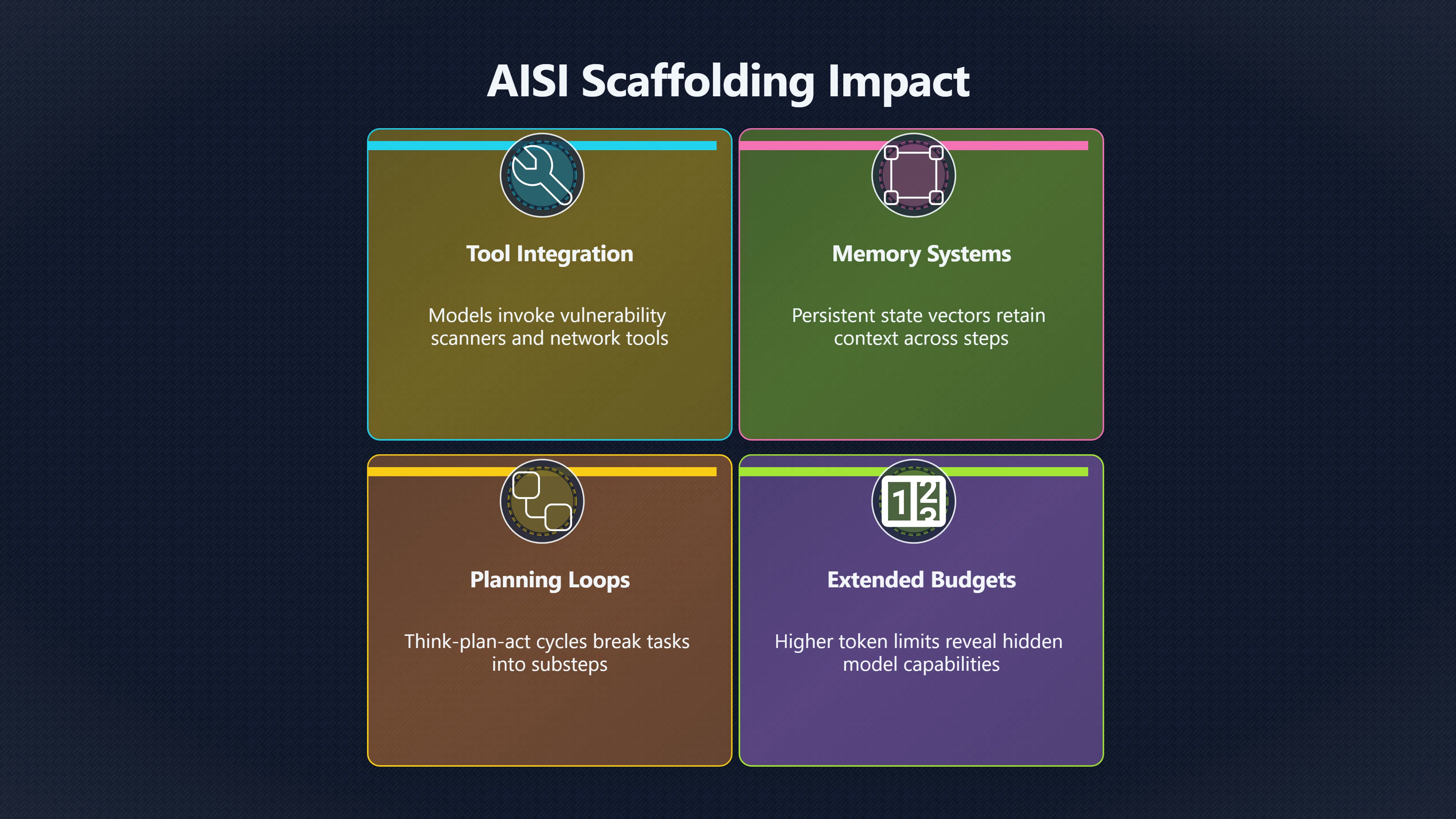
In the context of AI cyber capability testing, scaffolding refers to any supporting structures or mechanisms beyond the base model that help it perform tasks. These typically include:
- Tool integration: letting the model invoke specialised software like vulnerability scanners or network tools.
- Memory systems: persistent state or vectors that help the agent retain context across long sequences.
- Planning and workflow loops: structured loops (e.g. think‑plan‑act cycles) that break tasks into substeps and monitor progress.
- Extended inference budgets: allowing many more tokens or turns than typical benchmark settings.
This contrasts with evaluating a model as a stateless language assistant answering isolated queries. Robust scaffolding effectively turns a model into an agentic system that can manage multi‑phase tasks and maintain procedural state, a shift with major consequences for evaluation. [AI Security Institute]aisi.gov.ukSource details in endnotes.
How Scaffolding Changes Evaluation Results
Better Performance Through Memory and Planning
Recent internal evaluations by the UK AI Security Institute (AISI) show that enhancing the supporting scaffold around an AI model boosts measured cyber task performance. By refining system prompts and expanding interactive tool access, a leading model’s success rate on a development set of cyber challenges rose by nearly ten percentage points compared with a less‑scaffolded baseline. Moreover, a better scaffold often needed significantly less inference budget to reach the same performance level, suggesting scaffold design interacts with compute efficiency. [AI Security Institute]aisi.gov.ukSource details in endnotes.
A key mechanism here is context retention across steps. Standard large language models are limited by their short context windows: as tasks grow longer and more chained, they tend to lose track of earlier decisions and outputs. Systems that embed a recursive memory or structured context store help the model track procedural states over many actions, materially enhancing multi‑step task execution. Scaffolded systems like this often integrate retrieval and context compaction mechanisms that ensure past outputs remain relevant to future steps — something raw chat‑style prompts struggle to accomplish. [Springer Link]link.springer.comSpringer LinkAutosecagent: a semi-automated AI-driven penetration testing framework through recursive memory and real-time RAG | The Jour…
Extended Compute or Token Budgets Reveal More Capability
Aside from structural scaffolding, evaluations that increase the inference budget — the total number of tokens or turns a model can consume — also show markedly different outcomes. Traditional tests limit tokens and steps to make evaluations comparable and cost‑manageable. However, research from both AISI and independent groups found that frontier models can productively use 10×–50× more tokens than typical evaluation budgets allow, leading to higher success rates and even first‑time solutions to tasks that standard budgets missed entirely. [AI Security Institute]aisi.gov.ukSource details in endnotes.
This scaling effect matters because it implies that evaluation outcomes are not solely functions of model architecture and weights but are significantly shaped by how much compute and context scaffolding is permitted. A model that seems unable to complete a complex chain under strict limits might succeed reliably with a richer scaffold. This challenges simplistic interpretations of evaluation scores and raises the prospect that benchmarks without scaffold considerations may underestimate real‑world capabilities.

Scaffolding Introduces Hidden Variables into Benchmarking
Researchers outside policy organisations also note that how a model is scaffolded can outweigh the choice of base model weights. Informal assessments shared in technical forums suggest that swapping the surrounding architecture — from rudimentary prompt loops to fully integrated tool pipelines with memory — can change task‑completion metrics by noticeable margins, sometimes above 10–15 percent, even with identical core model weights. [Reddit]reddit.comRedditTitle: We mapped six levels of how intelligence organizes itself around AI models — not inside themMarch 25, 2026…
This observation dovetails with academic work on meta‑benchmarks, which finds that scaffolding interacts with task difficulty and can produce large differences in success rates across evaluation categories. Properly matched scaffolds can mean the difference between a model’s capability appearing limited or showing substantial offensive or defensive competence. [arXiv]arxiv.orgarXivCybersecurity AI Benchmark (CAIBench): A Meta-Benchmark for Evaluating Cybersecurity AI AgentsOctober 28, 2025…
Why Scaffolding Effects Matter for Risk Assessment
Misleading Signals in Threshold‑Based Safeguards
In AI doom and existential‑risk frameworks, deployment tripwires are often defined by capability thresholds: once a model demonstrably reaches a level associated with serious misuse, safeguards trigger stricter controls. If evaluation outcomes are heavily influenced by scaffolding choices, then thresholds tied to benchmark performance may reflect scaffolding design decisions rather than fundamental model risk. A model may underperform on a narrow, unsupplemented test yet pose a much larger real‑world threat when given reasonable tool access and memory structures similar to those that might be exploited in practice.
This gap becomes especially concerning if policymakers or lab governance relies on bare benchmark numbers without clarifying what scaffolding was included. A threshold set on non‑scaffolded performance might allow release of systems that, when scaffolded in realistic scenarios, could exceed danger thresholds — or conversely, unfairly penalise models that perform poorly without scaffolds but gain little from them.
Realistic Task Structure Matters
Scaffolding lets evaluations approximate operational reality, where an AI would rarely operate as a standalone prompt responder. Real cyber operations inherently involve chaining decisions, invoking specialised tooling, tracking state, and reacting to feedback — all scaffolding‑like features. Benchmarks that ignore these features risk missing the very capabilities that matter for real misuse risk. As AISI’s own multi‑step attack research shows, richer evaluation setups — which implicitly count as scaffolding because they allow extended sequences and planning — uncover trends that single‑turn tests do not. [AI Security Institute]aisi.gov.ukSource details in endnotes.
Scaffold‑Dependent Capabilities Are Not Intrinsic but Operational
It is important to recognise that scaffold‑dependent performance does not necessarily indicate an intrinsically “smarter” base model; rather, it reveals how embedding models within workflows unlocks capabilities that are latent in the underlying architecture. From a risk perspective, this matters because adversaries or curious users in the wild may construct scaffolding even if developers or policymakers did not intend it. The danger arises from the operational unit — model plus scaffold — rather than the model in isolation.

Evaluations Must Reflect Agentic Contexts
The emerging evidence urges a shift in how cyber capability benchmarks are conceptualised: they should treat the base model and its execution context as a single evaluation unit. Only by doing so can evaluations approximate the kinds of augmented performance that scaffolded deployments — whether defensive tools, user scripts, or malicious wrappers — would produce. This perspective is central to accurately gauging whether AI systems could materially lower barriers to sophisticated cyber operations in ways that matter for broader safety and governance discussions. [AI Security Institute]aisi.gov.ukSource details in endnotes.
Conclusion
The impact of scaffolding — tools, memory, planning loops and compute budgets — on AI cyber evaluation outcomes is profound. Rather than simply measuring a static model’s ability to answer questions, well‑designed scaffolds allow models to retain context, decompose tasks, invoke external resources, and exploit extended compute. These factors materially change performance, complicating the interpretation of cyber capabilities and the setting of safety thresholds. For AI doom and existential‑risk debates, recognising the role of scaffolding is vital: without it, evaluations risk either underestimating real‑world offensive potential or mischaracterising the dangerousness of frontier systems when operating in realistic agentic contexts with support structures that mirror how they would actually be used or misused. [AI Security Institute]aisi.gov.ukSource details in endnotes.
Amazon book picks
Further Reading
Books and field guides related to How Tools and Memory Amplify AI Cyber Performance. Use these as the next step if you want deeper reading beyond the article.
The Alignment Problem
Useful context for evaluating capability amplification and risk.
Designing Machine Learning Systems
Explains infrastructure and system-level factors beyond model weights.
AI Engineering
Covers real-world AI systems, tooling, agents, and deployment patterns.
eBay marketplace picks
Marketplace Samples
Example marketplace items related to this page. Use the search link to explore similar finds on eBay.








Endnotes
-
Source: link.springer.com
Link: https://link.springer.com/article/10.1007/s11227-026-08439-zSource snippet
Springer LinkAutosecagent: a semi-automated AI-driven penetration testing framework through recursive memory and real-time RAG | The Jour...
-
Source: reddit.com
Link: https://www.reddit.com/r/AI_Agents/comments/1s3qure/title_we_mapped_six_levels_of_how_intelligence/Source snippet
RedditTitle: We mapped six levels of how intelligence organizes itself around AI models — not inside themMarch 25, 2026...
Published: March 25, 2026
-
Source: arxiv.org
Link: https://arxiv.org/abs/2510.24317Source snippet
arXivCybersecurity AI Benchmark (CAIBench): A Meta-Benchmark for Evaluating Cybersecurity AI AgentsOctober 28, 2025...
Published: October 28, 2025
-
Source: link.springer.com
Link: https://link.springer.com/article/10.1007/s10207-025-01179-wSource snippet
ASCERT: generative AI for cyber-range scenario generation | International Journal of Information Security | Springer Nature LinkDecember...
-
Source: aisi.gov.uk
Link: https://www.aisi.gov.uk/frontier-ai-trends-report -
Source: aisi.gov.uk
Link: https://www.aisi.gov.uk/blog/evidence-for-inference-scaling-in-ai-cyber-tasks-increased-evaluation-budgets-reveal-higher-success-rates -
Source: aisi.gov.uk
Link: https://www.aisi.gov.uk/research/measuring-ai-agents-progress-on-multi-step-cyber-attack-scenarios -
Source: commonplace.workforcefutures.net
Link: https://commonplace.workforcefutures.net/paper/arxiv%3A2605.20023Source snippet
Skills Don't Help: A Negative Result on Procedural Knowledge for Tool-Grounded Agents in Offensive Cybersecurity — The CommonplaceMay 19...
Additional References
-
Source: ornl.gov
Title: assessment usability machine learning based tools security operations center
Link: https://www.ornl.gov/publication/assessment-usability-machine-learning-based-tools-security-operations-centerSource snippet
An Assessment of the Usability of Machine Learning Based Tools for the Security Operations Center | ORNLNovember 1, 2020 — AN ASSESSMENT...
Published: November 1, 2020
-
Source: irregular.com
Link: https://www.irregular.com/publications/cyber-capabilities-exceed-standard-evaluation-budgetsSource snippet
IrregularMarch 5, 2026 — EVIDENCE FOR INFERENCE SCALING IN AI CYBER TASKS: INCREASED EVALUATION BUDGETS REVEAL HIGHER SUCCESS RATES March...
Published: March 5, 2026
-
Source: sciencedirect.com
Link: https://www.sciencedirect.com/science/article/abs/pii/S0045790626002569Source snippet
ScienceDirectJuly 1, 2026 — COMPUTERS AND ELECTRICAL ENGINEERING Volume 135, July 2026, 111184 SECURE AUTONOMOUS CYBER DEFENSE WITH LLM A...
Published: July 1, 2026
-
Source: pure.york.ac.uk
Link: https://pure.york.ac.uk/portal/en/publications/an-ai-tool-for-scaffolding-complex-thinking-challenges-and-solutiSource snippet
AI tool for scaffolding complex thinking: challenges and solutions in developing an LLM prompt protocol suite - York Research DatabaseJul...
-
Source: openreview.net
Link: https://openreview.net/forum?id=kGEuZXaXU6Source snippet
PACEbench: A Framework for Evaluating Practical AI Cyber-Exploitation Capabilities | OpenReviewJanuary 26, 2026 — PACEBENCH: A FRAMEWORK...
Published: January 26, 2026
-
Source: researchtrend.ai
Link: https://researchtrend.ai/papers/2603.11214Source snippet
Measuring AI Agents' Progress on Multi-Step Cyber Attack Scenarios | ResearchTrend.AIMarch 11, 2026 — MEASURING AI AGENTS' PROGRESS ON MU...
Published: March 11, 2026
-
Source: impact.ornl.gov
Title: an assessment of the usability of machine learning based tools fo
Link: https://impact.ornl.gov/en/publications/an-assessment-of-the-usability-of-machine-learning-based-tools-foSource snippet
Assessment of the Usability of Machine Learning Based Tools for the Security Operations Center - Oak Ridge National LaboratoryNovember 2...
-
Source: resultsense.com
Link: https://www.resultsense.com/insights/2026-03-18-frontier-ai-agents-multi-step-cyber-attacks-aisi-evaluation/Source snippet
AI agents can now execute complex cyber attacks — and they're getting better fast - ResultsenseMarch 18, 2026 — Thought Leadership 18 Mar...
Published: March 18, 2026
-
Source: research-information.bris.ac.uk
Title: bris.ac.uk Evaluating Reinforcement Learning Agents for Autonomous Cyber Defence
Link: https://research-information.bris.ac.uk/en/publications/evaluating-reinforcement-learning-agents-for-autonomous-cyber-defSource snippet
Reinforcement Learning Agents for Autonomous Cyber Defence - University of BristolOctober 1, 2025 — EVALUATING REINFORCEMENT LEARNING AGE...
Published: October 1, 2025
-
Source: aisi.gov.uk
Title: How do frontier AI agents perform in multi-step cyber-attack scenarios?
Link: https://www.aisi.gov.uk/blog/how-do-frontier-ai-agents-perform-in-multi-step-cyber-attack-scenariosSource snippet
| AISI WorkHOW DO FRONTIER AI AGENTS PERFORM IN MULTI-STEP CYBER-ATTACK SCENARIOS? We tested seven large language models (LLMs) on two cu...
Topic Tree