Within AI Misuse Governance
How AI Driven Biotech Can Be Misused
This page examines how AI in biotechnology can accelerate research while creating potential pathways for catastrophic misuse.
On this page
- Dual use technologies and their regulatory challenges
- AI enabled lab automation and accelerated research cycles
- Policy dilemmas between innovation and safety
Page outline Jump by section
Introduction
AI is beginning to change biotechnology in the same way it changed software: by accelerating discovery, automating complex tasks and lowering the expertise needed to perform them. Systems that can predict protein structures, design biological molecules, optimise experiments or control laboratory equipment may help develop medicines, vaccines and industrial materials faster than before. The same capabilities, however, can create new pathways for misuse.
 Within debates about AI doom and existential risk, biotechnology matters because engineered biological threats remain one of the few known mechanisms that could plausibly cause global catastrophe. AI does not need to become superintelligent to affect this risk. Even narrower systems could make it easier to design dangerous pathogens, identify vulnerabilities in biological systems or accelerate research that previously required rare expertise. The governance challenge is that the same tools often have legitimate scientific value. Regulators therefore face a dual-use problem: how to preserve beneficial innovation while reducing the chance that increasingly capable AI systems contribute to large-scale biological harm. [arXiv]arxiv.orgarXivArtificial intelligence and biological misuse: Differentiating risks of language models and biological design toolsJune 24, 2023… [PMC]pmc.ncbi.nlm.nih.govPMCResponsible AI in biotechnology: balancing discoveryPMCby NE Wheeler · 2025 · Cited by 39 — This review examines the changing landscape of bioweapon risks, the dual-use potential of AI-driv…
Why AI Changes the Traditional Dual-Use Problem
Biotechnology has long faced concerns about dual-use research: work that can advance medicine and public health while also creating opportunities for harmful applications. What changes with AI is the speed, scale and accessibility of those capabilities.
Historically, sophisticated biological engineering often required years of training, specialised facilities and access to expert networks. AI systems can reduce some of those bottlenecks. Researchers increasingly distinguish between two related effects:
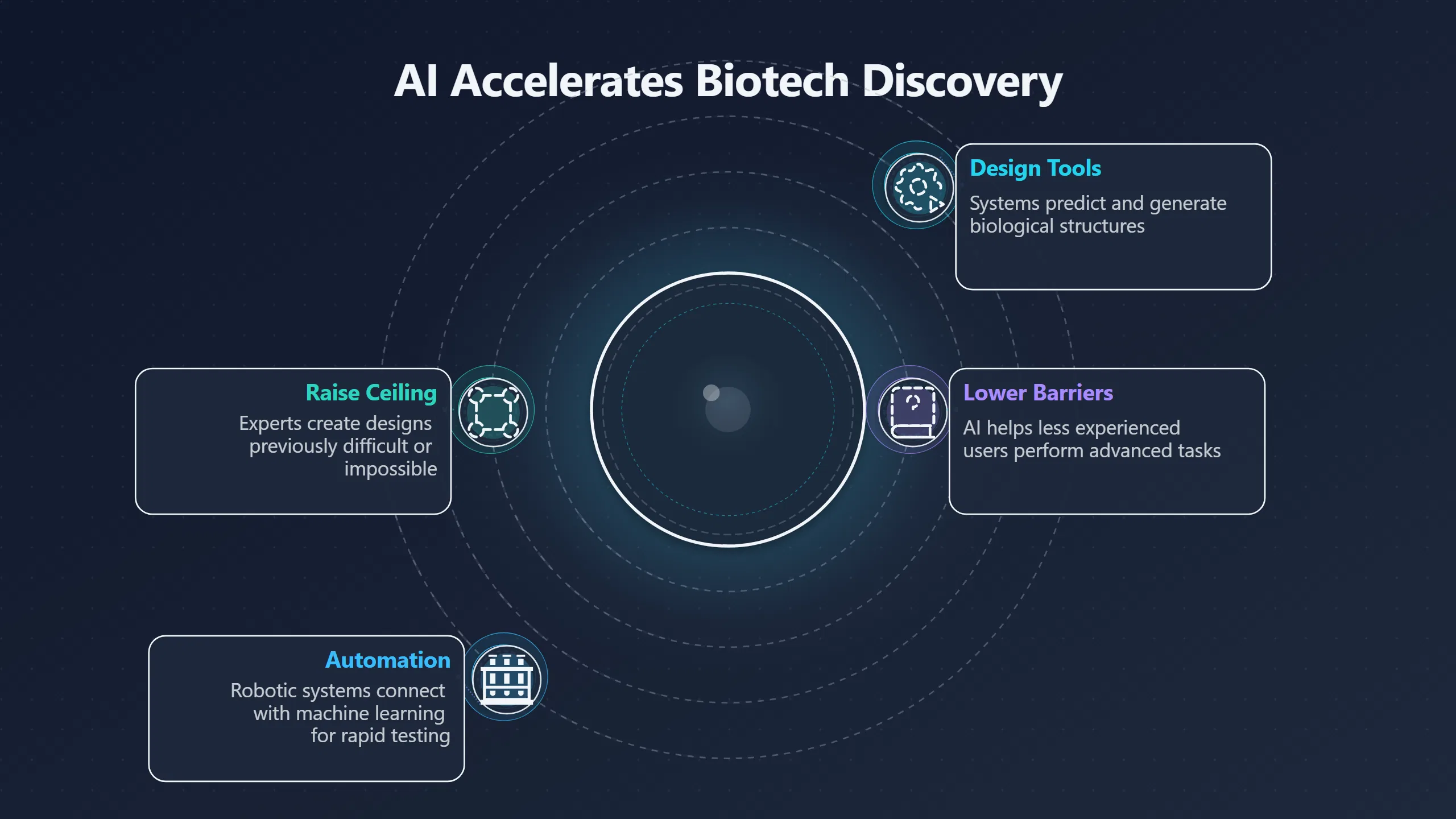
- Lowering barriers to entry, where AI helps less experienced users perform tasks that previously required advanced expertise.
- Raising the ceiling of capability, where AI enables expert actors to create biological designs or analyses that would otherwise be difficult or impossible. [arXiv]arxiv.orgarXivArtificial intelligence and biological misuse: Differentiating risks of language models and biological design toolsJune 24, 2023…
The distinction matters for governance. A chatbot that provides biological information presents different risks from a specialised biological design model capable of generating novel protein sequences or optimising pathogens. Policymakers often discuss “AI” as a single category, but the biosecurity implications vary dramatically depending on the system’s capabilities. [arXiv]arxiv.orgarXivArtificial intelligence and biological misuse: Differentiating risks of language models and biological design toolsJune 24, 2023…
For AI-risk researchers concerned about existential threats, the concern is not simply that dangerous information becomes available online. It is that AI systems may eventually function as increasingly capable scientific assistants, helping users move from ideas to laboratory implementation with far less human expertise than was previously required. [arXiv]arxiv.orgarXivArtificial intelligence and biological misuse: Differentiating risks of language models and biological design toolsJune 24, 2023…
How AI-Driven Biotech Can Be Misused
Biological design tools create new governance challenges
A growing class of systems known as biological design tools uses machine learning to predict, generate or optimise biological structures. Examples include protein-design models, genome-engineering systems and AI-assisted drug discovery platforms.
These tools can deliver major benefits. Protein design models may help create therapies for previously untreatable diseases. AI-guided synthetic biology could improve agriculture, environmental remediation and vaccine development.
The problem is that the same design capabilities may be adaptable to harmful objectives. Researchers have warned that advanced biological design tools could eventually assist in identifying more virulent pathogens, more effective toxins or methods for bypassing existing biological countermeasures. Although many of these scenarios remain uncertain and technically difficult, governance discussions increasingly focus on whether current safeguards are adequate if capabilities continue improving. [arXiv]arxiv.orgarXivArtificial intelligence and biological misuse: Differentiating risks of language models and biological design toolsJune 24, 2023… [PMC]pmc.ncbi.nlm.nih.govPMCGoverning the AI–biotech convergencePMCby BD Trump · 2026 — The convergence of artificial intelligence with biotechnology accelerates innovation but also introduces signific…
One recurring concern is that biological design models often emerge from open scientific environments. Unlike frontier language models that may require enormous computing resources, some biological AI systems can be trained by smaller organisations and shared openly, making centralised oversight more difficult. [arXiv]arxiv.orgarXivArtificial intelligence and biological misuse: Differentiating risks of language models and biological design toolsJune 24, 2023…
AI-enabled laboratory automation shortens research cycles
Another governance concern is the convergence between AI and automated laboratory systems.
Increasingly sophisticated platforms can connect machine-learning systems with robotic experimentation, allowing rapid testing and optimisation of biological designs. In beneficial settings, this may dramatically accelerate drug development and scientific discovery.
Critics argue that these systems could also compress the time available for oversight. Traditional governance often assumes meaningful delays between design, testing and deployment. Automated AI-driven research pipelines may reduce those delays, making it harder for regulators, institutional review boards and biosafety authorities to assess risks before capabilities are operational. [PMC]pmc.ncbi.nlm.nih.govPMCBiosecurity Risk Assessment for the Use of ArtificialPMCby LP De Haro · 2024 · Cited by 27 — This article proposes a specialized biosecurity risk assessment process designed to evaluate the…
Some analysts describe this as a governance race: technical capabilities advance continuously, while regulatory systems move through slower legislative, bureaucratic and international coordination processes. This mismatch is a recurring theme in broader AI doom discussions, where concerns about rapid capability gains often outpace institutional adaptation. [PMC]pmc.ncbi.nlm.nih.govPMCDual-use capabilities of concern of biological AI modelsPMCby J Pannu · 2025 · Cited by 33 — Ultimately, the goal of biosecurity evaluations for biological AI models should be to provide target…
Where Existing Governance Struggles
Most biosecurity rules were designed before modern AI
Many current biosecurity frameworks focus on physical materials, laboratory practices and known pathogens. They were not designed around AI systems that can generate biological hypotheses, design molecules or automate parts of scientific reasoning.
The World Health Organization’s guidance on dual-use life sciences acknowledges the growing need to address emerging technologies within broader biorisk governance frameworks. Yet many implementation mechanisms remain focused on traditional research oversight rather than AI-enabled biological design. [World Health Organization]who.intWorld Health OrganizationGlobal guidance framework for the responsible use of…The Global guidance framework for the responsible use of… [World Health Organization]who.intWorld Health OrganizationGlobal guidance framework for the responsible use of…The Global guidance framework for the responsible use of…
A central governance difficulty is that harmful capability may emerge from combinations of technologies rather than from any single tool. An AI model, a gene synthesis service, cloud computing infrastructure and automated laboratory equipment may each appear manageable individually while creating greater risks when combined. Existing regulatory systems often assign responsibility to separate agencies that rarely evaluate the entire chain together. [PMC]pmc.ncbi.nlm.nih.govPMCScreening State of Play: The Biosecurity Practices of Synthetic…by A Kane · 2024 · Cited by 15 — In this study, we aimed to determi…
Open science collides with security concerns
Biotechnology and AI both contain strong traditions of openness. Researchers frequently publish methods, datasets and software to accelerate scientific progress.
Many scientists argue that openness remains essential for medical innovation and global collaboration. Others worry that unrestricted publication of highly capable biological AI systems could create security risks that are difficult to reverse once information is widely distributed.
This creates a policy dilemma. Excessive restrictions could slow beneficial research and concentrate power among a small number of governments or corporations. Insufficient restrictions could allow dangerous capabilities to spread faster than safeguards. Unlike conventional software, biological knowledge can eventually interact with physical organisms and public health systems, raising the stakes of governance decisions. [arXiv]arxiv.orgarXivArtificial intelligence and biological misuse: Differentiating risks of language models and biological design toolsJune 24, 2023… [ScienceDirect]sciencedirect.comScienceDirect Governance strategies for biological AIA common framing for governing artificial intelligence (AI) in the biological sciences is to focus on risk mitigation owing to the…Rea…

Capability thresholds remain poorly defined
A persistent problem is determining when an AI system becomes dangerous enough to justify additional controls.
Researchers have increasingly proposed capability-based evaluations rather than broad rules covering all biological AI systems. The idea is to focus on specific high-consequence capabilities, such as assisting with pathogen engineering or substantially improving biological design performance, rather than regulating all biological AI equally. [arXiv]arxiv.orgarXivArtificial intelligence and biological misuse: Differentiating risks of language models and biological design toolsJune 24, 2023… [PMC]pmc.ncbi.nlm.nih.govPMCResponsible AI in biotechnology: balancing discoveryPMCby NE Wheeler · 2025 · Cited by 39 — This review examines the changing landscape of bioweapon risks, the dual-use potential of AI-driv…
However, no widely accepted global standard yet exists for measuring these thresholds. Policymakers still face difficult questions:
- Which biological capabilities deserve mandatory evaluation?
- Who performs evaluations?
- How frequently should models be retested?
- What evidence should trigger access restrictions?
- How should governments handle open-source releases?
These questions remain active areas of debate rather than settled policy. PMC [The Nuclear Threat Initiative]nti.orga framework for managed access to biological ai toolsThe Nuclear Threat InitiativeA Framework for Managed Access to Biological AI Tools28 Jan 2026 — Building off the work and recommendations…
DNA Synthesis Screening Is Becoming a Key Defensive Layer
One of the most concrete governance proposals focuses on DNA synthesis screening.
Modern biotechnology increasingly relies on commercial providers that manufacture custom genetic sequences. Screening systems attempt to identify orders associated with dangerous pathogens or suspicious activities before production occurs.
Many biosecurity experts view universal screening as one of the most practical safeguards against AI-enabled misuse because even advanced AI designs often require physical synthesis before becoming operational. If dangerous sequences can be detected at the synthesis stage, risks may be reduced regardless of how the designs were generated. [arXiv]arxiv.orgarXivArtificial intelligence and biological misuse: Differentiating risks of language models and biological design toolsJune 24, 2023… [IBBIS]ibbis.bioIBBISCommon MechanismA free, open-source, globally-available tool for synthesis screening. The Common Mechanism helps providers of synthe… Yet governance remains uneven. Screening practices vary across providers and jurisdictions. Researchers have documented gaps in adoption, implementation and consistency across the synthesis industry. Meanwhile, emerging technologies such as benchtop DNA synthesis devices could eventually allow more biological production outside established commercial screening systems. PMC [The Nuclear Threat Initiative]nti.orga framework for managed access to biological ai toolsThe Nuclear Threat InitiativeA Framework for Managed Access to Biological AI Tools28 Jan 2026 — Building off the work and recommendations…
This has led to efforts such as open screening infrastructure, industry standards and proposals for stronger international coordination. Supporters argue that screening represents a relatively targeted intervention that addresses concrete misuse pathways without broadly restricting biological research. [IBBIS]ibbis.bioIBBISCommon MechanismA free, open-source, globally-available tool for synthesis screening. The Common Mechanism helps providers of synthe…
Proposed Safeguards for Biological AI Systems
As concern has grown, researchers and policy organisations have proposed several layers of governance.
Pre-deployment evaluations
Many proposals call for biological capability testing before advanced models are released. These evaluations would examine whether systems can meaningfully assist with high-consequence biological tasks and whether safeguards remain effective under adversarial testing. [arXiv]arxiv.orgarXivArtificial intelligence and biological misuse: Differentiating risks of language models and biological design toolsJune 24, 2023…
The broader AI-risk community often sees this as analogous to safety testing in other high-risk industries. Critics respond that biological capabilities are difficult to measure consistently and that evaluations may become obsolete as models rapidly improve. [PMC]pmc.ncbi.nlm.nih.govPMCGoverning the AI–biotech convergencePMCby BD Trump · 2026 — The convergence of artificial intelligence with biotechnology accelerates innovation but also introduces signific…
Managed access rather than full openness
Some governance proposals recommend differentiated access models instead of unrestricted public release.
Under this approach, highly capable biological AI systems could require identity verification, institutional affiliation checks or other access controls. The goal is to preserve beneficial research use while making misuse more difficult. [The Nuclear Threat Initiative]nti.orga framework for managed access to biological ai toolsThe Nuclear Threat InitiativeA Framework for Managed Access to Biological AI Tools28 Jan 2026 — Building off the work and recommendations…
Supporters argue that managed access reflects existing practices in areas such as pathogen research. Critics question whether such systems can scale internationally and whether determined actors would simply migrate to less regulated jurisdictions. [The Nuclear Threat Initiative]nti.orga framework for managed access to biological ai toolsThe Nuclear Threat InitiativeA Framework for Managed Access to Biological AI Tools28 Jan 2026 — Building off the work and recommendations…
Built-in safeguards and monitoring
Another approach focuses on embedding security measures directly into biological AI tools.
Proposals include misuse detection systems, biological content filters, audit logging, suspicious-use monitoring and automated screening of generated outputs. Several organisations have argued that safety mechanisms should be integrated into design tools from the outset rather than added later. [The Nuclear Threat Initiative]nti.orga framework for managed access to biological ai toolsThe Nuclear Threat InitiativeA Framework for Managed Access to Biological AI Tools28 Jan 2026 — Building off the work and recommendations… [preprints]preprints.orgWith more research and development, emerging AI safety technologies.Read morePreprintsA Call for Built-in Biosecurity Safeguards for Generative AI…20 Mar 2025 — This Correspondence calls for proactive, built-in… A challenge is that safeguards can often be bypassed or degraded. Recent research on agentic biological AI systems suggests that specialisedscientific workflows may circumvent restrictions that exist in underlying foundation models, raising concerns that model-level protections alone may be insufficient. [arXiv]arxiv.orgarXivArtificial intelligence and biological misuse: Differentiating risks of language models and biological design toolsJune 24, 2023…
Why This Matters for AI Doom Debates
Most discussions of AI doom focus on misaligned artificial general intelligence, loss of control or autonomous systems acting against human interests. Biological misuse represents a different pathway.
The core concern is that increasingly capable AI systems may amplify humanity’s ability to engineer biological threats before governance institutions are ready. In this framing, AI functions as a force multiplier rather than an independent actor. It lowers barriers, accelerates research and expands the range of biological interventions available to both legitimate and malicious users. [arXiv]arxiv.orgarXivArtificial intelligence and biological misuse: Differentiating risks of language models and biological design toolsJune 24, 2023…
Not all researchers agree that AI will dramatically increase biological risk. Some argue that practical laboratory constraints, tacit knowledge requirements and existing public-health defences still limit misuse. Others contend that current evidence does not yet show AI providing transformative biological capabilities to non-experts. These disagreements remain important because many catastrophic scenarios depend on assumptions about how quickly AI-assisted biology will advance and how much expertise will remain necessary. [PMC]pmc.ncbi.nlm.nih.govPMCBiosecurity Risk Assessment for the Use of ArtificialPMCby LP De Haro · 2024 · Cited by 27 — This article proposes a specialized biosecurity risk assessment process designed to evaluate the… [arXiv]arxiv.orgarXivArtificial intelligence and biological misuse: Differentiating risks of language models and biological design toolsJune 24, 2023…
Even so, the convergence of AI and biotechnology occupies a distinctive place in existential-risk discussions because it links two powerful technologies that can affect global public health. Unlike many speculative AI doom scenarios, the governance questions are immediate: how to evaluate dangerous capabilities, how to manage access, how to strengthen DNA screening, how to monitor AI-enabled laboratory systems and how to coordinate internationally before capabilities become substantially more advanced. The difficulty is that governance institutions are still trying to answer those questions while the technology continues to evolve. [The Nuclear Threat Initiative]nti.orga framework for managed access to biological ai toolsThe Nuclear Threat InitiativeA Framework for Managed Access to Biological AI Tools28 Jan 2026 — Building off the work and recommendations… [3PMC 3World Health]who.intWorld Health OrganizationGlobal guidance framework for the responsible use of…The Global guidance framework for the responsible use of… Organization](#endnote-9 “Snippet: World Health OrganizationGlobal guidance framework for the responsible use of…The Global guidance framework for the responsible use of…”)
eBay marketplace picks
Marketplace Samples
Example marketplace items related to this page. Use the search link to explore similar finds on eBay.







Endnotes
-
Source: arxiv.org
Link: https://arxiv.org/abs/2306.13952Source snippet
arXivArtificial intelligence and biological misuse: Differentiating risks of language models and biological design toolsJune 24, 2023...
Published: June 24, 2023
-
Source: pmc.ncbi.nlm.nih.gov
Title: PMCResponsible AI in biotechnology: balancing discovery
Link: https://pmc.ncbi.nlm.nih.gov/articles/PMC11835847/Source snippet
PMCby NE Wheeler · 2025 · Cited by 39 — This review examines the changing landscape of bioweapon risks, the dual-use potential of AI-driv...
-
Source: pmc.ncbi.nlm.nih.gov
Title: PMCGoverning the AI–biotech convergence
Link: https://pmc.ncbi.nlm.nih.gov/articles/PMC12852783/Source snippet
PMCby BD Trump · 2026 — The convergence of artificial intelligence with biotechnology accelerates innovation but also introduces signific...
-
Source: arxiv.org
Link: https://arxiv.org/abs/2407.13059 -
Source: arxiv.org
Link: https://arxiv.org/abs/2605.00927 -
Source: arxiv.org
Title: arXiv Towards Responsible Governance of Biological Design Tools
Link: https://arxiv.org/abs/2311.15936Source snippet
arXivTowards Responsible Governance of Biological Design ToolsNovember 27, 2023...
Published: November 27, 2023
-
Source: preprints.org
Title: With more research and development, emerging AI safety technologies.Read more
Link: https://www.preprints.org/manuscript/202503.1761Source snippet
PreprintsA Call for Built-in Biosecurity Safeguards for Generative AI...20 Mar 2025 — This Correspondence calls for proactive, built-in...
-
Source: pmc.ncbi.nlm.nih.gov
Title: PMCBiosecurity Risk Assessment for the Use of Artificial
Link: https://pmc.ncbi.nlm.nih.gov/articles/PMC11313549/Source snippet
PMCby LP De Haro · 2024 · Cited by 27 — This article proposes a specialized biosecurity risk assessment process designed to evaluate the...
-
Source: who.int
Link: https://www.who.int/publications/b/65594Source snippet
World Health OrganizationGlobal guidance framework for the responsible use of...The Global guidance framework for the responsible use of...
-
Source: who.int
Link: https://www.who.int/groups/technical-advisory-group-on-the-responsible-use-of-the-life-sciences-and-dual-use-research-%28tag-ruls-dur%29Source snippet
World Health OrganizationTechnical Advisory Group on the Responsible Use of...In September 2022, WHO issued the Global guidance framewor...
Published: September 2022
-
Source: who.int
Link: https://www.who.int/news/item/30-01-2024-the-technical-advisory-group-on-the-responsible-use-of-the-life-sciences-and-dual-use-research-meets-for-the-first-timeSource snippet
World Health OrganizationThe Technical Advisory Group on the Responsible Use of...30 Jan 2024 — The Technical Advisory Group on the Resp...
-
Source: sciencedirect.com
Title: ScienceDirect Governance strategies for biological AI
Link: https://www.sciencedirect.com/science/article/abs/pii/S016777992500397XSource snippet
A common framing for governing artificial intelligence (AI) in the biological sciences is to focus on risk mitigation owing to the...Rea...
-
Source: pmc.ncbi.nlm.nih.gov
Title: PMCDual-use capabilities of concern of biological AI models
Link: https://pmc.ncbi.nlm.nih.gov/articles/PMC12061118/Source snippet
PMCby J Pannu · 2025 · Cited by 33 — Ultimately, the goal of biosecurity evaluations for biological AI models should be to provide target...
-
Source: ibbis.bio
Link: https://ibbis.bio/our-work/common-mechanism/Source snippet
IBBISCommon MechanismA free, open-source, globally-available tool for synthesis screening. The Common Mechanism helps providers of synthe...
-
Source: pmc.ncbi.nlm.nih.gov
Link: https://pmc.ncbi.nlm.nih.gov/articles/PMC11319849/Source snippet
PMCScreening State of Play: The Biosecurity Practices of Synthetic...by A Kane · 2024 · Cited by 15 — In this study, we aimed to determi...
-
Source: who.int
Link: https://www.who.int/publications/i/item/9789240029200Source snippet
Ethics and governance of artificial intelligence for healthJun 28, 2021 — The report identifies the ethical challenges and risks with the...
-
Source: who.int
Link: https://www.who.int/publications/i/item/9789240084759Source snippet
Ethics and governance of artificial intelligence for healthMar 25, 2025 — This guidance addresses one type of generative AI, large multi...
-
Source: arxiv.org
Link: https://arxiv.org/pdf/2510.15975Source snippet
Generative AI for Biosciences: Emerging Threats and...by Z Zhang · 2025 · Cited by 4 — This section outlines the emerging categories of...
-
Source: nti.org
Title: a framework for managed access to biological ai tools
Link: https://www.nti.org/analysis/articles/a-framework-for-managed-access-to-biological-ai-tools/Source snippet
The Nuclear Threat InitiativeA Framework for Managed Access to Biological AI Tools28 Jan 2026 — Building off the work and recommendations...
-
Source: nti.org
Link: https://www.nti.org/about/programs-projects/project/preventing-the-misuse-of-dna-synthesis-technology/Source snippet
The Nuclear Threat InitiativePreventing the Misuse of DNA Synthesis TechnologyA new NTI | bio report describes the status of benchtop DNA...
-
Source: nti.org
Title: advances biotechnology governance framework to reduce emerging biological risks
Link: https://www.nti.org/news/nti-advances-biotechnology-governance-framework-to-reduce-emerging-biological-risks/Source snippet
The Nuclear Threat InitiativeNTI Advances Biotechnology Governance Framework to...Jul 23, 2025 — A new NTI | bio report describes the st...
-
Source: nti.org
Title: developing guardrails for ai biodesign tools
Link: https://www.nti.org/analysis/articles/developing-guardrails-for-ai-biodesign-tools/Source snippet
The Nuclear Threat InitiativeDeveloping Guardrails for AI Biodesign Tools14 Nov 2024 — NTI outlines strategies to implement guardrails fo...
-
Source: nti.org
Link: https://www.nti.org/wp-content/uploads/2024/11/NTIBio_Paper_Developing-Guardrails-for-AI-Biodesign-Tools_FINAL.pdfSource snippet
The Nuclear Threat InitiativeDeveloping Guardrails for AI Biodesign ToolsThis report explores the potential for built-in guardrails for b...
-
Source: nti.org
Link: https://www.nti.org/wp-content/uploads/2024/06/Research-Agenda-for-Safeguarding-AI-Bio-Capabilities.pdfSource snippet
Research Agenda for Safeguarding AI-Bio CapabilitiesThe purpose of this white paper is to outline a research agenda for the AI, biosecuri...
-
Source: nti.org
Title: exploring ai biosecurity governance in the global south
Link: https://www.nti.org/risky-business/exploring-ai-biosecurity-governance-in-the-global-south/Source snippet
Exploring AI-Biosecurity Governance in the Global South5 Dec 2024 — AI offers transformative opportunities for the Global South, but its...
-
Source: frontiersin.org
Link: https://www.frontiersin.org/journals/bioengineering-and-biotechnology/articles/10.3389/fbioe.2025.1537471/fullSource snippet
Responsible AI in biotechnology: balancing discovery...by NE Wheeler · 2025 · Cited by 44 — This review examines the changing landscape...
-
Source: science.org
Link: https://www.science.org/doi/10.1126/science.adq1977Source snippet
AI and biosecurity: The need for governanceby D Bloomfield · 2024 · Cited by 48 — Government AI biosecurity policies should therefore app...
Additional References
-
Source: researchgate.net
Link: https://www.researchgate.net/publication/398691526_Artificial_intelligence_and_synthetic_biology_biosecurity_risks_dual-use_concerns_and_governance_pathwaysSource snippet
ResearchGateArtificial intelligence and synthetic biology: biosecurity risks...18 Dec 2025 — Artificial intelligence and synthetic biolo...
-
Source: linkedin.com
Link: https://www.linkedin.com/pulse/ai-accelerated-evolution-governance-edge-synthetic-life-timothy-kang-kepkcSource snippet
AI is Now Designing Life: Who Governs Synthetic Biology?This article proposes a Global AI-Biology Governance Charter—a multilateral frame...
-
Source: longtermresilience.org
Title: CLTR Report Capability Based Risk Assessment for AI Enabled Biological Tools
Link: https://www.longtermresilience.org/wp-content/uploads/2024/09/CLTR-Report-Capability-Based-Risk-Assessment-for-AI-Enabled-Biological-Tools_-Summary-Report-August-2024.pdfSource snippet
Assessment for AI-Enabled Biological Tools: Summary Report.... As an example, one subcategory of BTs is “protein design tools”...Read...
Published: August 2024
-
Source: thebulletin.org
Link: https://thebulletin.org/premium/2025-12/use-all-the-tools-of-the-trade-building-a-foundation-for-the-next-era-of-biosecurity/Source snippet
Use all the tools of the trade: Building a foundation for...Dec 10, 2025 — Many more are currently under development, like efforts to in...
-
Source: armscontrol.org
Link: https://www.armscontrol.org/blog/2025-11-24/regulatory-gaps-benchtop-nucleic-acid-synthesis-create-biosecurity-vulnerabilitiesSource snippet
Regulatory Gaps in Benchtop Nucleic Acid Synthesis...Nov 24, 2025 — The team utilized open-source AI tools to engineer new protein varia...
-
Source: oecd.org
Link: https://www.oecd.org/content/dam/oecd/en/publications/reports/2025/12/synthetic-biology-ai-and-automation_0179340f/12158721-en.pdfSource snippet
rsight of relevant AI tools, and more broadly take into account...Read more...
-
Source: youtube.com
Link: https://www.youtube.com/watch?v=1mepd3oFpq0 -
Source: nationalacademies.org
Link: https://www.nationalacademies.org/projects/DELS-BLS-17-07/publication/25154Source snippet
2018. Governance of Dual Use Research in the Life Sciences: Advancing Global Consensus on Research...Read more...
-
Source: frontiersin.org
Link: https://www.frontiersin.org/journals/bioengineering-and-biotechnology/articles/10.3389/fbioe.2026.1705143/fullSource snippet
haFold, synthetic chemistry and machine learning (ML) for reaction prediction, and LLMs as the...Read more...
-
Source: biosecurityhandbook.com
Title: Policy Frameworks for AI-Bio Convergence NIST AI 800-1 (U.S
Link: https://biosecurityhandbook.com/governance/policy-frameworks.htmlSource snippet
AI Safety Institute, January 2025) provides the primary U.S. government guidance for managing misuse risks from dual-use foundation model...
Published: January 2025
Topic Tree