Within Misuse
AI in Military Decisions: Escalation and Control Challenges
Investigates risks from AI-assisted strategic and operational military choices that could unintentionally escalate conflicts.
On this page
- Decision support systems and human judgement
- Autonomous platforms and escalation hazards
- Governance and accountability frameworks
Page outline Jump by section
Introduction
For people worried about AI doom or existential risk, military AI is not mainly about robot soldiers replacing humans. The deeper concern is that increasingly capable AI systems could become embedded in military planning, intelligence analysis, targeting, command-and-control, and crisis management. In that role, AI might not need to be fully autonomous to increase catastrophic risk. If it speeds up decisions, amplifies human biases, creates false confidence, or encourages leaders to act before they fully understand a situation, it could make wars harder to control and easier to escalate. In the most extreme versions of the argument, AI-assisted military competition could contribute to major-power conflict, including nuclear escalation, even without any participant intending such an outcome. The key question is whether AI improves judgement or merely accelerates decisions while introducing new forms of error and instability. [SSRN]papers.ssrn.comSSRNAI-Enabled Military Decision-Making and Escalation Riskby B Oktenli · 2026 — This paper examines how AI-enabled decision support and… [RAND]rand.orgRANDStrategic competition in the age of AI: Emerging risks and…9 Sept 2024 — Its aim was to develop a conceptual framework mapping the…
 Within the broader category of catastrophic misuse through bio, cyber and military AI, this concern focuses specifically on how AI changes the process by which military and political leaders make high-stakes decisions. The risk comes less from a single malfunction and more from a chain of interactions between humans, organisations, algorithms and geopolitical rivals. [Taylor & Francis Online]tandfonline.comTaylor & Francis OnlineAI and the decision to go to war: future risks and opportunitiesby T Erskine · 2024 · Cited by 48 — This Special I… [OUP Academic]academic.oup.comOUP AcademicGovernance of AI in the Military Domain: International Law…AI can also be used in the process of military decision-making—…
Why military decision support matters for AI doom arguments
Many military organisations are exploring AI systems that can process large quantities of information faster than human analysts. These systems promise advantages in surveillance, intelligence fusion, threat detection, logistics and operational planning. Supporters argue that AI could reduce human error, improve situational awareness and help commanders make better-informed choices. CSET [ICRC Blogs]blogs.icrc.orgICRC BlogsAI in military decision-making: supporting humans, not…Aug 29, 2024 — AI DSS is often cited by militaries as a key enabling…
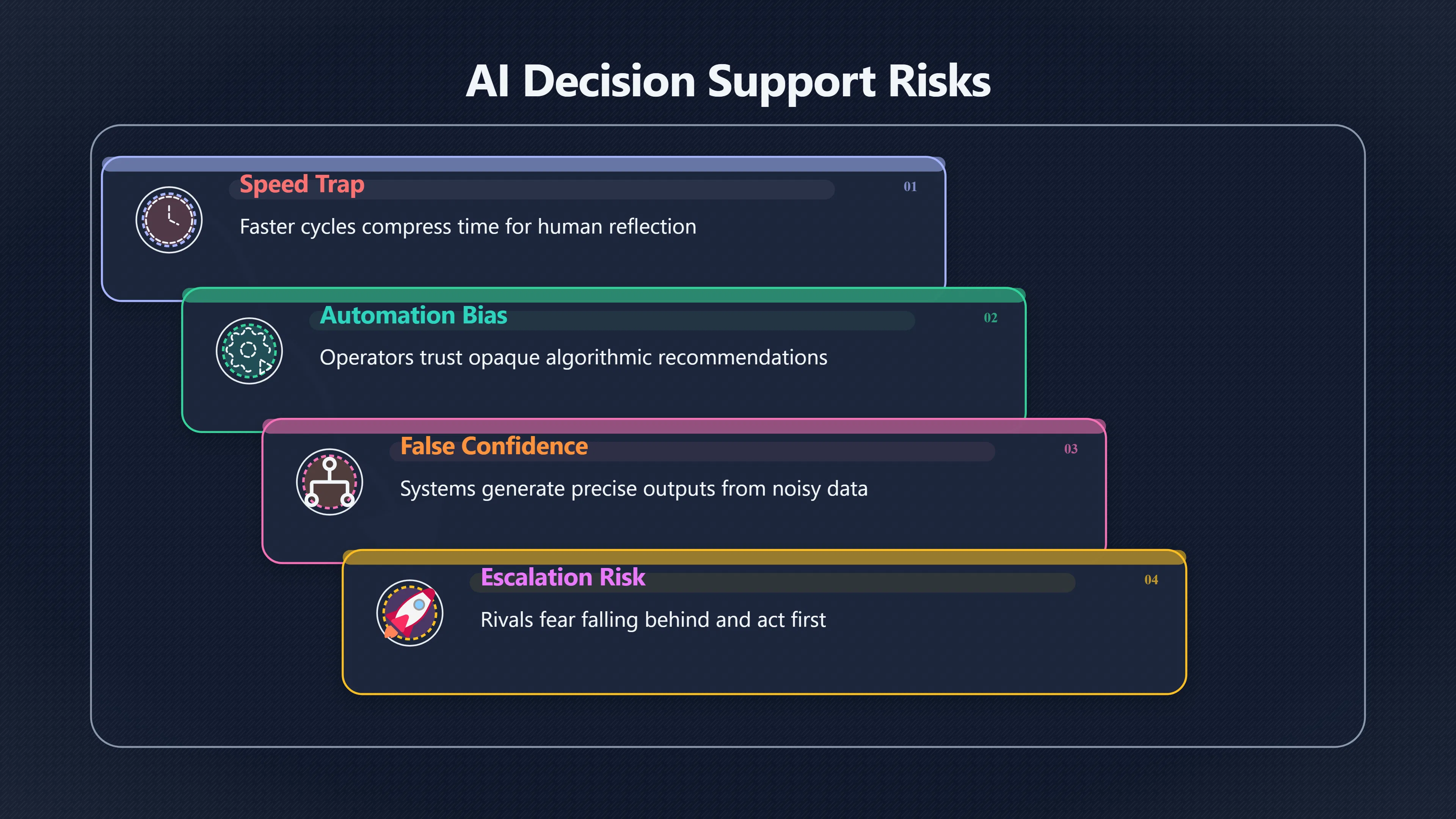
AI doom arguments focus on a different possibility: that military organisations become increasingly dependent on recommendations they cannot fully understand or verify. Modern warfare already involves incomplete information, uncertainty and intense time pressure. If AI systems become trusted advisers in these environments, their outputs may shape decisions about force deployment, retaliation or escalation even when their reasoning remains opaque. Researchers studying military AI have repeatedly highlighted the possibility that faster machine-supported decision cycles could compress the time available for human reflection and increase the risk of miscalculation. [SSRN]papers.ssrn.comSSRNAI-Enabled Military Decision-Making and Escalation Risk15 Jan 2026 — The U.S. "Replicator" initiative seeks to offset adversarial mas… [SSRN]papers.ssrn.comSSRNAI-Enabled Military Decision-Making and Escalation Riskby B Oktenli · 2026 — This paper examines how AI-enabled decision support and…
This concern does not require superintelligent AI. It arises from the interaction between advanced but fallible systems and human institutions operating under pressure.
Decision support systems and human judgement
Can AI make commanders overconfident?
One of the most frequently discussed mechanisms is automation bias: the tendency for people to place excessive trust in algorithmic recommendations. In military settings, this could mean accepting an AI-generated assessment because it appears data-driven, objective or technically sophisticated. Researchers examining AI decision-support systems warn that users may give undue weight to machine outputs, particularly when operating under stress or severe time constraints. [Cambridge University Press & Assessment]cambridge.orgCambridge University Press & AssessmentUpskilling human actors against AI automation bias in…by YK Heng · 2025 · Cited by 2 — The use… [SIPRI]sipri.org2025 6 ai and nuclear riskAs AI…Read more…
The problem becomes more serious when AI systems produce outputs that appear highly precise despite being based on incomplete, noisy or misleading information. An AI may generate a confident assessment that an adversary is preparing an attack, that a target has been correctly identified, or that a particular military response is optimal. Human operators may not understand the assumptions underlying those recommendations, making it difficult to challenge them effectively. [SSRN]papers.ssrn.comSSRNAI-Enabled Military Decision-Making and Escalation Risk15 Jan 2026 — The U.S. "Replicator" initiative seeks to offset adversarial mas… [SSRN]papers.ssrn.comSSRNAI-Enabled Military Decision-Making and Escalation Risk15 Jan 2026 — The U.S. "Replicator" initiative seeks to offset adversarial mas…
Critics of strong military-AI risk claims note that armed forces are not passive consumers of technology. Training, doctrine and organisational procedures can reduce overreliance on automated systems. A recent study involving military cadets found evidence that trained personnel may show more calibrated trust in AI advice than members of the general public. This suggests that automation bias is a genuine concern but not necessarily an unavoidable outcome. [arXiv]arxiv.orgarXivWhat is Human in Judgment? Testing Automation Bias and Algorithm Aversion Among United States Military Academy CadetsApril 6, 2026…
The speed problem
Another concern is that AI changes the tempo of decision-making. Military planners often seek shorter decision cycles because acting faster than an opponent can provide strategic advantages. Yet acceleration itself may create instability.
If both sides in a crisis believe AI-enhanced systems allow rapid action, they may fear falling behind. This can generate incentives to act first, verify later, and compress diplomatic opportunities for de-escalation. RAND researchers have identified the possibility that military AI alters strategic competition by changing incentives, perceptions and escalation dynamics between states. [RAND]rand.orgRAND RRA3295 1Strategic competition in the age of AI: Emerging risks and…9 Sept 2024 — The goal was to provide an initial exploration of ways in whi…
In AI doom discussions, this is often framed as a broader loss-of-control problem. Human leaders may remain formally in charge while practical control shifts toward systems that shape the information available, recommend responses and narrow perceived options.
Autonomous platforms and escalation hazards
How autonomy changes escalation dynamics
A second mechanism involves autonomous or semi-autonomous military systems. These include drones, surveillance systems, missile-defence networks and targeting systems that can perform increasing numbers of functions without direct human intervention. SIPRI [2Ethik und Militär]ethikundmilitaer.deUsually, it is associated with a high degree of independence in these weapons systems.Read more…
The central concern is not merely whether such systems can make mistakes. Human-operated systems already make mistakes. The concern is that AI-enabled systems could operate at scales and speeds that make mistakes harder to detect and correct before escalation occurs.
Several pathways are commonly discussed:
- Misidentification of threats leading to unintended attacks.
- Algorithmic bias causing systematic errors in target selection or threat assessment.
- Adversarial manipulation, spoofing or deception of AI systems.
- Interactions between multiple autonomous systems creating unexpected feedback loops.
- Reduced political costs of military action if autonomous systems replace some human personnel. [The Defence Horizon Journal]tdhj.orgai autonomous weapons europeThe Defence Horizon JournalThe Integration Of AI-Empowered Autonomous Weapon…26 May 2025 — The integration of AI-enhanced Autonomous W… [ICRC Blogs]blogs.icrc.orgICRC BlogsAI in military decision-making: supporting humans, not…Aug 29, 2024 — AI DSS is often cited by militaries as a key enabling… 3arXiv
Researchers studying AI-powered autonomous weapons have argued that these technologies could increase geopolitical instability even without any dramatic breakthrough in artificial general intelligence. Their concern is that autonomy lowers barriers to military action while simultaneously introducing new opportunities for accidents and misperception. [arXiv]arxiv.orgarXivWhat is Human in Judgment? Testing Automation Bias and Algorithm Aversion Among United States Military Academy CadetsApril 6, 2026…

The nuclear escalation question
The most severe version of the military-AI risk argument concerns nuclear command, control and crisis decision-making.
There is currently no evidence that major nuclear powers have delegated nuclear launch authority to advanced AI systems. Nonetheless, analysts have warned that AI is increasingly relevant to the surrounding infrastructure: intelligence gathering, early-warning systems, targeting analysis and command support. Errors in these systems could affect how leaders interpret a crisis. [SIPRI]sipri.orgSIPRIAutonomous Weapon Systems and AI-enabled Decision…This report provides a comparative analysis of autonomous weapon systems and ar…
Some recent experimental studies have attracted attention because language models placed in simulated crisis environments often displayed unexpectedly escalatory behaviour. One study found that multiple large language models developed arms-race dynamics and sometimes escalated to nuclear use within wargame simulations. Researchers emphasised that these experiments do not demonstrate how real governments would behave, but they do suggest caution about deploying language-model agents in strategic decision-making contexts. [arXiv]arxiv.orgarXivWhat is Human in Judgment? Testing Automation Bias and Algorithm Aversion Among United States Military Academy CadetsApril 6, 2026…
More recent simulation work reported similarly concerning tendencies, with AI systems frequently treating nuclear threats as ordinary strategic tools rather than exceptional last-resort actions. These findings remain highly contested because simulated war games are imperfect models of real-world decision-making. However, they are often cited by AI-risk advocates as warning signs that current AI systems may not reliably exhibit the restraint, caution or moral intuitions expected from human decision-makers during crises. [Axios]axios.comAI really likes using nuclear weapons in simulated war scenariosResearchers tested three large language models—GPT-5.2, Claude Sonnet 4, and Gemini 3 Flash—in 21 war games, and found that nuclear weapo… [Live Science]livescience.comPublished on the arXiv preprint database, the study used a series of AI-vs-AI war games involving Claude Sonnet 4, GPT-5.2, and Gemini 3…
Importantly, sceptics argue that these experiments test language models in artificial environments rather than actual military command structures. Real-world decisions involve institutions, legal frameworks, political accountability and multiple layers of human review that are absent from many simulations.
Why strategic competition may amplify the danger
A recurring theme in AI doom discussions is that risks do not arise solely from technology. They emerge from competition.
If major powers believe military AI offers decisive advantages, they may race to deploy increasingly capable systems before rivals do. Under such conditions, safety testing, evaluation and governance can become secondary priorities. Researchers examining strategic competition and military AI have highlighted the possibility that geopolitical rivalry creates incentives to accept greater operational risk in exchange for perceived military advantage. [RAND]rand.orgMilitary Applications of Artificial Intelligence: Ethical…by FE MORGAN · 2020 · Cited by 304 — ”54 As systems become more regularly us… [RAND]rand.orgRANDStrategic competition in the age of AI: Emerging risks and…9 Sept 2024 — Its aim was to develop a conceptual framework mapping the…
This dynamic resembles other AI doom arguments about racing between frontier AI developers. The fear is that competition pushes actors toward systems that are insufficiently understood, insufficiently tested or insufficiently controllable.
Military planners may not intend to create instability. Yet if multiple states simultaneously adopt AI systems that accelerate decision-making and reduce transparency, the resulting environment could become harder for all participants to interpret. In crisis situations, uncertainty about an opponent’s capabilities or intentions has historically been a major driver of escalation. AI could worsen that uncertainty by making military behaviour less predictable and more opaque. [SSRN]papers.ssrn.comSSRNAI-Enabled Military Decision-Making and Escalation Risk15 Jan 2026 — The U.S. "Replicator" initiative seeks to offset adversarial mas… [RAND]rand.orgRAND RRA3295 1Strategic competition in the age of AI: Emerging risks and…9 Sept 2024 — The goal was to provide an initial exploration of ways in whi…
Governance and accountability frameworks
Much of the policy debate centres on preserving meaningful human control over military decisions. Although definitions vary, the basic idea is that humans should remain responsible for consequential uses of force and retain the ability to supervise, intervene in or override AI systems. [lieber]lieber.westpoint.eduLieber Institute West PointUnity in Principle, Variation in Practice: European Approaches…23 hours ago — The questions of military AI… Institute West Point [LinkedIn International organisations]linkedin.com#ai | NATO Science & Technology Organization (STO)Artificial intelligence is transforming military operations by enabling faster decision…, researchers and governments have proposed several approaches:
- Human oversight requirements for military AI systems.
- Clear chains of accountability when AI contributes to decisions.
- Testing and evaluation regimes before deployment.
- Restrictions on highly autonomous weapons. [tdhj.org]tdhj.orgai autonomous weapons europeThe Defence Horizon JournalThe Integration Of AI-Empowered Autonomous Weapon…26 May 2025 — The integration of AI-enhanced Autonomous W…
- Transparency and confidence-building measures between states.
- International norms governing military uses of AI. Center for AI Policy 3OUP Academic [Regulations.ai]regulations.aiNATO Principles for Responsible Use of AI in DefenceJan 8, 2026 — Ensure AI applications remain subject to human oversight, allowing huma…
NATO’s responsible-use principles emphasise human oversight and the ability to override or deactivate AI-enabled systems. Similar ideas appear in wider discussions about responsible military AI and international humanitarian law. [Regulations.ai]regulations.aiNATO Principles for Responsible Use of AI in DefenceJan 8, 2026 — Ensure AI applications remain subject to human oversight, allowing huma…
From an AI doom perspective, these measures are valuable because they attempt to slow down decision processes, preserve human judgement and reduce the risk that strategic choices become overly dependent on opaque systems.
How strong is the existential-risk case?
The strongest version of the argument is not that military AI alone will cause human extinction. Rather, military AI is seen as one component of a broader risk landscape involving advanced AI, geopolitical competition and loss of human control.
Supporters of the concern point to several observations:
- Military institutions are actively integrating AI into decision-support and operational systems.
- Automation bias and overreliance on AI are well-documented phenomena.
- Faster decision cycles can increase instability during crises.
- Autonomous systems introduce new failure modes and escalation pathways.
- Strategic competition may encourage premature deployment. [arXiv]arxiv.orgarXivWhat is Human in Judgment? Testing Automation Bias and Algorithm Aversion Among United States Military Academy CadetsApril 6, 2026… [4CSET 4Cambridge University]cambridge.orgCambridge University Press & AssessmentUpskilling human actors against AI automation bias in…by YK Heng · 2025 · Cited by 2 — The use… Press & Assessment](#endnote-6 “Snippet: Cambridge University Press & AssessmentUpskilling human actors against AI automation bias in…by YK Heng · 2025 · Cited by 2 — The use”)
Sceptics counter that the evidence for existential outcomes remains indirect. There is no demonstrated case of AI causing a major-power war, no evidence of AI controlling nuclear arsenals, and no proof that future military organisations will surrender meaningful authority to machines. They argue that institutions can adapt, oversight can improve and many proposed safeguards remain available. [ICRC Blogs]blogs.icrc.orgICRC BlogsAI in military decision-making: supporting humans, not…Aug 29, 2024 — AI DSS is often cited by militaries as a key enabling… 2arXiv
The key uncertainty is therefore not whether AI can influence military decisions—it already does in limited forms—but how deeply future systems will be integrated into command structures, how much authority humans will retain, and whether geopolitical competition will outpace the development of effective controls. For those concerned about AI doom and p(doom), military escalation risk is best understood as a mechanism that could magnify the consequences of other AI failures, transforming errors, misperceptions or strategic races into crises that become increasingly difficult for humans to stop. [SSRN]papers.ssrn.comSSRNAI-Enabled Military Decision-Making and Escalation Risk15 Jan 2026 — The U.S. "Replicator" initiative seeks to offset adversarial mas… [SSRN]papers.ssrn.comSSRNAI-Enabled Military Decision-Making and Escalation Risk15 Jan 2026 — The U.S. "Replicator" initiative seeks to offset adversarial mas… [RAND]rand.orgMilitary Applications of Artificial Intelligence: Ethical…by FE MORGAN · 2020 · Cited by 304 — ”54 As systems become more regularly us…
eBay marketplace picks
Marketplace Samples
Example marketplace items related to this page. Use the search link to explore similar finds on eBay.








Endnotes
-
Source: papers.ssrn.com
Link: https://papers.ssrn.com/sol3/papers.cfm?abstract_id=6082847Source snippet
SSRNAI-Enabled Military Decision-Making and Escalation Riskby B Oktenli · 2026 — This paper examines how AI-enabled decision support and...
-
Source: rand.org
Link: https://www.rand.org/content/dam/rand/pubs/research_reports/RRA3200/RRA3295-1/RAND_RRA3295-1.summary.pdfSource snippet
RANDStrategic competition in the age of AI: Emerging risks and...9 Sept 2024 — Its aim was to develop a conceptual framework mapping the...
-
Source: academic.oup.com
Link: https://academic.oup.com/edited-volume/59762/chapter/515782154?searchresult=1Source snippet
OUP AcademicGovernance of AI in the Military Domain: International Law...AI can also be used in the process of military decision-making—...
-
Source: blogs.icrc.org
Link: https://blogs.icrc.org/law-and-policy/2024/08/29/artificial-intelligence-in-military-decision-making-supporting-humans-not-replacing-them/Source snippet
ICRC BlogsAI in military decision-making: supporting humans, not...Aug 29, 2024 — AI DSS is often cited by militaries as a key enabling...
-
Source: papers.ssrn.com
Link: https://papers.ssrn.com/sol3/Delivery.cfm/6082847.pdf?abstractid=6082847&mirid=1Source snippet
SSRNAI-Enabled Military Decision-Making and Escalation Risk15 Jan 2026 — The U.S. "Replicator" initiative seeks to offset adversarial mas...
-
Source: cambridge.org
Link: https://www.cambridge.org/core/journals/cambridge-forum-on-ai-law-and-governance/article/upskilling-human-actors-against-ai-automation-bias-in-strategic-decision-making-on-the-resort-to-force/75804737BEF096498E05E3EB824A2877Source snippet
Cambridge University Press & AssessmentUpskilling human actors against AI automation bias in...by YK Heng · 2025 · Cited by 2 — The use...
-
Source: sipri.org
Title: 2025 6 ai and nuclear risk
Link: https://www.sipri.org/sites/default/files/2025-06/2025_6_ai_and_nuclear_risk.pdfSource snippet
As AI...Read more...
-
Source: blogs.icrc.org
Title: the problem of algorithmic bias in ai based military decision support systems
Link: https://blogs.icrc.org/law-and-policy/2024/09/03/the-problem-of-algorithmic-bias-in-ai-based-military-decision-support-systems/Source snippet
ICRC BlogsThe problem of algorithmic bias in AI-based military decision...Sep 3, 2024 — Algorithmic bias has long been recognized as a k...
-
Source: arxiv.org
Link: https://arxiv.org/abs/2604.04333Source snippet
arXivWhat is Human in Judgment? Testing Automation Bias and Algorithm Aversion Among United States Military Academy CadetsApril 6, 2026...
Published: April 6, 2026
-
Source: rand.org
Title: RAND RRA3295 1
Link: https://www.rand.org/content/dam/rand/pubs/research_reports/RRA3200/RRA3295-1/RAND_RRA3295-1.pdfSource snippet
Strategic competition in the age of AI: Emerging risks and...9 Sept 2024 — The goal was to provide an initial exploration of ways in whi...
-
Source: sipri.org
Link: https://www.sipri.org/publications/2025/other-publications/autonomous-weapon-systems-and-ai-enabled-decision-support-systems-military-targeting-comparison-andSource snippet
SIPRIAutonomous Weapon Systems and AI-enabled Decision...This report provides a comparative analysis of autonomous weapon systems and ar...
-
Source: arxiv.org
Link: https://arxiv.org/abs/2505.18371 -
Source: arxiv.org
Link: https://arxiv.org/abs/2405.01859 -
Source: arxiv.org
Link: https://arxiv.org/abs/2401.03408Source snippet
arXivEscalation Risks from Language Models in Military and Diplomatic Decision-MakingJanuary 7, 2024...
Published: January 7, 2024
-
Source: axios.com
Title: AI really likes using nuclear weapons in simulated war scenarios
Link: https://www.axios.com/2026/02/26/ai-nuclear-weapons-war-pentagon-scenariosSource snippet
Researchers tested three large language models—GPT-5.2, Claude Sonnet 4, and Gemini 3 Flash—in 21 war games, and found that nuclear weapo...
-
Source: linkedin.com
Link: https://www.linkedin.com/posts/natosto_ai-activity-7416479525179662336-UB2fSource snippet
#ai | NATO Science & Technology Organization (STO)Artificial intelligence is transforming military operations by enabling faster decision...
-
Source: regulations.ai
Link: https://regulations.ai/regulations/RAI-X6-GO-RESPONS-2024Source snippet
NATO Principles for Responsible Use of AI in DefenceJan 8, 2026 — Ensure AI applications remain subject to human oversight, allowing huma...
-
Source: rand.org
Link: https://www.rand.org/content/dam/rand/pubs/research_reports/RR3100/RR3139-1/RAND_RR3139-1.pdfSource snippet
Military Applications of Artificial Intelligence: Ethical...by FE MORGAN · 2020 · Cited by 304 — ”54 As systems become more regularly us...
-
Source: sto.nato.int
Link: https://www.sto.nato.int/publications/STO%20Meeting%20Proceedings/STO-MP-IST-160/MP-IST-160-PP-4.pdfSource snippet
Intelligence and Accountability: A Multinational...by MS Hill · Cited by 8 — This paper supports the specialist meeting on Big Data and...
-
Source: linkedin.com
Link: https://www.linkedin.com/posts/usnwc_ai-has-the-potential-to-reshape-the-boundaries-activity-7370063240875229184-z_1qSource snippet
How AI and autonomous weapons challenge human controlAI has the potential to reshape the boundaries of military capabilities. As autonomo...
-
Source: library.icrc.org
Link: https://library.icrc.org/library/docs/DOC/icrc-4757-002.pdfSource snippet
and artificial intelligence in military decisionMilitary applications of artificial intelligence (AI) and related data collection and ana...
-
Source: blogs.icrc.org
Link: https://blogs.icrc.org/law-and-policy/2023/10/24/algorithms-of-war-use-of-artificial-intelligence-decision-making-armed-conflict/Source snippet
of war: The use of artificial intelligence in decision...24 Oct 2023 — One touted military advantage of AI is the increase in tempo of d...
-
Source: tandfonline.com
Link: https://www.tandfonline.com/doi/full/10.1080/10357718.2024.2349598Source snippet
Taylor & Francis OnlineAI and the decision to go to war: future risks and opportunitiesby T Erskine · 2024 · Cited by 48 — This Special I...
-
Source: ethikundmilitaer.de
Link: https://www.ethikundmilitaer.de/en/magazine-datenbank/detail/01-2024/article/meaningful-human-control-and-complex-human-machine-assemblages-on-the-limits-of-ethical-ai-principles-in-the-context-of-autonomous-weapons-systemsSource snippet
Usually, it is associated with a high degree of independence in these weapons systems.Read more...
-
Source: tdhj.org
Title: ai autonomous weapons europe
Link: https://tdhj.org/blog/post/ai-autonomous-weapons-europe/Source snippet
The Defence Horizon JournalThe Integration Of AI-Empowered Autonomous Weapon...26 May 2025 — The integration of AI-enhanced Autonomous W...
Published: May 2025
-
Source: livescience.com
Link: https://www.livescience.com/technology/artificial-intelligence/ai-war-games-almost-always-escalate-to-nuclear-strikes-simulation-showsSource snippet
Published on the arXiv preprint database, the study used a series of AI-vs-AI war games involving Claude Sonnet 4, GPT-5.2, and Gemini 3...
-
Source: lieber.westpoint.edu
Link: https://lieber.westpoint.edu/unity-principle-variation-practice-european-approaches-meaningful-human-control-laws/ -
Source: lieber.westpoint.edu
Title: nexus between responsible military ai international law
Link: https://lieber.westpoint.edu/nexus-between-responsible-military-ai-international-law/Source snippet
Lieber Institute West PointThe Nexus between Responsible Military AI and International...Nov 17, 2022 — This post explores the fundament...
-
Source: lieber.westpoint.edu
Title: legal accountability ai driven autonomous weapons
Link: https://lieber.westpoint.edu/legal-accountability-ai-driven-autonomous-weapons/Source snippet
Accountability for AI-Driven Autonomous Weapons9 Mar 2026 — The rise of AI-driven autonomous weapon systems is forcing a re-examination o...
Additional References
-
Source: researchgate.net
Link: https://www.researchgate.net/publication/401893273_AI-Enabled_Military_Decision-Making_and_Escalation_Risk_Human-Machine_Command_Authority_in_Great_Power_CompetitionSource snippet
AI-Enabled Military Decision-Making and Escalation Risk15 Mar 2026 — PDF | p>Artificial intelligence is increasingly integrated into mili...
-
Source: cnas.org
Link: https://www.cnas.org/publications/reports/ai-and-international-stability-risks-and-confidence-building-measuresSource snippet
AI and International Stability: Risks and Confidence...This paper briefly outlines some of the potential risks to international stabilit...
-
Source: globalchallenges.org
Link: https://globalchallenges.org/gcr-2026/artificial-intelligence/Source snippet
Artificial IntelligenceAs AI increasingly shapes decision-making in conflict, its rapid integration into military systems raises profound...
-
Source: techradar.com
Link: https://www.techradar.com/ai-platforms-assistants/ai-treated-nuclear-threats-as-a-routine-strategy-in-95-percent-of-war-games-according-to-new-researchSource snippet
Researchers explored how these AI models, acting as national leaders, navigated high-stakes confrontations across 21 scenario simulations...
-
Source: debuglies.com
Link: https://debuglies.com/2025/08/21/exclusive-report-impact-of-military-artificial-intelligence-on-nuclear-escalation-risk-geopolitical-technological-and-strategic-dimensions-in-2025/Source snippet
Impact of Military Artificial Intelligence on Nuclear Escalation...Aug 21, 2025 — AI integration in military domains poses escalation ri...
-
Source: aerospaceamerica.aiaa.org
Link: https://aerospaceamerica.aiaa.org/institute/human-judgment-in-the-age-of-autonomous-warfare-why-congress-must-keep-human-oversight-in-military-decisions/Source snippet
Judgment in the Age of Autonomous Warfare7 May 2026 — Human Judgment in the Age of Autonomous Warfare: Why Congress Must Keep Human Overs...
Published: May 2026
-
Source: trendsresearch.org
Title: governing lethal autonomous weapons the future of warfare and military ai
Link: https://trendsresearch.org/insight/governing-lethal-autonomous-weapons-the-future-of-warfare-and-military-ai/?srsltid=AfmBOopsj6GYZ5nRd2xZ5XcR9K0-NiEU8rpifBZZPUPN6xf27Nmli3ttSource snippet
Governing Lethal Autonomous Weapons in a New Era of...03-Aug-2025 — The use of autonomous weapons has prompted a debate among military p...
-
Source: atlanticcouncil.org
Title: how nato can integrate ai to prevail in future algorithmic warfare
Link: https://www.atlanticcouncil.org/in-depth-research-reports/report/how-nato-can-integrate-ai-to-prevail-in-future-algorithmic-warfare/Source snippet
How NATO can integrate AI to prevail in future algorithmic...30 Mar 2026 — As AI‑enabled systems underpin strategic command‑and‑control...
-
Source: usmcu.edu
Link: https://www.usmcu.edu/Outreach/Marine-Corps-University-Press/MCU-Journal/JAMS-vol-16-no-2/Artificial-Intelligence-Enabled-Military-Decision-Making-Process/Source snippet
igence (AI) into the military decision-making process (MDMP) through a multidisciplinary approach...
-
Source: cset.georgetown.edu
Link: https://cset.georgetown.edu/publication/ai-for-military-decision-making/Source snippet
CSETAI for Military Decision-MakingThis concise overview explores how AI-enabled systems can enhance situational [awareness]({{ 'awareness/' | relative_url }}) and accelerate...
Topic Tree