Within Chip Controls
Can chip controls worsen the AI race?
Chip controls may slow rivals, but they can also intensify AI race pressure and make international safety cooperation harder.
On this page
- Why restrictions can fuel strategic competition
- Domestic chip self sufficiency as a backlash effect
- Cooperation risks for global AI safety
Page outline Jump by section
Introduction
One objection to AI chip export controls is that they may reduce one risk while increasing another. In the context of AI doom or existential risk, the question is not simply whether restrictions slow the development of advanced AI systems. It is whether they reduce overall danger after accounting for geopolitical reactions.
 Critics argue that strict controls on advanced AI chips can intensify strategic rivalry, encourage technological self-sufficiency programmes, and make international cooperation on AI safety more difficult. If existential risk partly comes from a competitive race in which governments and companies feel pressure to deploy increasingly powerful systems before they are fully understood, then policies that deepen geopolitical confrontation may have unintended consequences. The debate is therefore not about whether chip controls have effects—they clearly do—but whether those effects ultimately reduce or increase long-term AI risk. [Chatham House]chathamhouse.orgChatham HouseAI export controls are not the best bargaining chip4 days ago — US export controls on chips and hardware alone will not prev…
Why restrictions can fuel strategic competition
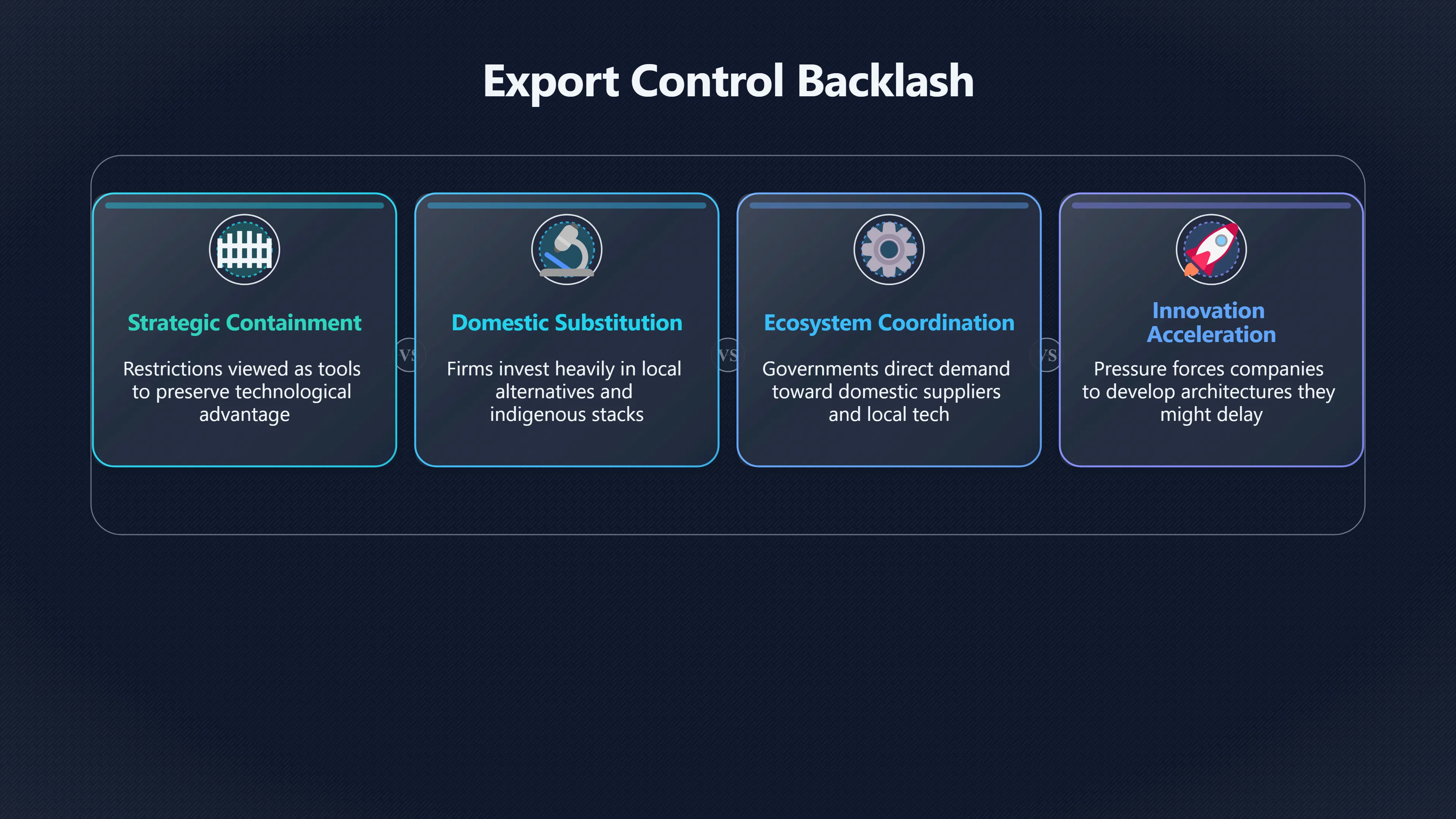
The core critique is that export controls can be interpreted not merely as safety measures but as tools of technological containment.
From the perspective of governments imposing them, chip restrictions may be intended to slow access to the computing power needed for frontier AI development. From the perspective of targeted states, however, the same measures can look like an attempt to preserve strategic advantage. When that happens, AI development becomes more closely linked to national prestige, economic security, and military competition.
For AI doom researchers concerned about race dynamics, this matters because competition can alter incentives. A government that believes it is falling behind may become less willing to support safety-related delays, testing requirements, or international oversight. Instead, it may prioritise rapid capability development.
This concern is not unique to AI. Scholars of international security have long noted that technology denial regimes sometimes produce counter-mobilisation rather than restraint. In the AI context, the worry is that export controls could transform advanced AI into an even more explicit geopolitical contest between major powers. [Chatham House]chathamhouse.orgChatham HouseAI export controls are not the best bargaining chip4 days ago — US export controls on chips and hardware alone will not prev… [CSIS]csis.orglimits chip export controls meeting china challengeThe Limits of Chip Export Controls in Meeting the China…Apr 14, 2025 — The US government and those of its allies have imposed and prog…
Supporters of controls often reply that competition already exists and that slowing a rival’s access to advanced compute still buys valuable time. The disagreement is therefore about the balance between delay effects and escalation effects, not about whether rivalry exists at all. [AI Frontiers]ai-frontiers.orgus chip export controls china aiAI FrontiersHow US Export Controls Have (and Haven't) Curbed…8 Jul 2025 — The past six years of export controls on chips and chipmakin…
Domestic chip self-sufficiency as a backlash effect
The strongest backlash argument concerns technological self-sufficiency.
For several years, Chinese policymakers have treated dependence on foreign semiconductors as a strategic vulnerability. Export controls have strengthened the political case for investing heavily in domestic alternatives. Beijing’s goal of creating an “independent and controllable” technology stack predates recent restrictions, but multiple analyses argue that controls have accelerated those efforts. [MERICS]merics.orgMERICSChina's drive toward self-reliance in artificial intelligenceJul 22, 2025 — China is pursuing self-reliance in AI at every level of… CSIS The mechanism is straightforward: [csis.org]csis.orglimits chip export controls meeting china challengeThe Limits of Chip Export Controls in Meeting the China…Apr 14, 2025 — The US government and those of its allies have imposed and prog…
- Access to foreign chips becomes uncertain.
- Domestic firms receive stronger incentives to switch suppliers.
- Governments direct funding towards local alternatives.
- Domestic ecosystems become more coordinated around indigenous technology.
A 2026 analysis from the Center for Strategic and International Studies argued that export controls were adding momentum to China’s localisation strategy and aligning domestic demand with Chinese technology suppliers. [CSIS]csis.orgreining export control arms raceReining in the Export Control Arms RaceApr 10, 2026 — The United States adds 23 Chinese companies to the Entity List, restricting trade t…
Recent developments illustrate this pattern. Chinese firms have increased investment in domestic AI chips, advanced packaging techniques, alternative architectures, and software ecosystems designed to reduce dependence on foreign suppliers. Huawei in particular has become a central symbol of this effort. [Reuters]reuters.comHuawei looks beyond Moore's LawHuawei looks beyond Moore's Law
Some observers argue that restrictions may therefore create a paradox. They may slow capabilities in the short term while encouraging the emergence of a more independent rival ecosystem in the long term. Huawei executives have publicly argued that sanctions accelerated domestic innovation and forced Chinese companies to develop technologies they might otherwise have postponed. [Tom's Hardware]tomshardware.comHe stated that without the pressure, Chinese companies like Huawei may not have pursued innovations such as their LogicFolding chip archi…
That does not necessarily mean the controls failed. A policy can both delay progress and stimulate adaptation. The question is which effect dominates over the timescales relevant to existential risk.

Does self-sufficiency make AI doom more likely?
The answer depends on how one thinks advanced AI becomes dangerous.
If one believes existential risk is mainly driven by the speed at which frontier capabilities arrive, then even temporary delays may be valuable. Several years of additional alignment research, interpretability work, evaluations, and governance preparation could matter substantially. Under that view, later self-sufficiency may be less important than immediate slowing. [AI Frontiers]ai-frontiers.orgus chip export controls china aiAI FrontiersHow US Export Controls Have (and Haven't) Curbed…8 Jul 2025 — The past six years of export controls on chips and chipmakin…
If, however, one believes existential risk is strongly driven by global race dynamics, then the creation of multiple competing AI ecosystems could be worrying.
A more fragmented technological world may create:
- More pressure to demonstrate national leadership.
- Less transparency between major AI powers.
- Reduced willingness to share safety research.
- Greater suspicion about verification and monitoring systems.
- Stronger incentives to deploy powerful systems before rivals do.
In extreme versions of AI doom scenarios, the problem is not merely that powerful systems exist. The problem is that competitive pressure encourages actors to accept risks they would otherwise avoid. Under that model, geopolitical fragmentation can itself become part of the risk pathway.
Cooperation risks for global AI safety
Perhaps the most important existential-risk concern is the effect on future cooperation.
Many proposed AI safety measures require some degree of international coordination. Examples include monitoring very large training runs, sharing information about dangerous model behaviour, agreeing on compute thresholds for scrutiny, or creating systems for incident reporting and emergency response.
These proposals become harder when states increasingly view AI as a strategic contest.
Critics of chip restrictions argue that policies framed primarily around technological denial can make later cooperation more difficult. A government that believes another country is trying to suppress its development may be less willing to trust safety initiatives proposed by that same country. Cooperation efforts may then be interpreted as attempts to preserve technological advantages rather than genuine risk-reduction measures. [Chatham House]chathamhouse.orgChatham HouseAI export controls are not the best bargaining chip4 days ago — US export controls on chips and hardware alone will not prev…
This concern appears in some recent policy commentary. Analysts have argued that export controls alone are unlikely to prevent advanced AI development indefinitely and may reduce their usefulness as bargaining tools if they undermine broader diplomatic relationships. [Chatham House]chathamhouse.orgChatham HouseAI export controls are not the best bargaining chip4 days ago — US export controls on chips and hardware alone will not prev…
For AI doom discussions, this matters because many long-term safety strategies assume some ability to coordinate internationally once systems become sufficiently capable. If geopolitical hostility grows faster than safety cooperation, then controls could inadvertently make some future governance proposals harder to implement.

The evidence remains mixed
The backlash argument should not be overstated.
Evidence suggests export controls have imposed real costs on Chinese access to frontier computing hardware and have complicated the construction of the largest AI training clusters. Multiple analyses conclude that restrictions have slowed progress in at least some areas. [AI Frontiers]ai-frontiers.orgus chip export controls china aiAI FrontiersHow US Export Controls Have (and Haven't) Curbed…8 Jul 2025 — The past six years of export controls on chips and chipmakin… [Libertify.com]libertify.comcsis china challenge american ai leadership export controlsChina AI Challenge to US Leadership | CSIS AnalysisMar 19, 2026 — Export controls are the most significant strategic tool: US restriction…
At the same time, evidence also suggests substantial adaptation. Chinese firms have pursued domestic substitutes, efficiency improvements, alternative architectures, and workarounds for restricted hardware. Researchers and policymakers continue to debate how much delay the controls create and whether that delay will persist. CSIS [2arXiv]arxiv.orgarXiv Whack-a-Chip: The Futility of Hardware-Centric Export ControlsarXiv Whack-a-Chip: The Futility of Hardware-Centric Export Controls
The key uncertainty is therefore not whether backlash exists. It clearly does. The uncertainty is whether the benefits of slowing frontier AI outweigh the risks created by stronger geopolitical competition and reduced trust.
What this means for existential-risk debates
The geopolitical backlash critique does not claim that chip controls are obviously harmful. Rather, it highlights a trade-off.
Export controls may buy time, reduce access to frontier compute, and slow the emergence of extremely capable AI systems. Yet they may also strengthen incentives for technological independence, deepen great-power rivalry, and complicate future cooperation on AI safety. [AI Frontiers]ai-frontiers.orgus chip export controls china aiAI FrontiersHow US Export Controls Have (and Haven't) Curbed…8 Jul 2025 — The past six years of export controls on chips and chipmakin… [CSIS]csis.orgcountering chinas challenge american ai leadershipCountering China's Challenge to American AI LeadershipDec 2, 2025 — To stay ahead in the AI race with China, the U.S. must protect its le…
For people concerned about AI doom, the central question is therefore not whether controls work in a narrow technical sense. It is whether they reduce the total probability of catastrophe once political reactions are included. A policy that delays dangerous capabilities but simultaneously intensifies a global race could have very different consequences from a policy that slows development while preserving the possibility of international coordination.
That tension is one of the main reasons export controls remain controversial within the broader debate about reducing existential risk from advanced AI systems.
eBay marketplace picks
Marketplace Samples
Example marketplace items related to this page. Use the search link to explore similar finds on eBay.







Endnotes
-
Source: csis.org
Title: limits chip export controls meeting china challenge
Link: https://www.csis.org/analysis/limits-chip-export-controls-meeting-china-challengeSource snippet
The Limits of Chip Export Controls in Meeting the China...Apr 14, 2025 — The US government and those of its allies have imposed and prog...
-
Source: csis.org
Title: reining export control arms race
Link: https://www.csis.org/analysis/reining-export-control-arms-raceSource snippet
Reining in the Export Control Arms RaceApr 10, 2026 — The United States adds 23 Chinese companies to the Entity List, restricting trade t...
-
Source: ai-frontiers.org
Title: us chip export controls china ai
Link: https://ai-frontiers.org/articles/us-chip-export-controls-china-aiSource snippet
AI FrontiersHow US Export Controls Have (and Haven't) Curbed...8 Jul 2025 — The past six years of export controls on chips and chipmakin...
-
Source: csis.org
Title: countering chinas challenge american ai leadership
Link: https://www.csis.org/analysis/countering-chinas-challenge-american-ai-leadershipSource snippet
Countering China's Challenge to American AI LeadershipDec 2, 2025 — To stay ahead in the AI race with China, the U.S. must protect its le...
-
Source: merics.org
Link: [https://merics.org/en/report/chinas-drive-toward-self-reliance-artificialSource snippet
MERICSChina's drive toward self-reliance in artificial intelligenceJul 22, 2025 — China is pursuing self-reliance in AI at every level of...
-
Source: csis.org
Link: https://www.csis.org/analysis/chinas-localization-drive-semiconductors-gains-impetus-allied-chip-export-controlsSource snippet
CSISChina's Localization Drive in Semiconductors Gains...Mar 24, 2026 — U.S. and allied export controls aimed at slowing China's semicon...
-
Source: reuters.com
Title: Huawei looks beyond Moore’s Law
Link: https://www.reuters.com/technology/artificial-intelligence/huawei-looks-beyond-moores-law-2026-05-27/ -
Source: csis.org
Title: deepseek huawei export controls and future us china ai race
Link: https://www.csis.org/analysis/deepseek-huawei-export-controls-and-future-us-china-ai-raceSource snippet
CSISDeepSeek, Huawei, Export Controls, and the Future of...Mar 7, 2025 —... implications for AI and semiconductor export controls. The...
-
Source: libertify.com
Title: csis china challenge american ai leadership export controls
Link: https://www.libertify.com/interactive-library/csis-china-challenge-american-ai-leadership-export-controls/Source snippet
China AI Challenge to US Leadership | CSIS AnalysisMar 19, 2026 — Export controls are the most significant strategic tool: US restriction...
-
Source: arxiv.org
Title: arXiv Whack-a-Chip: The Futility of Hardware-Centric Export Controls
Link: https://arxiv.org/abs/2411.14425 -
Source: csis.org
Link: https://www.csis.org/Source snippet
CSIS | Center for Strategic and International StudiesA leading resource for policymakers confronting a new era of great power competition...
-
Source: csis.org
Title: export controls national security tool or industrial policy lever
Link: https://www.csis.org/blogs/perspectives-innovation/export-controls-national-security-tool-or-industrial-policy-leverSource snippet
Export Controls: National Security Tool or Industrial Policy...Apr 7, 2026 — In December 2025, the Trump administration relaxed regulato...
Published: December 2025
-
Source: csis.org
Title: Understanding U.S
Link: https://www.csis.org/analysis/understanding-us-allies-current-legal-authority-implement-ai-and-semiconductor-exportSource snippet
Allies' Current Legal Authority to...Mar 14, 2025 — This paper provides an in-depth analysis of US allies' export control authorities re...
-
Source: chathamhouse.org
Link: https://www.chathamhouse.org/2026/04/ai-export-controls-are-not-best-bargaining-chipSource snippet
Chatham HouseAI export controls are not the best bargaining chip4 days ago — US export controls on chips and hardware alone will not prev...
-
Source: chathamhouse.org
Link: https://www.chathamhouse.org/2026/04/how-surge-defence-and-dual-use-technology-investment-could-reconfigure-global-ai-race/02Source snippet
Chatham HouseHow a surge in defence and dual-use technology...28 Apr 2026 — 18 Export controls preventing Chinese rivals from accessing...
-
Source: tomshardware.com
Link: https://www.tomshardware.com/tech-industry/huawei-chairman-thanks-the-us-for-supercharging-chinas-semiconductor-industry-washingtons-export-controls-encouraged-chinese-firms-to-invest-in-r-and-d-and-build-their-own-tech-stack-competing-with-american-technologiesSource snippet
He stated that without the pressure, Chinese companies like Huawei may not have pursued innovations such as their LogicFolding chip archi...
-
Source: chathamhouse.org
Title: breaking deadlock ai governance
Link: https://www.chathamhouse.org/2026/03/breaking-deadlock-ai-governanceSource snippet
Breaking the deadlock on AI governance30 Mar 2026 — US export controls on chips and hardware alone will not prevent China from further de...
-
Source: chathamhouse.org
Link: https://www.chathamhouse.org/topics/technologySource snippet
TechnologyAI export controls are not the best bargaining chip. US export controls on chips and hardware alone will not prevent China from...
-
Source: chathamhouse.org
Link: https://www.chathamhouse.org/regions/asia-pacificSource snippet
Asia-PacificAI export controls are not the best bargaining chip. US export controls on chips and hardware alone will not prevent China fr...
-
Source: chathamhouse.org
Link: https://www.chathamhouse.org/Source snippet
US export controls on chips and hardware alone will not prevent China from further developing advanced AI.Read more...
-
Source: chathamhouse.org
Link: https://www.chathamhouse.org/topics/technology-governanceSource snippet
Technology governanceAI export controls are not the best bargaining chip. US export controls on chips and hardware alone will not prevent...
-
Source: chathamhouse.org
Title: 02 why build sovereign ai
Link: https://www.chathamhouse.org/2026/02/how-middle-powers-can-weather-us-and-chinese-ai-dominance/02-why-build-sovereign-aiSource snippet
The case for 'sovereign AI' strategies. Research paper. Published 16 February 2026.Read more...
Published: February 2026
Additional References
-
Source: linkedin.com
Link: https://www.linkedin.com/posts/digital-society-programme_ai-export-controls-are-not-the-best-bargaining-activity-7455564081224302592-vH1lSource snippet
AI export controls are not the best bargaining chipChatham House Digital Society Programme's Post. View organization... AI export contro...
-
Source: linkedin.com
Link: https://www.linkedin.com/posts/stephaniegriffiths1_ai-export-controls-are-not-the-best-bargaining-activity-7456033381466816513-_tnWSource snippet
AI export controls are not the best bargaining chip“An AI system where no single actor controls every layer is harder to circumvent, corr...
-
Source: linkedin.com
Link: https://www.linkedin.com/posts/rowan-wilkinson-023b96141_ai-export-controls-are-not-the-best-bargaining-activity-7455567069309374465-lvh4Source snippet
US Export-Control Policy on Semiconductors Misses the...... AI export controls are not the best bargaining chip chathamhouse.org... I a...
-
Source: facebook.com
Link: https://www.facebook.com/ChathamHouse/posts/us-export-controls-on-chips-and-hardware-alone-will-not-prevent-china-from-furth/1379472084217145/Source snippet
US export controls on chips and hardware alone will not...US export controls on chips and hardware alone will not prevent China from fur...
-
Source: x.com
Link: https://x.com/ChathamHouse/status/2049911664389116340Source snippet
US policy aims to slow the progress of Chinese AI and give...Relying on export controls alone is a hardware-centric approach destined fo...
-
Source: linkedin.com
Link: https://www.linkedin.com/posts/gadallon_weaponized-inventory-how-the-uschina-activity-7436657447911649280-bTbMSource snippet
US-China Tech Confrontation: Supply Chain RedesignThe US is drafting rules that would put government approval on every AI chip export, no...
-
Source: premia-partners.com
Link: https://www.premia-partners.com/insight/china-s-path-to-domestic-substitution-and-technology-independence-many-breakthroughs-one-challengeSource snippet
China's path to domestic substitution and technology...Apr 8, 2026 — To bridge that gap, China has responded with a high-cost, high-stak...
-
Source: markets.financialcontent.com
Link: https://markets.financialcontent.com/wral/article/tokenring-2025-10-22-silicon-curtain-descends-geopolitical-tensions-choke-ai-ambitions-as-global-chip-supply-fracturesSource snippet
Tensions Choke AI Ambitions as Global Chip...Oct 22, 2025 — The United States has progressively tightened export controls on advanced AI...
-
Source: cetas.turing.ac.uk
Link: https://cetas.turing.ac.uk/publications/chinas-quest-semiconductor-self-sufficiencySource snippet
turing.ac.ukChina's Quest for Semiconductor Self-Sufficiencyby A Janjeva · Cited by 6 — This CETaS Briefing Paper examines how China's qu...
-
Source: linkedin.com
Link: https://www.linkedin.com/posts/chathamhouse_ai-export-controls-are-not-the-best-bargaining-activity-7455586844299194371-lU5vSource snippet
AI export controls are not the best bargaining chipUS policy aims to slow the progress of Chinese AI and give the US time to advance its...
Topic Tree