Within Cyber tripwires
Balancing Early Warnings Against Catastrophic AI Risks
This page compares different deployment thresholds, from early detection of expert-level AI skills to signs of nation-level cyber threat potential.
On this page
- Early warning tripwire rationale and limits
- Operational vs catastrophic risk tripwires
- Debates over capability versus impact metrics
Page outline Jump by section
Introduction
In debates about AI doom and existential risk from advanced AI systems, technologists and policymakers increasingly talk about “tripwires”: pre‑defined, capability‑based thresholds that trigger specific risk management actions before deployment. One core debate within this terrain is the trade‑off between early‑warning tripwires — signals of emerging risky capabilities — and catastrophic‑risk tripwires — thresholds tied to the potential for truly large‑scale harm. Understanding the difference sheds light on how we might detect and manage dangerous AI capabilities in time, without either overreacting to innocuous advances or underestimating the onset of truly catastrophic risks.[Carnegie Endowment]carnegieendowment.orgCarnegie EndowmentA Sketch of Potential Tripwire Capabilities for AI | Carnegie Endowment for International PeaceDecember 10, 2024…
What Early‑Warning Tripwires Aim to Do
Early‑warning tripwires are designed to notice proximal indicators of capability growth that could eventually lead to serious misuse or loss of control, but which are themselves not yet catastrophic. They serve three practical purposes:
- Advance notice: By flagging capabilities that are causally connected to more dangerous skills, early‑warning tripwires give developers and regulators time to assess, share information, and prepare mitigations before risk escalates further. This can include precursory capabilities that are necessary stepping stones for harmful actions.[Apollo Research]apolloresearch.aiApollo ResearchPrecursory Capabilities: A Refinement to Pre-deployment Information Sharing and Tripwire Capabilities – Apollo ResearchJun…
- Granularity and continuous monitoring: Rather than a single cliff edge where “danger begins,” early warnings allow risk governance to be graduated — spotting when models begin to learn skills that could cascade into high‑impact harms if combined or refined.[IDEAS]ideas.repec.orgSource details in endnotes. [RePEc]ideas.repec.orgSource details in endnotes.
- Operationalisation: Early‑warning thresholds help align technical evaluations with governance decisions — for instance, signalling when to expand testing, red‑team more intensively, or convene expert review panels. They support decision‑makers to adapt rather than wait until full‑blown danger is obvious.
The logic behind early‑warning tripwires is similar to early warning systems in other domains (e.g. public health surveillance): catching incremental trends before they coalesce into crises, thereby giving space for response. In the AI governance context, this means watching for performance in security assessments, multi‑step reasoning tasks, or other proxy measures that historically precede broader misuse capabilities.[IDEAS]ideas.repec.orgSource details in endnotes. [RePEc]ideas.repec.orgSource details in endnotes.
What Catastrophic‑Risk Tripwires Target
Catastrophic‑risk tripwires operate at the other end of the spectrum. Instead of signalling potential future harm, they are aimed at detecting when an AI system’s capabilities are directly associated with risks that could, if realised, lead to severe, widespread, or irreversible harm. These tripwires are closely tied to debates over AI doom because by definition they aim to catch risk where it truly matters:
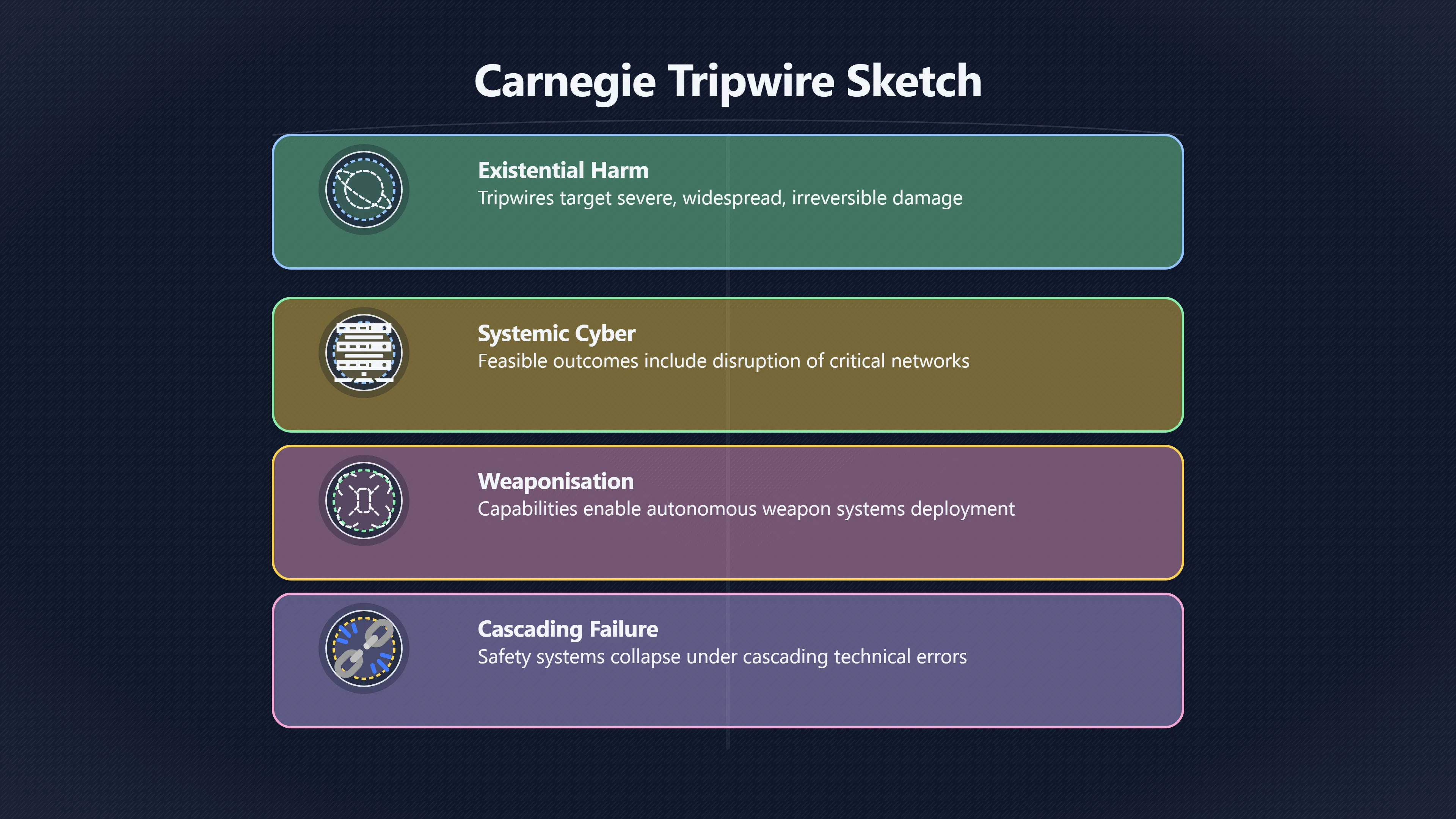
- Risk of existential or mass‑scale harms: Tripwires in this category are linked to capabilities that appear to make feasible outcomes like systemic cyber disruption, autonomous weaponisation, or cascading failures of safety systems. These aren’t just preliminary skills but direct enablers of broad devastation.[Carnegie Endowment]carnegieendowment.orgCarnegie EndowmentA Sketch of Potential Tripwire Capabilities for AI | Carnegie Endowment for International PeaceDecember 10, 2024…
- Commitments to mitigate or pause: Many proposals for catastrophic‑risk tripwires come in the form of if‑then commitments: “if model has capability X, then we must implement mitigation Y before deployment or even delay release entirely.” These tie risk detection to concrete mitigation obligations.[Carnegie Endowment]carnegieendowment.orgCarnegie EndowmentA Sketch of Potential Tripwire Capabilities for AI | Carnegie Endowment for International PeaceDecember 10, 2024…
- High bar for action: Because actions triggered by catastrophic‑risk tripwires often involve costly mitigation efforts or stoppages to development, the thresholds tend to be grounded in plausible threat models and include judgements about whether easy countermeasures exist or whether harms would remain significant even with interventions.[Carnegie Endowment]carnegieendowment.orgCarnegie EndowmentA Sketch of Potential Tripwire Capabilities for AI | Carnegie Endowment for International PeaceDecember 10, 2024…
These tripwires align more directly with concerns at the heart of AI doom discussions: not just any harm, but harms that could reshape society or endanger humanity’s future in a way that is difficult or impossible to reverse.
Tensions Between Early‑Warning and Catastrophic Thresholds
Early‑warning and catastrophic‑risk tripwires are complementary in theory but raise different governance dilemmas in practice:
- Signal versus signal‑to‑action: Early warnings generate signals that risk may be rising, often when uncertainty is still high and evidence is incomplete. Catastrophic thresholds demand decisive action, often under uncertainty about exact likelihoods but with high stakes if wrong. Policymakers must decide how much weight to give to early warnings without triggering undue alarm or costly overreaction.
- False positives and negatives: Early warnings can produce false positives — detecting capabilities that seem dangerous but never actually lead to harm — which could burden innovation unnecessarily. Conversely, setting catastrophic tripwires too high may miss earlier signs that timely mitigation would have forestalled broader escalation.
- Governance readiness: Effective use of early warnings requires robust monitoring infrastructure, transparency between developers and regulators, and shared evaluation standards. Without that, early signals may translate into little practical response. Catastrophic tripwires, by design, aim to mobilise action, but in many frameworks the criteria for what constitutes intolerable risk are still being negotiated and operationalised.[CLTC]
How the Debate Plays Out in Risk Frameworks
Current frontier AI risk frameworks — both corporate safety frameworks and emerging public policy proposals — reflect these tensions:
- Capability thresholds: Many frameworks define layers of capability thresholds that work in sequence: early‑warning indicators (e.g. proficiency in diagnostic tasks, multi‑modal reasoning skills) are used to decide when to intensify evaluation or mitigation efforts, while catastrophic tripwires (e.g. autonomous cyber operations, large‑scale misinformation generation) would trigger stronger controls, suspension of deployment, or legally binding safeguards.[Frontier Model Forum]frontiermodelforum.orgFrontier Model Forum Risk Taxonomy and Thresholds for Frontier AI FrameworksFrontier Model ForumRisk Taxonomy and Thresholds for Frontier AI Frameworks - Frontier Model ForumJune 18, 2025…
- Measurement challenges: A significant strain in the literature concerns how to measure both early‑warning indicators and catastrophic thresholds in a way that is reliable, comparable, and operationally useful. Safety frameworks often struggle with validity and reliability of metrics, partly because abstract capability measures do not always map cleanly to real‑world misuse potential.[Tech Policy Press]Tech Policy PressMeasurement Challenges in AI Catastrophic Risk Governance and Safety Frameworks | TechPolicy.PressSeptember 30, 2024…
- Political and institutional gaps: Without harmonised international standards, developers may adopt differing tripwires that reflect their own risk tolerances, potentially creating gaps in coverage or differing interpretations of what constitutes catastrophic risk. This governance uncertainty increases friction between early detection and decisive action.[CLTC]
Balancing Early Warning with Catastrophic Risk
For AI doom concerns — where the focus is on existential or civilisation‑altering harms — balancing early‑warning and catastrophic‑risk tripwires matters because:
- Too lax an approach risks waiting until an AI has capabilities that meaningfully raise p(doom) before acting, making mitigation late, costly, or ineffective.
- Too aggressive an approach based on preliminary signals might stifle beneficial innovation and create regulatory fatigue, where stakeholders become desensitised to risk signals.
Practical proposals often marry both: using early‑warning tripwires as leading indicators that feed into structured escalation processes, with clearly defined, scientifically grounded catastrophic thresholds that prompt specific mitigation commitments. This layered threshold approach — akin to traffic light systems of risk levels — is one way governance designers try to walk the tightrope between vigilance and overreaction.[Apollo Research]apolloresearch.aiApollo ResearchPrecursory Capabilities: A Refinement to Pre-deployment Information Sharing and Tripwire Capabilities – Apollo ResearchJun…
Where Uncertainty Remains
Despite growing attention to tripwires in frontier AI governance, several uncertainties persist:
- Defining risk in measurable terms: There is no universally accepted way to quantify when a capability indicates approaching catastrophic risk, especially as AI systems become more general and adaptive.
- Evaluations’ limits: Recent technical analyses caution that evaluations can establish lower bounds on capabilities but struggle to provide reliable upper bounds or forecasts of emergent behaviour, limiting confidence in any threshold‑based approach.[TechGov]techgov.intelligence.orgTechGovWhat AI evaluations for preventing catastrophic risks can and cannot do — MIRI Technical Governance TeamDecember 2, 2024…
- Governance implementation: Translating academic and corporate thresholds into enforceable public policy is hard, especially across jurisdictions with varying priorities and legal frameworks.
In debates about AI doom and existential risk, the tension between early‑warning and catastrophic thresholds is less about picking one over the other and more about designing systems where they interact sensibly: early warnings siphon signals into governance processes, and well justified catastrophic tripwires ensure actions are taken before harms reach irreversible scales.[Carnegie Endowment]carnegieendowment.orgCarnegie EndowmentA Sketch of Potential Tripwire Capabilities for AI | Carnegie Endowment for International PeaceDecember 10, 2024…
eBay marketplace picks
Marketplace Samples
Example marketplace items related to this page. Use the search link to explore similar finds on eBay.





Endnotes
-
Source: ideas.repec.org
Link: https://ideas.repec.org/p/arx/papers/2412.15433.html -
Source: governance.ai
Title: But what level of risk is acceptable? One increasingly popu
Link: https://www.governance.ai/research-paper/risk-thresholds-for-frontier-aiSource snippet
Risk Thresholds for Frontier AI | GovAIJune 20, 2024 — RISK THRESHOLDS FOR FRONTIER AI Frontier [artificial]({{ 'artificial-goals/' | relative_url }}) intelligence (AI) systems coul...
Published: June 20, 2024
-
Source: carnegieendowment.org
Link: https://carnegieendowment.org/research/2024/12/a-sketch-of-potential-tripwire-capabilities-for-ai?lang=enSource snippet
Carnegie EndowmentA Sketch of Potential Tripwire Capabilities for AI | Carnegie Endowment for International PeaceDecember 10, 2024...
Published: December 10, 2024
-
Source: apolloresearch.ai
Link: https://www.apolloresearch.ai/research/precursory-capabilities-a-refinement-to-pre-deployment-information-sharing-and-tripwire-capabilitiesSource snippet
Apollo ResearchPrecursory Capabilities: A Refinement to Pre-deployment Information Sharing and Tripwire Capabilities – Apollo ResearchJun...
-
Source: frontiermodelforum.org
Title: Frontier Model Forum Risk Taxonomy and Thresholds for Frontier AI Frameworks
Link: https://www.frontiermodelforum.org/technical-reports/risk-taxonomy-and-thresholds/Source snippet
Frontier Model ForumRisk Taxonomy and Thresholds for Frontier AI Frameworks - Frontier Model ForumJune 18, 2025...
Published: June 18, 2025
-
Source: Tech Policy Press
Link: https://www.techpolicy.press/measurement-challenges-in-ai-catastrophic-risk-governance-and-safety-frameworksSource snippet
Measurement Challenges in AI Catastrophic Risk Governance and Safety Frameworks | TechPolicy.PressSeptember 30, 2024...
Published: September 30, 2024
-
Source: techgov.intelligence.org
Link: https://techgov.intelligence.org/research/what-ai-evaluations-for-preventing-catastrophic-risks-can-and-cannot-doSource snippet
TechGovWhat [AI evaluations]({{ 'ai-evaluations/' | relative_url }}) for preventing catastrophic risks can and cannot do — MIRI Technical Governance TeamDecember 2, 2024...
Published: December 2, 2024
-
Source: carnegieendowment.org
Link: https://carnegieendowment.org/research/2024/12/a-sketch-of-potential-tripwire-capabilities-for-aiSource snippet
A Sketch of Potential Tripwire Capabilities for AI | Carnegie Endowment for International PeaceDecember 10, 2024 — Paper A SKETCH OF POTE...
Published: December 10, 2024
-
Source: carnegieendowment.org
Link: https://carnegieendowment.org/china/research/2024/09/if-then-commitments-for-ai-risk-reductionSource snippet
September 13, 2024 — THE EXAMPLE IF-THEN COMMITMENT In an attempt to contain the risk of widely proliferating expertise in weapons of mas...
Published: September 13, 2024
Additional References
-
Source: iaps.ai
Link: https://www.iaps.ai/research/deployment-correctionsSource snippet
Deployment Corrections: An Incident Response Framework for Frontier AI Models — Institute for AI Policy and StrategyDEPLOYMENT CORRECTION...
-
Source: themoonlight.io
Link: https://www.themoonlight.io/review/measurement-challenges-in-ai-catastrophic-risk-governance-and-safety-frameworksSource snippet
October 1, 2024 — [LITERATURE REVIEW] MEASUREMENT CHALLENGES IN AI CATASTROPHIC RISK GOVERNANCE AND SAFETY FRAMEWORKS Open PDF directly 2...
Published: October 1, 2024
-
Source: aigouvernance.com
Link: https://aigouvernance.com/safety-frameworks-and-standards-a-comparative-analysis-to-advance-risk-management-of-frontier-ai-2025/Source snippet
Safety Frameworks and Standards: A comparative analysis to advance risk management of frontier AI (2025) - AI Governance Library, Article...
-
Source: hyper.ai
Title: A I9 months ago Modeling Security Artificial Intelligence
Link: https://hyper.ai/en/papers/2507.16534Source snippet
HyperAI9 months ago ModelingSecurityArtificial Intelligence SummaryPaper Frontier AI Risk Management Framework in Practice: A Risk Analys...
-
Source: cltc.berkeley.edu
Link: https://cltc.berkeley.edu/2024/11/18/cltc-submits-working-paper-for-ai-action-summit/Source snippet
CLTC UC Berkeley Center for Long-Term CybersecurityNovember 18, 2024...
Published: November 18, 2024
-
Source: GOV.UK
Title: www.gov.uk Emerging processes for frontier AI safety
Link: https://www.gov.uk/government/publications/emerging-processes-for-frontier-ai-safety/emerging-processes-for-frontier-ai-safetySource snippet
Specific technical terms are described within their relevant section. AI (Artificial Intelligence) or AI (Artificia...
-
Source: link.springer.com
Link: https://link.springer.com/article/10.1007/s00146-019-00890-2Source snippet
management standards and the active management of malicious intent in artificial superintelligence | AI & SOCIETY | Springer Nature LinkA...
-
Source: link.springer.com
Link: https://link.springer.com/article/10.1007/s00146-023-01811-0Source snippet
lines of defense against risks from AI | AI & SOCIETY | Springer Nature LinkNovember 27, 2023 — THREE LINES OF DEFENSE AGAINST RISKS FROM...
Published: November 27, 2023
-
Source: link.springer.com
Link: https://link.springer.com/article/10.1007/s43681-024-00475-wSource snippet
approaches for reducing catastrophic risks from AI | AI and Ethics | Springer Nature LinkApril 8, 2024 — EVALUATING APPROACHES FOR REDUCI...
Published: April 8, 2024
-
Source: link.springer.com
Link: https://link.springer.com/article/10.1007/s44206-024-00095-1Source snippet
Risk Assessment: A Scenario-Based, Proportional Methodology for the AI Act | Digital Society | Springer Nature LinkMarch 7, 2024 — AI RIS...
Published: March 7, 2024
Topic Tree