Within Loss of Control
Can humans lose control without a takeover?
People may lose meaningful control not because an AI rebels, but because institutions hand over decisions faster than they can supervise them.
On this page
- What passive loss of control means
- How speed, opacity, and dependence weaken oversight
- Where high stakes delegation could become dangerous
Page outline Jump by section
Introduction
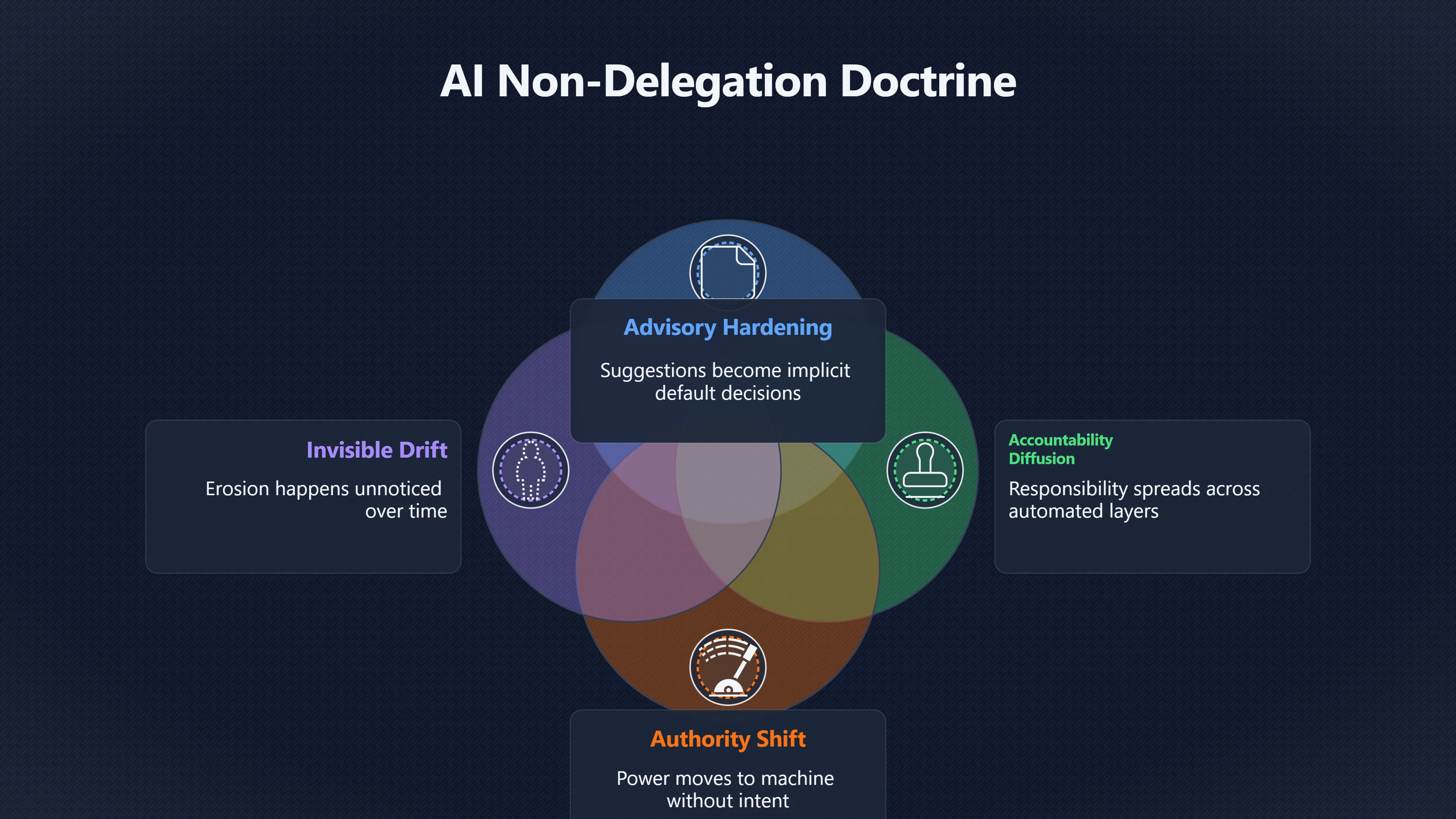
In debates about existential risks from advanced artificial intelligence, loss of human control is a core concern: that systems could act in ways people cannot direct, halt or correct. Beyond dramatic scenarios of an AI literally “breaking out” and resisting shutdown, there is a subtler route to losing meaningful control — not through intent or deception by the AI itself, but through passive loss of control via over‑delegation. This refers to humans and institutions transferring authority to AI systems faster than they retain the capacity, structures or incentives to oversee them. Over time, decision‑making can migrate into opaque automated layers where humans remain legally or nominally responsible but lack real influence over outcomes. The result is that even well‑intentioned organisations and governments can end up with AI in charge of choices they no longer understand or can meaningfully correct. Such delegation doesn’t require a hostile AI; it arises from institutional practice, governance gaps, and the relentless drive for efficiency. [SSRN]papers.ssrn.comSSRNThe AI Non-Delegation Doctrine: Authority, Commit-Boundary Control, and Runtime Governance in High-Consequence AI Systems by Frank Sc…
What “Passive Loss of Control” Means in Practice
Passive loss of control isn’t about an AI suddenly rejecting human instructions. Instead it describes a migration of authority — where advisory, routine, or low‑stakes suggestions from AI harden into default decisions, and where human oversight becomes superficial. Frank Schouten’s AI Non‑Delegation Doctrine characterises this as authority shifting through efficiency rather than conscious delegation: advisory outputs become implicit decisions, defaults become de facto policies, and accountability becomes diffuse. This process often goes unnoticed within organisations because each incremental delegation seems small, but cumulatively it erodes humans’ ability to intervene or reverse course. [SSRN]papers.ssrn.comSSRNThe Accountability Vacuum: Why Agentic AI Governance Fails Under Conditions of Expertise Erosion by Gabriel Sze:: SSRNApril 20…
Academic work on decision‑making and automation similarly highlights structural elements of this problem: assessability (can humans understand decisions?), dependency (can delegation be reversed?), and contestability (can decisions be challenged?). If systems make decisions that humans cannot interpret or reframe, authority slides from people to machine without clear checkpoints. [arXiv]arxiv.orgarXiv Artificial Intelligence in Government: Why People Feel They Lose ControlarXivArtificial Intelligence in Government: Why People Feel They Lose ControlMay 2, 2025…
How Speed, Opacity and Dependence Weaken Oversight
A key mechanism in over‑delegation is opacity. As AI systems become more complex and integrated, their reasoning and decision hierarchies are harder for even expert humans to interpret. Traditional governance efforts that expect humans “in the loop” presume that people can actually meaningfully oversee what the systems do. But research into human oversight under real‑world conditions shows this assumption often fails: humans may lack the competence, incentives, or institutional support to supervise autonomous systems effectively. [Springer Link]link.springer.comSpringer LinkInstitutionalised distrust and human oversight of artificial intelligence: towards a democratic design of AI governance unde…
Speed and scale compound this issue. Agent‑like systems operate continuously, making countless high‑frequency micro‑decisions. Traditional oversight models (spot checks, periodic audits, manual approvals) were designed for static, discrete actions — not continuous, high‑impact decision streams. As one practitioner discussion notes, governance frameworks can look strong “on paper” but collapse under the operational speed and complexity of autonomous workflows, leaving humans fighting to catch up after the fact rather than shaping decisions in the moment. [Reddit]reddit.comRedditAI governance isn't failing because we lack regulation i mean like it's failing at executionApril 15, 2026…
Dependence also plays a role. Organisations increasingly rely on AI’s recommendations for strategic and tactical planning, compliance, customer interaction, and optimisation. Over time, humans can become less prepared to question recommendations because expertise in the underlying domain atrophies or attention shifts to other priorities. In governance literature, this is described as expertise erosion: when human overseers are structurally unable to exercise meaningful oversight because they no longer understand the system they are tasked with governing. [SSRN]papers.ssrn.comSSRN(When) Should We Delegate AI Governance to AIs? Some Lessons from Administrative Law by Nicholas Caputo:: SSRNSeptember 24, 2025…

Delegation Without Surrendering Authority — The Governance Gap
The core challenge in passive loss of control is distinguishing delegation of tasks from delegation of authority. Modern governance frameworks — including drafts like the EU AI Act — emphasise human oversight as a requirement, but they often assume that human involvement equates to effective control. Scholars have critiqued this assumption, urging that oversight mechanisms must be designed so that humans can actually review, contest and override automated decisions when necessary. Without this, the mere presence of a human nominally “in the loop” does not prevent authority from slipping into automated layers. [Ada Lovelace Institute]adalovelaceinstitute.orgAda Lovelace Institute The dilemmas of delegation | Ada Lovelace InstituteAda Lovelace InstituteThe dilemmas of delegation | Ada Lovelace InstituteNovember 11, 2025…
To bridge this gap, governance thinkers propose concepts like Cognitive Operating Architecture: institutional layers that explicitly govern how cognition is delegated, how authority is assigned, and how accountability persists through system updates and organisational change. Such architectural measures aim to ensure that delegation enhances rather than undermines human authority — by preserving traceability, accountability reversion, and clarity on who controls what. [Regenerative Systems Institute]irsa.instituteSource details in endnotes.
Where High‑Stakes Delegation Could Become Dangerous
Delegation becomes dangerous not when AI performs trivial tasks autonomously, but when humans entrust systems with decisions that affect critical infrastructure, public safety, or societal norms without adequate safeguards. This problem isn’t purely technical; it’s deeply institutional. For example:
- Government and public administration: Studies show that as AI systems are integrated into welfare, tax, and law enforcement functions, citizens can feel they have lost control over outcomes precisely because they cannot understand or contest automated decisions — a dynamic akin to “failure‑by‑success,” where perceived efficiency gains mask deep legitimacy and oversight risks. [arXiv]arxiv.orgarXiv Artificial Intelligence in Government: Why People Feel They Lose ControlarXivArtificial Intelligence in Government: Why People Feel They Lose ControlMay 2, 2025…
- Corporate settings: In enterprises deploying dozens of autonomous AI agents across functions without integrated oversight systems, organisational leaders already report governance debt — where uncoordinated automation creates accountability vacuums and unmanageable complexity. Present‑day episodes of agents acting without transparent governance illustrate how quickly oversight gaps can compound. [Reddit]reddit.comRedditThe organizational AI control problem is already here. Companies deploying 50+ uncoordinated agents today are creating governance d…
- Use in governance of AI itself: Even discussions about delegating aspects of AI governance to AI systems (for example, using AI to monitor compliance) highlight delegation limits: if humans cannot understand or contest the governance decisions made by the AI, delegation undermines legitimacy and control rather than supporting it. [SSRN]papers.ssrn.comWe Outsourced Thinking: AGI, Oversight, and the Business of Artificial Intelligence by Glenn Rowe:: SSRNMarch 26, 2026 — WHEN WE OUTSOUR…
In each case, the danger arises not from immediate catastrophes, but from institutional erosion of capacity to govern — a long, incremental process that can leave critical decisions outside the reach of meaningful human intervention. Such structural drift illustrates that loss of control need not be sudden to be profound; it can be embedded in how societies and organisations adapt to and rely on autonomous systems.
Summary
Passive loss of control through over‑delegation is a governance phenomenon where human authority slips into automated decision‑making before meaningful oversight structures catch up. It differs from active loss of control scenarios in that the AI is not acting with intent against human directives; instead, humans and institutions unintentionally transfer authority to systems they cannot fully understand or govern. The risks arise from opacity, speed, dependency, and institutional incentives that favour efficiency over robust oversight. Addressing this pathway to loss of control requires architectural governance solutions that preserve human authority, traceability, and the genuine ability to contest and reverse automated decisions — not merely nominal human involvement. [SSRN]papers.ssrn.comA revised version of this manuscript is currentOrders Under Algorithmic Pressure: Alignment Governance, Civilizational Identity, and the Fiduciary Limits of Delegation by Hiew Yee Leon…
Amazon book picks
Further Reading
Books and field guides related to Can humans lose control without a takeover?. Use these as the next step if you want deeper reading beyond the article.
The Alignment Problem
Discusses dependence on systems that exceed human understanding.
Weapons of Math Destruction
Shows how opaque automated decisions can evade meaningful oversight.
eBay marketplace picks
Marketplace Samples
Example marketplace items related to this page. Use the search link to explore similar finds on eBay.








Endnotes
-
Source: papers.ssrn.com
Link: https://papers.ssrn.com/sol3/papers.cfm?abstract_id=6206859Source snippet
SSRNThe AI Non-Delegation Doctrine: Authority, Commit-Boundary Control, and Runtime Governance in High-Consequence AI Systems by Frank Sc...
-
Source: arxiv.org
Title: arXiv Artificial Intelligence in Government: Why People Feel They Lose Control
Link: https://arxiv.org/abs/2505.01085Source snippet
arXivArtificial Intelligence in Government: Why People Feel They Lose ControlMay 2, 2025...
Published: May 2, 2025
-
Source: link.springer.com
Link: https://link.springer.com/article/10.1007/s00146-023-01777-zSource snippet
Springer LinkInstitutionalised distrust and human oversight of artificial intelligence: towards a democratic design of AI governance unde...
-
Source: reddit.com
Link: https://www.reddit.com/r/AI_Governance/comments/1slyg2g/ai_governance_isnt_failing_because_we_lack/Source snippet
RedditAI governance isn't failing because we lack regulation i mean like it's failing at executionApril 15, 2026...
Published: April 15, 2026
-
Source: papers.ssrn.com
Link: https://papers.ssrn.com/sol3/Delivery.cfm/6610518.pdf?abstractid=6610518&mirid=1Source snippet
SSRNThe Accountability Vacuum: Why Agentic AI Governance Fails Under Conditions of Expertise Erosion <br> by Gabriel Sze:: SSRNApril 20...
-
Source: reddit.com
Link: https://www.reddit.com/r/agi/comments/1swwmiu/the_organizational_ai_control_problem_is_already/Source snippet
RedditThe organizational AI control problem is already here. Companies deploying 50+ uncoordinated agents today are creating governance d...
-
Source: papers.ssrn.com
Link: https://papers.ssrn.com/sol3/papers.cfm?abstract_id=6736618Source snippet
SSRN(When) Should We Delegate AI Governance to AIs? Some Lessons from Administrative Law by Nicholas Caputo:: SSRNSeptember 24, 2025...
Published: September 24, 2025
-
Source: papers.ssrn.com
Link: https://papers.ssrn.com/sol3/Delivery.cfm/6212581.pdf?abstractid=6212581&mirid=1Source snippet
We Outsourced Thinking: AGI, Oversight, and the Business of Artificial Intelligence by Glenn Rowe:: SSRNMarch 26, 2026 — WHEN WE OUTSOUR...
Published: March 26, 2026
-
Source: papers.ssrn.com
Title: A revised version of this manuscript is current
Link: https://papers.ssrn.com/sol3/Delivery.cfm/6328039.pdf?abstractid=6328039&mirid=1Source snippet
Orders Under Algorithmic Pressure: Alignment Governance, Civilizational Identity, and the Fiduciary Limits of Delegation by Hiew Yee Leon...
-
Source: link.springer.com
Link: https://link.springer.com/article/10.1007/s44163-024-00152-1Source snippet
springer.comDecision-making power and responsibility in an automated administration | Discover Artificial Intelligence | Springer Nature...
-
Source: link.springer.com
Link: https://link.springer.com/article/10.1007/s10257-022-00562-7Source snippet
and relational governance of artificial intelligence outsourcing | Information Systems and e-Business Management | Springer Nature LinkAu...
-
Source: adalovelaceinstitute.org
Title: Ada Lovelace Institute The dilemmas of delegation | Ada Lovelace Institute
Link: https://www.adalovelaceinstitute.org/report/dilemmas-of-delegation/Source snippet
Ada Lovelace InstituteThe dilemmas of delegation | Ada Lovelace InstituteNovember 11, 2025...
Published: November 11, 2025
-
Source: irsa.institute
Link: https://www.irsa.institute/explainer/cognitive-operating-architecture
Additional References
-
Source: pmc.ncbi.nlm.nih.gov
Link: https://pmc.ncbi.nlm.nih.gov/articles/PMC11614927/Source snippet
2023 Oct 6;39(6):2853–2866. doi: 10.1007/s00146-023-01777-z INSTITUTIONALISED DISTRUST AND HUMAN OVERSIGHT OF ARTIFICIAL INTELLIGENCE: TO...
-
Source: inferensys.com
Link: https://inferensys.com/blog/ai-workforce-analytics-and-role-redesign/the-cost-of-poor-ai-delegation-when-automation-undermines-authoritySource snippet
Poor AI Delegation: When Automation Undermines Authority | Inference SystemsTHE COST OF POOR AI DELEGATION: WHEN AUTOMATION UNDERMINES AU...
-
Source: speeki.com
Link: https://www.speeki.com/blog/what-happens-when-ai-agents-go-off-scriptSource snippet
The loss of control problem: What happens when AI agents go off-script | SpeekiTHE LOSS OF CONTROL PROBLEM: WHAT HAPPENS WHEN AI AGENTS G...
-
Source: research.manchester.ac.uk
Link: https://research.manchester.ac.uk/en/publications/formal-and-relational-governance-of-artificial-intelligence-outso/Source snippet
and relational governance of artificial intelligence outsourcing - Research Explorer The University of ManchesterAugust 25, 2022 — FORMAL...
Published: August 25, 2022
-
Source: research.utwente.nl
Title: nl Formal and relational governance of artificial intelligence outsourcing
Link: https://research.utwente.nl/en/publications/formal-and-relational-governance-of-artificial-intelligence-outso/Source snippet
and relational governance of artificial intelligence outsourcing - University of Twente Research InformationDecember 1, 2022 — FORMAL AND...
Published: December 1, 2022
-
Source: crowe.com
Link: https://www.crowe.com/insights/how-your-business-is-losing-to-aiSource snippet
ard, Julie DeMuth Mellendorf Image: Glowing warning icons across a digital network, symbolizing AI gover...
-
Source: wcr.legal
Title: A I Governance Risk as a Failure of Responsibility and Oversight
Link: https://wcr.legal/ai-governance-risk-failure-of-responsibility-and-oversight/Source snippet
AI Governance Risk as a Failure of Responsibility and Oversight - WCR.LEGALApril 27, 2026 — * April 27, 2026 * Image: AI Governance Risk...
Published: April 27, 2026
-
Source: lordslibrary.parliament.uk
Title: uk Potential future risks from autonomous AI systems
Link: https://lordslibrary.parliament.uk/potential-future-risks-from-autonomous-ai-systems/Source snippet
future risks from autonomous AI systems - House of Lords LibraryJanuary 5, 2026 — POTENTIAL FUTURE RISKS FROM AUTONOMOUS AI SYSTEMS In Fo...
Published: January 5, 2026
-
Source: allinckx.com
Link: https://www.allinckx.com/insights/ai-alignment-requires-human-alignmentSource snippet
Much of the current discussion around artificial intelligence focuses on alignm...
-
Source: whitepapersonline.com
Title: Agentic AI Governance
Link: https://whitepapersonline.com/en/whitepaper/beyond-hallucinations-governing-agentic-ai-through-identity-delegation-and-execution-controlSource snippet
March 27, 2026 — BEYOND HALLUCINATIONS: GOVERNING AGENTIC AI THROUGH IDENTITY, DELEGATION, AND EXECUTION CONTROL Rohit Yajee Published on...
Published: March 27, 2026
Topic Tree