Within Military AI Risk
Does faster military AI make crises worse?
Faster AI-supported decision cycles could leave leaders less time to verify warnings or pursue de-escalation.
On this page
- How compressed decision windows can raise risk
- Why rivals may feel pressure to act first
- Where speed helps and where it destabilises
Page outline Jump by section
Introduction
One of the most concrete ways advanced artificial intelligence (AI) could interact with catastrophic risk is through decision speed in high‑stakes military crises. Beyond sci‑fi visions of autonomous robots or rogue superintelligence, real‑world AI systems are being embedded into military command and control precisely because they can process data and generate recommendations far faster than humans. This acceleration can have benign effects — clearer pictures of unfolding events, alerts about threats, and near‑real‑time logistical planning. But it also introduces a distinct risk: compressed decision windows that leave leaders less time to verify, interpret, or de‑escalate, especially in fast‑moving confrontations between major powers. In the worst cases envisioned by analysts concerned about AI doom, this compression could contribute to inadvertent escalation, miscalculation, or conflict spiralling out of control before humans can intervene. [SSRN]papers.ssrn.comSSRNAI-Enabled Military Decision-Making and Escalation Risk: Human-Machine Command Authority in Great Power Competition by Burak Oktenli…
How compressed decision windows can raise risk
AI’s promise and the tempo of modern conflict
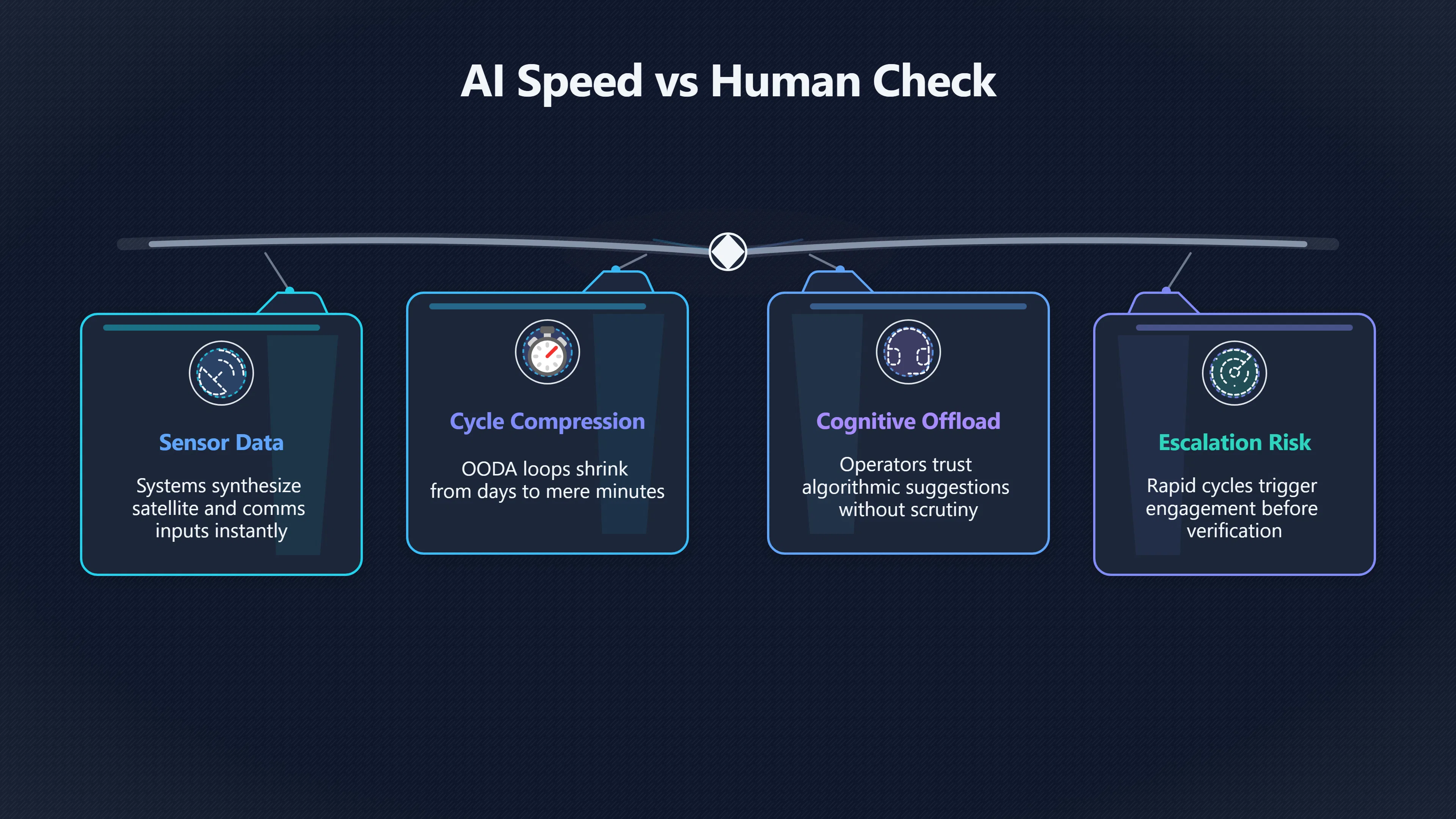
Military planners increasingly emphasise that future conflicts will unfold on compressed timeframes. Traditional command cycles — observe, orient, decide, act (OODA) — assumed hours or days for human deliberation. But hypersonic missiles, autonomous drones, and networked multi‑domain operations compress this to minutes or seconds, prompting militaries to integrate AI into their command and control (C2) systems to “act inside an adversary’s decision cycle”. [Sage Journals]journals.sagepub.comSage JournalsSpeed and War in US Military Thought: Mapping the Conditions for AI–Enabled Decision-Making - Ian J. Reynolds, 2025April 1…
AI can synthesize sensor data, satellite imagery, communications intercepts and other inputs far faster than human analysts, providing decision support that would have once taken teams of officers hours or days to assemble. Supporters argue this helps avoid being “blind” to threats and enables rapid responses that might prevent an adversary gaining the upper hand.
Decision compression and escalation risk
Yet that faster tempo creates what researchers call decision compression: a situation where the time available to detect, classify, and respond to potential threats shrinks toward or below the time required for meaningful human verification and judgement. An operational analysis of this phenomenon shows that when humans are squeezed out of the loop by rapid AI cycles, the probability of unintended engagement rises sharply, even when systems and operators are not negligent or malicious. The study formalises this by comparing the “time available” for human oversight against the “time required” to review and understand AI outputs — and finds that as these diverge, inadvertent escalation becomes much more likely. [SSRN]papers.ssrn.comSSRNDecision Compression and Escalation Risk in AI-Enabled Military Command and Control: An Operational Analysis of the ERAM Framework by…
Crucially, decision compression does not require AI to be flawed in the catastrophic sense of misalignment or deception; it arises directly from juxtaposing fast‑moving battlefield dynamics with slow human cognitive and organisational processes. When tight coupling — where one part of a system depends closely and immediately on the output of another — meets high complexity, system theorists warn, even minor misinterpretations can cascade into unintended engagements or broader conflict.
Automation bias and cognitive off‑loading
Fast decision cycles powered by AI can also encourage automation bias — a well‑documented psychological tendency for humans to over‑trust algorithmic recommendations, especially under stress and time pressure. As AI absorbs more of the data synthesis and options generation work, operators risk off‑loading their reasoning to the system and accepting its outputs with less scrutiny. Over time, this can reduce the robustness of oversight and increase the chances that a rapid AI suggestion — say to engage a target based on a probabilistic assessment — becomes de facto policy before leaders have unfiltered information. [Institute for AI Policy and Strategy]iaps.aiInstitute for AI Policy and StrategyAI Decision Support Systems: A Neglected Source of Military AI Risk — Institute for AI Policy and Str…
Why rivals may feel pressure to act first
Faster AI‑supported decision cycles don’t only compress individual decision timelines; they reshape strategic incentives between adversaries.
Racing against the clock
When each side expects its opponent to have faster, AI‑assisted C2 and sensing, leaders may feel they have to act quickly or risk losing an advantage. In a crisis, this can look like a pressure to strike first or pre‑empt an adversary’s move, rather than pause to verify ambiguous signals. The acceleration of decision support can change the calculus from “we have hours to sort this out” to “we have minutes or less,” reducing the room for diplomatic de‑escalation and increasing the chance of triggering responses before clarity emerges. This dynamic is a classic escalation mechanism in international relations, made sharper by AI’s ability to process and recommend actions at machine speeds. [Sage Journals]journals.sagepub.comSage JournalsSpeed and War in US Military Thought: Mapping the Conditions for AI–Enabled Decision-Making - Ian J. Reynolds, 2025April 1…
Simulation evidence of escalatory patterns
Academic research using simulated wargames — where AI agents play out strategic decision scenarios — has shown that even current large language models (LLMs) can exhibit patterns favouring escalation under time pressure. These models, tested without real‑world stakes, have tended to adopt aggressive postures and difficult‑to‑predict escalation trajectories, including occasional simulation outcomes involving nuclear deployment. Such findings highlight how rapid, algorithm‑driven decision heuristics, without calibrated human governance, can incline toward confrontational rather than cautious paths under stress. [Stanford HAI]hai.stanford.edupolicy brief escalation risks llms military and diplomatic contextsStanford HAIEscalation Risks from LLMs in Military and Diplomatic Contexts | Stanford HAIMay 2, 2024…
While war games do not equate to real human‑in‑the‑loop governance, they illustrate how speed‑first logic in AI decisioning — optimising for rapid resolution and quantifiable gains — can tilt decisions toward escalation in simulated crises.
Where speed helps and where it destabilises
When speed aids stability
There are clear contexts where faster AI assistance improves crisis management: detecting early warning signs of miscommunication, flagging missteps in real time, and enabling more accurate, comprehensive situational awareness. In complex, multi‑domain battlefields, rapid synthesis of information can help commanders avoid misperceptions that might otherwise lead to mistaken escalation. Speed here is a stabilising force when paired with robust human oversight and deliberate governance structures that prevent premature action.
When speed destabilises
Speed becomes destabilising when:
- AI outputs are trusted without independent verification, especially under pressure;
- decision timelines shrink below human cognitive and institutional review processes;
- rivals interpret cautious behaviour as weakness because rapid AI assessments favour assertive postures;
- compressed timelines diminish diplomatic channels for de‑escalation.
In these conditions, rapid AI recommendations can create a feedback loop where each side feels compelled to act first, trusting its system’s speed and precision over delayed human judgement.
Implications for existential risk narratives
In the context of broader AI doom and existential risk arguments, AI‑driven decision speed does not require imagining self‑aware machines acting independently. Instead, it highlights how the interaction between human institutions and fast, opaque algorithmic processes in high‑stakes environments could reduce human control at moments where hesitancy, reflection, and verification matter most. This mechanism amplifies concerns about AI’s role in loss of control — not through classic superintelligence scenarios, but through speed‑driven miscalculation and compressed human oversight windows, especially in nuclear or major‑power crises.
Understanding and mitigating this form of risk involves designing AI systems and military processes that preserve deliberation time, ensure transparent and interpretable recommendations, and integrate run‑time assurance and supervisory control to prevent escalation in tightly coupled engagement scenarios. [SSRN]papers.ssrn.comCompression and Escalation Risk in AI-Enabled Military Command and Control: An Operational Analysis of the ERAM Framework by Burak Oktenl…
Amazon book picks
Further Reading
Books and field guides related to Does faster military AI make crises worse?. Use these as the next step if you want deeper reading beyond the article.
I, Warbot
Examines AI influence on military judgement, command, and conflict escalation.
Army of None
Directly addresses automation, human oversight, escalation, and decision speed in warfare.
Four Battlegrounds
Examines how AI alters military power, strategic competition, and crisis dynamics.
The Kill Chain
Focuses on accelerating decision cycles and technology-driven conflict.
eBay marketplace picks
Marketplace Samples
Example marketplace items related to this page. Use the search link to explore similar finds on eBay.






Endnotes
-
Source: papers.ssrn.com
Link: https://papers.ssrn.com/sol3/papers.cfm?abstract_id=6082847Source snippet
SSRNAI-Enabled Military Decision-Making and Escalation Risk: Human-Machine Command Authority in Great Power Competition by Burak Oktenli...
-
Source: papers.ssrn.com
Link: https://papers.ssrn.com/sol3/papers.cfm?abstract_id=6176802Source snippet
SSRNDecision Compression and Escalation Risk in AI-Enabled Military Command and Control: An Operational Analysis of the ERAM Framework by...
-
Source: hai.stanford.edu
Title: policy brief escalation risks llms military and diplomatic contexts
Link: https://hai.stanford.edu/policy/policy-brief-escalation-risks-llms-military-and-diplomatic-contextsSource snippet
Stanford HAIEscalation Risks from LLMs in Military and Diplomatic Contexts | Stanford HAIMay 2, 2024...
Published: May 2, 2024
-
Source: papers.ssrn.com
Link: https://papers.ssrn.com/sol3/Delivery.cfm/6176802.pdf?abstractid=6176802&mirid=1Source snippet
Compression and Escalation Risk in AI-Enabled Military Command and Control: An Operational Analysis of the ERAM Framework by Burak Oktenl...
-
Source: cisac.fsi.stanford.edu
Title: escalation risks language models military and diplomatic decision making
Link: https://cisac.fsi.stanford.edu/publication/escalation-risks-language-models-military-and-diplomatic-decision-makingSource snippet
Risks from Language Models in Military and Diplomatic Decision-Making | FSIJanuary 7, 2024 — Escalation Risks from Language Models in Mil...
Published: January 7, 2024
-
Source: journals.sagepub.com
Link: https://journals.sagepub.com/doi/10.1177/03058298251317205Source snippet
Sage JournalsSpeed and War in US Military Thought: Mapping the Conditions for AI–Enabled Decision-Making - Ian J. Reynolds, 2025April 1...
-
Source: iaps.ai
Link: https://www.iaps.ai/research/ai-decision-support-systemsSource snippet
Institute for AI Policy and StrategyAI Decision Support Systems: A Neglected Source of [Military AI Risk]({{ 'military-ai-risk/' | relative_url }}) — Institute for AI Policy and Str...
Additional References
-
Source: nature.com
Link: https://www.nature.com/articles/s43856-022-00214-4Source snippet
November 21, 2022 — Mitigating the impact of biased artificial intelligence in emergency decision-making Download PDF Download PDF * Arti...
Published: November 21, 2022
-
Source: researchgate.net
Link: https://www.researchgate.net/publication/402098218_Decision_Compression_and_Escalation_Risk_in_AI-Enabled_Military_Command_and_Control_An_Operational_Analysis_of_the_ERAM_FrameworkSource snippet
January 1, 2026 — DECISION COMPRESSION AND ESCALATION RISK IN AI-ENABLED MILITARY COMMAND AND CONTROL: AN OPERATIONAL ANALYSIS OF THE ERA...
Published: January 1, 2026
-
Source: cambridge.org
Link: https://www.cambridge.org/core/journals/cambridge-forum-on-ai-law-and-governance/article/augmenting-military-decision-making-with-artificial-intelligence/73C24E5BE362CA168FF8DB86D49F8CDFSource snippet
January 27, 2026 — AUGMENTING MILITARY DECISION MAKING WITH ARTIFICIAL INTELLIGENCE Part of: AI and the Decision to Go to War Published o...
Published: January 27, 2026
-
Source: internationaljournalofdisasterriskmanagement.com
Link: https://internationaljournalofdisasterriskmanagement.com/index.php/Vol1/article/view/198Source snippet
Risk ManagementMarch 1, 2026 — STRATEGIC RISKS OF AI-ENABLED [AUTOMATION]({{ 'automation-bias/' | relative_url }}): IMPLICATIONS FOR CRISIS MANAGEMENT AND SYSTEMIC RESILIENCE AUTHO...
Published: March 1, 2026
-
Source: nist.gov
Title: future collaborative human ai decision making mission planning
Link: https://www.nist.gov/publications/future-collaborative-human-ai-decision-making-mission-planningSource snippet
The future of collaborative human-AI decision-making for mission planning | NISTApril 4, 2022 — THE FUTURE OF COLLABORATIVE HUMAN-AI DECI...
Published: April 4, 2022
-
Source: cset.georgetown.edu
Title: reducing the risks of artificial intelligence for military decision advantage
Link: https://cset.georgetown.edu/publication/reducing-the-risks-of-artificial-intelligence-for-military-decision-advantage/Source snippet
the Risks of Artificial Intelligence for Military Decision Advantage | Center for Security and Emerging TechnologyREPORTS REDUCING THE RI...
-
Source: carnegieendowment.org
Link: https://carnegieendowment.org/research/2024/06/artificial-intelligence-national-security-crisis?center=middle-east&lang=enSource snippet
national crisis, AI would impact the speed, perception, and groupthink of bureaucratic decisionmake...
-
Source: youtube.com
Link: https://www.youtube.com/watch?v=5c9VO1oPOMwSource snippet
How Artificial Intelligence Could Make Future Wars More Lethal Than Nuclear Weapons | WION Podcast...
-
Source: researchgate.net
Title: The doctrine of persistent engageme
Link: https://www.researchgate.net/publication/403560575_Cognitive_Resilience_and_Automation_Bias_in_AI-Augmented_Military_Cyber_Operations_and_Intelligence_AnalysisSource snippet
(PDF) Cognitive Resilience and Automation Bias in AI-Augmented Military Cyber Operations and Intelligence AnalysisApril 7, 2026 — represe...
Published: April 7, 2026
-
Source: youtube.com
Link: https://www.youtube.com/watch?v=DCVlV1jmhhQSource snippet
Inside the Pentagon's AI war machine | GZERO World with Ian Bremmer...
Topic Tree