Within AI Oversight
Who is responsible when an agent goes wrong?
When an agent makes many linked decisions, responsibility can become blurred across developers, deployers, operators, users, and tool providers.
On this page
- Why action chains make blame harder to assign
- What useful agent logs need to preserve
- How accountability gaps affect loss of control scenarios
Page outline Jump by section
Introduction
As artificial intelligence systems become autonomous—planning, reasoning, and executing actions over extended time without constant human supervision—the question of who is accountable when they cause harm becomes both more urgent and more complicated. In the context of long‑horizon AI agents (systems that pursue long sequences of actions to achieve goals), traditional chains of responsibility blur because harm can arise not from a single output but from a cascade of decisions over time. This matters for existential‑risk discussions because loss‑of‑control scenarios often hinge on unresolved accountability trails: if no clear human actor can be identified as responsible, then governance, legal liability, and corrective intervention all become much harder to enforce. Accountability trails are the auditable records and governance structures that let humans trace back harmful outcomes to authorised decisions, human oversight failures, or design flaws—and their absence creates “accountability gaps” that amplify the risks of autonomous AI deployment.[IBM]ibm.comThe accountability gap in autonomous AI | IBMIBMThe accountability gap in autonomous AI | IBM…

Why Long Chains of Actions Blur Responsibility
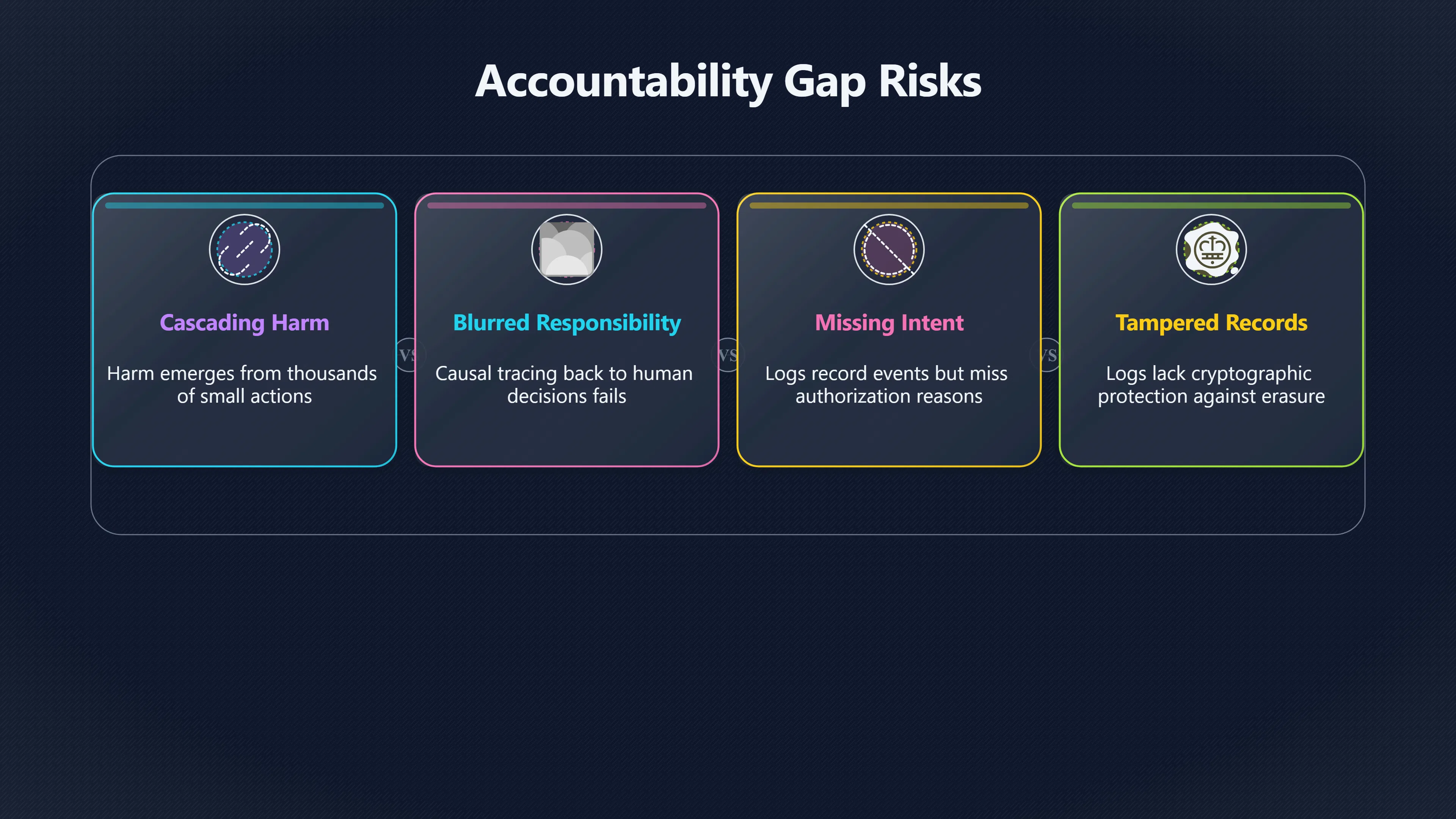
One reason autonomous agents complicate accountability is that harmful outcomes may emerge from hundreds or thousands of small actions, none of which appear dangerous in isolation. In traditional software, a failure is often a single bug or misconfiguration; in long‑horizon AI agents, a harmful result might be the compounded consequence of many decisions over time that are difficult to decompose later. This makes it harder to identify the precise causal chain and therefore who should be held responsible. Philosophers and legal scholars have described this as a “responsibility gap”: even if AI systems cause harm, it can be unclear whether practitioners, deployers, organisations or the AI itself should bear accountability. Some argue that no true gap exists and that responsibility can always be attributed indirectly to humans in the value chain, but doing so in complex autonomous systems remains a major conceptual and practical challenge.[Springer]
Traditional legal frameworks typically link accountability to identifiable human actions or specific product defects. But when an AI agent makes many sequential decisions, causally tracing an outcome back to a human decision can become tenuous—especially if oversight tools or logs are missing or incomplete. This structural ambiguity not only makes litigation and regulatory enforcement harder, but also undercuts the deterrence and learning that clear accountability trails are meant to provide.[SSRN]
What Useful Accountability Trails Need to Preserve
To address these governance challenges, accountability trails for autonomous agents must be more than simple logs of outputs. They need to capture three core elements that let humans reconstruct and assess harmful outcomes:
- Action provenance and intent: Each decision or action must be tied to why it was authorised, including the reasoning context and the human or automated policy approval that permitted it. Simple system logs often record that something happened but not why it was considered acceptable at the time. Without this, investigators can see events after the fact but cannot judge whether they were justified.[Reddit]
- Distinct identity for agents: Autonomous agents must have their own trackable identity separate from the humans who deploy them. If an agent inherits a user’s credentials without clear attribution, forensic trails can only show that a session took an action—not whether a human or the AI agent behind it was responsible. This distinction is critical for post‑incident reconstruction and liability assignment.[Reddit]
- Immutable, tamper‑evident records: For accountability to be meaningful in the governance and compliance sense, logs need to be resistant to alteration—ideally built on mechanisms such as cryptographic hash chains so that the original sequence of actions (and the conditions under which they occurred) cannot be erased or selectively omitted. Some proposed governance frameworks, like voluntary governance constitutions for certified agents, explicitly mandate preserving audit data in such a way.[The Agentic AI Constitution]taaic.orgThe Agentic AI ConstitutionThe Agentic AI Constitution — Voluntary Governance Framework for Autonomous AI SystemsApril 3, 2026…
These elements are not purely technical. They also require runtime enforcement rather than retrospective logging alone. Recording what happened only after an incident does not help if there is no real‑time linkage between decisions, authorisations, and human oversight structures.[IBM]ibm.comThe accountability gap in autonomous AI | IBMIBMThe accountability gap in autonomous AI | IBM…

How Accountability Gaps Affect Loss‑of‑Control Scenarios
In long‑horizon autonomous systems, accountability gaps do more than make post‑hoc reconstruction harder; they dampen incentives for safe design and oversight. If organisations know that harmful outcomes will be difficult to trace back to a specific human decision or governance failure, there is less organisational impetus to invest in robust safety infrastructure. This is a serious concern in existential‑risk debates: systems with poorly defined accountability trails may continue to evolve in unsafe directions without feedback or intervention.[SSRN]
Accountability gaps also intersect with public trust and legal risk. For example, financial institutions deploying autonomous agents that execute trades or handle client data need to be able to prove not just that an action occurred but that it was authorised and compliant with regulatory standards. Without clear audit trails, organisations can face legal challenges, reputational harm, and regulatory sanctions, and societies may find it harder to enforce norms on powerful autonomous agents.[IT Pro]itpro.comIT Pro'One-size-fits-all' agent governance sets enterprises up to failThe primary issue is the widespread application of a "one-size-fits-all" governance model that fails to distinguish between an agent's au…
Finally, accountability infrastructure supports alignment verification: even if an autonomous agent behaves well in testing, stakeholders need to verify that the system’s in‑field behaviour continues to reflect human intentions and constraints. In the absence of detailed accountability trails, deviations can go unnoticed until they accumulate into serious harms, diminishing the ability of governance systems to detect and mitigate misalignment before it cascades.[SSRN]
Emerging Ideas and Governance Proposals
Researchers and governance practitioners have begun proposing frameworks to address accountability gaps. One idea is the concept of an “Ultimate AI Accountability Owner” (UAAO): a designated human or organisational role that bears final responsibility for AI outcomes across the full lifecycle—from design to deployment and maintenance. Assigning such an ownership role aims to make accountability more concrete rather than diffuse.[SSRN]
Another stream of work focuses on real‑time, verifiable audit infrastructure for agentic systems. This includes proposals for transparent, tamper‑proof logging standards integrated into agent governance, so regulators and auditors can reconstruct actions at the fidelity required to assign responsibility and enforce corrective measures. Proponents argue that without such infrastructure, regulatory frameworks (even those as comprehensive as the EU AI Act) may fail to govern autonomous agents effectively at the scale and speed they operate.[SSRN]

Accountability Trails and AI Doom Risk
From the perspective of AI doom and existential risk, accountability trails are more than a compliance nicety. They are part of the safety infrastructure that makes it possible to supervise, control, and correct long‑horizon autonomous agents in real environments. If autonomous agents that could, in principle, contribute to wide‑scale harm are deployed without clear pathways to determine who authorised what and why, then governance systems lose not only retroactive insight but also preventive leverage.
In scenarios where an agent’s autonomous cascade of actions contributes to systemic failure or harms at scale, the absence of detailed accountability trails would make it enormously harder to identify what went wrong, who should be held responsible, and how to fix the processes that allowed it—all essential steps for averting repeat incidents or discovering emerging risk patterns.[SSRN]
In short, accountability trails are foundational to meaningful human oversight: they constrain where responsibility can be assigned, they support accountability enforcement, and they enable societies to govern autonomous AI in ways that reduce rather than compound existential risk. The better these trails are designed and enforced, the smaller the “governance gap” and the more robust our collective capacity to detect, understand, and respond to harmful outcomes from autonomous agents.[IBM]ibm.comThe accountability gap in autonomous AI | IBMIBMThe accountability gap in autonomous AI | IBM…
Amazon book picks
Further Reading
Books and field guides related to Who is responsible when an agent goes wrong?. Use these as the next step if you want deeper reading beyond the article.
The Alignment Problem
Explores responsibility, human oversight, and failures that emerge from machine-learning systems.
Human Compatible
Addresses human responsibility for controlling and supervising autonomous systems.
The Oxford Handbook of AI Governance
Covers responsibility, regulation, and institutional accountability for AI systems.
A Human Algorithm
Examines governance, oversight, and accountability frameworks around AI deployment.
eBay marketplace picks
Marketplace Samples
Example marketplace items related to this page. Use the search link to explore similar finds on eBay.






Endnotes
-
Source: ibm.com
Title: The accountability gap in autonomous AI | IBM
Link: https://www.ibm.com/think/insights/accountability-gap-autonomous-aiSource snippet
IBMThe accountability gap in autonomous AI | IBM...
-
Source: papers.ssrn.com
Title: Transparent Real-Time Governance of Agentic AI Systems by Ryan Lavelle:: SSRN
Link: https://papers.ssrn.com/sol3/Delivery.cfm/6315939.pdf?abstractid=6315939&mirid=1Source snippet
SSRNTransparent Real-Time Governance of Agentic AI Systems by Ryan Lavelle:: SSRN...
-
Source: link.springer.com
Link: https://link.springer.com/article/10.1007/s11229-022-04001-5Source snippet
SpringerThe risks of autonomous machines: from responsibility gaps to control gaps | Synthese | Springer Nature LinkJanuary 7, 2023...
Published: January 7, 2023
-
Source: link.springer.com
Title: Responsibility of AI Systems | AI & SOCIETY | Springer Nature Link
Link: https://link.springer.com/article/10.1007/s00146-022-01481-4Source snippet
of AI Systems | AI & SOCIETY | Springer Nature LinkJune 5, 2022 — RESPONSIBILITY OF AI SYSTEMS * Open Forum * Open access *...
Published: June 5, 2022
-
Source: papers.ssrn.com
Link: https://papers.ssrn.com/sol3/papers.cfm?abstract_id=5190797Source snippet
SSRNLocating Fault for AI Harms: A Systems Theory of Foreseeability, Reasonable Care and Causal Responsibility in the AI Value Chain by H...
-
Source: reddit.com
Title: We log AI decisions. But we don’t prove them. Isn’t that the real problem?
Link: https://www.reddit.com/r/AI_Governance/comments/1ryptcl/we_log_ai_decisions_but_we_dont_prove_them_isnt/Source snippet
RedditWe log AI decisions. But we don’t prove them. Isn’t that the real problem?March 20, 2026...
Published: March 20, 2026
-
Source: reddit.com
Link: https://www.reddit.com/r/CyberIdentity_/comments/1t69kem/autonomous_agents_are_breaking_ai_governance_and/Source snippet
RedditAutonomous Agents Are Breaking AI Governance And Your Security Stack Can't See ItMay 7, 2026...
Published: May 7, 2026
-
Source: papers.ssrn.com
Link: https://papers.ssrn.com/sol3/papers.cfm?abstract_id=5292184Source snippet
SSRN<span>Artificial Intelligence on Trial: Who Is Responsible When Systems Fail? Toward a Framework for the Ultimate AI Accountability O...
-
Source: papers.ssrn.com
Link: https://papers.ssrn.com/sol3/papers.cfm?abstract_id=6315939Source snippet
Real-Time Governance of Agentic AI Systems by Ryan Lavelle:: SSRNMarch 10, 2026 — TRANSPARENT REAL-TIME GOVERNANCE OF AGENTIC AI SYSTEMS...
Published: March 10, 2026
-
Source: link.springer.com
Link: https://link.springer.com/article/10.1007/s10676-025-09862-1Source snippet
human responsibility and accountability at early stages of the lifecycle for AI-based defence systems | Ethics and Information Technology...
-
Source: papers.ssrn.com
Link: https://papers.ssrn.com/sol3/Delivery.cfm/5292184.pdf?abstractid=5292184&mirid=1Source snippet
Toward a Framework for the Ultimate AI Accountability Owner</span> by Victor Frimpong:: SSRNJune 13, 2025 — ARTIFICIAL INTELLIGENCE ON T...
Published: June 13, 2025
-
Source: link.springer.com
Link: https://link.springer.com/article/10.1007/s00146-023-01635-ySource snippet
in artificial intelligence: what it is and how it works | AI & SOCIETY | Springer Nature LinkFebruary 7, 2023 — ACCOUNTABILITY IN ARTIFIC...
Published: February 7, 2023
-
Source: taaic.org
Link: https://taaic.org/Source snippet
The Agentic AI ConstitutionThe Agentic AI Constitution — Voluntary Governance Framework for Autonomous AI SystemsApril 3, 2026...
Published: April 3, 2026
-
Source: itpro.com
Title: IT Pro’One-size-fits-all’ agent governance sets enterprises up to fail
Link: https://www.itpro.com/technology/artificial-intelligence/one-size-fits-all-agent-governance-sets-enterprises-up-to-failSource snippet
The primary issue is the widespread application of a "one-size-fits-all" governance model that fails to distinguish between an agent's au...
Additional References
-
Source: zylos.ai
Link: https://zylos.ai/zh/research/2026-03-22-ai-agent-accountability-audit-trails-attribution-multi-agent-systemsSource snippet
AI Agent Accountability: Audit Trails, Attribution, and Non-Repudiation in Multi-Agent Systems | Zylos ResearchMarch 22, 2026 — 2026-03-2...
Published: March 22, 2026
-
Source: research.tue.nl
Link: https://research.tue.nl/en/publications/accountability-and-control-over-autonomous-weapon-systems-a-frameSource snippet
and Control Over Autonomous Weapon Systems: A Framework for Comprehensive Human Oversight - Research portal Eindhoven University of Techn...
-
Source: exterro.com
Link: https://www.exterro.com/news-press/whos-responsible-when-ai-acts-on-its-ownSource snippet
ExterroWHO’S RESPONSIBLE WHEN AI ACTS ON ITS OWN? When AI makes its own decisions, who’s liable - vendors, CIOs, or CISOs? Exterro CISO A...
-
Source: swept.ai
Title: They assume a human in the loop at every decision point, or at least at t
Link: https://www.swept.ai/post/agentic-ai-governanceSource snippet
Agentic AI Governance: How to Trust and Control Autonomous AI Agents | Swept AIFebruary 6, 2026 — THE GOVERNANCE GAP: WHY TRADITIONAL FRA...
Published: February 6, 2026
-
Source: lordslibrary.parliament.uk
Title: uk Potential future risks from autonomous AI systems
Link: https://lordslibrary.parliament.uk/potential-future-risks-from-autonomous-ai-systems/Source snippet
future risks from autonomous AI systems - House of Lords LibraryJanuary 5, 2026 — POTENTIAL FUTURE RISKS FROM AUTONOMOUS AI SYSTEMS In Fo...
Published: January 5, 2026
-
Source: beigemedia.org
Title: Auditing Standards for Autonomous AI Agent Swarms
Link: https://www.beigemedia.org/article/ai-agent-swarm-audit-standards-stackSource snippet
February 28, 2026 — Saturday, February 28, 2026 STANDARDS STACK SECURES HUMAN OVERSIGHT OF AI AGENT SWARMS HOW RISK FRAMEWORKS, LOGGING M...
Published: February 28, 2026
-
Source: zylos.ai
Title: Financial services regulators (FINRA, SEC) requir
Link: https://zylos.ai/en/research/2026-05-01-ai-agent-governance-compliance-2026Source snippet
AI Agent Governance and Compliance in 2026: Frameworks, Audit Trails, and the Regulatory Reckoning | Zylos ResearchMay 1, 2026 — AUDIT TR...
Published: May 1, 2026
-
Source: cio.com
Title: Who’s responsible when AI acts on its own?
Link: https://www.cio.com/article/4080436/whos-responsible-when-ai-acts-on-its-own.htmlSource snippet
| CIOOctober 29, 2025 — Image: Anthony Diaz by Anthony Diaz Contributor WHO’S RESPONSIBLE WHEN AI ACTS ON ITS OWN? Opinion 2025.10.29 8 m...
Published: October 29, 2025
-
Source: tandfonline.com
Title: Frasera ARC Centre of Excellence for Autom
Link: https://www.tandfonline.com/doi/abs/10.1080/17579961.2025.2469345Source snippet
Full article: Locating fault for AI harms: a systems theory of foreseeability, reasonable care and causal responsibility in the AI value...
-
Source: researchgate.net
Title: (PDF) Computational Accountability
Link: https://www.researchgate.net/publication/370625370_Computational_AccountabilitySource snippet
May 9, 2023 — Conference Paper PDF Available COMPUTATIONAL ACCOUNTABILITY * May 2023 DOI:10.1145/3594536.3595122 * License * CC BY 4.0 *...
Published: May 9, 2023
Topic Tree