Within Misuse
Why Policy Gaps Heighten Risks of AI Misuse
Highlights weaknesses in policy, oversight, and safeguards that could fail to stop catastrophic human-directed AI misuse.
On this page
- Current regulatory and oversight limitations
- Challenges in dual use and cybersecurity domains
- Paths to effective mitigation and coordination
Page outline Jump by section
Introduction
Even as AI systems grow more capable, policy and regulatory structures intended to prevent their catastrophic misuse lag behind. Across biological, cybersecurity and military domains, analysts and regulators are sounding alarm bells: existing frameworks, institutional capacities and enforcement mechanisms are fragmented, under‑resourced, or ill‑matched to the technical realities of modern AI. These “governance gaps” matter for the broader debate about AI doom and existential risk because weak oversight makes it easier for powerful AI tools to be misapplied at scale — whether by accident, negligence or deliberate misuse. This article examines where governance frameworks are currently weakest, and why those weaknesses could increase the risk that AI systems contribute to truly catastrophic outcomes. [Political Marketer]politicalmarketer.comPolitical Marketer AI Governance: What Governments Are Actually DoingPolitical MarketerAI Governance: What Governments Are Actually DoingFebruary 2, 2026…
Current Regulatory and Oversight Limitations
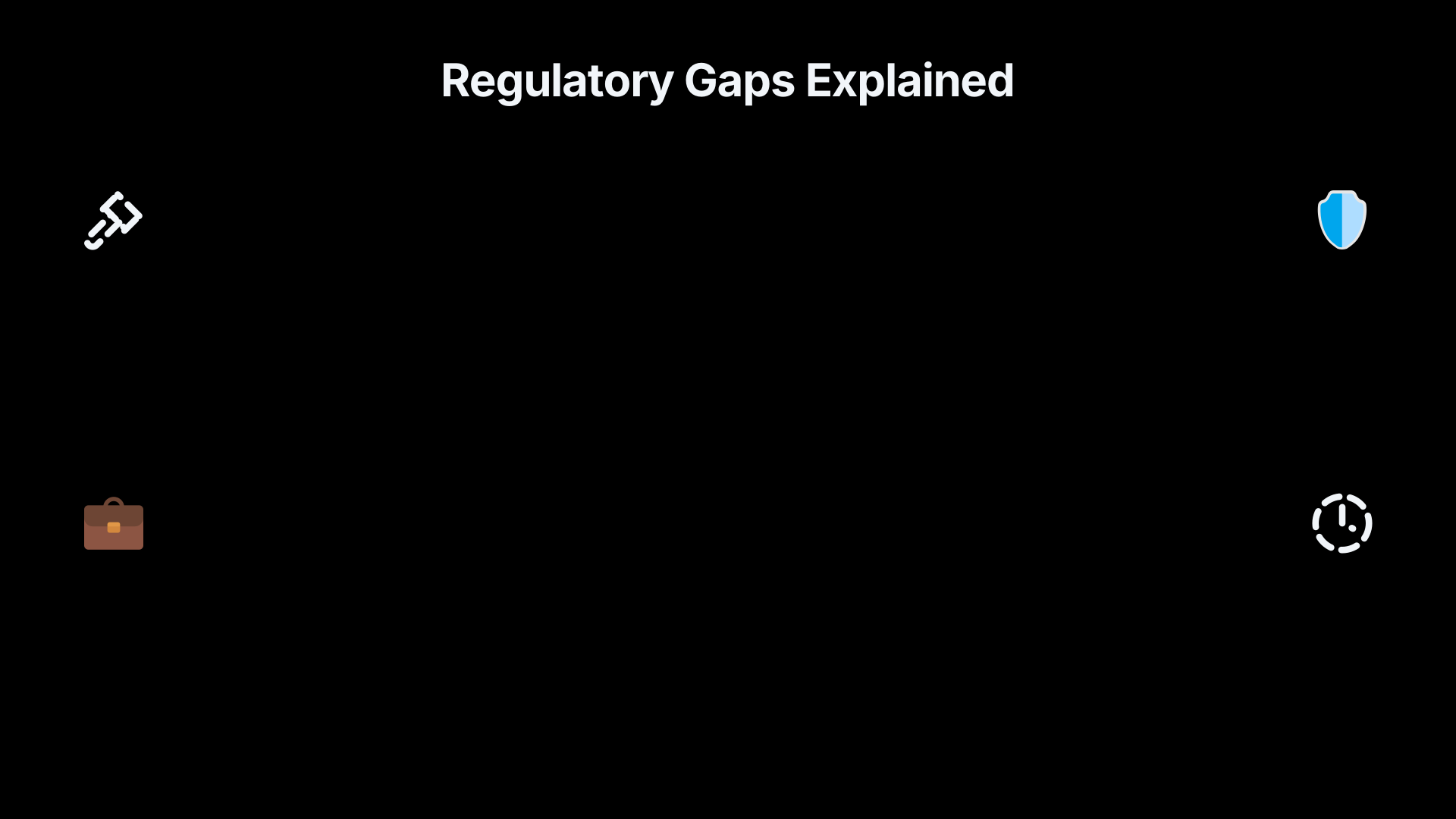
A recurring theme in policy reviews is that frameworks exist in theory but struggle in practice. Governments and international bodies have proliferated high‑level AI principles and draft legislation, such as the EU’s risk‑based AI regulatory framework, but these often lack the enforceability, auditability and operational clarity needed to prevent misuse across complex domains. For example, scholars reviewing major governance instruments — including the EU AI Act, ISO standards, the NIST AI Risk Management Framework, and OECD principles — identify persistent gaps in how obligations can be audited and enforced, especially among smaller actors with limited capacity. [MDPI]mdpi.comMDPIGaps in AI-Compliant Complementary Governance Frameworks’ Suitability (for Low-Capacity Actors), and Structural Asymmetries (in the C…
One structural weakness is fragmented oversight. Governments often regulate AI piecemeal through existing sectoral rules rather than a coherent, mission‑oriented approach. This leaves coverage uneven: some use cases, like consumer AI chatbots, attract guidance on transparency and fairness, while high‑stakes deployments in national security or bioinformatics may escape meaningful regulatory scrutiny. Enforcement capacity also lags: regulators frequently lack the technical expertise and institutional coordination to verify compliance or hold actors accountable when misuses occur. [Political Marketer]politicalmarketer.comPolitical Marketer AI Governance: What Governments Are Actually DoingPolitical MarketerAI Governance: What Governments Are Actually DoingFebruary 2, 2026…
In the national context, this fragmentation is mirrored by organisational readiness gaps. Many regulatory bodies remain early in their “AI journeys”, struggling with limited skills, weak coordination and resource constraints that undermine their ability to detect misuse or intervene effectively in complex cross‑sector threats. [The Alan Turing Institute]turing.ac.ukSource details in endnotes.
Challenges in Dual‑Use and Security‑Sensitive Domains
Dual‑Use Technologies Defy Traditional Governance
AI’s dual‑use nature — where the same capabilities can be used for benefit or harm — complicates regulation. Tools that accelerate drug discovery or genome analysis can also lower barriers to biological threat design, yet export controls and sectoral safety norms for dual‑use technologies rarely cover algorithmic risks or AI‑mediated misuse scenarios. Dual‑use technologies resist easy categorisation into “safe” or “hazardous”, weakening the reach of existing governance structures. [ORF Online]orfonline.orgORF Online From Satellites to Synthetic Biology: The Dual-Use DilemmaORF OnlineFrom Satellites to Synthetic Biology: The Dual-Use DilemmaMarch 19, 2026…
In biotechnology, the convergence of AI and laboratory automation accelerates research cycles, leaving policymakers scrambling to respond. Traditional governance faces a dilemma: acting too early risks stifling innovation; waiting too long cedes the initiative to actors who may deploy tools without sufficient safeguards. Without more adaptive oversight, the pace of technical change can outstrip the ability to anticipate and mitigate misuse pathways. [PMC]pmc.ncbi.nlm.nih.govlient regulatory frameworks to address potential risks - PMCJanuary 3, 2026…
Cybersecurity and Military Use Cases Fall Through the Cracks
Sophisticated cyberattacks and autonomous military systems illustrate another governance gap: existing civil AI regulation often explicitly excludes defence and national security, creating a regulatory vacuum for dual‑use military AI technologies. Civil frameworks may set standards for safety and transparency in public services or commercial products, but they do not easily map onto offensive cyber tooling or autonomous weapon systems. The national security community is aware that civil governance discussions have limited impact on defence AI policy, yet there is still no consistent mechanism linking these domains. [Atlantic Council]atlanticcouncil.orgAtlantic CouncilSecond-order impacts of civil artificial intelligence regulation on defense: Why the national security community must eng…
In cybersecurity, AI tools intended for defence — such as intrusion detection or automated response — also present offensive misuse risks. Autonomous “agentic” systems blur the lines between protection and exploitation; defenders worry that systems designed to probe networks could be repurposed into offensive tools by state or non‑state actors. These dynamics sit in a grey area that traditional cybersecurity law and policy struggle to regulate. [PMC]pmc.ncbi.nlm.nih.govlient regulatory frameworks to address potential risks - PMCJanuary 3, 2026…
Gaps in Accountability, Enforcement, and Institutional Capacity
A pervasive governance issue is the accountability gap. Even where laws exist on the books, holding actors to account after AI misuse is structurally difficult. Powerful AI firms operate globally and across jurisdictions, making it hard for any single regulator to enforce compliance or impose sanctions. Critics argue that many frameworks assume unrealistic institutional capacities — expecting regulators to audit and control systems they cannot realistically monitor or explain in detail. Bridging this gap requires not just better laws, but deeper institutional capacity and international cooperation. [KU Leuven]kuleuven.beKU LeuvenWhen Regulation Is Not Enough: AI Accountability and the Limits of Law, Governance, and Institutional Capacity — KU Leuven Digit…
Enforcement mechanisms are often weak or under‑developed. For example, regulatory audits and reporting obligations may exist, but without technical capacity to scrutinise complex models or real‑time monitoring tools, regulators may be unable to discern misuse until after damage has been done. This reactive posture contrasts sharply with the fast, automated pace at which modern AI systems can be misused. [Political Marketer]politicalmarketer.comPolitical Marketer AI Governance: What Governments Are Actually DoingPolitical MarketerAI Governance: What Governments Are Actually DoingFebruary 2, 2026…
Fragmented Global Governance and Geopolitical Barriers
AI governance is not only a domestic challenge: it is a global coordination problem. Scholars of international technology governance highlight how geopolitical tensions, divergent national policies, and fragile cooperative institutions undermine efforts to build coherent global standards. When states prioritise national security and competitive advantage, they may resist external oversight or unified norms, leading to a fragmented regulatory landscape that adversarial actors can exploit. Without stronger multinational frameworks, regulatory “race to the bottom” dynamics may prevail, weakening global barriers to misuse. [Springer]link.springer.comSpringerGoverning High-Risk Technologies in a Fragmented World: Geopolitical Tensions, Regulatory Gaps, and Institutional Barriers to Glo…
Historical lessons from areas like biological weapons control suggest that treaty gaps — where governance frameworks fail to encompass new tech realities — can persist for years, eroding norms and enabling misuse. Modern AI‑enabled biological and cyber threats may reveal similar treaty and norm deficiencies unless governance instruments evolve. [Digital Commons]digitalcommons.ndu.eduDigital CommonsBiotechnologies and the Treaty Gap: Why Biological Weapons Governance Is Falling Behind; and Some Thoughts on How to Fix I…
Paths to Effective Mitigation and Coordination
While the governance gaps outlined above are substantial, researchers and policymakers propose several avenues to strengthen oversight. A common theme is anticipatory and adaptive governance — frameworks that evolve with technological change rather than reacting after harms emerge. This may involve iterative risk assessment, real‑time monitoring tools, and dynamic policy mechanisms capable of adjusting to new threat models as they arise. [PMC]pmc.ncbi.nlm.nih.govlient regulatory frameworks to address potential risks - PMCJanuary 3, 2026…
Closer alignment is also needed between civil and defence regulation, ensuring that high‑risk dual‑use systems do not fall outside regulatory purview simply because they cross domain boundaries. This would require new institutional mechanisms for cross‑sector dialogue and oversight. [Atlantic Council]atlanticcouncil.orgAtlantic CouncilSecond-order impacts of civil artificial intelligence regulation on defense: Why the national security community must eng…
Finally, international coordination remains vital. Experts argue for multilateral governance regimes that combine non‑proliferation norms with verification and transparency measures tailored to AI’s specific characteristics. Although challenging, such regimes could create shared norms and accountability mechanisms that reduce incentives for misuse. [Springer]link.springer.comSpringerInternational governance of advancing artificial intelligence | AI & SOCIETY | Springer Nature LinkSeptember 19, 2024…

Why These Gaps Matter for Catastrophic Misuse Risk
Governance gaps heighten the risk that powerful AI systems will be misapplied in ways with far‑reaching consequences. Weak enforcement, fragmented oversight, dual‑use ambiguities and geopolitical fragmentation all contribute to an environment where misuse can proliferate unnoticed and unchallenged. In the context of existential risk debates, these weaknesses are not abstract: they shape the probability pathways by which AI capabilities could intersect with biological, cyber or military systems to produce cascading systemic harms. Addressing these governance gaps is therefore central to any credible strategy for reducing the likelihood of catastrophic misuse arising from advanced AI systems. [Political Marketer]politicalmarketer.comPolitical Marketer AI Governance: What Governments Are Actually DoingPolitical MarketerAI Governance: What Governments Are Actually DoingFebruary 2, 2026…
eBay marketplace picks
Marketplace Samples
Example marketplace items related to this page. Use the search link to explore similar finds on eBay.







Endnotes
-
Source: mdpi.com
Link: https://www.mdpi.com/2624-800X/5/4/101Source snippet
MDPIGaps in AI-Compliant Complementary Governance Frameworks’ Suitability (for Low-Capacity Actors), and Structural Asymmetries (in the C...
-
Source: pmc.ncbi.nlm.nih.gov
Link: https://pmc.ncbi.nlm.nih.gov/articles/PMC12852783/Source snippet
lient regulatory frameworks to address potential risks - PMCJanuary 3, 2026...
Published: January 3, 2026
-
Source: link.springer.com
Link: https://link.springer.com/article/10.1007/s40647-025-00445-4Source snippet
SpringerGoverning High-Risk Technologies in a Fragmented World: Geopolitical Tensions, Regulatory Gaps, and Institutional Barriers to Glo...
-
Source: link.springer.com
Link: https://link.springer.com/article/10.1007/s00146-024-02050-7Source snippet
SpringerInternational governance of advancing [artificial]({{ 'artificial-goals/' | relative_url }}) intelligence | AI & SOCIETY | Springer Nature LinkSeptember 19, 2024...
Published: September 19, 2024
-
Source: politicalmarketer.com
Title: Political Marketer AI Governance: What Governments Are Actually Doing
Link: https://politicalmarketer.com/ai-governance/Source snippet
Political MarketerAI Governance: What Governments Are Actually DoingFebruary 2, 2026...
Published: February 2, 2026
-
Source: turing.ac.uk
Link: https://www.turing.ac.uk/news/publications/common-regulatory-capacity-ai -
Source: orfonline.org
Title: ORF Online From Satellites to [Synthetic]({{ ‘synthetic-data/’ | relative_url }}) Biology: The Dual-Use Dilemma
Link: https://www.orfonline.org/research/from-satellites-to-synthetic-biology-the-dual-use-dilemmaSource snippet
ORF OnlineFrom Satellites to Synthetic Biology: The Dual-Use DilemmaMarch 19, 2026...
Published: March 19, 2026
-
Source: atlanticcouncil.org
Link: https://www.atlanticcouncil.org/in-depth-research-reports/report/second-order-impacts-of-civil-artificial-intelligence-regulation-on-defense-why-the-national-security-community-must-engage/Source snippet
Atlantic CouncilSecond-order impacts of civil artificial intelligence regulation on defense: Why the national security community must eng...
-
Source: pmc.ncbi.nlm.nih.gov
Link: https://pmc.ncbi.nlm.nih.gov/articles/PMC12569510/Source snippet
PMCSeptember 1, 2025...
Published: September 1, 2025
-
Source: kuleuven.be
Link: https://www.kuleuven.be/digisoc/blog-posts/when-regulation-is-not-enough-ai-accountability-and-the-limits-of-law-governance-and-institutional-capacitySource snippet
KU LeuvenWhen Regulation Is Not Enough: [AI Accountability]({{ 'ai-accountability/' | relative_url }}) and the Limits of Law, Governance, and Institutional Capacity — KU Leuven Digit...
-
Source: digitalcommons.ndu.edu
Link: https://digitalcommons.ndu.edu/strategic-insights/43/Source snippet
Digital CommonsBiotechnologies and the Treaty Gap: Why Biological Weapons Governance Is Falling Behind; and Some Thoughts on How to Fix I...
Additional References
-
Source: researchgate.net
Link: https://www.researchgate.net/publication/392085008_Mitigating_Cyber_Risk_in_the_Age_of_Open-Weight_LLMs_Policy_Gaps_and_Technical_RealitiesSource snippet
May 21, 2025 — MITIGATING CYBER RISK IN THE AGE OF OPEN-WEIGHT LLMS: POLICY GAPS AND TECHNICAL REALITIES * May 2025 DOI:10.48550/arXiv.25...
Published: May 21, 2025
-
Source: committees.parliament.uk
Link: https://committees.parliament.uk/work/6986/governance-of-artificial-intelligence-ai/news/199791/ai-regulatory-gap-analysis-a-welcome-first-step-towards-addressing-ai-governance-challenges-says-committee-chair/Source snippet
regulatory gap analysis a welcome first step towards addressing AI governance challenges, says Committee Chair - Committees - UK Parliame...
-
Source: doaj.org
Link: https://doaj.org/article/f90d2cac0f264b959dba4bfbff1a3152Source snippet
iance Ecosystem)—A Systematic Review – DOAJJournal of Cybersecurity and Privacy (Nov 2025) GAPS IN AI-COMPLIANT COMPLEMENTARY GOVERNANCE...
-
Source: dgap.org
Title: anticipatory governance emerging and disruptive technologies dual use
Link: https://dgap.org/en/research/publications/anticipatory-governance-emerging-and-disruptive-technologies-dual-useSource snippet
Anticipatory governance of emerging and disruptive technologies with dual-use potential | DGAPJuly 25, 2022 — Jul 25, 2022 ANTICIPATORY G...
Published: July 25, 2022
-
Source: pmc.ncbi.nlm.nih.gov
Title: While a range of potentia
Link: https://pmc.ncbi.nlm.nih.gov/articles/PMC11835847/Source snippet
AI in biotechnology: balancing discovery, innovation and biosecurity risks - PMCFebruary 5, 2025 — SAFEGUARDS FOR MITIGATING RISKS: CURRE...
Published: February 5, 2025
-
Source: GOV.UK
Title: www.gov.uk Cyber security risks to artificial intelligence
Link: https://www.gov.uk/government/publications/research-on-the-cyber-security-of-ai/cyber-security-risks-to-artificial-intelligenceSource snippet
Executive summary 2. 1. Introduction 3. 2. Methodology 4. 3. Background 5. 4. Findings of the risk assessment 6. 5...
-
Source: chathamhouse.org
Title: Breaking the deadlock on AI governance
Link: https://www.chathamhouse.org/node/38293/nojsSource snippet
SummaryMarch 30, 2026 — BREAKING THE DEADLOCK ON AI GOVERNANCE How a crisis could lead to global coordination Research paper Published 30...
Published: March 30, 2026
-
Source: sciety.org
Title: William Walter Finch
Link: https://sciety.org/articles/activity/10.3390/jcp5040101Source snippet
Gaps in AI-Compliant Complementary Governance Frameworks’ Suitability (for Low-Capacity Actors), and Structural Asymmetries (in the Compl...
-
Source: youtube.com
Title: ‘Godfather of AI’ warns of existential risks | GZERO World with Ian Bremmer
Link: https://www.youtube.com/watch?v=tuCBVuzTKAUSource snippet
The “Godfather of AI,” Dr. Geoffrey Hinton, on AI's Existential Risk...
-
Source: pmc.ncbi.nlm.nih.gov
Link: https://pmc.ncbi.nlm.nih.gov/articles/PMC7310294/Source snippet
Tucker in his 2012 book, Innovation, Dual Use, and Security: Managing the Risks of Emerging Biological and Chemical Technologies...
Topic Tree