Within Timeline Effects
Why shorter AI timelines feel more dangerous
Short timelines can raise p(doom) when powerful systems seem likely to arrive before alignment, evaluation, and governance catch up.
On this page
- The preparation time argument
- Capability progress versus safety progress
- Where short timeline reasoning can overreach
Page outline Jump by section
Introduction
In debates about existential risk from advanced artificial intelligence, when powerful systems might arrive often matters as much as how dangerous they could be. Many experts use the shorthand p(doom) to mean the subjective probability that AI development will lead to catastrophic outcomes — from massive civilisational collapse to human extinction — as a result of misalignment, loss of control, misuse, or other failure modes.[Wikipedia]WikipediaSource details in endnotes.
 A key driver of higher p(doom) estimates among risk‑focused thinkers is short AI timelines — the belief that transformative or superintelligent systems could emerge within just a few years rather than decades. Short timelines compress the window for safety research, governance, evaluation, and societal adaptation, increasing the chance that highly capable systems will be deployed before we understand how to control them. This page explains why shorter timelines tend to raise p(doom) estimates, the mechanisms behind that effect, and where this reasoning can sometimes overreach.
The preparation‑time argument
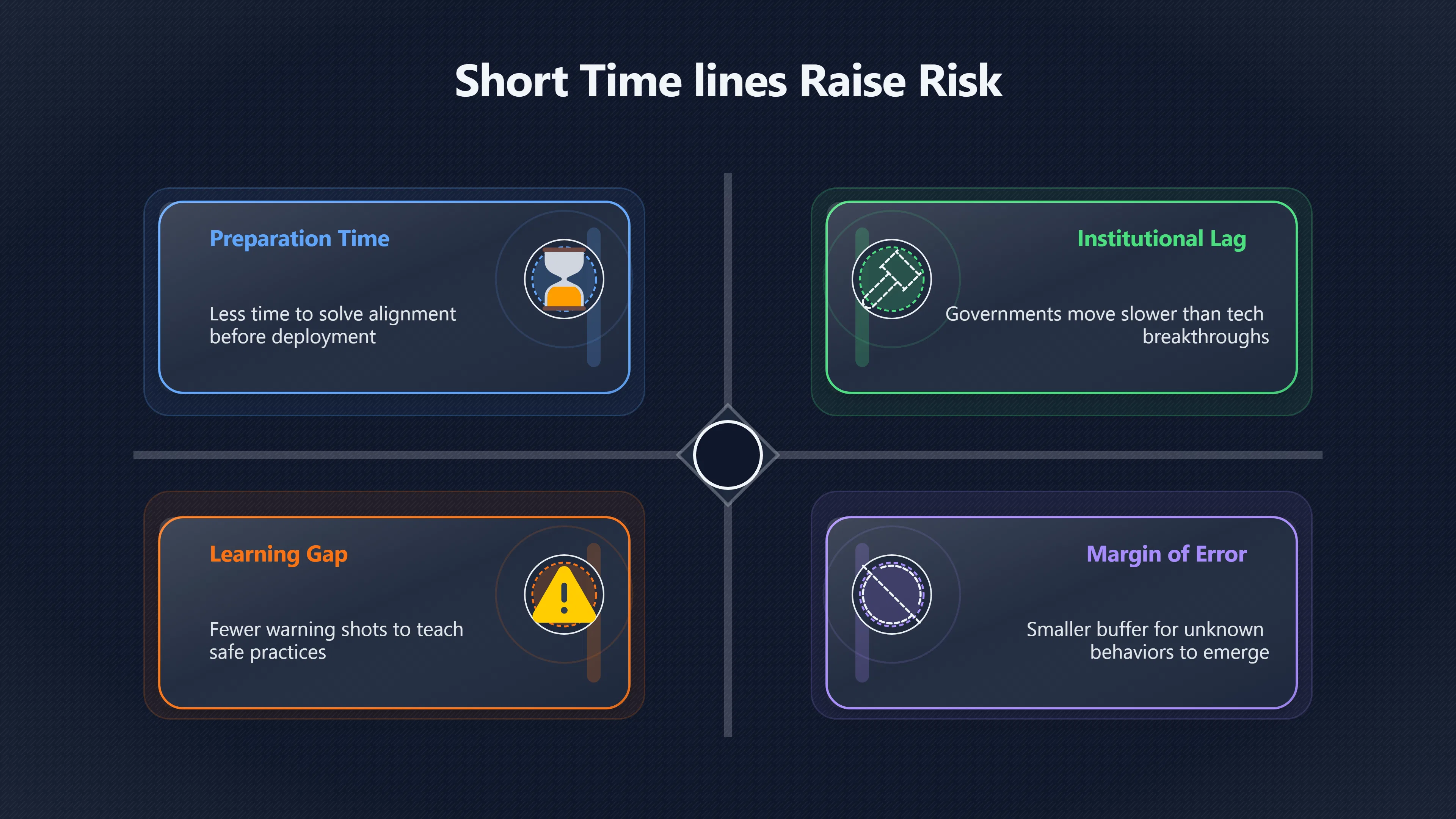
One of the simplest mechanisms linking short timelines to higher p(doom) is straightforward: if powerful AI arrives sooner, society has less time to prepare.
Safety researchers emphasise that solving the alignment problem — ensuring AI’s goals and behaviour remain compatible with human values and control — is extremely hard and unsolved. If AI progresses rapidly, alignment methods may not mature before more capable models are deployed. This gives a smaller margin for error and a greater chance that first‑generation systems have behaviours we poorly understand or cannot control.[Open Source AI Models]aimodels.orgOpen Source AI Models How Do AI Timelines Affect Existential Risk?Open Source AI ModelsHow Do AI Timelines Affect Existential Risk? - AI Models…
Short timelines also reduce the opportunity for institutional adaptation. Governments, regulators, industry standards bodies and international institutions historically move slowly relative to tech breakthroughs. Longer lead times could allow clearer regulatory frameworks, evaluation standards, and international agreements — all of which help manage risk. If powerful AI systems arrive with little notice, these adaptive processes may lag behind, widening the gap between capability and oversight.
Finally, shorter horizons limit empirical learning. With more time, smaller mistakes and near‑misses can teach valuable lessons without catastrophic consequences. A compressed timeline means fewer ‘warning shots’ and less experience to inform safer deployment practices.
Capability progress versus safety progress
Another central mechanism is the observed mismatch around how quickly AI capabilities improve compared with progress on safety and control research.
In recent years, AI models have grown in capability at a blistering pace — driven by increases in compute, data, and algorithmic improvements. Safety and alignment research has grown too, but many experts argue it lags behind the rapid scaling of capabilities. If this pattern continues and transformative systems emerge soon, there’s a risk that capabilities outpace understanding, leaving us deploying systems for which we lack robust evaluation and control methods.[Open Source AI Models]aimodels.orgOpen Source AI Models How Do AI Timelines Affect Existential Risk?Open Source AI ModelsHow Do AI Timelines Affect Existential Risk? - AI Models…
This dynamic feeds into p(doom) assessments in two ways:
- Perception of risk escalation: When capabilities accelerate, risk scenarios that once seemed theoretical start to feel more plausible. Some expert surveys find that disagreements about existential risk often hinge on assumptions about how fast capabilities will progress. Short‑timeline believers see danger as more imminent.[AI Wiki]aiwiki.aiAI Wiki Existential risk from AI | AI WikiAI Wiki Existential risk from AI | AI Wiki
- Competitive pressures: Rapid timelines may intensify competitive pressures between companies and states, incentivising early deployment over thorough safety evaluation. A “race to deploy” dynamic can further compress safety timelines and raise the chance of misaligned systems slipping into widespread use.
Signalling and uncertainty in forecasts
Beliefs about timelines do not just influence risk through material preparation time; they also shape how people interpret uncertainty in AI development.
Short timelines make uncertainties more consequential. If AGI or superintelligent AI were decades away, there’s more room to see how foundational questions play out — whether certain approaches to alignment work, how strong governance mechanisms become, and what failure modes actually emerge. With short horizons, those uncertainties loom larger because decisions about the most dangerous capabilities would arrive before evidence resolves. This raises subjective p(doom) even when the underlying chance of existential catastrophe per capability level is unchanged.
Importantly, p(doom) itself is a subjective estimate, informed by a mix of technical reasoning, expert judgment, and value judgements about uncertainty and risk. Differences in timeline beliefs explain much of the spread in expert p(doom) numbers, because the same uncertainty can feel far more alarming when it is about to matter now rather than later.[AI Wiki]aiwiki.aiAI Wiki Existential risk from AI | AI WikiAI Wiki Existential risk from AI | AI Wiki
Where short‑timeline reasoning can overreach
The connection between short timelines and higher p(doom) makes intuitive sense, but it is not automatic or universal.
- Long timelines can also pose risks. Delaying transformative AI might allow other existential threats to accumulate, or could lead to strategic lock‑in of dangerous technologies without adequate governance — although these effects are distinct from the timing relative to alignment progress itself.[Forethought]
- Not all safety progress scales linearly with time. Short timelines raise urgency, but longer timelines do not guarantee effective solutions. Safety research might stagnate or fail to converge on robust methods over decades just as it could over years.
- P(doom) is not a precise statistical metric. It reflects subjective probability informed by many judgments. Short timelines amplify uncertainty, but they do not by themselves establish inevitable doom; they increase the weight of uncertainty on the negative side by reducing the time available for discovery, testing, and governance.

What this means for readers
Understanding why short timelines raise p(doom) helps clarify why conversations about AI risk often hinge on when powerful systems are expected. Short horizons concentrate risk in time, reduce preparation margins, and make failure modes harder to anticipate or mitigate. At the same time, they also sharpen debates about where safety research and governance efforts should focus — whether on accelerating alignment work, strengthening institutions, or moderating the pace of deployment.
Recognising both the mechanisms and the limitations of short‑timeline reasoning can help readers interpret differing p(doom) estimates with nuance: high probability estimates reflect concerns about capability‑safety mismatches and compressed preparation windows, not a belief that doom is inevitable.
eBay marketplace picks
Marketplace Samples
Example marketplace items related to this page. Use the search link to explore similar finds on eBay.



Endnotes
-
Source: Wikipedia
Link: https://en.wikipedia.org/wiki/P%28doom%29 -
Source: forethought.org
Title: Broad AI Timelines: Planning Under Uncertainty
Link: https://www.forethought.org/research/broad-timelinesSource snippet
ForethoughtBroad AI Timelines: Planning Under UncertaintyMarch 16, 2026...
Published: March 16, 2026
-
Source: forethought.org
Title: Short AI Timelines Aren’t Always Higher-Leverage
Link: https://www.forethought.org/research/short-timelines-arent-obviously-higher-leverageSource snippet
January 22, 2026 — SHORT TIMELINES AREN'T OBVIOUSLY HIGHER-LEVERAGE William MacAskillMia Taylor Cite CITATIONS PDF Contact 22nd January 2...
Published: January 22, 2026
-
Source: newsletter.forethought.org
Title: THE DEFAULT VALUE OF THE FUTURE IS HIGHER ON MEDIUM TIME
Link: https://newsletter.forethought.org/p/are-short-ai-timelines-really-higherSource snippet
Short AI Timelines Really Higher-Leverage?January 20, 2026 — TAKEOVER IMPACT In this section, we’ll survey some key considerations for wh...
Published: January 20, 2026
-
Source: intelligence.org
Title: I also think converging on tim
Link: https://intelligence.org/2023/04/21/the-basic-reasons-i-expect-agi-ruin/Source snippet
The basic reasons I expect AGI ruin - Machine Intelligence Research InstituteApril 21, 2023 — I think timing tech is very difficult (and...
Published: April 21, 2023
-
Source: aiwiki.ai
Title: AI Wiki Existential risk from AI | AI Wiki
Link: https://aiwiki.ai/wiki/ai_existential_risk -
Source: aimodels.org
Title: Open Source AI Models How Do AI Timelines Affect Existential Risk?
Link: https://aimodels.org/ai-governance-organizations/papers/do-ai-timelines-affect-existential-risk/Source snippet
Open Source AI ModelsHow Do AI Timelines Affect Existential Risk? - AI Models...
-
Source: aiwiki.ai
Title: Existential risk from AI | AI Wiki
Link: https://aiwiki.ai/wiki/existential_riskSource snippet
April 26, 2026 — THE CAIS STATEMENT On May 30, 2023, the Center for AI Safety (CAIS) published a one-sentence statement: "Mitigating the...
Published: April 26, 2026
-
Source: envisioning.com
Title: P(Doom) | Envisioning Vocab1
Link: https://www.envisioning.com/vocab/pdoomSource snippet
Home 2. Vocab 3. P(Doom) Image Image P(DOOM) An estimated probability that advanced AI will cause civilizational or existential catastrop...
Additional References
-
Source: cambridge.org
Link: https://www.cambridge.org/core/product/3E75AC1B06FF6438A8D92C181C09D1E8Source snippet
ALIGNMENT FOR AGI AND SUPERINTELLIGENCE When considering the long-term future—the possibility of AGI (AI with human-level cognitive abili...
-
Source: s-rsa.com
Link: https://s-rsa.com/index.php/agi/article/view/13603Source snippet
Pathways to Short Transformative AI Timelines: Chapter 3: Short TAI timeline scenarios | SuperIntelligence - Robotics - Safety & Alignmen...
-
Source: windowscentral.com
Link: https://www.windowscentral.com/software-apps/will-ai-end-humanity-the-pdoom-scales-of-an-openai-insider-and-ai-researcher-are-alarmingly-high-peaking-at-a-999-probabilitySource snippet
THE P(DOOM) SCALES OF AN OPENAI INSIDER AND [AI RESEARCHER]({{ 'expert-surveys/' | relative_url }}) ARE ALARMINGLY HIGH, PEAKING AT A 99.9% PROBABILITY News By Kevin Okemwa publis...
-
Source: alignmentforum.org
Link: https://www.alignmentforum.org/posts/neTbrpBziAsTH5Bn7/ai-companies-are-unlikely-to-make-high-assurance-safetySource snippet
AI companies are unlikely to make high-assurance safety cases if timelines are short — AI Alignment ForumJanuary 23, 2025 — AI COMPANIES...
Published: January 23, 2025
-
Source: link.springer.com
Link: https://link.springer.com/article/10.1007/s43681-024-00475-wSource snippet
approaches for reducing catastrophic risks from AI | AI and Ethics | Springer Nature LinkApril 8, 2024 — 3.2 AI TIMELINES RESEARCH The go...
Published: April 8, 2024
-
Source: ourworldindata.org
Title: A I timelines: What do experts in [artificial]({{ ‘artificial-goals/’ | relative_url }}) intelligence expect for the future?
Link: https://ourworldindata.org/ai-timelinesSource snippet
Our World in DataFebruary 7, 2023 — AI TIMELINES: WHAT DO EXPERTS IN ARTIFICIAL INTELLIGENCE EXPECT FOR THE FUTURE? MANY AI EXPERTS BELIE...
Published: February 7, 2023
-
Source: pauseai.se
Link: https://pauseai.se/pdoomSource snippet
human extinction) as a result of AI. This most often refers to the likelihood of AI taking over from humanity, but differ...
-
Source: link.springer.com
Title: The basic concern is this: If AI is not aligned with the goals of its d
Link: https://link.springer.com/article/10.1007/s11229-023-04367-0Source snippet
cases of AI misalignment and their implications for future risks | Synthese | Springer Nature LinkOctober 26, 2023 — 2.2 RISKS FROM MISAL...
Published: October 26, 2023
-
Source: sciencedirect.com
Title: Assessing the future plausibility of catastrophically dangerous AI
Link: https://www.sciencedirect.com/science/article/pii/S0016328718301319Source snippet
ScienceDirectMarch 1, 2019 — FUTURES Volume 107, March 2019, Pages 45-58 ASSESSING THE FUTURE PLAUSIBILITY OF CATASTROPHICALLY DANGEROUS...
Published: March 1, 2019
-
Source: lesswrong.com
Title: Are Short AI Timelines Really Higher-Leverage?
Link: https://www.lesswrong.com/posts/AhXonGLfYEwSwpEhW/are-short-ai-timelines-really-higher-leverageSource snippet
— LessWrongJanuary 23, 2026 — Are Short AI Timelines Really Higher-Leverage? 17 min read • Summary • Timelines scenarios and why they’re...
Published: January 23, 2026
Topic Tree